
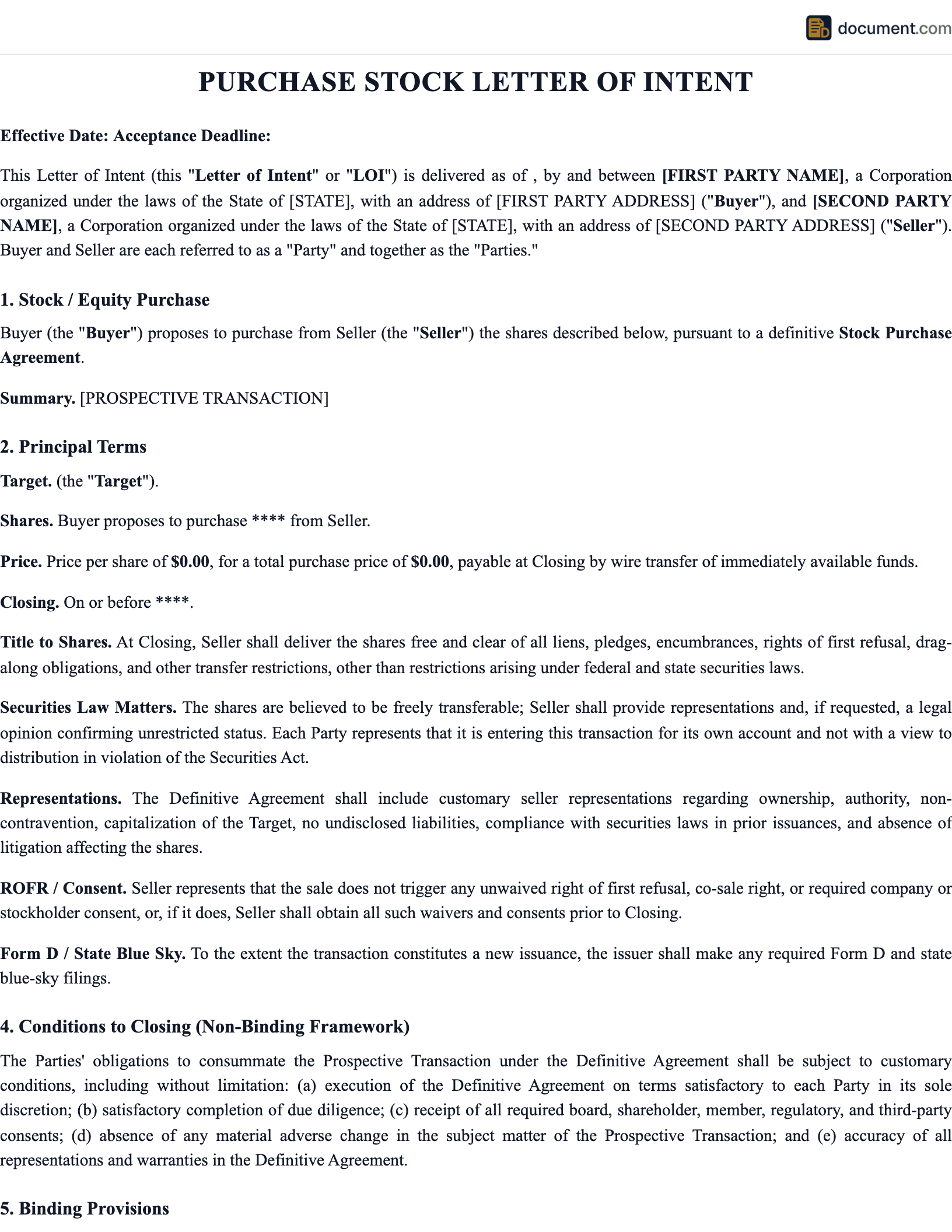



What Is a Letter of Intent to Purchase Stock?
A letter of intent to purchase stock is a preliminary agreement in which a prospective buyer outlines the principal terms under which they propose to acquire equity shares in a corporation or membership interests in a limited liability company. The LOI serves as a negotiation framework that crystallizes the essential deal points — per-share price, number and class of shares, valuation methodology, due diligence scope, regulatory requirements, and transaction timeline — before either party commits the substantial legal and financial resources required to draft and negotiate a definitive stock purchase agreement.
Stock purchase transactions are fundamentally different from asset purchases because the buyer acquires the entity itself rather than individual assets. This means the buyer inherits the corporation's entire legal and financial history, including all liabilities (known, unknown, and contingent), pending and threatened litigation, tax obligations, environmental exposure, employment relationships, and contractual commitments. The LOI must reflect this heightened risk profile by establishing comprehensive due diligence requirements, robust representations and warranties frameworks, and appropriate indemnification structures that will be detailed in the definitive agreement.
Securities law compliance adds another layer of complexity to stock purchase LOIs that does not exist in asset transactions. Whether the target company is publicly traded or privately held, the transfer of equity interests implicates federal and state securities regulations. For public companies, the buyer must consider insider trading prohibitions, Regulation FD disclosure requirements, tender offer rules, and beneficial ownership reporting obligations. For private companies, the parties must ensure the transaction qualifies for an exemption from SEC registration, typically under Section 4(a)(2) or Regulation D, and must comply with state blue sky laws in every jurisdiction where the shares will be offered or sold.
Share Valuation
Establishes per-share pricing using defensible valuation methodologies and market comparables.
Equity Due Diligence
Defines scope for investigating capitalization, share restrictions, and corporate governance.
Securities Compliance
Addresses SEC exemptions, state blue sky laws, and transfer restriction requirements.
Stock Purchase LOI Form Preview
Letter of Intent
Proposed Stock Purchase Transaction
1. PARTIES AND TRANSACTION
This Letter of Intent outlines the terms under which ("Buyer") proposes to acquire shares of stock from ("Seller").
2. PURCHASE PRICE
Buyer proposes to purchase the Shares at a price of $ per share, for a total consideration of $ .
3. DUE DILIGENCE
Buyer shall have days to complete due diligence on the Company, including review of capitalization, financial statements, and material contracts.
BUYER
SELLER
Key Components
A stock purchase LOI must address these essential deal elements to create a productive framework for the definitive agreement:
| Component | Purpose | Key Details |
|---|---|---|
| Share Identification | Defines what is being purchased | Class, number, percentage of outstanding, voting rights, dividends, liquidation preferences |
| Purchase Price | Establishes valuation | Per-share price, total consideration, valuation methodology, price adjustments, earnout provisions |
| Due Diligence | Enables buyer investigation | Financial, legal, tax, IP, employment, capitalization table, shareholder agreements, corporate minutes |
| Regulatory Approvals | Identifies compliance requirements | HSR filing, SEC filings, industry regulators, CFIUS review, state blue sky compliance |
| Representations & Warranties | Outlines expected assurances | Capitalization accuracy, authority to sell, no encumbrances, financial accuracy, material contracts |
| Closing Conditions | Sets requirements for completion | Regulatory clearance, third-party consents, no MAC, financing commitments, board approvals |
| Indemnification | Allocates post-closing risk | Survival periods, escrow holdbacks, basket/deductible, caps, special indemnities for known issues |
How to Draft a Stock Purchase LOI
Identify the Shares and Parties
Specify the target company's legal name and jurisdiction of incorporation, the seller's identity (individual shareholders, institutional investors, or the company itself in a primary issuance), the class and series of shares to be acquired (common, preferred Series A/B/C), the exact number of shares or percentage of outstanding equity, and whether the shares carry full voting rights, anti-dilution protections, or liquidation preferences. Reference the company's current capitalization table and identify any options, warrants, or convertible instruments that could affect the buyer's post-closing ownership percentage.
Establish the Purchase Price and Valuation
State the proposed per-share price and total consideration, and identify the valuation methodology supporting the price (comparable company analysis, discounted cash flow, precedent transactions, book value). Address whether the price is fixed or subject to adjustment based on closing date financial metrics such as working capital, net debt, or cash-on-hand. Specify the form of consideration (cash, stock of the acquiring entity, promissory notes, or a combination) and any earnout provisions tied to post-closing performance milestones.
Define the Due Diligence Scope
Outline the due diligence categories the buyer will investigate: capitalization table accuracy, corporate minute books and governance documents, financial statements and audit reports, tax returns and compliance history, material contracts and change-of-control provisions, intellectual property portfolio, litigation and regulatory matters, employment agreements and benefit plans, insurance coverage, and environmental compliance. Stock purchases require more extensive diligence than asset purchases because the buyer inherits the entity's full legal history.
Address Securities Law Compliance
Specify the applicable securities law exemption for the share transfer (Section 4(a)(2), Regulation D Rule 506(b) or 506(c), or state exemptions). Include representations regarding the buyer's accredited investor status if applicable, investment intent (holding for investment vs. resale), and acknowledgment of transfer restrictions including restrictive legends on stock certificates. For public companies, address compliance with insider trading prohibitions, beneficial ownership reporting under Section 13(d), and any required SEC filings.
Identify Regulatory and Third-Party Approvals
List all regulatory approvals required for the transaction: HSR Act premerger notification if the transaction exceeds filing thresholds, industry-specific regulatory approvals (banking, insurance, telecom, gaming), CFIUS review for foreign buyers, and state regulatory filings. Identify material third-party consents required under change-of-control provisions in key contracts, loan agreements, and leases. Specify which party is responsible for each filing, the associated costs, and the timeline for obtaining approvals.
Outline Representations, Warranties, and Indemnification
Describe the general categories of representations and warranties the buyer expects in the definitive agreement: accuracy of capitalization, authority to sell, no liens or encumbrances on shares, accuracy of financial statements, no undisclosed liabilities, compliance with laws, tax compliance, and absence of material adverse change. Outline the indemnification framework including survival periods for different categories of representations, escrow or holdback amounts, basket and cap provisions, and any special indemnities for identified risks.
Designate Binding and Non-Binding Terms
Clearly label which provisions are binding (confidentiality, exclusivity, expense allocation, governing law, and dispute resolution) and which are non-binding (purchase price, share identification, due diligence scope, representations and warranties, and closing conditions). Include explicit language that the non-binding provisions do not obligate either party to consummate the transaction and that the definitive stock purchase agreement will supersede the LOI upon execution.
Valuation Methods
The per-share price in a stock purchase LOI must be supported by a defensible valuation methodology, and the choice of method significantly influences the proposed price. Different valuation approaches can produce materially different results for the same company, which is why the LOI should specify which method or combination of methods was used to arrive at the proposed price. This transparency facilitates productive negotiations and helps both parties understand the assumptions underlying the offer.
For closely held corporations, where no public market exists for the shares, valuation is inherently subjective and often contentious. The IRS requires valuations for tax purposes to reflect fair market value — the price at which property would change hands between a willing buyer and a willing seller, neither being under compulsion and both having reasonable knowledge of the relevant facts (Revenue Ruling 59-60). Courts have applied similar standards in shareholder disputes, dissenter appraisal proceedings, and estate tax audits. For these reasons, many stock purchase LOIs specify that the parties will engage an independent third-party valuation firm to provide an objective assessment, with the cost typically shared between buyer and seller or allocated in the LOI.
Section 409A Compliance
For private companies that have issued stock options or other equity compensation, the per-share price in the LOI may create a 409A valuation event. Under IRC Section 409A, stock options must be granted at no less than fair market value, and a contemporaneous third-party transaction can establish or challenge the company's current 409A valuation. Companies should coordinate with their 409A valuation firm and equity compensation counsel before executing an LOI at a per-share price that differs materially from the most recent 409A appraisal.
Frequently Asked Questions
Official Resources
Authoritative resources on stock purchase transactions, securities compliance, and equity valuation.
SEC - Exempt Offerings
Securities and Exchange Commission guidance on registration exemptions for private stock transactions including Regulation D and Section 4(a)(2).
FTC - Premerger Notification
Federal Trade Commission information on Hart-Scott-Rodino Act filing requirements, thresholds, and procedures for stock acquisitions.
IRS - Business Valuation
IRS guidance on fair market value determination including Revenue Ruling 59-60 factors and accepted valuation methodologies.
Securities Exchange Act - Section 13
Legal Information Institute text of beneficial ownership reporting requirements under Section 13(d) for significant stock acquisitions.
Treasury - CFIUS
Committee on Foreign Investment in the United States information on mandatory and voluntary filing requirements for foreign buyers.
ABA Business Law Today
American Bar Association resources on M&A transaction structuring, stock purchase agreements, and corporate governance best practices.
Create Your Stock Purchase LOI
Structure your equity acquisition with a professionally drafted letter of intent covering share valuation, due diligence, and regulatory compliance.
Create DocumentNo account required. Free to create and preview.