



What Is a Memorandum of Understanding?
A Memorandum of Understanding — usually shortened to MOU — is a written document that records an agreement in principle between two or more parties about a future relationship, joint project, or cooperative arrangement. It captures the mutual intent of the parties, describes the scope of cooperation, allocates responsibilities, and sets expectations for how the relationship will work. MOUs are widely used by businesses entering partnerships, nonprofits collaborating on programs, government agencies coordinating activities, and academic institutions structuring research or exchange agreements.
Most MOUs are intentionally drafted to be non-binding so the parties can commit publicly to working together without exposing themselves to legal liability if the relationship ends. However, the line between a non-binding MOU and a binding contract is thinner than many people realize. Courts will look at the substance of the document, not just its title, when deciding whether obligations are enforceable. The cleanest MOUs include explicit language stating that the document is or is not legally binding, and they separate any clauses that are binding (such as confidentiality) from those that are not.
Our MOU templates give you a clean, professional structure with the key sections every cooperation document needs — purpose, scope, responsibilities, term, confidentiality, termination, and signatures — and let you set the binding nature of the document with clear, unambiguous language.
Mutual Intent
Documents that all parties are committed to the framework
Flexible Enforceability
Can be binding, non-binding, or a mix of both
Bridge to a Contract
A clear step toward a future binding agreement
MOU Form Preview
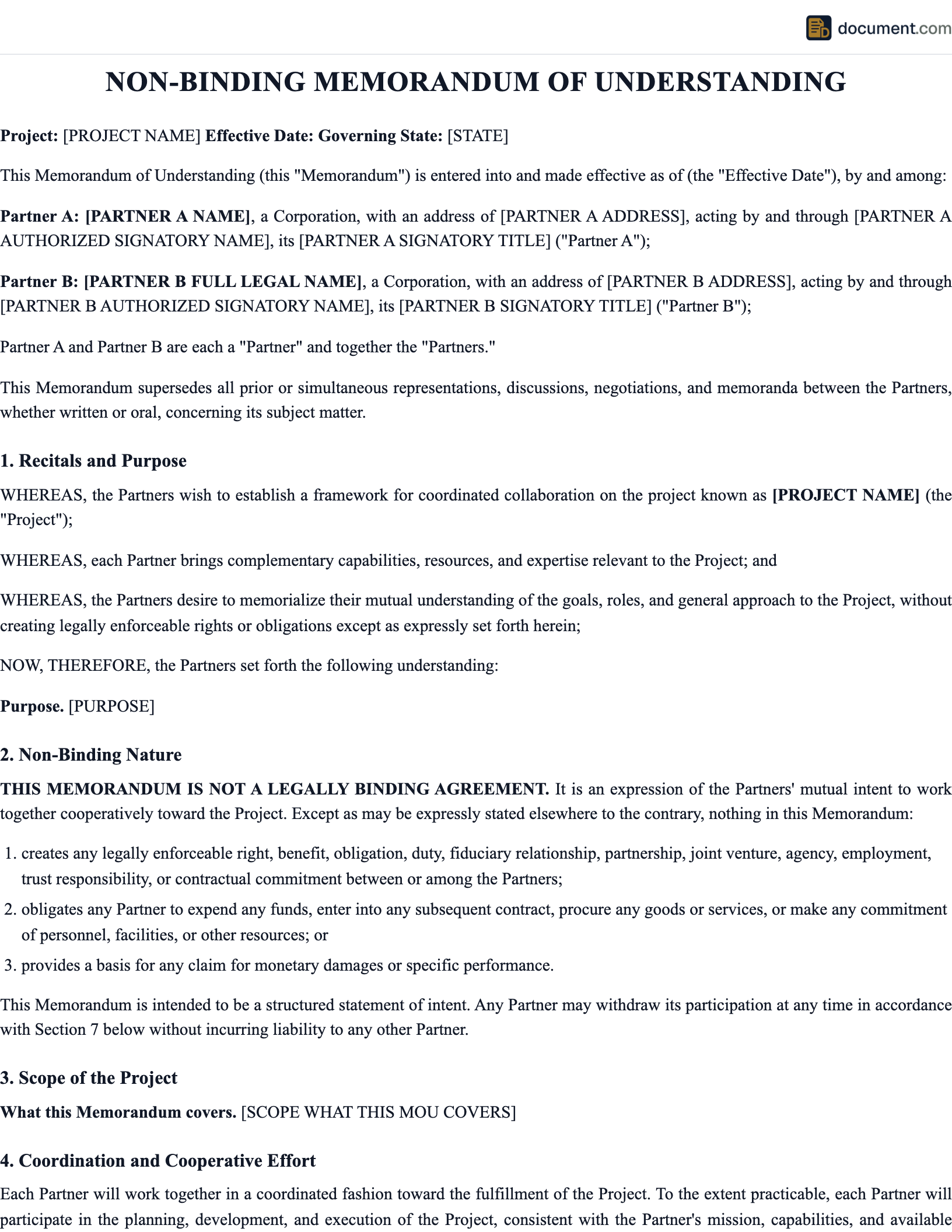
The preview below illustrates the structure of a typical multi-page MOU.
Memorandum of Understanding
Between [Party A] and [Party B]
Section 1: Parties
Section 2: Purpose & Scope
Section 3: Responsibilities of Party A
Section 4: Responsibilities of Party B
Section 5: Term & Termination
Section 6: Confidentiality
Section 7: Binding / Non-Binding Nature
Section 8: Signatures
How to Write an MOU
- 1
Identify the parties
List each organization's full legal name, jurisdiction, and the authorized representative.
- 2
Define the purpose
Write a clear, plain-language description of what the parties intend to accomplish together.
- 3
Specify responsibilities
Allocate who is doing what, including any contributions of money, staff, materials, or information.
- 4
Set the term
State the start date, the duration (or trigger for ending), and renewal terms if applicable.
- 5
Address confidentiality
Decide what information is confidential and whether confidentiality obligations are binding.
- 6
Declare binding nature
Include explicit language stating whether the MOU as a whole is legally binding or only certain provisions are.
- 7
Sign and date
Have authorized representatives of each party sign and date the document, and exchange originals.
Key Components of an MOU
Parties
Full legal names and authorized signatories of each organization.
Purpose & Scope
Clear statement of what the cooperation is intended to achieve.
Responsibilities
Specific obligations and contributions of each party.
Term & Termination
Duration, renewal, and how either party can end the arrangement.
Confidentiality
Protection of sensitive information shared during the relationship.
Binding Statement
Explicit declaration of whether the MOU is legally binding.
Dispute Resolution
How disagreements will be handled if they arise.
Signatures
Authorized signatures, printed names, titles, and dates.
Sample Memorandum of Understanding
MEMORANDUM OF UNDERSTANDING
Between [Party A] and [Party B]
1. PARTIES. This Memorandum of Understanding ("MOU") is entered into as of [Date] by and between [Party A], a [state] [entity type] with its principal office at [Address] ("Party A"), and [Party B], a [state] [entity type] with its principal office at [Address] ("Party B").
2. PURPOSE. The purpose of this MOU is to set forth the mutual understanding of the Parties regarding [describe the project, partnership, or cooperation]. The Parties intend to work together in good faith to achieve [shared objective].
3. RESPONSIBILITIES. Party A agrees to [list responsibilities]. Party B agrees to [list responsibilities]. Each Party will bear its own costs unless otherwise agreed in writing.
4. TERM. This MOU shall be effective from [Start Date] and shall continue until [End Date or completion of project], unless earlier terminated as provided herein.
5. CONFIDENTIALITY. Each Party agrees to keep confidential all non-public information received from the other Party in connection with this MOU. The confidentiality obligations in this section shall be legally binding and shall survive termination of this MOU.
6. NON-BINDING NATURE. Except for the confidentiality provisions in Section 5, this MOU is not a legally binding agreement and is intended only to express the mutual intent of the Parties to cooperate. Neither Party shall have any legal obligation to enter into a definitive agreement.
7. TERMINATION. Either Party may terminate this MOU at any time upon thirty (30) days' written notice to the other Party.
8. SIGNATURES. The undersigned represent that they have the authority to execute this MOU on behalf of their respective organizations.
__________________________ __________________________
[Name, Title — Party A] [Name, Title — Party B]
Frequently Asked Questions
Official Resources
ABA — Business Law Section
American Bar Association resources on contracts and agreements
Uniform Law Commission
Model contract acts and uniform laws adopted across states
SBA — Contracts
Small Business Administration guidance on business agreements
Cornell Law — Contracts
Legal Information Institute overview of contract law
U.S. State Department
Reference for international and inter-governmental MOUs
GAO
Government Accountability Office guidance on inter-agency MOUs
Create your Memorandum of Understanding in under 10 minutes.
Answer a few questions and download a compliant, attorney-drafted document ready for your state.