



What Is a Joint Venture Agreement?
A joint venture agreement is the contract that governs a defined collaboration between two or more independent businesses (or individuals) who come together to pursue a specific opportunity, project, or strategic objective while preserving their separate legal identities. It is the document that turns "let's work together on this" into a legally enforceable framework that defines who contributes what, who owns what, who decides what, who gets the profits, and what happens if things go wrong or the venture ends. JVs are the standard tool for projects too large or risky for one company to undertake alone.
Joint ventures are everywhere in the modern economy. A construction firm and an engineering firm form a JV to bid on a hospital project. A U.S. consumer brand teams up with a Vietnamese manufacturer to enter Southeast Asian markets. Two software companies create a JV to combine complementary technologies into a new product. A real estate developer and a family with land form a JV to develop the property. A pharmaceutical company licenses a promising compound to a biotech in exchange for a JV stake in the resulting drug. Each of these arrangements requires a tailored agreement that addresses the unique risks of the collaboration.
Legally, joint ventures occupy a middle ground between contractual relationships and full-blown business entities. Most courts treat a JV as a kind of partnership for the duration of the project, applying partnership principles like fiduciary duty, joint and several liability for venture obligations, and pro-rata sharing of profits and losses unless the agreement clearly provides otherwise. This means that a poorly documented JV can expose each participant to liability for the other's actions and create unintended fiduciary duties that constrain how each party can run its own separate business.
Joint ventures can be structured as purely contractual arrangements (no new entity created — each party simply commits resources and shares results under a contract) or as equity ventures (the parties form a new LLC, corporation, or partnership jointly owned in agreed percentages to operate the venture). Contractual JVs are simpler and faster but offer less liability separation; equity JVs require more formation work but provide cleaner governance, easier funding, and stronger liability protection. The right choice depends on the size, duration, capital intensity, and risk profile of the venture.
Whether you are pursuing a one-time construction bid, a multi-year technology development, a market-entry collaboration, or an international joint venture, our attorney-reviewed templates give you a thorough framework for documenting the deal. Each template addresses IP ownership, capital and resource contributions, profit sharing, governance and voting, fiduciary duties, confidentiality, exclusivity, exit mechanics, and dispute resolution — configurable for the structure and jurisdictions involved.
Defined Scope
Limits the collaboration to a specific project or objective without merging the underlying businesses
IP Protection
Clearly assigns ownership of background IP each party brings and foreground IP created during the venture
Cross-Border Ready
Handles international joint ventures with governing-law, currency, and dispute-resolution provisions
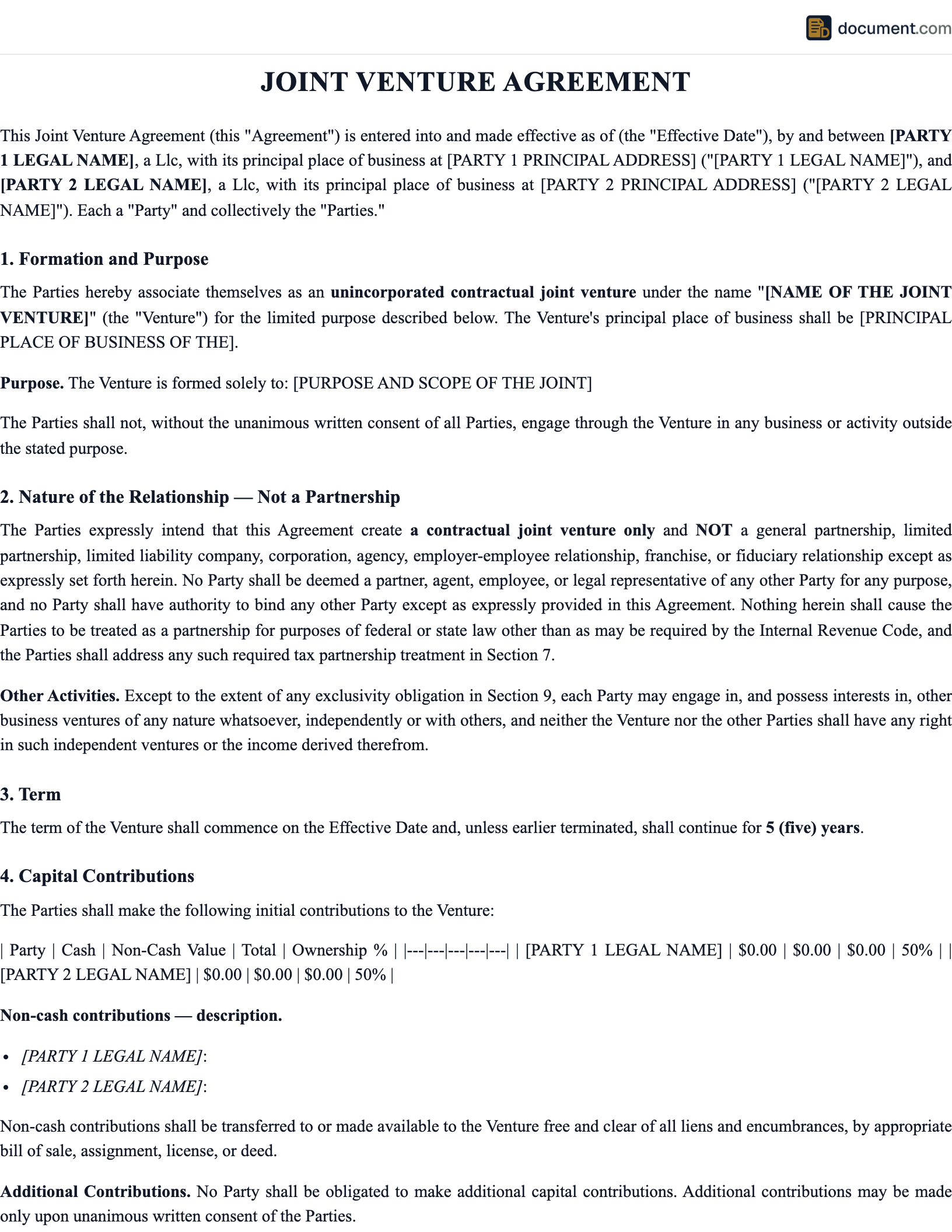
Joint Venture Agreement Form Preview
Below is a preview of the major sections found in a typical joint venture agreement. Your finished document will be fully formatted and customized for the structure, parties, and jurisdiction involved.
Joint Venture Agreement
Equity JV — Project: Riverview Solar Phase II
Section 1: Parties
Section 2: Purpose & Scope
The Parties shall jointly develop, finance, construct, and operate a 240-megawatt utility-scale solar generating facility located in Pecos County, Texas, including all interconnection, permitting, and ancillary work.
Section 3: Contributions
Party A: $42,000,000 cash, project rights, PPA with utility offtaker, 60% ownership.
Party B: EPC services valued at $28,000,000, equipment procurement, construction management, 40% ownership.
Section 4: Governance
Five-member Steering Committee: three appointed by Party A, two by Party B. Major decisions (capital calls > $5M, refinancing, sale of facility) require unanimous consent.
Section 5: Term & Exit
Term: 25 years from commercial operation date, with optional 10-year extension. Exit triggers: project completion, mutual termination, material breach, change of control, deadlock.
IP & Confidentiality
Intellectual property terms are often the most heavily negotiated provisions in any JV because each party usually brings valuable IP into the venture and wants to control any IP created during it.
Background IP
IP each party owns before the JV begins. Typically, each party retains ownership and grants the JV (or the other party) a non-exclusive license to use it solely for the purpose of the venture.
Foreground IP
IP created during the JV. Ownership can be assigned to the JV entity, jointly owned by the parties, owned by the party that does the inventive work, or owned by the party best positioned to commercialize it. Cross-licenses are common.
Confidentiality
A robust confidentiality clause protects the proprietary information each party shares. Typical terms include a 3-to-5-year tail after termination, exceptions for publicly known information, and stricter protection for trade secrets indefinitely.
Improvements & Derivatives
Improvements to background IP discovered during the venture should be expressly addressed — the default rules vary by IP type and jurisdiction and rarely match what the parties intend.
Profit Sharing & Contributions
Contributions and profit sharing should be defined precisely. Each party may contribute a combination of cash, services, technology, equipment, real estate, customer relationships, or regulatory licenses, and each contribution should be assigned a specific value used to calculate ownership percentages and profit allocations.
Pro Rata to Contribution
Profits split in proportion to the agreed contribution values — clean and aligned with investment but may undercredit ongoing operational efforts.
Tiered Waterfall
First return of capital, then preferred return on capital, then a 'promote' to the operating party — standard in real estate and infrastructure JVs.
Service Fees + Profit Split
One party charges the JV a fee for services rendered, with remaining profits split by ownership — useful when one party provides ongoing operations.
Milestone-Based
Profit shares shift as the venture hits defined milestones, rewarding execution risk taken at different stages.
Governance & Control
JV governance defines who decides what. Most agreements create a steering committee or board with representatives from each party, distinguish day-to-day operational decisions (typically delegated to a managing party or general manager) from major strategic decisions (which require supermajority or unanimous consent), and address how deadlocks are resolved.
Steering Committee
A representative body with members appointed by each party in proportion to ownership. Meets regularly to review progress, approve budgets, and authorize major actions.
Reserved Matters
A list of decisions that cannot be made without supermajority or unanimous consent: changes in scope, capital calls above a threshold, sale of the venture, amendment of the agreement.
Managing Party
One party (often the more operational one) is designated to handle day-to-day affairs, subject to oversight by the steering committee.
Deadlock Resolution
Escalation to senior executives, mediation, arbitration, shotgun clauses, or put/call mechanisms that automatically trigger an exit if a stalemate persists.
JV vs Partnership vs LLC
| Feature | Joint Venture | Partnership | LLC |
|---|---|---|---|
| Duration | Project-specific | Ongoing | Indefinite |
| Separate Entity | Optional | Optional (entity status) | Yes |
| Liability | Joint & several | Joint & several | Limited |
| Tax Treatment | Usually partnership | Pass-through | Flexible |
| Formation | By agreement | Automatic or by filing | State filing required |
How to Create a Joint Venture Agreement
- 1
Define the venture and its scope
Articulate the specific project, market, or objective the JV will pursue and the boundaries of the collaboration.
- 2
Choose contractual or equity structure
Decide whether to form a new entity (LLC, corporation) or proceed with a purely contractual arrangement.
- 3
Document each party's contributions
Cash, services, IP, equipment, real estate, customer relationships, regulatory approvals — assign a value to each.
- 4
Negotiate IP ownership and licenses
Address background IP, foreground IP, improvements, and confidentiality.
- 5
Set governance and decision rights
Steering committee composition, reserved matters, day-to-day management, deadlock-breaking mechanisms.
- 6
Define profit sharing and distributions
Pro rata, waterfall, milestone-based, service fees plus split — pick the structure that matches the deal.
- 7
Address antitrust and regulatory issues
Review HSR filings, foreign-investment approvals, and anti-corruption compliance.
- 8
Document term, exit, and dispute resolution
Term length, early termination triggers, exit mechanics, governing law, and dispute resolution forum.
- 9
Sign and operationalize
All parties sign; if forming an entity, file the necessary formation documents and execute supporting agreements (services, license, IP assignments).
Key Components
Recitals & Purpose
Background, the parties' separate businesses, and the specific objective of the venture.
Structure
Whether the JV is contractual or equity, and the form of any new entity.
Contributions
What each party contributes and the agreed value of each contribution.
Ownership & Profit Sharing
Percentage interests, allocation methods, and distribution waterfall.
Governance
Steering committee, voting rules, reserved matters, and managing party.
IP Ownership & Licenses
Background IP, foreground IP, improvements, and cross-licenses.
Confidentiality
Definition of confidential information, permitted uses, and tail period.
Exclusivity & Non-Compete
Restrictions on competing activities while the JV is active.
Term & Termination
Initial term, renewal options, and early termination triggers.
Exit & Buyout
Procedures for ending the JV and dividing assets and IP.
Reps & Warranties
Each party's promises about its authority, condition of contributed assets, and IP ownership.
Dispute Resolution
Governing law, forum, mediation, and arbitration provisions.
Antitrust & Foreign JVs
Joint ventures between competitors raise antitrust concerns because they involve coordination among firms that would otherwise be required to compete. Federal regulators apply a rule-of-reason analysis to most JVs, allowing those that create genuine efficiencies while challenging those that primarily restrict competition.
- Hart-Scott-Rodino pre-merger notification may be required for JVs above certain size thresholds
- JVs that fix prices, allocate markets, or restrict output between competitors are per se illegal
- Cross-border JVs may also trigger merger review in the European Union, China, and other jurisdictions
- Foreign Investment Risk Review (CFIUS) reviews JVs involving foreign acquisition of U.S. businesses in sensitive sectors
- Local-content and local-ownership rules in many host countries limit foreign participation in JVs
- Anti-corruption laws (FCPA, U.K. Bribery Act) apply to interactions with foreign officials in the course of forming or operating a JV
- Export control and sanctions laws may restrict the technologies and information that can be contributed to a JV with foreign participants
Sample Joint Venture Language
RECITALS. WHEREAS, the Parties wish to combine their respective resources, expertise, and capabilities to pursue the Project (as defined herein) on the terms and subject to the conditions set forth in this Agreement; NOW THEREFORE, in consideration of the mutual covenants contained herein, the Parties agree as follows.
SECTION 2 — SCOPE. The Parties hereby establish a joint venture (the "Venture") for the sole and limited purpose of developing, financing, constructing, owning, and operating the Project. Nothing in this Agreement shall be construed to create any joint venture, partnership, or other association of the Parties beyond the limited scope expressly set forth herein, and neither Party shall have any authority to bind the other except as expressly authorized in writing.
SECTION 5 — INTELLECTUAL PROPERTY. All Background IP shall remain the sole property of the contributing Party. The contributing Party hereby grants the Venture a non-exclusive, royalty-free, non-transferable license to use such Background IP solely for the purpose of, and during the term of, the Venture. All Foreground IP developed by or for the Venture shall be jointly owned by the Parties in proportion to their Percentage Interests, with each Party granted a perpetual, royalty-free license to use such Foreground IP outside the scope of the Venture in its own separate business activities.
SECTION 9 — STEERING COMMITTEE. The Venture shall be governed by a Steering Committee comprising five (5) members, three (3) appointed by Party A and two (2) appointed by Party B. The Steering Committee shall meet not less than quarterly. The following actions (the "Reserved Matters") shall require the unanimous approval of the Steering Committee: (i) approval of annual budgets; (ii) capital calls in excess of $5,000,000; (iii) sale, lease, or material encumbrance of Venture assets; (iv) entry into financing arrangements; (v) admission of additional parties; and (vi) amendment of this Agreement.
SECTION 14 — DEADLOCK. If the Steering Committee fails to reach a decision on a Reserved Matter after two (2) consecutive duly noticed meetings, the dispute shall be escalated to the Chief Executive Officers of the Parties for resolution within thirty (30) days. If unresolved, either Party may invoke the buy-sell mechanism set forth in Section 15.
Frequently Asked Questions
Official Resources
Ready to Document Your JV?
Build a joint venture agreement tailored to your project and partners.
Create JV Agreement