
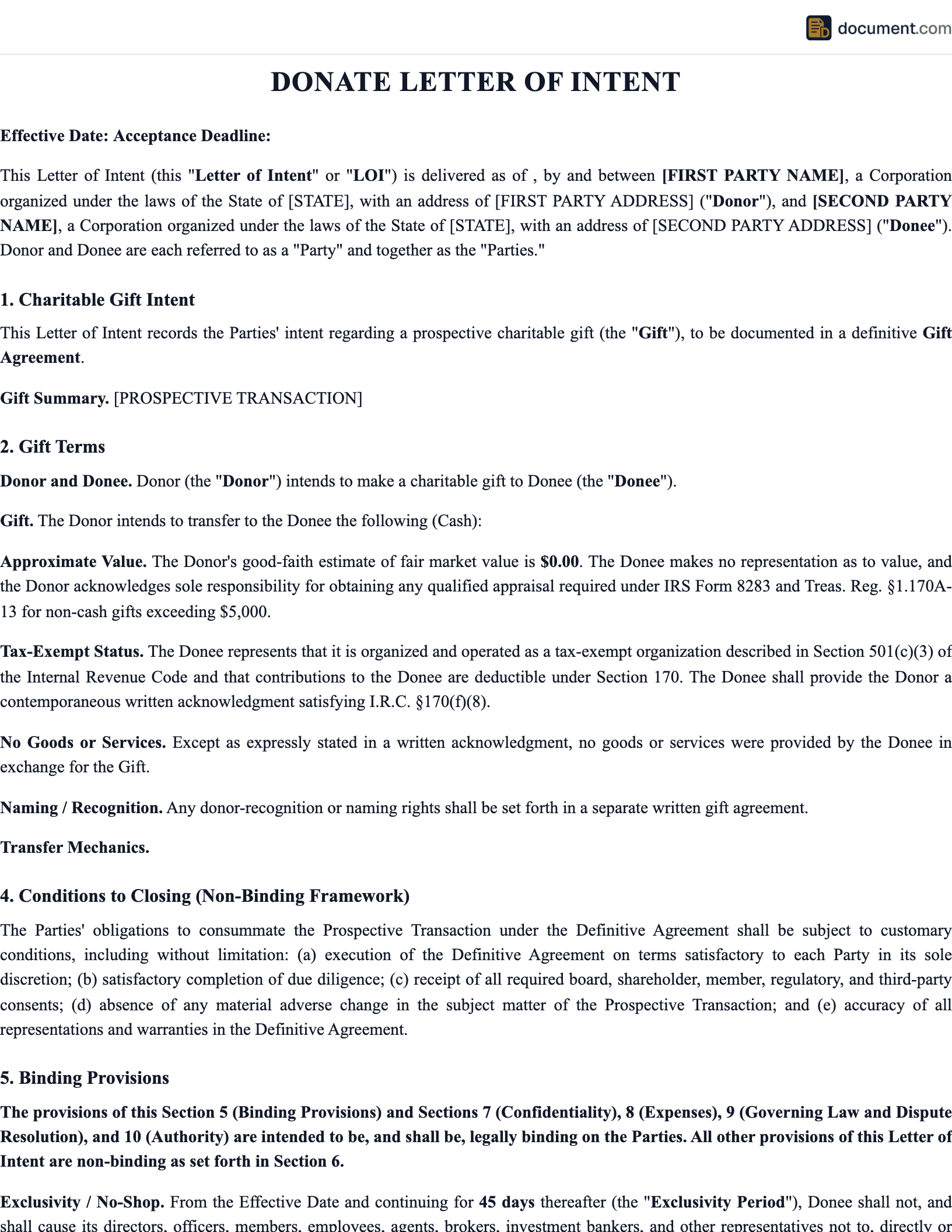



What Is a Letter of Intent to Donate?
A letter of intent to donate is a formal document through which a donor communicates their intention to make a charitable contribution to a nonprofit organization, foundation, educational institution, or other tax-exempt entity. The LOI serves as a bridge between the donor's initial expression of interest and the execution of any formal gift agreement, pledge document, or deed of gift that may be required for larger or more complex donations. It provides the receiving organization with sufficient detail to plan around the anticipated gift — informing budget projections, campaign progress reporting, matching gift applications, and donor stewardship activities — while preserving the donor's flexibility to finalize the gift's terms and timing.
The donation LOI is particularly valuable in several contexts: capital campaigns where organizations need to demonstrate committed support to justify construction or program expansion decisions; endowment building where multi-year pledges create predictable revenue streams; planned giving where the donor intends to include the organization in their estate plan; gifts of complex property (real estate, artwork, closely held securities) where the transfer requires appraisals, title work, and regulatory compliance; and foundation grants where the funder issues an LOI before the formal grant agreement to signal funding approval and allow the grantee to begin program preparations.
From an accounting perspective, charitable organizations must comply with Financial Accounting Standards Board (FASB) Accounting Standards Codification (ASC) 958 when recording contributions and pledges. Unconditional promises to give are recognized as revenue when the promise is made, regardless of when the cash is received, while conditional promises are recognized only when the conditions are substantially met. The language of the LOI directly affects this accounting treatment — if the LOI contains conditions (matching requirements, performance milestones, regulatory approvals), the organization cannot book the revenue until those conditions are satisfied, which materially affects financial statements and audit outcomes.
Gift Description
Specifies the nature, amount, and form of the charitable contribution in detail.
Donor Restrictions
Documents purpose restrictions, naming conditions, and use requirements for the gift.
Tax Documentation
Establishes the framework for appraisals, receipts, and IRS substantiation requirements.
Donation LOI Form Preview
Letter of Intent to Donate
Charitable Gift Declaration
1. DONOR AND RECIPIENT
This Letter of Intent confirms the intention of ("Donor") to make a charitable gift to ("Organization"), a qualified 501(c)(3) entity.
2. GIFT DESCRIPTION
Donor intends to contribute in the form of for the purpose of .
3. TIMELINE
Donor anticipates completing the gift by , subject to the conditions described herein.
DONOR
ORGANIZATION
Key Components
A comprehensive donation LOI addresses the following elements to protect both the donor and the receiving organization:
| Component | Purpose | Key Details |
|---|---|---|
| Donor Identification | Establishes who is making the gift | Full legal name, address, contact information, whether individual, trust, foundation, or corporate donor |
| Gift Description | Defines what is being donated | Cash amount, property description, securities (ticker, shares), estimated fair market value |
| Purpose Restrictions | Directs how the gift is used | Specific program, scholarship fund, building project, endowment, unrestricted operating support |
| Timeline | Sets gift completion schedule | Single transfer date, multi-year installments, contingency deadlines, pledge fulfillment schedule |
| Recognition | Specifies donor acknowledgment | Naming opportunities, donor wall, annual report listing, anonymity preferences |
| Reporting | Ensures stewardship accountability | Annual impact reports, financial statements, fund performance, program outcomes |
| Tax Documentation | Supports charitable deductions | Written acknowledgment, quid pro quo disclosure, appraisal requirements, Form 8283 |
How to Write a Letter of Intent to Donate
Identify the Donor and Recipient Organization
Provide the donor's full legal name, address, and capacity (individual, trustee, corporate officer, foundation representative). Identify the receiving organization by its legal name, EIN (Employer Identification Number), and confirm its tax-exempt status under IRC Section 501(c)(3) or the applicable subsection. If the gift is being made through a donor-advised fund or private foundation, identify the intermediary entity and its relationship to the ultimate recipient.
Describe the Gift in Detail
Specify the exact nature of the gift: for cash, state the dollar amount and payment method (check, wire transfer, credit card, cryptocurrency); for securities, identify the company, ticker symbol, number of shares, and current market value; for real property, provide the legal description and address; for personal property, describe the items with sufficient specificity to identify them. State the donor's estimate of fair market value and note whether a qualified appraisal will be obtained.
State the Purpose and Any Restrictions
Clearly articulate how the donor intends the gift to be used. Distinguish between unrestricted gifts (available for the organization's general purposes) and restricted gifts (designated for a specific program, scholarship, building, or endowment). If restrictions are imposed, define them precisely to avoid future disputes about the organization's compliance. Include a variance clause that permits the organization to redirect funds if the original purpose becomes impractical or impossible, subject to cy pres or equitable deviation principles.
Establish the Timeline and Payment Schedule
Specify when the gift will be completed — immediately, on a specific future date, or through a series of installments over a multi-year period. For multi-year pledges, detail the installment amounts, payment dates, and any conditions that could modify the schedule. For gifts of property, identify the anticipated transfer date and any logistical steps required (title search, appraisal, deed preparation, regulatory approvals). Address what happens if the donor is unable to complete the gift on schedule.
Address Recognition and Naming
Document the donor's preferences for recognition: desired naming on buildings, rooms, programs, scholarships, or endowments; preferred name format for donor rolls, publications, and annual reports; whether the gift should be anonymous; and any conditions under which the organization may publicly acknowledge the gift. If naming rights are involved, specify the duration (perpetual vs. term), the circumstances under which naming could be revoked, and the signage or branding specifications.
Specify Tax Documentation Requirements
Reference the donor's expectation for a contemporaneous written acknowledgment under IRC Section 170(f)(8) for gifts of $250 or more. For gifts of non-cash property, note whether a qualified appraisal under IRC Section 170(f)(11) is required and who will bear the cost. Confirm that the organization will not provide goods or services in exchange for the gift (or, if it will, that the quid pro quo disclosure requirements will be satisfied). Specify the donor's tax year for planning purposes.
Include Non-Binding Language and Conditions
Clearly state whether the LOI is intended as a binding pledge or a non-binding expression of intent. If non-binding, include explicit language that the letter does not create a legally enforceable obligation. Identify any conditions precedent to completing the gift (board approval, tax advice confirmation, sale of assets, matching fund achievement, estate settlement). Address the implications of the donor's death or incapacity on the commitment, and specify whether the donor's estate or successors are expected to honor the pledge.
Tax Considerations
The charitable deduction rules under IRC Section 170 are complex and vary significantly based on the type of property donated, the type of charitable organization receiving the gift, and the donor's adjusted gross income. For cash gifts to public charities, donors can generally deduct up to 60% of their adjusted gross income (AGI), with unused deductions carrying forward for up to five years. For gifts of long-term capital gain property (appreciated stocks held more than one year, real estate), the deduction is limited to 30% of AGI when the property is donated at fair market value, or 50% of AGI if the donor elects to reduce the deduction to the property's cost basis.
Gifts of appreciated securities present a particularly favorable tax scenario for donors: by donating stocks or mutual fund shares that have increased in value since purchase, the donor avoids the capital gains tax that would be owed on a sale while claiming a charitable deduction for the full fair market value of the securities on the date of the gift. This double benefit makes securities donations one of the most tax-efficient forms of charitable giving. The LOI should reference the donor's intent to transfer securities and identify the brokerage account and transfer instructions to facilitate the gift.
Substantiation Requirements
The IRS imposes strict substantiation requirements for charitable deductions. For gifts of $250 or more, the donor must obtain a contemporaneous written acknowledgment from the charity before filing their tax return. For non-cash gifts exceeding $500, the donor must file Form 8283 with their return. For non-cash gifts exceeding $5,000 (other than publicly traded securities), a qualified independent appraisal must be obtained no earlier than 60 days before the gift and no later than the due date of the return on which the deduction is claimed. Failure to meet these requirements can result in complete disallowance of the charitable deduction.
Frequently Asked Questions
Official Resources
Authoritative resources on charitable giving, tax deductions, and nonprofit gift acceptance.
IRS - Charitable Contribution Deductions
IRS guidance on charitable deduction rules, AGI limitations, carryforward provisions, and substantiation requirements under IRC Section 170.
IRS Form 8283 - Noncash Contributions
Official IRS form for reporting noncash charitable contributions exceeding $500, including qualified appraisal requirements.
National Council - Gift Acceptance
National Council of Nonprofits guidance on developing gift acceptance policies, evaluating complex gifts, and managing donor restrictions.
FASB ASU 2018-08 - Revenue Recognition
Financial Accounting Standards Board update on accounting for contributions received and made, distinguishing conditional from unconditional promises.
IRS - 501(c)(3) Requirements
IRS overview of requirements for tax-exempt charitable organizations, including organizational and operational tests.
ABA - Charitable Giving
American Bar Association resources on charitable giving strategies, planned gifts, and estate planning integration for donors.
Create Your Donation LOI
Formalize your charitable giving with a professionally structured letter covering gift terms, donor restrictions, and tax documentation requirements.
Create DocumentNo account required. Free to create and preview.