
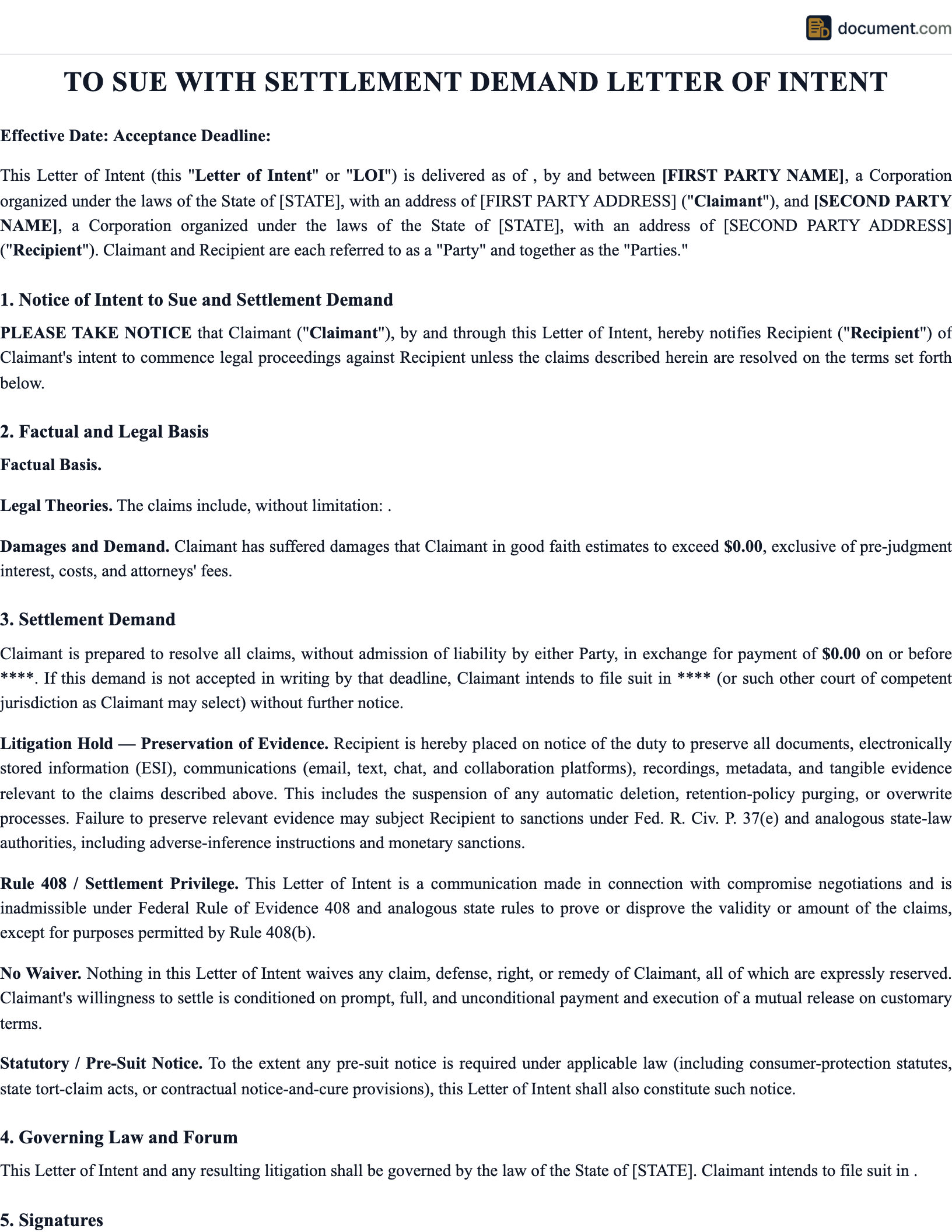



What Is a Letter of Intent to Sue?
A letter of intent to sue with settlement demand is a formal pre-litigation document that serves as a final opportunity for the parties to resolve a legal dispute before the claimant files a lawsuit. The letter performs several critical functions simultaneously: it formally notifies the recipient that a legal claim exists, identifies the specific legal theories and factual basis for the claim, quantifies the damages the claimant has suffered, proposes concrete settlement terms that would resolve the dispute, and establishes a firm deadline after which the claimant intends to file suit. The strategic importance of this document cannot be overstated — it often determines whether a dispute resolves through negotiation or escalates into expensive, time-consuming litigation.
From a practical standpoint, pre-suit demand letters resolve the majority of civil disputes before they ever reach a courtroom. Insurance companies, corporate legal departments, and sophisticated parties routinely evaluate and respond to demand letters because the cost of settling a meritorious claim at the pre-litigation stage is almost always lower than the combined cost of defense counsel, discovery, motion practice, and trial. The demand letter gives the recipient an opportunity to assess the claim's strength, consult with their attorney or insurer, and make a rational business decision about whether to settle, deny the claim, or negotiate different terms — all before the public filing of a lawsuit creates reputational exposure and the formal discovery process reveals potentially damaging information.
The legal landscape for pre-suit demands varies significantly by state and claim type. Some states mandate pre-suit notice for specific causes of action — medical malpractice claims in Florida require a 90-day pre-suit investigation period, California's Proposition 65 requires a 60-day pre-suit notice for toxic exposure claims, and virtually every state's tort claims act requires written notice before suing a government entity. Other states incentivize pre-suit demands through their consumer protection statutes by awarding enhanced damages and attorney's fees to plaintiffs who sent demand letters that the defendant ignored. Understanding these jurisdictional requirements is essential to drafting an effective letter.
Legal Notice
Formally puts the recipient on notice of the claim, its legal basis, and the intent to litigate.
Damages Quantification
Itemizes and calculates the full extent of compensable damages with supporting documentation.
Response Deadline
Sets a firm timeline for response that creates urgency and preserves litigation rights.
Letter of Intent to Sue Form Preview
Notice of Intent to Sue
With Settlement Demand
1. NOTICE OF CLAIM
This letter serves as formal notice that ("Claimant") intends to file a civil action against ("Respondent") for .
2. SETTLEMENT DEMAND
Claimant demands payment of $ in full satisfaction of all claims, to be paid within days of receipt of this letter.
3. DEADLINE FOR RESPONSE
If no response is received by , Claimant will proceed to file suit without further notice.
CLAIMANT / ATTORNEY
DATE
Key Components
An effective letter of intent to sue must address the following elements to maximize the likelihood of pre-suit resolution:
| Component | Purpose | Key Details |
|---|---|---|
| Party Identification | Establishes who is making the claim | Full legal names, addresses, relationship between parties, capacity in which claims are made |
| Factual Statement | Sets out what happened | Chronological account of events, dates, locations, witnesses, documentary evidence |
| Legal Basis | Identifies the causes of action | Specific legal theories (breach of contract, negligence, fraud), statutes, elements of each claim |
| Damages Calculation | Quantifies the harm suffered | Economic losses, non-economic damages, statutory damages, attorney's fees, pre-judgment interest |
| Settlement Terms | Proposes resolution | Demand amount, payment structure, release terms, confidentiality, non-admission clause |
| Response Deadline | Creates urgency | Specific date, method of response, consequences of non-response, preservation of rights |
How to Write a Letter of Intent to Sue
Identify the Parties and Verify the Correct Recipient
Determine the correct legal entity to whom the demand should be directed. For businesses, this means identifying the proper corporate entity (not just a trade name), the registered agent for service of process, and any parent or successor companies. For individuals, confirm their legal name and current address. If the claim involves insurance coverage, determine whether the demand should also be directed to the insurer. Sending the demand to the wrong entity can waste time and may not satisfy statutory pre-suit notice requirements.
State the Facts Chronologically and Specifically
Present a clear, factual narrative of the events giving rise to the claim, organized chronologically with specific dates, times, locations, and participants. Avoid emotional language or legal conclusions — let the facts speak for themselves. Reference specific documents, communications, and witnesses that support the factual account. The factual statement should be detailed enough to demonstrate the seriousness and specificity of the claim without revealing the claimant's entire trial strategy.
Identify the Legal Theories and Causes of Action
Specify each legal theory supporting the claim: breach of contract (identifying the specific contract provisions violated), negligence (duty, breach, causation, damages), fraud (misrepresentation, scienter, reliance, damages), statutory violations (citing the specific statute and the conduct that violated it), and any other applicable causes of action. Reference the statute of limitations for each claim to demonstrate timeliness. This section signals to the recipient that the claimant has a solid legal foundation and has conducted the legal analysis necessary to pursue the case.
Quantify Damages with Supporting Documentation
Itemize every category of damages with specificity: medical expenses (past and future, itemized by provider and treatment), lost wages (employer verification, hourly rate, hours missed), property damage (repair estimates, replacement costs, diminution in value), out-of-pocket expenses (receipts, invoices), non-economic damages (severity and duration of pain, impact on daily activities, emotional distress documentation), and any applicable statutory damages, treble damages, or punitive damages. Attach or reference supporting documentation for each damage category.
Make a Specific Settlement Demand
State a specific dollar amount that would fully resolve all claims, along with any non-monetary terms (corrective action, apology, policy changes, injunctive relief). Specify the payment method (lump sum, structured settlement, installments), the timeframe for payment, and the scope of the release the claimant would provide upon settlement (general release vs. limited release). If the demand is made pursuant to a statutory requirement, cite the statute and confirm compliance with its notice provisions.
Set a Response Deadline and Consequences
Establish a specific date by which the recipient must respond — typically 15 to 30 days for most claims, though statutory pre-suit notice periods may require longer timeframes. State clearly that failure to respond by the deadline will result in the claimant filing a civil complaint in the appropriate court without further notice. Specify that the claimant will seek to recover all damages identified in the letter plus attorney's fees, costs of litigation, and pre-judgment interest from the date of the demand.
Deliver the Letter with Proof of Receipt
Send the letter via certified mail with return receipt requested, and consider simultaneously sending a copy via regular first-class mail, email, and/or overnight courier to ensure actual delivery. Retain the certified mail receipt and tracking confirmation as proof of delivery. For claims against government entities, verify the specific delivery requirements under the applicable tort claims act — some states require delivery to specific officials (attorney general, risk management, agency head) at specific addresses, and failure to serve the correct official can invalidate the notice.
Settlement Demand Strategy
The settlement demand portion of the letter requires balancing competing objectives. The demand must be high enough to leave room for negotiation while remaining credible enough to be taken seriously. An unreasonably inflated demand signals that the claimant has not conducted a realistic assessment of their case and invites the recipient to dismiss the letter entirely. Conversely, a demand that is too low may be accepted immediately, leaving the claimant with the suspicion that they undervalued their claim.
Experienced practitioners typically evaluate the claim from multiple angles before setting the demand figure. They consider the likely jury verdict range if the case proceeds to trial, the strength of liability evidence, the availability and credibility of witnesses, the jurisdiction's jury demographics and verdict history, the availability of insurance coverage, the defendant's financial capacity to pay a judgment, and the litigation costs both parties would incur through trial. The demand is then set at a figure that provides a meaningful discount from the high end of the trial value range — giving the recipient an economic incentive to settle — while still delivering fair compensation for the claimant after accounting for attorney's fees and litigation risk.
Statute of Limitations
Sending a letter of intent to sue does not toll or extend the statute of limitations in most jurisdictions. The claimant must ensure they have sufficient time remaining on the applicable limitations period to both send the demand letter, allow the response deadline to pass, and file the complaint if settlement fails. If the limitations period is about to expire, the complaint should be filed simultaneously with or before sending the demand letter, and the letter should reference the filed case while offering to dismiss if settlement terms are met.
Frequently Asked Questions
Official Resources
Authoritative resources on pre-suit demands, settlement procedures, and litigation requirements.
FRE Rule 408 - Compromise and Offers
Federal Rules of Evidence provision on the admissibility of settlement communications and compromise negotiations.
U.S. Courts - Civil Cases
Federal judiciary resource on civil case filing procedures, jurisdiction requirements, and the litigation process.
ABA - Dispute Resolution
American Bar Association resources on alternative dispute resolution, mediation, arbitration, and settlement best practices.
FTC - Consumer Protection Statutes
Federal Trade Commission compilation of consumer protection statutes that may require or incentivize pre-suit demand letters.
NAIC - Unfair Claims Settlement
National Association of Insurance Commissioners model act on unfair claims settlement practices and insurer response obligations.
LII - Statutes of Limitations
Legal Information Institute overview of statutes of limitations for various civil causes of action across jurisdictions.
Create Your Letter of Intent to Sue
Put the opposing party on formal notice with a professionally structured demand letter that quantifies damages and proposes settlement terms.
Create DocumentNo account required. Free to create and preview.