



What Is a National Letter of Intent?
The National Letter of Intent (NLI) is the foundational document in NCAA college athletic recruitment that creates a binding, bilateral agreement between a prospective student-athlete and an NCAA Division I or Division II institution. Administered by the Collegiate Commissioners Association (CCA), the NLI program has governed the recruitment signing process since 1964, establishing standardized rules that protect both student-athletes and institutions from the instability that characterized early college recruitment. When a prospective student-athlete signs an NLI, the institution commits to providing athletics financial aid for a minimum of one academic year, and the student-athlete commits to attending that institution for one academic year. This reciprocal commitment distinguishes the NLI from an ordinary letter of intent used in business transactions, which is typically non-binding.
The NLI program operates as a voluntary agreement among participating institutions — schools are not required by the NCAA to use the NLI, though approximately 650 Division I and Division II institutions participate. Notably, the Ivy League conference does not participate in the NLI program, instead relying on a separate Ivy League agreement process, and the service academies (Army, Navy, Air Force) do not use the NLI due to their unique federal appointment process. The NLI must be accompanied by a financial aid agreement issued by the institution, and both documents must be signed on the same date for the NLI to be valid. The financial aid agreement specifies the actual scholarship terms — whether the aid covers tuition, fees, room, board, and books — while the NLI addresses the commitment and penalties framework.
Understanding the legal weight of the NLI is critical for student-athletes and their families. Unlike a business LOI that can be structured as non-binding, the NLI is intentionally designed as a binding contract with real consequences for breach. A student-athlete who signs an NLI and then enrolls at a different NLI member institution without obtaining a release faces the loss of one full year of athletic eligibility and must complete a one-year residence requirement before competing. These penalties apply across all sports, meaning a football recruit who breaks an NLI commitment and transfers cannot compete in any sport at the new institution for one year. The binding nature of the NLI has generated significant debate, particularly as the broader landscape of college athletics has evolved with Name, Image, and Likeness (NIL) rights and the NCAA transfer portal.
Binding Commitment
Creates an enforceable one-year commitment between the student-athlete and the institution.
Financial Aid Guarantee
Institution must provide athletics scholarship for at least one full academic year.
Recruitment Closure
Ends the active recruitment process and prohibits contact from other NLI institutions.
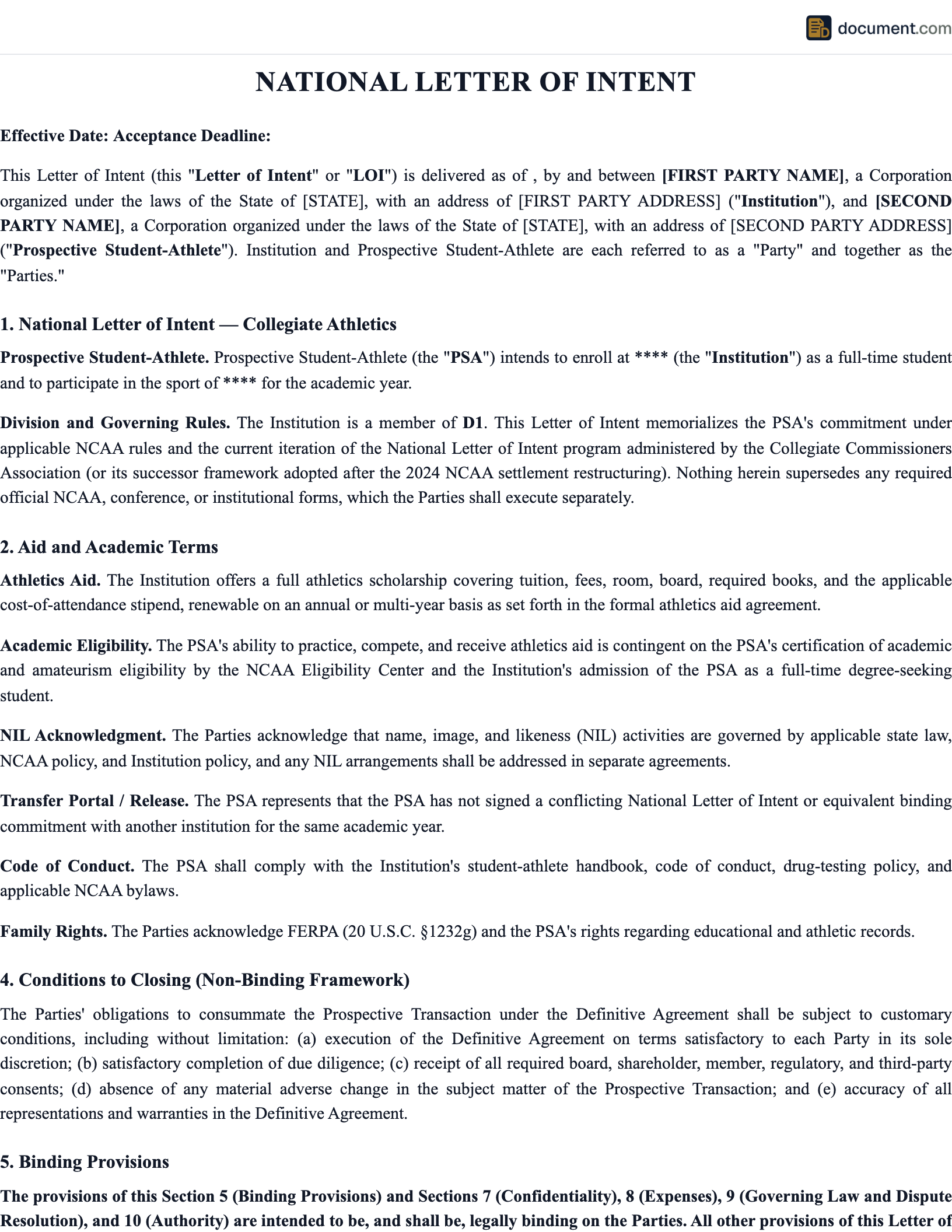
National Letter of Intent Form Preview
National Letter of Intent
NCAA Division I / Division II Athletic Recruitment
1. STUDENT-ATHLETE INFORMATION
I, (Student-Athlete), agree to attend (Institution) for the academic year.
2. FINANCIAL AID COMMITMENT
The Institution agrees to provide athletics financial aid for the academic year in the amount specified in the accompanying Financial Aid Agreement.
3. SPORT
This NLI applies to the sport of .
STUDENT-ATHLETE
PARENT / GUARDIAN
NLI Signing Periods
The NLI program establishes specific signing periods for different sports, during which prospective student-athletes may sign their NLI and accompanying financial aid agreement. These signing windows are critical dates that govern the entire recruitment calendar. Student-athletes must sign within the designated period for their sport, and any NLI signed outside the applicable signing period is automatically invalid.
The NCAA has consolidated and simplified its signing periods in recent years. Division I Football Bowl Subdivision (FBS) and Football Championship Subdivision (FCS) programs observe an early signing period in December and a regular signing period beginning the first Wednesday in February. For all other Division I sports, there is typically an early signing period in November and a regular signing period that varies by sport. Division II follows its own signing calendar. Student-athletes should verify the exact dates each year through the NCAA website or their institution's compliance office, as the signing dates are announced annually and may shift slightly from year to year.
| Sport Category | Early Signing Period | Regular Signing Period |
|---|---|---|
| Football (FBS/FCS) | Three-day period in mid-December | First Wednesday in February through April 1 |
| Basketball (Men's and Women's) | One-week period in mid-November | Mid-April through mid-May |
| All Other Division I Sports | One-week period in mid-November | Mid-April through August 1 |
| Division II (All Sports) | One-week period in mid-November | Mid-April through August 1 |
Key Components
A valid National Letter of Intent must contain and correctly address these essential elements to create a binding commitment under the NLI program:
Student-Athlete and Institution Identification
The NLI must clearly identify the prospective student-athlete by full legal name, sport, and the specific NCAA Division I or Division II institution making the scholarship offer. The institution must be a current, active participant in the NLI program — if the institution has been suspended or terminated from the program, any NLI it issues is automatically void.
Financial Aid Agreement
The NLI must be accompanied by a written financial aid agreement from the institution specifying the exact terms of the athletics scholarship — the amount, the components covered (tuition, fees, room, board, books, and cost of attendance), and the duration. Both the NLI and the financial aid agreement must be signed on the same date. An NLI submitted without a financial aid agreement is invalid.
Signatures and Filing Deadline
The student-athlete must sign the NLI, and a parent or legal guardian must co-sign if the student-athlete is under 21 years of age. The signed NLI must be returned to the institution within the signing period and filed with the conference office within 14 days of the signing date. Late filing does not invalidate the NLI, but may trigger compliance review by the conference office.
Penalty Provisions
The NLI contains standardized penalty language informing the student-athlete that violation of the agreement — enrolling at a different NLI member institution without a release — results in a one-year loss of eligibility in all sports and a one-year residence requirement at the new institution. These penalties are not negotiable and apply uniformly across all NLI signings.
Void and Release Conditions
The NLI specifies the conditions under which it becomes automatically void (institution fails to provide aid, student-athlete is not academically eligible, sport is discontinued, institution receives major NCAA sanctions) and the process for requesting a discretionary release from the athletics director. These provisions are standardized across all NLI institutions.
Recruitment Cessation
Once a valid NLI is signed, all other NLI member institutions must cease recruitment of that student-athlete. This is a core feature of the NLI program — it provides finality in the recruitment process and prevents the destabilizing practice of continued recruiting after a commitment has been made. Institutions that continue recruiting a student-athlete with a signed NLI may face NLI program sanctions.
Release Procedures
The NLI release process is one of the most consequential aspects of the program for student-athletes who wish to change their commitment after signing. Understanding the release framework — from initial request through potential appeal — is essential for any student-athlete considering whether to sign an NLI or how to navigate a change of circumstances after signing.
A student-athlete seeking release must submit a written request to the athletics director of the institution that holds the NLI. The institution has 30 business days to respond. If the institution grants a complete release, the student-athlete is free to sign a new NLI with any institution during a subsequent signing period, and the one-year eligibility loss and residence penalties do not apply. If the institution denies the release or grants only a partial release (allowing the student-athlete to contact certain schools but not others), the student-athlete may file a formal appeal with the NLI Appeals Committee.
The NLI Appeals Committee, composed of conference commissioners or their designees, considers appeals based on several recognized grounds: a coaching change in the student-athlete's sport after the NLI was signed; documented medical or health conditions that affect the student-athlete's ability to participate at the institution; evidence that the institution or its coaching staff misrepresented material information that influenced the student-athlete's decision to sign; circumstances beyond the student-athlete's control, such as a family financial emergency requiring proximity to home; or the institution's failure to provide the financial aid specified in the accompanying scholarship agreement. The Appeals Committee's decision is final and binding on all parties.
Transfer Portal Impact
The NCAA transfer portal has changed the landscape for student-athletes considering a change after signing an NLI. However, entering the transfer portal does not automatically release a student-athlete from their NLI obligations. The student-athlete must still obtain a formal release from the institution holding the NLI to avoid the one-year eligibility loss and residence penalties. Student-athletes and families should consult with the institution's compliance office and consider seeking independent legal advice before making transfer decisions that involve an existing NLI commitment.
Frequently Asked Questions
Official Resources
Authoritative resources on the National Letter of Intent program, NCAA eligibility, and college athletic recruitment rules.
National Letter of Intent Official Website
Official NLI program website with signing dates, program rules, release and appeal procedures, and participating institution directories.
NCAA Eligibility Center
NCAA resource for prospective student-athletes covering academic eligibility requirements, registration, and initial eligibility certification.
NCAA Legislative Services Database
Searchable database of NCAA bylaws, interpretations, and legislative proposals governing recruiting and financial aid.
NCAA Transfer Portal
Official NCAA resource explaining the transfer portal process, eligibility implications, and the relationship between transfers and existing NLI commitments.
NCAA Recruiting Rules
Comprehensive guide to NCAA recruiting rules including contact periods, official visit policies, and impermissible benefits.
NAIA Eligibility Center
Resources for student-athletes considering NAIA institutions, which use a separate Letter of Intent process from the NCAA NLI program.
Create Your National Letter of Intent
Draft an NCAA-compliant National Letter of Intent with proper signing period formatting, financial aid terms, and commitment provisions.
Create DocumentNo account required. Free to create and preview.