
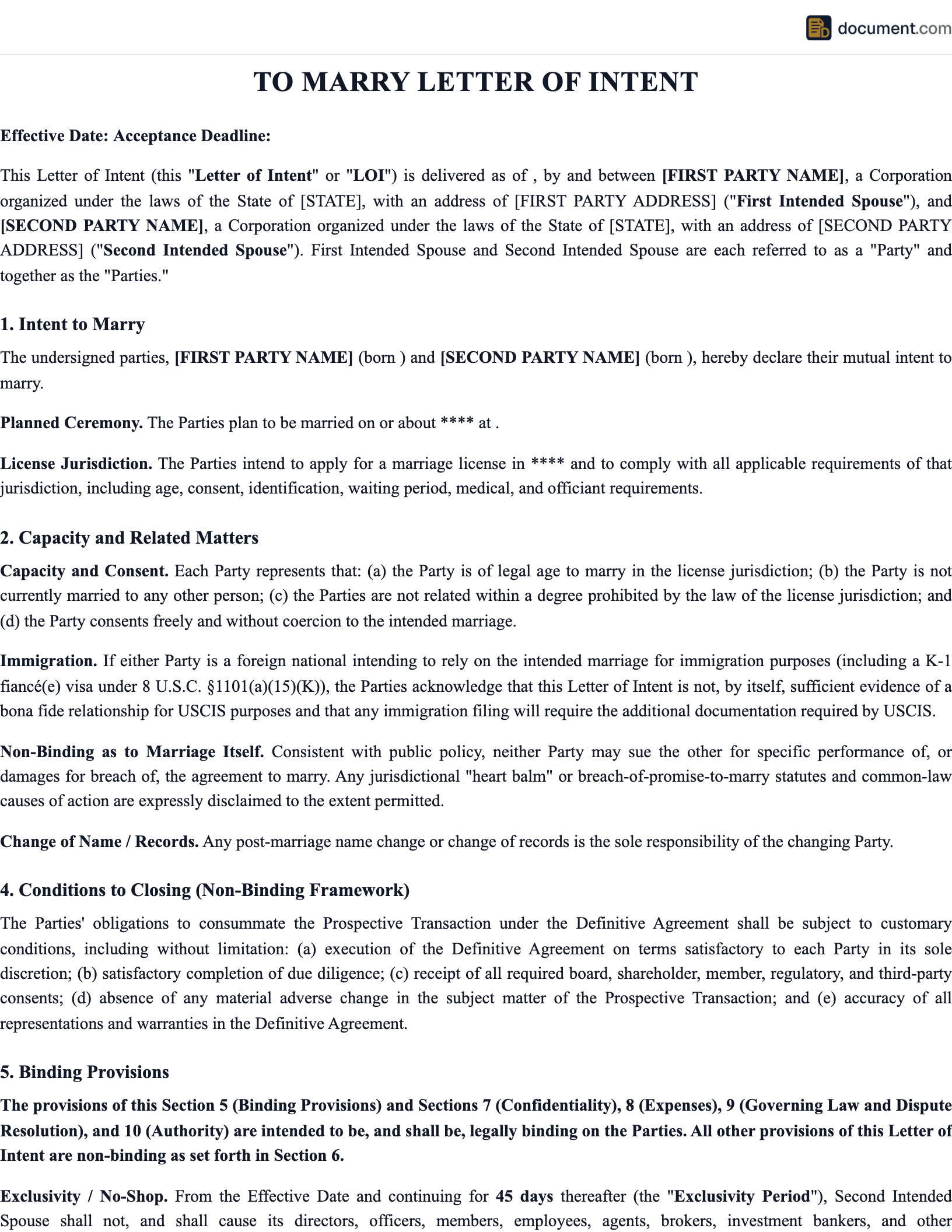



What Is a Letter of Intent to Marry?
A letter of intent to marry is a formal written declaration in which one or both members of a couple affirm their genuine intention to enter into a lawful marriage. While the concept may seem straightforward, the document carries significant legal weight in several contexts — most notably in United States immigration proceedings where the K-1 fiance(e) visa requires the petitioner to demonstrate that both parties have a bona fide intent to marry within 90 days of the foreign national's admission to the country. The letter serves as primary evidence that the relationship is genuine and not entered into solely for immigration benefits, which would constitute marriage fraud under 8 U.S.C. Section 1325(c).
Beyond the immigration context, letters of intent to marry appear in several other legal and cultural settings. Some religious institutions require a formal declaration of intent before scheduling pre-marital counseling or reserving the ceremony venue. Certain states have waiting periods between filing a marriage license application and the ceremony, during which an LOI may be filed with the county clerk. In international marriages where one party's home country requires a Certificate of No Impediment (CNI) or similar document, the LOI may serve as supporting evidence for the CNI application filed with the U.S. embassy or consulate abroad.
The letter should be drafted with care because USCIS adjudicators, consular officers, and immigration judges scrutinize intent-to-marry letters for consistency, specificity, and credibility. Generic or boilerplate letters that lack personal detail about the relationship raise red flags and may trigger a Request for Evidence (RFE) or, worse, a denial based on insufficient proof of bona fide intent. A strong letter narrates the couple's history in specific terms — where and when they met, how the relationship developed, the proposal or engagement circumstances, and concrete wedding plans including venue, date, officiant, and guest arrangements.
Relationship History
Documents how the couple met, the relationship timeline, and evidence of genuine commitment.
Immigration Compliance
Satisfies K-1 visa evidentiary requirements and USCIS bona fide intent standards.
Wedding Planning Details
Outlines concrete ceremony plans including date, venue, officiant, and guest arrangements.
Letter of Intent to Marry Form Preview
Letter of Intent to Marry
Declaration of Bona Fide Marriage Intent
1. DECLARATION OF INTENT
I, ("Petitioner"), a citizen of the United States, hereby declare my sincere and bona fide intention to marry ("Beneficiary"), a citizen of .
2. RELATIONSHIP HISTORY
We first met on in and have maintained a continuous relationship since that date.
3. WEDDING PLANS
We intend to marry within 90 days of Beneficiary's admission to the United States at in .
PETITIONER
BENEFICIARY
Key Components
A persuasive letter of intent to marry should include the following elements to satisfy legal requirements and demonstrate genuine intent:
| Component | Purpose | Key Details |
|---|---|---|
| Party Identification | Establishes who is declaring intent | Full legal names, dates of birth, citizenship, current addresses, passport numbers |
| Relationship Narrative | Proves relationship is genuine | How and where the couple met, relationship timeline, visits, communication history, engagement details |
| Declaration of Intent | States the legal intent to marry | Clear statement of bona fide intent, 90-day commitment for K-1, voluntary and knowing consent |
| Wedding Plans | Demonstrates concrete preparation | Planned ceremony date, venue, officiant, witnesses, marriage license jurisdiction |
| Eligibility Confirmation | Verifies legal capacity to marry | No existing marriages, legal age, no impediments, prior divorce decrees if applicable |
| Supporting Evidence | Corroborates the declaration | Photographs, travel records, communication logs, third-party affidavits, financial co-mingling |
How to Write a Letter of Intent to Marry
Identify Both Parties Completely
Provide the full legal names (as they appear on passports and official identification), dates of birth, places of birth, nationalities, current residential addresses, and contact information for both the petitioner and the beneficiary. For immigration filings, include alien registration numbers (A-numbers) if previously assigned, and reference any pending or prior immigration applications. Accuracy in this section is critical because USCIS cross-references this information against other filings.
Narrate the Relationship History
Describe in specific detail how the couple met — the date, location, circumstances, and mutual connections. Chronicle the development of the relationship through key milestones: first date, introduction to family and friends, engagement, cohabitation, and shared life experiences. Include dates and locations of in-person visits, particularly for couples in long-distance or international relationships where USCIS requires evidence of meeting within the past two years.
Declare the Intent to Marry
Make a clear, unequivocal statement that both parties intend to enter into a legal marriage freely, voluntarily, and without coercion, fraud, or misrepresentation. For K-1 visa purposes, explicitly state the intent to marry within 90 days of the beneficiary's admission to the United States. Affirm that the marriage is being entered into for genuine emotional and personal reasons, not solely for immigration benefits.
Detail the Wedding Plans
Provide concrete wedding arrangements: the planned ceremony date or date range, the ceremony location (specific venue name and address), the type of ceremony (civil, religious, cultural), the name of the officiant, the planned number of guests, and any wedding-related reservations or contracts already in place. The more specific and verifiable the wedding plans, the stronger the evidence of genuine intent.
Confirm Legal Eligibility
Declare that both parties are legally free to marry — neither is currently married to another person, both are of legal age in the relevant jurisdiction, and there are no legal impediments to the marriage such as close familial relationship or guardianship issues. If either party has been previously married, reference the divorce decree, annulment, or death certificate that terminated the prior marriage and confirm that a certified copy is available for submission.
Reference Supporting Evidence
List the supporting documentation being submitted with the letter: photographs with dates and descriptions, communication records (phone bills, messaging app screenshots, video call logs), travel records (flight itineraries, hotel receipts, visa stamps), evidence of wedding planning (venue contracts, invitations, catering agreements), third-party affidavits from friends and family, and any other documentation that corroborates the relationship's genuineness.
Execute the Letter Properly
Both parties should sign and date the letter. Include a statement affirming that the contents are true and correct under penalty of perjury, using language consistent with 28 U.S.C. Section 1746. Consider having the letter notarized for additional evidentiary weight, and obtain an apostille if the letter will be used in international proceedings. Keep copies of the signed letter and all supporting documentation for personal records.
Immigration and Visa Context
The letter of intent to marry plays a pivotal role in the K-1 fiance(e) visa process, which is governed by Section 101(a)(15)(K)(i) of the Immigration and Nationality Act (INA). The K-1 visa allows a U.S. citizen to petition for their foreign fiance(e) to enter the United States for the specific purpose of getting married. The petition (Form I-129F) requires the petitioner to demonstrate that both parties have a bona fide intention to marry and that they have met in person within the past two years (with limited exceptions for extreme hardship or cultural customs that prohibit pre-marital meetings).
The LOI must be persuasive because marriage fraud is one of the most common grounds for visa denial and can result in severe penalties including criminal prosecution, fines of up to $250,000, imprisonment for up to five years, and permanent bars to future immigration benefits. USCIS officers are trained to identify indicators of fraudulent relationships, including significant age disparities without explanation, inability to communicate in a common language, inconsistent statements about the relationship, and lack of evidence of in-person contact. The LOI is an opportunity to preemptively address any unusual circumstances in the relationship that might otherwise raise concerns.
After the K-1 visa is approved and the fiance(e) enters the United States, the couple must marry within 90 days. Following the marriage, the foreign spouse files Form I-485 (Application to Register Permanent Residence or Adjust Status) to become a conditional permanent resident. The initial LOI filed with the petition remains part of the immigration record and may be referenced during the adjustment of status interview and the subsequent petition to remove conditions on residence (Form I-751) filed two years later.
Marriage Fraud Penalties
Entering into a marriage for the purpose of evading immigration laws is a federal crime under 8 U.S.C. Section 1325(c). Penalties include imprisonment for up to five years, fines up to $250,000, and permanent bars to immigration benefits. Both the U.S. citizen petitioner and the foreign national beneficiary can be prosecuted. The letter of intent to marry should only be used to document genuine relationships — never to facilitate fraudulent immigration schemes.
Frequently Asked Questions
Official Resources
Authoritative resources on K-1 visa requirements, marriage intent documentation, and immigration procedures.
USCIS - K-1 Fiance(e) Visa
Official USCIS guide on K-1 visa eligibility, filing procedures, required documentation, and processing timelines.
State Department - Fiance(e) Visa
Department of State guidance on consular processing, interview preparation, and required documents for K-1 visa applicants.
USCIS - Form I-129F Instructions
Official filing instructions for the Petition for Alien Fiance(e) including evidentiary requirements and supporting documentation.
DOJ - Marriage Fraud
Department of Justice information on marriage fraud prosecution, penalties, and reporting procedures.
USCIS - Adjustment of Status
Form I-485 instructions for adjusting to permanent resident status after marriage, including the conditional residence process.
Hague - Apostille Convention
Hague Conference guidance on apostille certification for international authentication of notarized documents.
Create Your Letter of Intent to Marry
Document your bona fide marriage intent with a professionally structured letter for immigration filings, visa petitions, or personal records.
Create DocumentNo account required. Free to create and preview.