
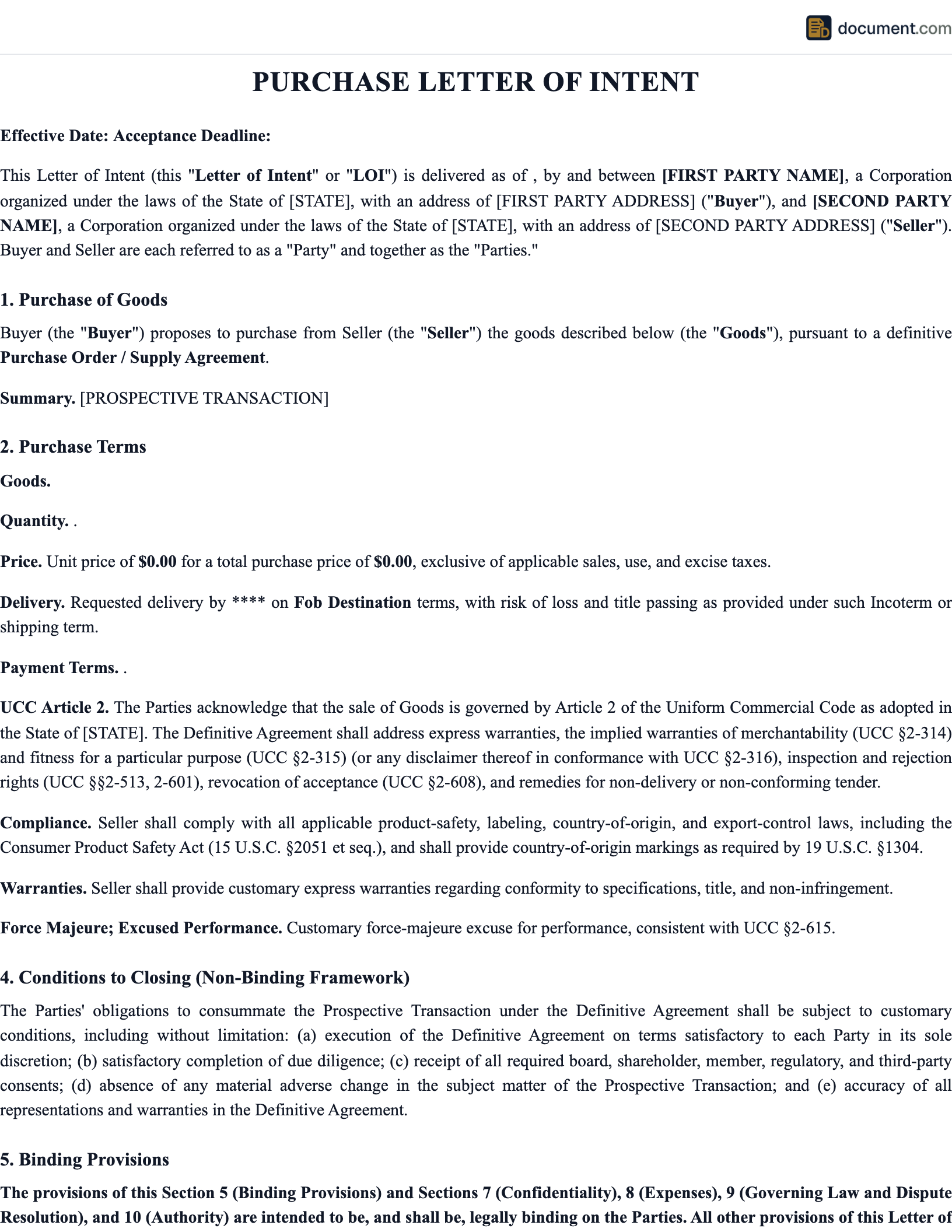



What Is a Letter of Intent to Purchase?
A letter of intent to purchase is a preliminary written agreement in which a prospective buyer presents the key terms under which they propose to acquire an asset, property, or group of goods from a seller. The LOI establishes a negotiation framework that captures the essential deal points — proposed purchase price, payment structure, inspection and due diligence rights, contingencies that must be satisfied before closing, and the anticipated timeline — before either party commits the time and expense required to negotiate and execute a comprehensive purchase agreement. The LOI functions as a gatekeeping document: if the parties cannot reach agreement on fundamental terms at the LOI stage, they avoid the substantially greater expense of detailed legal drafting, professional inspections, and third-party due diligence.
The versatility of the purchase LOI makes it one of the most widely used preliminary agreement formats in commercial transactions. Real estate investors use LOIs to propose terms for acquiring commercial properties, land, and development sites. Manufacturing companies use them when purchasing large equipment, production lines, or industrial machinery. Technology companies use LOIs when acquiring intellectual property portfolios, software assets, or domain names. Retailers and wholesalers use them for bulk inventory purchases. In each context, the LOI serves the same fundamental purpose: it tests whether the parties are aligned on essential terms before either side invests significant resources in the transaction.
From a legal perspective, the purchase LOI occupies a middle ground between a casual expression of interest and a binding contract. Courts across the country have developed a substantial body of case law addressing when an LOI creates enforceable obligations. The general principle is that the parties' intent controls — if the LOI clearly states which provisions are binding and which are not, courts will respect that designation. Problems arise when the LOI is ambiguous about enforceability, when the parties have substantially performed under the LOI as if it were a binding agreement, or when one party has reasonably relied on the LOI to their detriment. These risks underscore the importance of clear, deliberate drafting with explicit binding/non-binding designations.
Price and Terms
Establishes the proposed purchase price, payment structure, and financing arrangements.
Due Diligence Rights
Defines inspection periods, investigation scope, and termination rights based on findings.
Closing Framework
Sets contingencies, conditions precedent, and the timeline for completing the transaction.
Purchase LOI Form Preview
Letter of Intent to Purchase
Proposed Acquisition Terms
1. PARTIES AND SUBJECT PROPERTY
This Letter of Intent sets forth the terms under which ("Buyer") proposes to purchase ("Property/Asset") from ("Seller").
2. PURCHASE PRICE
Buyer proposes a total purchase price of $ payable as at closing, subject to adjustments.
3. DUE DILIGENCE PERIOD
Buyer shall have days from execution to inspect the Property/Asset and may terminate this LOI if results are unsatisfactory.
BUYER
SELLER
Key Components
A well-drafted purchase LOI addresses these essential elements to establish a clear framework for the definitive purchase agreement:
| Component | Purpose | Key Details |
|---|---|---|
| Asset Description | Identifies what is being purchased | Legal description, serial numbers, specifications, condition, included accessories or components |
| Purchase Price | Sets the valuation framework | Total price, per-unit pricing, price adjustments, valuation basis, appraisal contingency |
| Payment Terms | Defines how payment is structured | Cash at closing, seller financing, installments, escrow, earnest money deposit |
| Due Diligence | Enables buyer investigation | Inspection period, scope of access, professional assessments, termination right |
| Contingencies | Sets conditions for closing | Financing, inspection, title, appraisal, regulatory approvals, third-party consents |
| Closing Terms | Establishes completion mechanics | Target closing date, location, deliverables, title transfer method, risk of loss allocation |
| Binding Provisions | Creates enforceable obligations | Confidentiality, exclusivity, expense allocation, governing law, termination |
How to Write a Letter of Intent to Purchase
Describe the Asset or Property
Identify the subject of the purchase with sufficient specificity that both parties and any third parties can unambiguously determine what is being acquired. For real property, include the legal description, parcel number, and street address. For equipment, include the make, model, serial number, and year. For intellectual property, identify each patent, trademark, copyright, or trade secret by registration number. For bulk goods, specify the quantity, grade, specifications, and storage location. Identify any items specifically excluded from the purchase.
Propose the Purchase Price and Payment Structure
State the total proposed purchase price and break down the payment method: cash at closing, seller financing terms (promissory note principal, interest rate, term, security), earnest money deposit amount and escrow instructions, and any price adjustment mechanisms (appraisal contingency, inventory true-up, working capital adjustment). If the price is based on a valuation methodology (comparable sales, replacement cost, discounted cash flow), reference the methodology and the key assumptions.
Establish Due Diligence and Inspection Rights
Define the due diligence period (typically 15-90 days depending on complexity), the scope of the buyer's investigation rights (physical inspection, document review, financial analysis, environmental assessment, title search), the seller's cooperation obligations, and the buyer's right to terminate the LOI without penalty if due diligence reveals material issues. Specify whether professional inspectors, appraisers, or environmental consultants will be engaged and who bears the cost of each investigation.
List Contingencies and Conditions Precedent
Enumerate each condition that must be satisfied before the transaction closes: financing approval within a specified timeframe, satisfactory inspection results, clear title confirmed by title search or commitment, appraised value meeting or exceeding the purchase price, receipt of necessary permits or regulatory approvals, landlord or tenant estoppel certificates for leased property, and absence of material adverse change. Specify objective satisfaction criteria where possible and allow subjective satisfaction where the buyer needs flexibility.
Set the Timeline and Closing Mechanics
Establish a target closing date and describe the closing process: location, required documents (deed, bill of sale, assignment agreements, transfer certificates), title transfer method (warranty deed, quitclaim deed, bill of sale), proration of taxes, utilities, and other ongoing expenses, risk of loss allocation between signing and closing, and post-closing obligations (warranty periods, transition assistance, holdback release conditions).
Include Exclusivity and Confidentiality Provisions
If the buyer is investing significant time and money in due diligence, include a binding no-shop clause preventing the seller from soliciting or entertaining competing offers during the LOI period. Draft binding confidentiality provisions protecting proprietary information shared by both parties during negotiations and due diligence. These provisions should be clearly designated as binding and should survive termination of the LOI.
Designate Binding and Non-Binding Provisions
Use explicit section headers or a concluding provision to designate which LOI provisions are binding (confidentiality, exclusivity, expenses, governing law, dispute resolution) and which are non-binding (purchase price, asset description, payment terms, contingencies, closing date). Include a clear statement that the non-binding provisions do not obligate either party to consummate the transaction and that the definitive purchase agreement, once executed, will supersede the LOI in its entirety.
Common Uses for a Purchase LOI
The purchase LOI is employed across a wide spectrum of commercial transactions, each with its own conventions and considerations. In commercial real estate, the LOI is standard practice for initiating negotiations on office buildings, retail centers, industrial warehouses, and undeveloped land parcels — often with complex contingencies covering environmental assessment, zoning, financing, and tenant lease review. In equipment and machinery transactions, the LOI is used when the purchase involves significant inspection requirements, installation considerations, or seller warranties that need to be negotiated before committing to a binding agreement.
Intellectual property purchases use LOIs when the buyer needs time to evaluate patent portfolios, conduct freedom- to-operate analyses, assess trademark enforcement history, or audit software code before committing to definitive terms. Inventory and wholesale goods purchases employ LOIs when the transaction involves quality inspection, quantity verification, or customs and import compliance that must be confirmed before the buyer assumes the risk of ownership. In each context, the LOI performs the same essential function: it establishes a zone of agreement on fundamental terms, secures exclusivity for the buyer, and defines the due diligence process that will determine whether the deal proceeds to closing.
Statute of Frauds
Under the Statute of Frauds, certain purchase agreements must be in writing to be enforceable — including contracts for the sale of real property, contracts for the sale of goods valued at $500 or more under UCC Section 2-201, and contracts that cannot be performed within one year. While a non-binding LOI may not itself be subject to the Statute of Frauds, any LOI provisions intended to be binding must satisfy applicable writing requirements. If the parties inadvertently create a binding agreement through an LOI that does not satisfy the Statute of Frauds, the agreement may be unenforceable despite the parties' intent.
Frequently Asked Questions
Official Resources
Authoritative resources on purchase transactions, commercial law, and due diligence best practices.
UCC Article 2 - Sale of Goods
Legal Information Institute text of the Uniform Commercial Code provisions governing contracts for the sale of goods, including Statute of Frauds requirements.
SBA - Buying Assets Guide
Small Business Administration guidance on acquiring business assets, equipment, and property through structured purchase transactions.
FTC - Competition Guidance
Federal Trade Commission resources on premerger notification requirements and antitrust considerations for significant purchases.
IRS - Sale of a Business
IRS guidance on tax implications of asset purchases including allocation requirements under IRC Section 1060.
ABA - Business Law Resources
American Bar Association resources on commercial transaction documentation, purchase agreement drafting, and due diligence practices.
EPA - Environmental Due Diligence
Environmental Protection Agency resources on environmental site assessments and due diligence standards for property purchases.
Create Your Purchase LOI
Initiate your purchase transaction with a professionally drafted letter of intent covering price, terms, contingencies, and closing mechanics.
Create DocumentNo account required. Free to create and preview.