
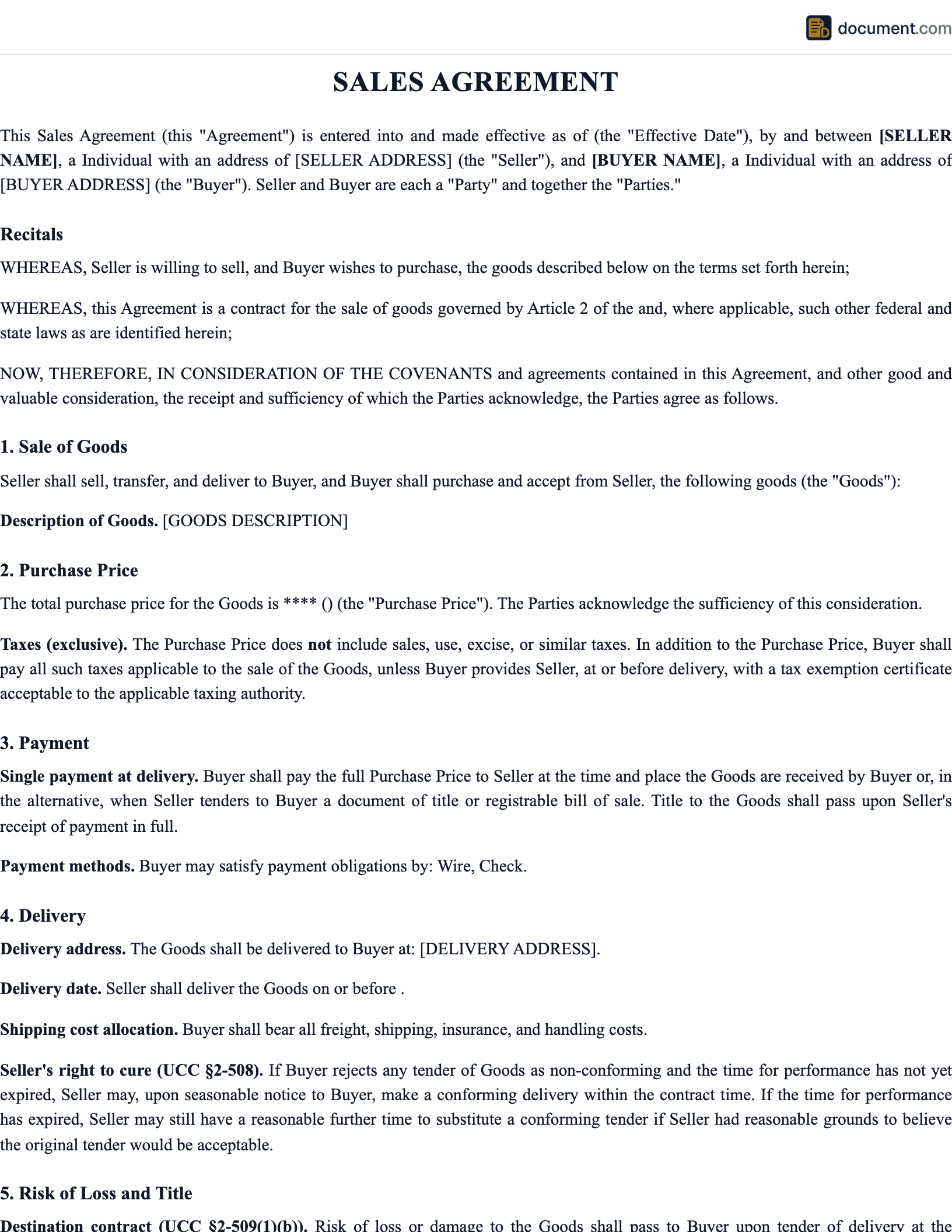



What Is a Sales Agreement?
A sales agreement is a legally binding contract between a seller and a buyer for the sale and transfer of tangible movable goods in exchange for payment. It documents what is being sold, the agreed price, when and how delivery will occur, what warranties the seller makes about the goods, who bears the risk if something goes wrong during shipment, and what remedies each side has if the other fails to perform. Whether the transaction is a one-time sale of equipment between two businesses, an ongoing supply relationship between a manufacturer and distributor, or a custom-made product built to a buyer's specifications, a clear sales agreement is the foundation of any commercial sale of goods.
In the United States, sales agreements for goods are governed by Article 2 of the Uniform Commercial Code, which has been adopted in some form by every state except Louisiana (which uses a similar civil-law equivalent). UCC Article 2 supplies the default rules: how a sales contract is formed, what implied warranties apply, when title passes, who bears risk of loss during shipment, and what remedies each party has if the other breaches. A written sales agreement either confirms these defaults or, more commonly, modifies them to reflect what the parties actually negotiated. Knowing which UCC defaults apply and which you want to override is the entire reason to put a sales contract in writing.
Article 2 also imposes a statute of frauds: contracts for the sale of goods worth $500 or more are generally unenforceable without a signed writing showing that a contract exists and identifying the quantity sold. This makes a written sales agreement legally necessary for most commercial transactions, not just commercially advisable. There are exceptions (specially manufactured goods, partial performance, judicial admissions, and the merchant confirmation rule), but relying on an exception is far riskier than simply documenting the deal in a short, clear writing at the start.
Sales agreements differ from many other commercial contracts because the goods themselves are physical and can be inspected, damaged, lost in transit, or fail to perform as promised. As a result, sales agreements include provisions you do not see in services contracts: detailed product specifications, packaging and labeling requirements, shipment and freight terms, inspection and acceptance procedures, allocation of risk during transit, return and exchange rights, and warranty terms specifying what the seller promises about the condition and performance of the goods after delivery.
Whether you are selling consumer products, industrial equipment, raw materials, inventory, custom-manufactured goods, or any other tangible item, our attorney-reviewed sales agreement templates give you a thorough framework that complies with UCC Article 2 and addresses the issues most sellers and buyers need to negotiate. Each template can be configured for goods sales, bulk sales, installment sales, conditional sales, and international sales under the CISG.
Clear Specifications
Defines exactly what is being sold so disputes about quality and conformity can be resolved by reference to the contract
Shipping & Risk Allocation
Allocates freight, insurance, customs, and risk of loss between seller and buyer using clear shipment terms
Warranty Control
Spells out express warranties given and disclaims implied warranties the seller does not want to make
Sales Agreement Form Preview
Below is a preview of the major sections of a typical UCC Article 2 sales agreement. Your finished document will be fully formatted and customized for your goods, parties, and shipping arrangements.
Sales Agreement
For the Sale of Goods (UCC Article 2)
Section 1: Parties
Section 2: Goods & Price
Section 3: Delivery & Shipment
Shipment Term: FOB Origin (Grand Rapids, MI). Carrier: Buyer's designated freight company. Title and risk of loss pass to Buyer upon delivery to carrier.
Estimated Delivery: 8-10 weeks from date of this Agreement.
Section 4: Payment Terms
30% deposit due upon signing; 60% upon shipment notification; 10% net 30 days after delivery and acceptance.
Section 5: Warranties
Seller warrants the Goods will be free from defects in materials and workmanship for twelve (12) months from delivery. EXCEPT AS EXPRESSLY SET FORTH HEREIN, ALL OTHER WARRANTIES, WHETHER EXPRESS OR IMPLIED, INCLUDING THE IMPLIED WARRANTIES OF MERCHANTABILITY AND FITNESS FOR A PARTICULAR PURPOSE, ARE HEREBY DISCLAIMED.
UCC Article 2
Article 2 of the Uniform Commercial Code is the default body of law that governs sales of goods in the United States. It supplies dozens of background rules that apply unless the parties expressly contract around them.
Scope
Applies to transactions in goods (tangible movable items), not services, real estate, or intangibles. Mixed contracts are typically classified by their predominant purpose.
Statute of Frauds (§2-201)
Contracts for goods worth $500 or more must be evidenced by a signed writing. Exceptions exist for specially manufactured goods, partial performance, and merchant confirmations.
Battle of the Forms (§2-207)
When buyer and seller exchange purchase orders and acknowledgments with conflicting terms, additional terms become part of the contract between merchants unless they materially alter it.
Implied Warranties
The warranty of merchantability (§2-314) and fitness for a particular purpose (§2-315) apply automatically to most sales by merchants unless effectively disclaimed.
Perfect Tender Rule (§2-601)
In a single-shipment contract, the buyer can reject goods that fail in any respect to conform to the contract — modified for installment contracts under §2-612.
Cure (§2-508)
A seller whose goods are rejected may have the right to cure the nonconformity by retendering conforming goods within the original contract time.
Risk of Loss (§§2-509, 2-510)
Risk passes from seller to buyer based on the shipment terms agreed in the contract or the UCC defaults if the parties do not specify.
Good Faith (§1-304)
Every contract within the UCC imposes an obligation of good faith in performance and enforcement that cannot be disclaimed.
Warranties & Disclaimers
Warranties are seller promises about the goods. UCC Article 2 creates several implied warranties automatically; sellers commonly add express warranties and try to disclaim the implied ones.
Express Warranties
Explicit promises about the goods made in the contract, advertising, samples, or product descriptions. Cannot be disclaimed once made.
Implied Warranty of Merchantability
An automatic guarantee from merchant sellers that the goods are fit for the ordinary purposes for which goods of that kind are used. Disclaimer must mention 'merchantability' and be conspicuous.
Implied Warranty of Fitness
Applies when the buyer relies on the seller's expertise to recommend goods for a particular purpose. Disclaimer must be in writing and conspicuous.
Warranty of Title
Automatic in every sale — the seller warrants good title, free of encumbrances, and the right to convey. Very difficult to disclaim.
Magnuson-Moss Warranty Act
Federal law governing written warranties on consumer products; restricts implied-warranty disclaimers when express written warranties are given.
AS IS / WITH ALL FAULTS
Common disclaimer language that, when conspicuous, eliminates implied warranties in commercial transactions but is limited in consumer sales.
Title Transfer & Risk of Loss
When ownership transfers and who bears the risk during shipment are two of the most important questions in any sale of goods. They are governed separately by the UCC and often handled with shipping terms like Incoterms or FOB designations.
FOB Origin (Shipment Contract)
Title and risk of loss pass to the buyer when the seller delivers the goods to the carrier at the seller's location. The buyer pays freight and insures the shipment. Most common for B2B sales of standard goods.
FOB Destination (Destination Contract)
Title and risk of loss pass to the buyer only when the goods are tendered at the buyer's designated destination. The seller bears all freight and insurance during transit. More common in consumer sales.
CIF (Cost, Insurance, Freight)
Common in international sales. The seller's price includes the cost of the goods, insurance, and freight to the named destination port, but risk passes when the goods are loaded onto the vessel at the origin port.
DDP (Delivered Duty Paid)
The seller bears every cost and risk through delivery at the buyer's premises, including customs duties and import clearance. The most buyer-friendly Incoterm.
Sales Agreement vs Other Documents
| Document | Used For | Governing Law |
|---|---|---|
| Sales Agreement | Sale of goods between merchants or to consumers | UCC Article 2 |
| Purchase Agreement | Goods, real estate, or business asset purchases | UCC, common law, or real estate law |
| Bill of Sale | Receipt evidencing transfer of ownership | UCC Article 2 + state title laws |
| Sales Order | Buyer's confirmation of an order | UCC Article 2 |
| Invoice | Demand for payment after delivery | UCC Article 2 |
How to Create a Sales Agreement
- 1
Identify the parties
Full legal names and addresses of seller and buyer, and whether each is acting as a merchant.
- 2
Describe the goods precisely
Quantity, model numbers, specifications, packaging, labeling, and any reference to samples or descriptions.
- 3
Set the price and payment terms
Unit price, total, deposit, payment schedule, late fees, currency, and accepted payment methods.
- 4
Define delivery and shipment terms
FOB or Incoterm, carrier, expected delivery date, packaging, insurance responsibility.
- 5
Allocate title and risk of loss
When title passes, when risk passes, and how loss in transit is handled.
- 6
Spell out warranties
Express warranties given, implied warranties disclaimed, and warranty period.
- 7
Address inspection and acceptance
Right of inspection on arrival, time to reject nonconforming goods, cure rights.
- 8
Add remedies and limitations
Liquidated damages, limitation of liability, exclusion of consequential damages, choice of law and forum.
- 9
Sign and store
Both parties sign; the original is kept with each party's records along with shipping documentation.
Key Components
Parties & Recitals
Identifies seller and buyer and the background of the transaction.
Description of Goods
Detailed specifications, quantities, model numbers, and packaging requirements.
Price & Payment Terms
Unit price, total, deposit, schedule, and accepted payment methods.
Delivery & Shipment
FOB or Incoterm, carrier, freight terms, expected delivery date.
Title & Risk of Loss
When ownership passes and when risk transfers from seller to buyer.
Inspection & Acceptance
Buyer's right to inspect, deadline to reject, cure rights.
Warranties
Express warranties given and implied warranties disclaimed.
Limitation of Liability
Caps on damages and exclusion of consequential damages.
Force Majeure
Excuses performance for events beyond either party's control.
Indemnification
Each party's obligation to defend the other against specific claims.
Default & Remedies
Events of default and the remedies available to the non-breaching party.
Governing Law & Forum
Which state's law governs and where disputes will be resolved.
Breach & Remedies
When one party breaches a sales agreement, the UCC provides a menu of remedies for the non-breaching party. These can be modified by the contract within limits.
Seller's Remedies (Buyer Breach)
- Withhold delivery of unshipped goods
- Stop delivery in transit
- Reclaim goods from insolvent buyer
- Resell and recover difference
- Sue for contract-market price difference
- Sue for full price (limited circumstances)
- Cancel and recover damages
Buyer's Remedies (Seller Breach)
- Reject nonconforming goods
- Revoke acceptance after discovery
- Cancel the contract and recover payments
- Cover by buying substitutes and recover difference
- Sue for contract-market price difference
- Sue for damages on accepted goods
- Specific performance (rare for ordinary goods)
Sample Sales Agreement Language
SECTION 1 — SALE AND PURCHASE. Subject to the terms and conditions of this Agreement, Seller hereby agrees to sell and deliver to Buyer, and Buyer hereby agrees to purchase from Seller, the goods described on Exhibit A attached hereto and incorporated herein by reference (the "Goods"), at the prices set forth therein.
SECTION 3 — DELIVERY AND RISK OF LOSS. Delivery of the Goods shall be made FOB Seller's facility located at [Address] (the "Origin Point"). Title to and risk of loss of the Goods shall pass to Buyer upon delivery of the Goods to a common carrier at the Origin Point. Seller shall use commercially reasonable efforts to ship the Goods within the delivery window set forth on Exhibit A, but shall not be liable for delays caused by carriers or other events beyond Seller's reasonable control.
SECTION 5 — LIMITED WARRANTY. Seller warrants that the Goods will (i) conform to the specifications set forth on Exhibit A, (ii) be free from defects in materials and workmanship under normal use, and (iii) convey good title free and clear of all liens and encumbrances. This warranty shall extend for a period of twelve (12) months from the date of delivery (the "Warranty Period"). Buyer's sole and exclusive remedy for breach of this warranty shall be, at Seller's option, repair or replacement of the nonconforming Goods or refund of the purchase price paid for such Goods.
SECTION 6 — DISCLAIMER. EXCEPT FOR THE EXPRESS WARRANTY SET FORTH IN SECTION 5, SELLER MAKES NO WARRANTIES, WHETHER EXPRESS, IMPLIED, OR STATUTORY, REGARDING THE GOODS, AND SELLER SPECIFICALLY DISCLAIMS ALL IMPLIED WARRANTIES, INCLUDING THE IMPLIED WARRANTIES OF MERCHANTABILITY AND FITNESS FOR A PARTICULAR PURPOSE.
SECTION 9 — LIMITATION OF LIABILITY. IN NO EVENT SHALL SELLER BE LIABLE TO BUYER FOR ANY INDIRECT, INCIDENTAL, SPECIAL, CONSEQUENTIAL, OR PUNITIVE DAMAGES, INCLUDING LOST PROFITS OR LOSS OF USE, ARISING OUT OF OR RELATED TO THIS AGREEMENT, EVEN IF SELLER HAS BEEN ADVISED OF THE POSSIBILITY OF SUCH DAMAGES. SELLER'S TOTAL LIABILITY UNDER THIS AGREEMENT SHALL NOT EXCEED THE TOTAL AMOUNT PAID BY BUYER FOR THE GOODS GIVING RISE TO THE CLAIM.
Frequently Asked Questions
Official Resources
Ready to Document Your Sale?
Build a sales agreement tailored to your goods and shipping terms in minutes.
Create Sales Agreement