



What Is a Media Release?
A media release — sometimes called a model release, talent release, appearance release, or personality release — is a legal document in which an individual grants permission for their name, image, voice, likeness, or performance to be captured, recorded, edited, and used in specified media. It is the document that makes it legally safe to photograph a model, interview a subject, feature an employee in a commercial, include a passerby in a documentary, or publish a testimonial from a happy customer. Without a media release, the subject retains legal control over their identity and can bring claims for violation of publicity rights, invasion of privacy, misappropriation of likeness, and related torts.
Media releases exist at the intersection of three distinct areas of law: the right of publicity (a property-like right to control commercial use of one's identity), the right of privacy (a personal right to control disclosure of private matters), and copyright law (which governs ownership of the creative work that captures the subject). A complete media-use arrangement may involve all three: the subject signs a media release authorizing use of their image, the photographer retains copyright in the photos they create, and the publisher obtains a license from the photographer to actually use the work.
The need for a media release depends on the intended use. For purely personal use — family photos, memories — no release is needed. For editorial use such as news reporting, documentary, journalism, and commentary, the First Amendment generally protects publication of identifiable individuals in public places without a release, though fair-use principles and privacy torts still apply. For commercial use — advertising, marketing, endorsements, product packaging, stock photography sold for commercial licensing — a signed release is almost always required, regardless of where the content was captured. The distinction between editorial and commercial use is the most important variable in determining when a release is needed.
Our attorney-reviewed media release template provides the language needed to secure broad rights to use a subject's name, image, voice, and likeness across multiple media types — photographs, video, audio recordings, streaming content, print publications, websites, social media, advertising, and emerging formats. It includes both commercial and editorial variants, parental consent provisions for minors, options for perpetual or limited-term licenses, assignability provisions for third-party distribution, and state-specific language addressing California, New York, Tennessee, and other jurisdictions with robust right-of-publicity regimes.
Publicity Rights
Secures the right to use name, image, voice, and likeness in commercial and editorial media
Worldwide License
Grants perpetual, worldwide rights to distribute across all media platforms
Legal Protection
Releases claims for privacy, publicity, and misappropriation of likeness
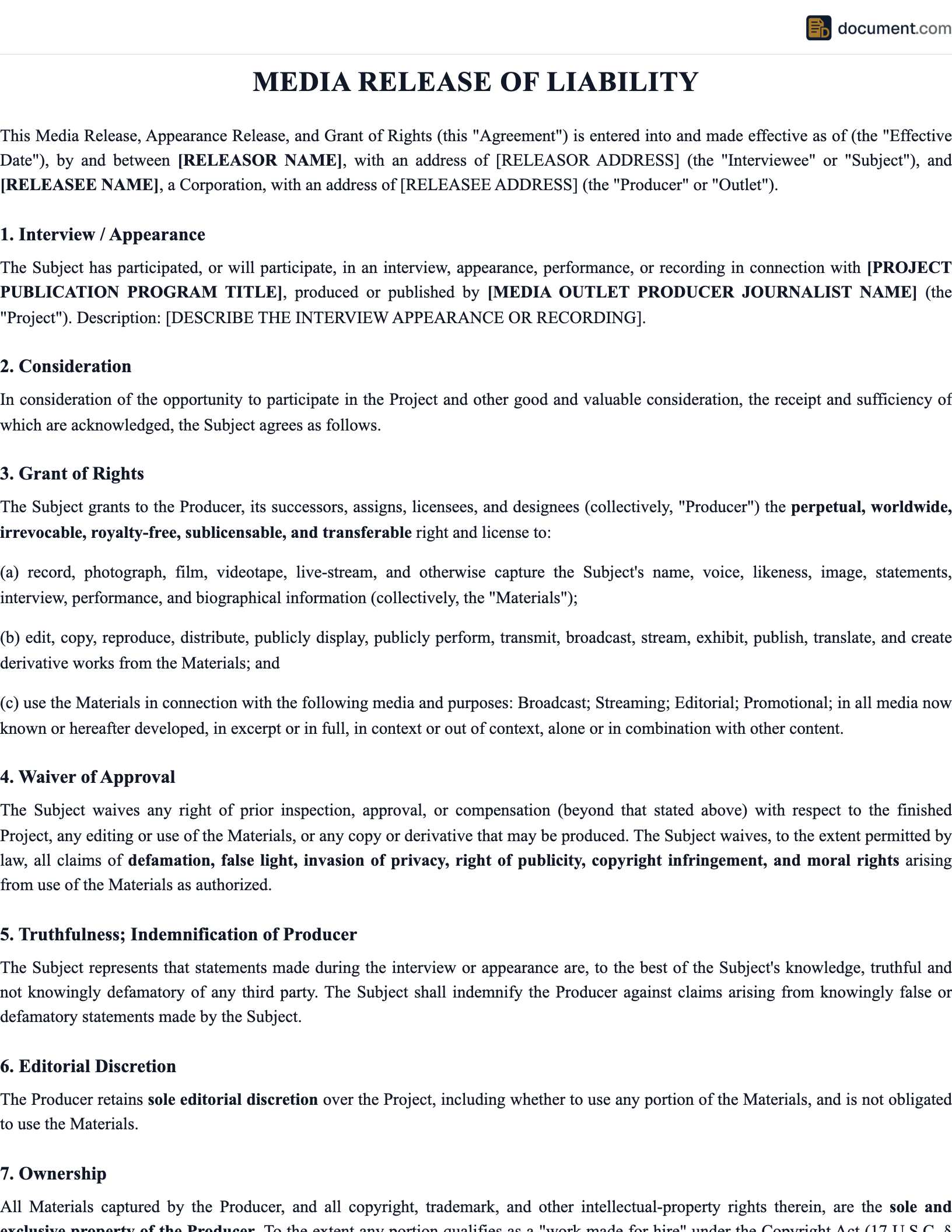
Media Release Form Preview
Media Release and Publicity Rights Grant
Section 1: Subject Information
Section 2: Project and Producer
Section 3: Scope of Release
Types of Media Releases
Different projects call for different types of releases. Understanding the distinctions helps you pick the right one and draft it appropriately.
Model Release
Used when photographing or filming a person (professional model or otherwise) for commercial use. Grants rights to use the person's image in advertising, stock photography, and marketing.
Appearance Release
Used for interview subjects, documentary participants, and reality TV appearances. Grants the producer rights to use the person's statements and appearance in the finished work.
Talent Release
Used for professional performers, actors, musicians, and on-camera talent. Often includes compensation terms and may address performance credit and payment.
Testimonial Release
Used when a customer provides a testimonial or endorsement. Grants rights to use the testimonial in marketing materials and complies with FTC endorsement rules.
Minor Release
Used when the subject is under 18. Must be signed by a parent or legal guardian on behalf of the minor. May require additional protections depending on state law.
Crowd/Event Release
Posted at entry points to public events advising attendees that their presence constitutes consent to being photographed and filmed. Not as strong as individual signed releases.
The Right of Publicity
The right of publicity is the legal foundation that makes media releases necessary. It is a property-like right that gives individuals control over the commercial use of their identity — their name, image, voice, likeness, signature, and other distinctive personal attributes. Violating someone's right of publicity by using their identity without permission for commercial purposes can result in substantial damages, including statutory minimums in some states, actual damages, disgorgement of profits, injunctive relief, and attorney's fees.
California
California Civil Code 3344 provides a statutory right of publicity with minimum $750 damages per violation plus actual damages. California Civil Code 3344.1 (the "Celebrities Rights Act") extends protection for 70 years after death.
New York
New York Civil Rights Law Sections 50 and 51 prohibit use of a person's name, portrait, picture, or voice for advertising or trade without written consent, with monetary damages and injunctive relief available.
Tennessee, Indiana, Nevada, Washington
These states have notable statutory right-of-publicity regimes with varying post-mortem durations and remedies.
Model Release vs Location Release vs Property Release
Professional photographers and filmmakers often need multiple release types for a single project.
Model Release
Rights to use a person's image or likeness.
Location Release
Rights to film or photograph at a specific location (a store, home, restaurant, venue). Usually obtained from the property owner.
Property Release
Rights to use images of distinctive property (artwork, trademarks, buildings, products) in commercial content.
How to Create a Media Release
Identify the Subject and Producer
Clearly name the subject (person being photographed or recorded) and the producer (the party obtaining the release).
Describe the Project
Provide enough information about the project to make the scope clear. Include the project title, type of media, and intended use.
Specify the Scope of Rights
List exactly what is being released: still photographs, video, audio, name, biographical information, and any modifications or editing.
Address the Intended Uses
Specify whether the use is commercial, editorial, or both. List the intended distribution channels.
Set the Duration
Specify whether the license is perpetual, limited to a specific project, or for a defined time period.
Address Assignability
State whether the producer can assign the rights to third parties.
Include a Release of Claims
Add language releasing the producer from claims for privacy, publicity, defamation, and related torts.
Address Parental Consent for Minors
For subjects under 18, include a parental consent section and signature block.
Specify Consideration
State the consideration being paid (money, credit, copies, or general consideration). Even a nominal amount creates binding contract consideration.
Obtain Signature and Store Securely
Have the subject sign and retain the release with the associated media assets.
Key Components of a Media Release
| Component | Description |
|---|---|
| Subject Identification | Full legal name, contact info, and (for minors) parent/guardian |
| Producer Identification | Company or individual obtaining the release |
| Project Description | Title, type of media, and scope of the project |
| Grant of Rights | Express grant of publicity rights in the specified media |
| Scope of Media | Still photos, video, audio, streaming, print, digital, and other formats |
| Permitted Uses | Commercial, editorial, advertising, promotional, educational |
| Duration | Perpetual, limited-term, or project-specific |
| Territory | Worldwide or limited geographic scope |
| Assignability | Whether the producer can transfer the rights to third parties |
| Modification Rights | Authorization to edit, modify, or create derivative works |
| Consideration | Payment, credit, copies, or other consideration |
| Release of Claims | Waiver of privacy, publicity, defamation, and related claims |
| Parental Consent (Minors) | Parent or guardian signature for subjects under 18 |
| Governing Law | State whose law governs the release |
| Signature | Subject signature, date, and witness where required |
Media Releases for Minors
Minors cannot enter into legally binding contracts, so media releases for subjects under 18 must be signed by a parent or legal guardian on the minor's behalf. Additional state-specific protections may apply, particularly in California where child performers are protected under Coogan-law requirements and the California Child Actor's Bill.
Important: The parental signature should include the parent's relationship to the minor, the minor's name and date of birth, and an explicit statement that the parent has the legal authority to consent on the minor's behalf. In joint-custody situations, obtaining both parents' signatures is the safest approach.
Commercial vs Editorial Use
The commercial/editorial distinction is the single most important variable in determining whether a media release is required.
Commercial Use
- - Advertising and marketing
- - Product packaging
- - Brand promotion
- - Stock photography licensed commercially
- - Endorsements
- - Nearly always requires a signed release
Editorial Use
- - Journalism and news reporting
- - Documentary filmmaking
- - Educational materials
- - Artistic and fine-art photography
- - Books and commentary
- - Generally protected by First Amendment, but releases still recommended
Sample Media Release Language
MEDIA RELEASE AND GRANT OF PUBLICITY RIGHTS
For good and valuable consideration, the receipt of which is hereby acknowledged, I, [Subject Name] ("Subject"), grant to [Producer Name] ("Producer") and its successors, assigns, and licensees, the irrevocable right and permission to:
1. GRANT OF RIGHTS
Use, reproduce, edit, distribute, publish, and exhibit my name, photograph, image, likeness, voice, and biographical information, in whole or in part, in any and all media now known or hereafter devised, worldwide, in perpetuity, for any purpose including but not limited to commercial advertising, marketing, promotion, editorial publication, and broadcast.
2. MODIFICATION AND COMPOSITE USE
I consent to the alteration, editing, cropping, and combination of my image, likeness, and voice with other images, text, sound, or other media, and waive any right to inspect or approve the finished work or the uses to which it may be put.
3. RELEASE OF CLAIMS
I hereby release Producer and its affiliates, successors, assigns, and licensees from any and all claims, demands, and causes of action that I may have arising out of the use of my name, image, likeness, voice, or biographical information pursuant to this Release, including without limitation any claims for violation of privacy, publicity, defamation, or misappropriation of likeness.
4. ACKNOWLEDGMENT
I am at least 18 years of age, have read this Release, understand its terms, and sign it voluntarily. I understand that this Release is binding upon me, my heirs, executors, and assigns.
Frequently Asked Questions
Official Resources
U.S. Copyright Office
Information on copyright, licensing, and creative work protection
FTC Endorsement Guides
Federal Trade Commission rules on endorsements and testimonials
California Civil Code 3344
California's statutory right of publicity
New York Civil Rights Law 50-51
New York's right of privacy and publicity statute
Create your Media Release of Liability Waiver in under 10 minutes.
Answer a few questions and download a compliant, attorney-drafted document ready for your state.