
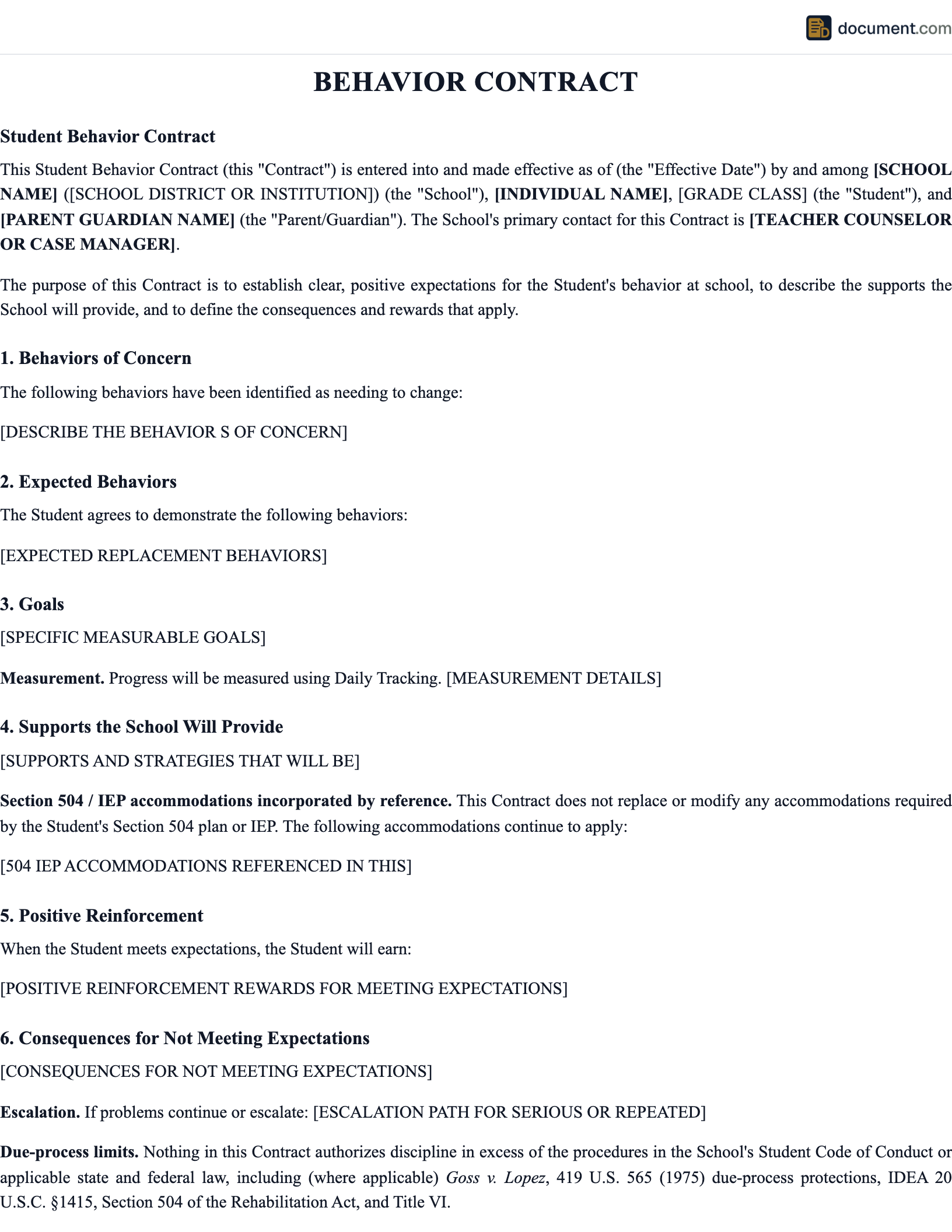



What Is a Behavior Contract?
A behavior contract is a written agreement between two or more parties that defines specific behavior expectations, the rewards earned for meeting them, and the consequences for failing to meet them. Behavior contracts are widely used in classrooms by teachers, in homes by parents, in workplaces by managers, and in counseling settings by therapists. They translate vague rules — "be respectful," "do your homework," "come to work on time" — into concrete, measurable commitments that everyone has signed off on in advance, removing ambiguity and giving the subject a clear path to success.
Behavior contracts trace their roots to applied behavior analysis and contingency management — branches of behavioral psychology that emerged in the mid-20th century and have been refined through decades of research in educational and clinical settings. The core insight is that behavior change is most likely when expectations are explicit, when consequences are predictable, and when the subject has meaningful input into the agreement. Contracts succeed because they replace the moment-to-moment unpredictability of authority decisions with a stable framework that everyone understands and has consented to.
A typical contract has five basic parts: the parties involved, the target behaviors to increase or decrease, the positive reinforcers or rewards, the negative consequences, and the timeline for review and renegotiation. Some contracts add measurement protocols (how the behavior will be tracked), tier systems (escalating rewards for sustained compliance), reset provisions (a clean slate after a setback), and signatures from witnesses such as a school counselor or family therapist. The structure can be as simple as a one-page handwritten agreement between a parent and a child or as detailed as a multi-page Behavior Intervention Plan developed by a school IEP team for a student with disabilities.
Behavior contracts work best when they are co-created rather than imposed. A child or student who feels coerced into signing a contract will not internalize its terms and will treat it as just another rule to evade. A child who has had genuine input into the target behaviors, the rewards, and the consequences feels ownership of the agreement and is more motivated to honor it. The same principle applies to employee performance plans: workers who feel that the plan was handed down without consultation often comply just enough to avoid termination, while workers who participated in shaping the plan often demonstrate genuine improvement and emerge with stronger relationships with their managers.
Whether you are a teacher addressing classroom disruption, a parent working through chronic power struggles with a teenager, an HR professional documenting performance concerns, a therapist establishing treatment goals with a client, or a coach setting expectations for an athlete, our behavior contract templates provide a tested framework you can customize. Each template includes positive reinforcement language, fair consequence structures, review schedules, and signature blocks for everyone involved — giving you a tool that is both flexible enough for your specific situation and structured enough to actually change behavior.
Clear Expectations
Replaces vague rules with specific, measurable commitments
Positive Reinforcement
Rewards desired behavior rather than punishing unwanted behavior alone
Shared Ownership
Co-created agreements have higher buy-in and better outcomes
Behavior Contract Preview
Below is a visual preview of the structure of a typical behavior contract. Your completed contract will be customized for your specific situation, target behaviors, and review schedule.
Behavior Contract
Student / Parent / Teacher Agreement
Section 1: Parties
Section 2: Target Behaviors
Section 3: Rewards
Section 4: Consequences
Section 5: Signatures
Student Signature
Teacher Signature
Parent / Guardian Signature
Date
Types of Behavior Contracts
Behavior contracts work in many settings — from kindergarten classrooms to corporate offices. Choose the variant that matches your context.
Behavior Contracts in the Classroom
Classroom behavior contracts help teachers manage individual students whose behavior interferes with learning — their own or their classmates'. Rather than relying on reactive discipline, the contract creates a forward-looking framework that the student, teacher, and parent all sign. Research published in journals like the Journal of Applied Behavior Analysis and School Psychology Review consistently shows that individualized behavior contracts reduce off-task behavior, decrease office referrals, and improve academic engagement, particularly when paired with regular monitoring and parent communication.
Effective classroom contracts identify two to four specific target behaviors (more than that becomes overwhelming), use language the student can understand, include daily and weekly rewards, and provide a clear procedure for tracking progress — usually a chart on the teacher's desk or in the student's folder. The teacher meets briefly with the student each day to review progress, celebrate wins, and reset after setbacks. Parents receive regular updates via the chart, a behavior log, or an app. This three-way communication loop is what makes the contract sustainable: the student feels supported by both home and school, and the parent sees concrete evidence of progress.
Parent-Child Behavior Contracts
At home, behavior contracts give families a structured way to address recurring conflicts without daily arguments. Common targets include screen time, homework completion, chore responsibility, sibling treatment, curfew compliance, and respectful communication. The process of writing the contract together — sitting down at the kitchen table, listening to the child's concerns, negotiating reasonable rewards and consequences — is often as valuable as the contract itself. It models adult conflict resolution and gives the child a sense of being taken seriously.
Family therapists and parenting coaches recommend behavior contracts especially for families with tweens and teens, where unilateral parenting often produces escalating resistance. The contract reframes the parent-child relationship from one of power struggles to one of mutual commitments. Even very young children benefit from simple picture-based contracts with stickers, smiley faces, and color codes. The principle is the same regardless of age: clear expectations, visible progress, predictable consequences, and consistent follow-through on the parent's part.
Workplace Behavior Plans
In the workplace, behavior contracts take the form of Performance Improvement Plans (PIPs) or behavior expectations memos. They are typically issued after informal coaching has failed and serve two purposes: giving the employee a structured opportunity to improve, and creating documentation that supports a future termination decision if improvement does not occur. A well-drafted workplace behavior plan identifies specific concerns (tardiness, communication style, dress code, interpersonal conduct), describes the expected standards in measurable terms, sets a review timeline (commonly 30, 60, or 90 days), and outlines the support the employer will provide.
Workplace behavior plans should always be drafted in consultation with HR and, where appropriate, employment counsel. Plans that single out employees in protected classes, retaliate for protected activity, or fail to accommodate disabilities can give rise to discrimination, retaliation, and ADA claims. The strongest plans are objective, focus on observable behaviors rather than personality, set clear standards, document support offered, and apply equally to all employees in similar situations regardless of race, gender, age, disability, or other protected characteristics.
How to Create a Behavior Contract
Follow these steps to draft a behavior contract that is specific enough to drive change and flexible enough to last.
Identify the Specific Target Behaviors
Choose two to four observable, measurable behaviors. Avoid vague language like 'be good' or 'try harder.' Instead, write 'complete daily math worksheet without prompting' or 'speak in an inside voice during class.'
Involve the Subject in Drafting
Sit down with the child, student, or employee and ask for their input. Buy-in is the difference between a contract that works and one that gets ignored. Their voice should appear in the language and the choice of rewards.
Define the Rewards Carefully
Choose rewards that are meaningful to the subject — not what you assume they should want. Some children want screen time; others want one-on-one time with a parent. Some employees want public recognition; others want to be left alone to do good work.
Set Fair, Proportionate Consequences
Consequences should escalate gradually and be applied consistently. Avoid harsh punishments that you will not actually follow through on. The most effective consequences are mild but reliable.
Build in a Review Schedule
Set specific dates for daily check-ins (for children) or weekly meetings (for employees) to review progress, troubleshoot, and renegotiate as needed.
Sign and Display
All parties sign and date the contract. For children, post the contract somewhere visible — the refrigerator, the classroom wall, the student's folder. Visibility reinforces the agreement.
Track Progress Visibly
Use a chart, sticker board, point system, or digital tracker so the subject can see their progress in real time. Visible progress fuels continued effort.
Celebrate Successes and Adjust as Needed
Acknowledge wins explicitly. If something is not working, adjust the contract rather than abandoning it. The goal is sustained behavior change, not perfect compliance.
Key Components
The Role of Positive Reinforcement
Decades of research in behavioral psychology — beginning with B.F. Skinner's work on operant conditioning and continuing through modern applied behavior analysis — show that positive reinforcement is more effective at producing lasting behavior change than punishment alone. A behavior contract that focuses primarily on consequences for failure tends to create resentment and avoidance; a contract that pairs clear consequences with meaningful rewards tends to build motivation and self-efficacy. The best contracts make the rewards more prominent than the punishments, signaling that the goal is success, not surveillance.
Reinforcers can be tangible (snacks, small toys, screen time), social (praise, attention, recognition), or activity-based (game time, choice of activity, special privileges). What works varies by individual: some children are powerfully motivated by adult attention, others by tangible rewards, others by autonomy. A token economy — in which the subject earns points or tokens that can be exchanged for larger rewards — is one of the most well-researched reinforcement systems and works across age groups, settings, and developmental levels.
Are Behavior Contracts Legally Enforceable?
Most behavior contracts are not legally enforceable in the courtroom sense — courts will not award damages if a child fails to clean their room or a student refuses to raise their hand. They are behavioral tools, not legal contracts. Their power lies in the structure, consistency, and accountability they create. The two important exceptions are workplace performance plans, which can be central to wrongful-termination defenses, and school-based Behavior Intervention Plans (BIPs) developed under the Individuals with Disabilities Education Act (IDEA), which carry federal statutory weight and procedural protections.
Even though most behavior contracts are not legally binding, treating them as serious, written agreements increases their effectiveness. The act of putting commitments on paper, signing them in front of others, and posting them visibly transforms them from vague intentions into shared social commitments — which behavioral research shows are significantly more powerful drivers of behavior change than unwritten expectations.
Sample Behavior Contract
Below is a condensed preview of a student behavior contract template. Your completed contract will be customized for your specific situation.
BEHAVIOR CONTRACT
Student / Teacher / Parent Agreement
I, [Student Name], agree to work with my teacher and parent/guardian to improve my behavior in the classroom. I understand that this contract describes the expectations I will meet, the rewards I will earn for meeting them, and the consequences if I do not.
1. TARGET BEHAVIORS
I agree to:
- Raise my hand and wait to be called on before speaking
- Stay in my seat unless given permission to move
- Complete my classwork and turn in homework on time
- Speak respectfully to my teachers and classmates
2. REWARDS
For each day I meet all of the target behaviors, I will earn one star on my chart. Each star earns me [reward]. At the end of each week with five stars, I will earn[weekly reward].
3. CONSEQUENCES
If I do not meet a target behavior, I will receive a verbal reminder. If the behavior continues, I will complete a behavior reflection sheet, and my parent will be contacted. Repeated incidents will result in loss of[privilege].
4. REVIEW SCHEDULE
This contract will be reviewed weekly with my teacher and parent. We will discuss what is working, what is not, and whether changes need to be made.
5. SIGNATURES
By signing below, the student, teacher, and parent agree to follow this behavior contract from [Date]to [Date].
Frequently Asked Questions
Common questions about behavior contracts in classrooms, homes, workplaces, and counseling settings.
Official Resources
Authoritative sources on behavior interventions, special education, classroom management, and workplace performance.
U.S. Dept of Education - IDEA
Federal special education law including BIPs and Functional Behavior Assessments
PBIS - Positive Behavioral Interventions & Supports
National technical assistance center on school-wide behavior systems
NASP - National Association of School Psychologists
Resources on behavior contracts, classroom management, and student support
CDC - Essentials for Parenting
Evidence-based parenting strategies for ages 2 through 11
AAP - HealthyChildren.org
American Academy of Pediatrics resources on child behavior and discipline
EEOC - Equal Employment Opportunity Commission
Federal guidance on workplace performance plans and discrimination
SHRM - Society for Human Resource Management
Best practices for performance improvement plans and progressive discipline
Understood.org
Resources on behavior plans for kids with learning and attention differences
Create your Behavior Contract in under 10 minutes.
Answer a few questions and download a compliant, attorney-drafted document ready for your state.