



What Is an Activity Waiver and Release of Liability?
An activity waiver and release of liability— also called a liability release, participant waiver, or simply a "waiver" — is a contract in which a person participating in an activity agrees not to sue the activity provider, operator, or sponsor for injuries, damages, or losses that arise from participation. The waiver typically performs three interlocking functions: it discloses the risks of the activity so the participant is on informed notice, it documents the participant's express assumption of those risks, and it releases the provider from liability for the provider's ordinary negligence.
Activity waivers are the backbone of the recreation, fitness, and adventure industries. Gyms, yoga studios, CrossFit boxes, climbing gyms, trampoline parks, ski resorts, whitewater outfitters, horseback riding stables, adventure parks, mud runs, triathlons, martial arts schools, children's sports leagues, summer camps, and countless other businesses rely on waivers as their first line of defense against participant injury claims. Without an enforceable waiver, even a routine incident — a twisted ankle in a yoga class, a fall during a cycling class, a bruise from a paintball game — could expose the business to costly litigation.
The legal foundation for waivers rests on two closely related doctrines: freedom of contract and assumption of risk. Freedom of contract allows adults to agree to terms that limit their own legal remedies, including the right to sue. Assumption of risk holds that a person who voluntarily engages in an activity with known dangers impliedly accepts those dangers. Waivers combine these two principles by (a) making the risks explicit so they cannot be denied later, and (b) adding a contractual release that goes beyond the default assumption-of-risk rules.
Not every waiver is enforceable. Courts scrutinize waivers carefully because they ask participants to give up valuable legal rights, and apply a range of enforceability criteria: clarity of language, conspicuousness of the waiver provisions, specificity about the risks being assumed, absence of public-policy violations, and limits on the types of conduct that can be waived. Most courts will not enforce a waiver that attempts to release gross negligence, recklessness, or intentional misconduct. Many states have statutes that specifically address waivers for activities like skiing, equine sports, whitewater rafting, or recreational hunting — providing both additional protections and additional requirements.
Our attorney-reviewed activity waiver template is engineered to maximize enforceability in your state. It includes a detailed description of activity risks, an express assumption of risk, a release of ordinary negligence claims, an indemnification provision, a medical authorization, electronic-signature support, parental consent provisions for minors (where enforceable), and state-specific statutory disclosures for activities covered by inherent-risk statutes.
Risk Disclosure
Documents the inherent risks of the activity so participants cannot claim ignorance
Legal Protection
Releases the provider from claims for ordinary negligence where state law allows
Enforceable Language
Includes state-specific wording required by courts for maximum enforceability
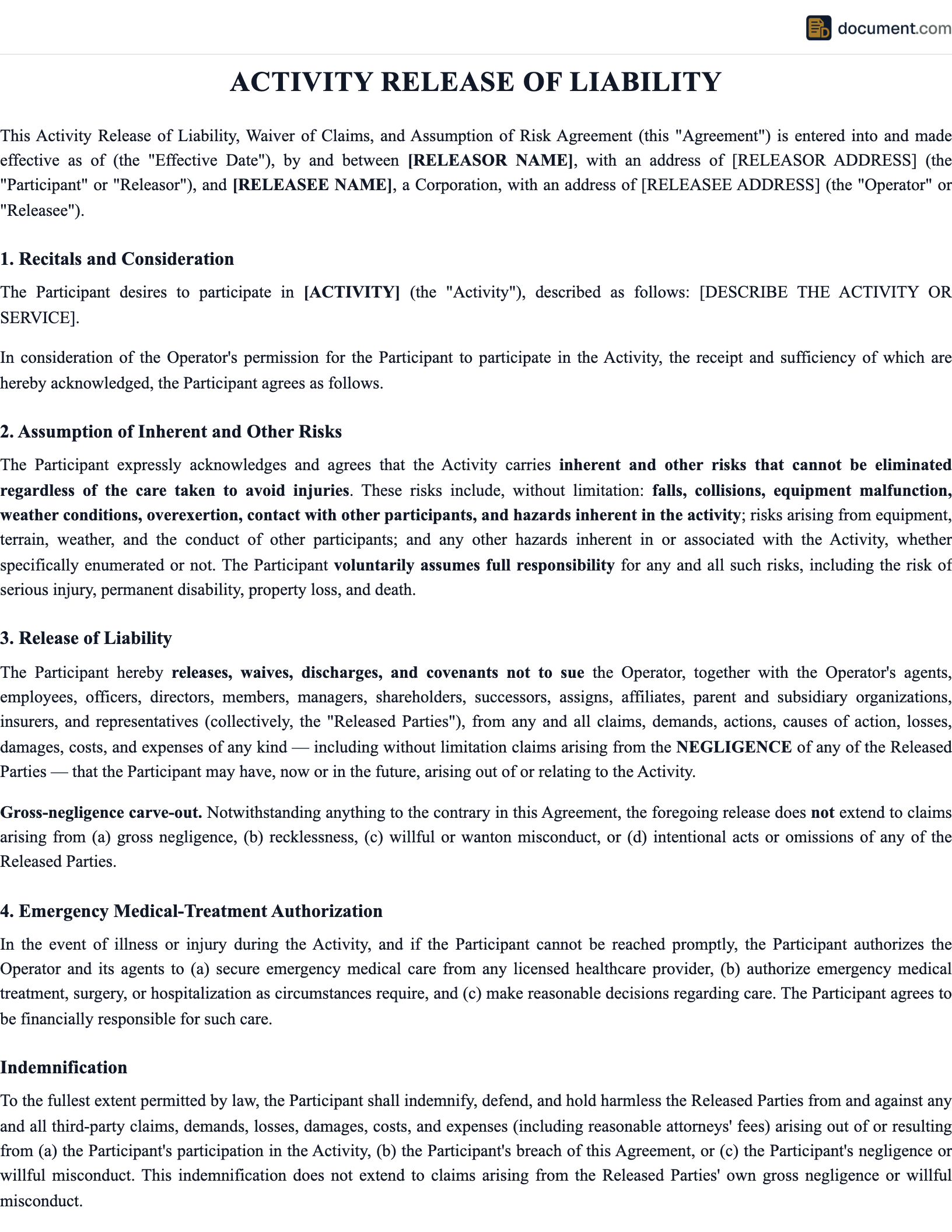
Activity Waiver Form Preview
Activity Waiver and Release of Liability
Assumption of Risk and Release of Claims
Section 1: Participant Information
Section 2: Activity Description
Section 3: Acknowledged Risks
Activities That Typically Require Waivers
Waivers are used across a broad range of activities with varying risk profiles. The type of activity affects what risks must be disclosed, what statutory protections apply, and how the waiver should be drafted.
Fitness and Gym Activities
Gym memberships, personal training, group fitness classes, CrossFit, bootcamps, HIIT, martial arts, yoga, Pilates, cycling classes
Adventure and Outdoor Sports
Rock climbing, mountaineering, whitewater rafting, kayaking, scuba diving, zip lines, ropes courses, caving, bungee jumping
Extreme Sports
Skydiving, BASE jumping, paragliding, hang gliding, motocross, downhill mountain biking, snowmobiling, snowboarding
Youth and Children's Programs
Summer camps, youth sports leagues, gymnastics, cheerleading, swim lessons, martial arts for kids, after-school programs
Equestrian Activities
Horseback riding lessons, trail rides, boarding facilities, horse shows, rodeo — often covered by state equine statutes
Events and Races
Marathons, triathlons, obstacle course races, charity runs, cycling events, trail runs, mud runs, Spartan races
Enforceability Requirements
Courts apply several tests when deciding whether to enforce a waiver. Meeting all of these requirements maximizes the likelihood that your waiver will hold up in court.
- Clear and Unambiguous Language: The release language must be clear enough that a reasonable person would understand they are giving up the right to sue.
- Conspicuousness: The waiver should be prominently displayed — not buried in fine print. Use bold, larger fonts, or separate signature lines for release provisions.
- Specificity About Risks: List the specific risks of the activity rather than relying on generic language.
- Express Mention of Negligence: Some states (notably California) require the word "negligence" to explicitly appear.
- Voluntary Signature: The participant must sign voluntarily, without coercion or duress.
- Adult Capacity: The signer must be a legal adult with capacity (parental signatures for minors have their own rules).
- No Public Policy Violation: The activity must not be one where waivers are prohibited by statute or public policy.
Waiver vs Indemnification vs Hold Harmless
These three related concepts are often combined in a single document, but they perform different legal functions.
Waiver / Release
The participant gives up their own right to sue the provider for covered claims. This prevents the participant from filing a lawsuit against the provider for activity-related injuries.
Indemnification
The participant agrees to reimburse the provider for any losses, damages, or legal fees the provider incurs as a result of claims brought by third parties.
Hold Harmless
The participant agrees not to hold the provider responsible for losses — often functionally equivalent to indemnification, though the precise legal meaning varies by jurisdiction.
How to Create an Activity Waiver
Identify the Specific Activity
Name the activity or activities with precision. Generic waivers covering 'all activities' are more likely to be found unenforceable than waivers that specifically describe the covered activities.
Disclose Material Risks
List the foreseeable risks of the activity: physical injury, equipment failure, interactions with other participants, environmental hazards, and — for high-risk activities — serious injury or death.
Use State-Specific Language
Different states require different magic words. California requires 'negligence' to appear; some states require all-caps release language; Colorado requires specific notice about skiing statutes.
Make the Release Conspicuous
Use a separate section with a header like 'RELEASE OF LIABILITY' or 'WAIVER OF CLAIMS.' Consider bold or larger type. Put a separate initial line next to the key release paragraph.
Include an Express Assumption of Risk
Add a paragraph in which the participant expressly acknowledges the risks and voluntarily assumes them. This strengthens the waiver even if the release provision is struck down.
Address Medical Authorization
Include consent for the provider to arrange emergency medical care if the participant is injured and unable to consent. This protects the provider and supports participant safety.
Provide Parental Consent for Minors
For participants under 18, include a parent or guardian signature block. Understand that parental waivers may not be fully enforceable in your state.
Support Electronic Signatures
Format the waiver to work in digital check-in systems. Under the E-SIGN Act and UETA, electronic signatures are valid, but you must retain signed copies.
Collect and Store Signed Copies
Retain signed waivers for the length of the applicable statute of limitations (typically 2-6 years, longer for minors). Store digitally with backup.
Update Periodically
Review waivers annually and update after significant legal developments, adding new activities, or expanding into new states.
Key Components of an Activity Waiver
| Component | Description |
|---|---|
| Participant Identification | Full legal name, date of birth, address, and emergency contact |
| Activity Description | Specific activity being waived, provider name, date and location |
| Risk Disclosure | Detailed list of the inherent and foreseeable risks of the activity |
| Assumption of Risk | Express statement that the participant understands and accepts the risks |
| Release of Claims | Release of the provider from liability for ordinary negligence |
| Indemnification | Participant agrees to indemnify the provider for third-party claims |
| Medical Authorization | Consent for emergency medical care |
| Parental Consent (Minors) | Parent or guardian signature for participants under 18 |
| Acknowledgment of Reading | Statement that the participant has read and understood the waiver |
| Governing Law | State whose law applies to the waiver |
| Severability Clause | Provision keeping the rest of the waiver enforceable if one part is struck |
| Signature and Date | Participant and, where applicable, witness signatures |
Waivers and Minors
One of the most legally nuanced issues in activity waivers is whether a parent or guardian can waive a minor's right to sue. The answer varies dramatically by state.
States Where Parental Waivers Are Generally Enforceable
California, Colorado, Florida, Maryland, Massachusetts, Minnesota, Ohio, and several others have judicial or statutory authority supporting parental waivers for minor participants.
States Where Parental Waivers Are Generally Unenforceable
New York, New Jersey, Washington, Pennsylvania, Texas (for some activities), and others have held that parents cannot prospectively waive a minor's legal claims for ordinary negligence.
Partial Enforcement
Some states allow parental waivers only for specific activity categories (interscholastic sports, community recreation) or treat them as evidence of assumption of risk without full release effect.
Gross Negligence and Public Policy Limits
No waiver — no matter how carefully drafted — can release an activity provider from liability for gross negligence, recklessness, or intentional misconduct. This is a fundamental principle of public policy in virtually every state.
Practical Implication: A waiver is not a license to be careless. Providers must still maintain equipment, train staff, follow safety regulations, and operate the activity with reasonable care. The waiver protects against the consequences of ordinary human error, but not against systemic safety failures or conscious disregard for participant well-being.
Sample Activity Waiver Language
ACTIVITY WAIVER AND RELEASE OF LIABILITY
In consideration of being permitted to participate in [Activity Name] provided by [Provider Name] ("Provider"), I, the undersigned participant, agree as follows:
1. ACKNOWLEDGMENT OF RISKS
I understand and acknowledge that participation in the Activity involves inherent and other risks, including but not limited to: falling, collision, equipment failure, environmental hazards, contact with other participants, and other foreseeable and unforeseeable risks. I understand that these risks may result in property damage, physical injury, disability, or death.
2. ASSUMPTION OF RISK
I voluntarily assume full responsibility for any and all risks, whether or not described above, and agree to participate with full knowledge of the dangers involved. I represent that I am in good physical condition and have no medical condition that would prevent safe participation.
3. RELEASE AND WAIVER OF LIABILITY
I HEREBY RELEASE, WAIVE, AND DISCHARGE Provider, its owners, officers, directors, employees, agents, and volunteers from any and all liability, claims, demands, and causes of action of any kind arising out of or related to my participation in the Activity, INCLUDING CLAIMS BASED ON THE NEGLIGENCE OF PROVIDER, to the fullest extent permitted by law.
4. INDEMNIFICATION
I agree to indemnify and hold harmless Provider against any claims, damages, or expenses brought against Provider by any third party arising out of my participation or conduct during the Activity.
5. MEDICAL AUTHORIZATION
I authorize Provider and its staff to arrange emergency medical treatment if I am injured and unable to consent to treatment myself. I agree to be financially responsible for any medical expenses incurred on my behalf.
6. ACKNOWLEDGMENT
I HAVE READ THIS WAIVER AND RELEASE, UNDERSTAND IT, AND SIGN IT VOLUNTARILY. I understand that by signing this document I am giving up substantial legal rights.
Frequently Asked Questions
Official Resources
CPSC - Consumer Product Safety
U.S. Consumer Product Safety Commission — recreation and sports equipment safety
OSHA - Occupational Safety
Workplace and facility safety standards relevant to activity providers
National Safety Council
Recreation and sports safety guidance and injury prevention
FTC - Business Guidance
Federal Trade Commission guidance on consumer contracts and disclosures
Create your Activity Release of Liability Waiver in under 10 minutes.
Answer a few questions and download a compliant, attorney-drafted document ready for your state.