
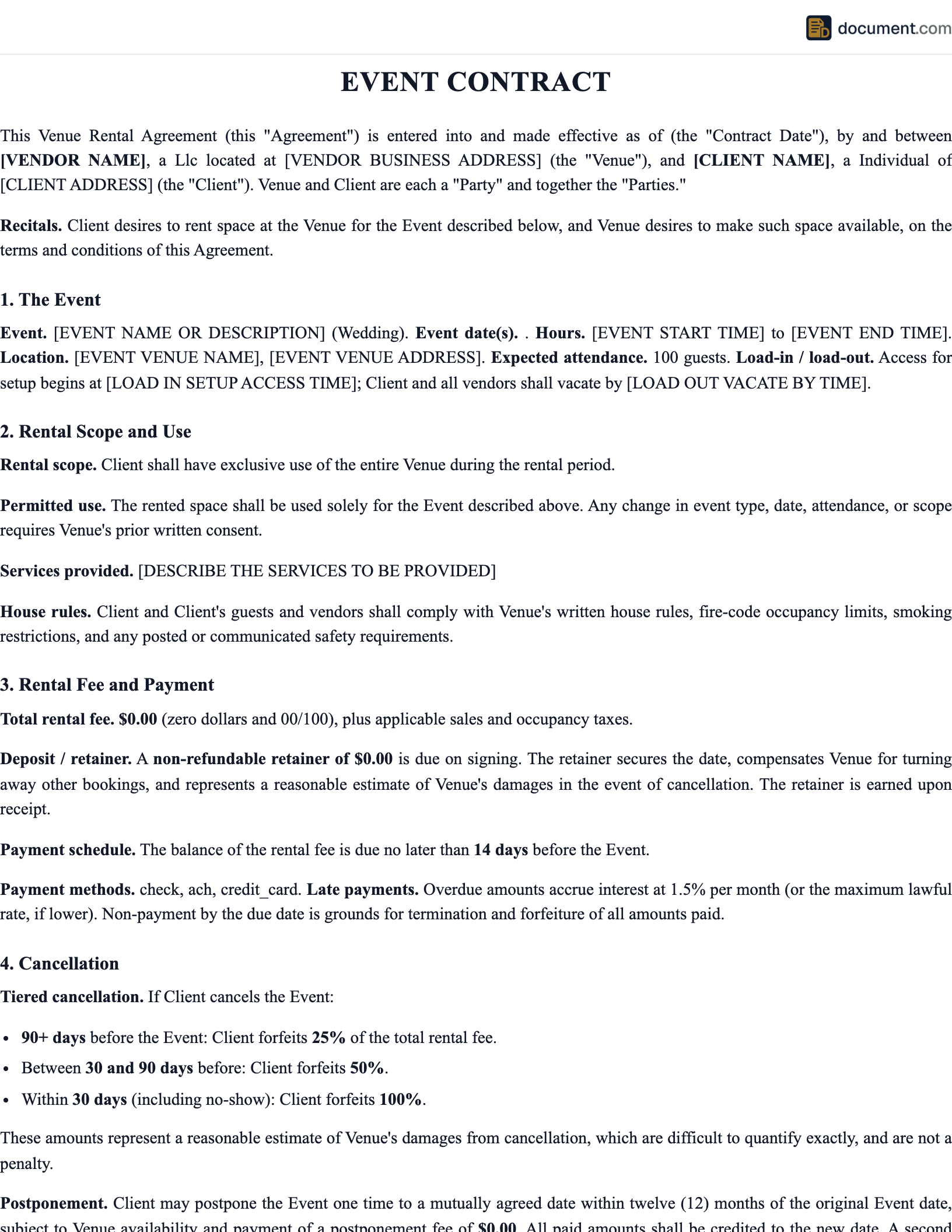



What Is an Event Contract?
An event contract is a written agreement that governs the planning, production, or hosting of an event. It can be between a client and an event planner, between a client and a venue, between an organizer and a vendor (caterer, photographer, DJ, florist), or between any combination of parties involved in making an event happen. The contract defines what services will be provided, when and where the event will take place, how much it will cost, what happens if the event is canceled or postponed, who is responsible for insurance, and how disputes will be resolved. It is the single document that separates a professional event from a series of informal promises that nobody can enforce when things go wrong.
Events are high-stakes transactions for everyone involved. The client is often spending thousands of dollars on an experience that happens once and cannot be re-done if it fails. The planner or vendor is committing time, staff, and resources to a specific date and turning away other business. The venue is opening its property to a group of people and assuming premises liability for their safety. Because the stakes are high and the opportunity cost of a failed event is enormous, event contracts tend to be more detailed about cancellation, force majeure, insurance, and liability than most other service contracts.
The COVID-19 pandemic fundamentally changed how event contracts are written. Before 2020, force majeure clauses were boilerplate language that most parties skimmed past. After the pandemic forced the cancellation or postponement of millions of events worldwide, those clauses became the most negotiated provision in the contract. Today, sophisticated event contracts include pandemic-specific language, government shutdown triggers, tiered postponement options (move to a new date within 12 months, move to a new date beyond 12 months, or cancel outright), and clear rules about what happens to deposits and vendor payments when a force majeure event occurs.
Event contracts also intersect with several areas of law beyond basic contract principles. Liquor liability laws apply when alcohol is served and can impose liability on the event organizer, the venue, and the bartending service. Fire codes and occupancy limits affect how many guests can attend. Noise ordinances restrict amplified music and entertainment. Health department regulations govern food preparation and service. Permitting requirements vary by municipality for outdoor events, tent installations, fireworks, and temporary structures. A comprehensive event contract addresses these regulatory requirements and assigns responsibility for compliance to the appropriate party.
Our attorney-reviewed event contract template covers the complete scope of an event engagement: event description and logistics, services and deliverables, venue arrangements, vendor coordination, payment schedule and deposits, cancellation and postponement terms, force majeure, insurance requirements, liability and indemnification, and dispute resolution. It works for wedding planners, corporate event producers, venue operators, catering companies, and anyone who organizes events professionally.
Lock in Your Date
Secure the venue and vendors with a signed contract and non-refundable deposit
Cancellation Protection
Tiered cancellation fees and force majeure provisions for every scenario
Liability Coverage
Insurance requirements and indemnification to protect everyone involved
Event Contract Form Preview
Below is a visual preview of the sections and fields included in a standard event contract. Your completed document will be customized for your event type, venue, and vendor arrangements.
Event Services Agreement
Professional Event Planning Contract
Section 1: Parties & Event Details
Section 2: Services
Full-service planning and day-of coordination
Vendor selection and management
Floor plan design and logistics
Timeline creation and rehearsal coordination
Section 3: Fees & Payment Schedule
Section 4: Cancellation & Force Majeure
Section 5: Signatures
Event Planner Signature
Client Signature
How to Create an Event Contract
A professional event contract is built in seven steps. Working through them in order ensures nothing falls through the cracks and both parties have clear expectations before any deposits change hands.
Define the event details
Specify the event type, date, time, location, expected guest count, and any theme or style requirements. These details anchor the entire contract and determine the scope of planning, the size of the vendor team, and the overall budget.
Outline the services and deliverables
List exactly what the planner, venue, or vendor will provide. For a planner, this might include vendor sourcing, floor plan design, timeline management, and day-of coordination. For a venue, it might include the space, tables, chairs, linens, and staff. Be specific about what is included and what costs extra.
Set the payment schedule
Structure payments in stages: a non-refundable deposit to secure the date, a progress payment as the event approaches, and a final balance before the event day. Specify the amount and due date for each installment, the late fee for missed payments, and the consequences of non-payment.
Draft the cancellation and postponement terms
Create a tiered cancellation fee structure that increases as the event date gets closer. Address postponement separately from outright cancellation. Define how deposits and vendor costs are handled in each scenario.
Add force majeure provisions
List the specific events that excuse performance (pandemic, natural disaster, government order, venue closure, power failure) and describe the process for invoking force majeure, including notice requirements, postponement options, and refund rules.
Address insurance and liability
Require each party to carry appropriate insurance (general liability, liquor liability if applicable). Include mutual indemnification clauses and specify who is responsible for damage to the venue, injuries to guests, and losses caused by vendor non-performance.
Sign the contract and collect the deposit
Get both signatures before any planning work begins or any vendor commitments are made. Electronic signatures are legally binding in every state under the ESIGN Act. Do not begin work until the signed contract and the initial deposit are both in hand.
Key Components
A complete event contract contains the following building blocks regardless of whether the event is a backyard birthday party or a corporate conference for 2,000 attendees.
Event details and logistics
Date, time, location, guest count, setup and teardown schedule
Services and deliverables
Specific services included, vendor responsibilities, and scope limitations
Payment schedule and deposits
Deposit amount, installment dates, final balance, late fees, and refund policy
Cancellation and postponement
Tiered cancellation fees, postponement procedures, and forfeiture rules
Force majeure
Specific triggering events, notice requirements, and financial remedies
Insurance requirements
General liability, liquor liability, and additional insured obligations
Liability and indemnification
Mutual indemnities, damage responsibility, and liability caps
Vendor coordination
Vendor selection authority, contracts, and non-performance responsibility
Entertainment and noise
Sound levels, amplification limits, curfew times, and neighbor considerations
Confidentiality and privacy
Guest lists, event details, photos, and social media permissions
Types of Event Contracts
Event contracts take different shapes depending on who is involved and what kind of event is being planned. Choosing the right contract type ensures the scope, payment structure, and liability provisions match the specific engagement.
Event Planning Agreement
A contract between a client and an event planner for full-service or partial planning. Covers design, vendor management, timeline coordination, and day-of execution. Best for weddings, galas, fundraisers, and milestone celebrations where the client wants a dedicated professional managing the entire production.
Venue Rental Agreement
A contract between an event host and a venue for the use of a specific space on a specific date. Covers rental period, capacity, noise restrictions, damage deposits, insurance requirements, setup and teardown rules, and the venue's right to approve vendors. Required by nearly every professional venue.
Catering Agreement
A contract between an event host and a catering company for food and beverage service. Covers the menu, per-person pricing, dietary accommodations, staff count, bar service, equipment, setup and cleanup, health department compliance, and the caterer's liability for food safety issues.
Entertainment and Vendor Contract
A contract between an event host and a specific vendor such as a photographer, videographer, DJ, band, florist, or decorator. Covers the vendor's scope of services, hours, equipment, setup requirements, deliverable timeline (for photo/video), cancellation terms, and backup plan if the vendor cannot perform.
Legal Requirements
Event contracts are governed by general contract law, premises liability, liquor liability statutes, health and safety codes, and local permitting requirements. The requirements below apply to most events, with additional obligations depending on the event type and location.
- General liability insurance typically required by venues, with the venue named as additional insured
- Liquor liability insurance required when alcohol is served, whether by a licensed bartender or through a catering service
- Local permits may be required for outdoor events, tent installations, amplified music, fireworks, and temporary food service
- Fire code and occupancy limits apply to all indoor venues and must be observed regardless of the contract terms
- Health department regulations govern food preparation, service temperatures, allergen disclosures, and kitchen inspections
- Noise ordinances restrict amplified sound levels and event end times, particularly in residential areas
- Sales tax may apply to event planning fees, catering, and venue rental depending on the state
- Dram shop liability statutes may hold the event organizer liable for injuries caused by intoxicated guests
Sample Event Contract
Below is a condensed preview of our standard event contract template. Your final document will be customized for your event type, venue, vendors, and state requirements.
EVENT SERVICES AGREEMENT
Professional Event Contract
This Event Services Agreement ("Agreement") is entered into as of[Date]between [Planner/Vendor]("Provider") and [Client]("Client").
1. EVENT DETAILS
Provider shall plan, coordinate, and manage the event described as follows: Type: [Event Type], Date: [Date], Venue: [Venue], Guest Count: [Number].
2. FEES AND PAYMENT
The total fee for services is $[Amount]. A non-refundable deposit of [%]% is due at signing. The balance is due [days]days before the event. Late payments accrue interest at 1.5% per month.
3. CANCELLATION
Client may cancel on written notice subject to the following fees: more than 90 days before the event, deposit forfeited; 60-90 days, 50% of total fee; 30-60 days, 75%; less than 30 days, 100%. Client is also responsible for any non-recoverable vendor costs incurred by Provider.
4. FORCE MAJEURE
Neither party shall be liable for failure to perform due to pandemic, natural disaster, government order, or other event beyond reasonable control. If force majeure prevents the event, Client may reschedule within 12 months or receive a refund of amounts paid less non-recoverable vendor costs and a [%]% administrative fee.
5. INSURANCE AND LIABILITY
Provider shall maintain general liability insurance with a minimum limit of $[Amount]per occurrence. Each party indemnifies the other against claims arising from that party's negligence.
Frequently Asked Questions
Answers to common questions about event contracts, deposits, cancellation policies, force majeure, insurance requirements, and vendor management.
Official Resources
For additional information on event regulations, insurance requirements, and industry standards, consult these official resources.
SBA - Licenses and Permits
Federal guidance on business licensing and permit requirements for event services
National Fire Protection Association
Fire safety codes and standards for event venues and temporary structures
FDA Food Safety Standards
Federal food safety regulations relevant to catering and event food service
III - Event Liability Insurance
Insurance Information Institute guidance on event liability coverage
NACE - Catering and Events
National Association for Catering and Events industry standards and education
ILEA - Live Events
International Live Events Association resources for event professionals
Create your Event Contract in under 10 minutes.
Answer a few questions and download a compliant, attorney-drafted document ready for your state.