
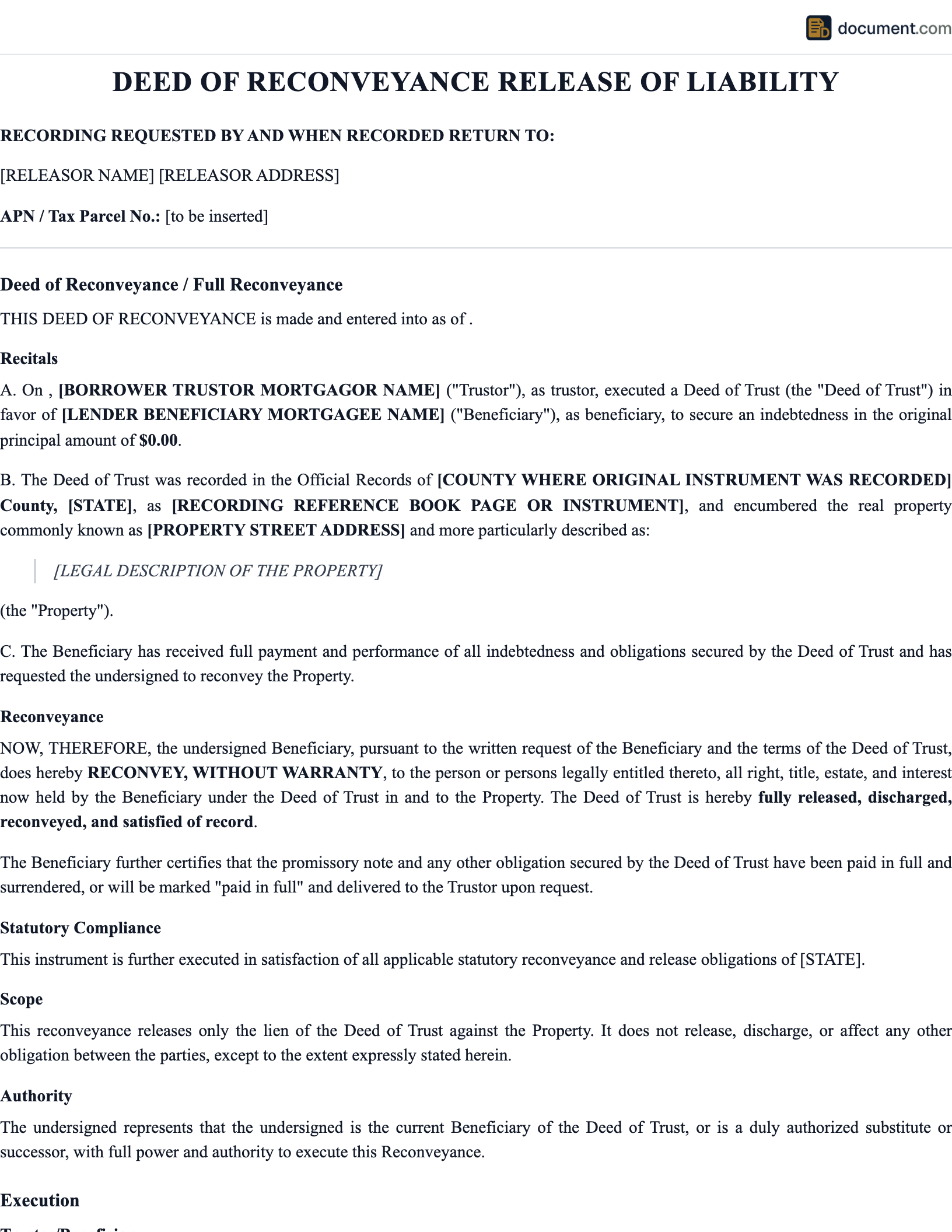



What Is a Deed of Reconveyance?
A deed of reconveyance is a legal document that releases a deed of trust from the public real estate records after the underlying loan has been paid in full. In states that follow the deed-of-trust model — California, Texas, Arizona, Colorado, Nevada, Washington, Oregon, and many others — a real estate loan involves three parties: the borrower (called the trustor), the lender (called the beneficiary), and a neutral third party (called the trustee) who holds legal title to the property as security for the debt. When the borrower pays off the loan, the trustee executes and records a deed of reconveyance, which transfers legal title back from the trustee to the borrower and removes the lender's security interest from the public record.
Without a recorded reconveyance, the original deed of trust remains as an encumbrance on the property's title — sometimes called a "cloud" on title — even though the underlying loan has been paid. This creates significant problems when the owner tries to sell, refinance, or transfer the property: title companies will refuse to insure the new transaction, lenders will refuse to issue new loans, and buyers will refuse to close. The reconveyance is therefore not just a procedural formality; it is the document that actually frees the property from the lender's lien in the eyes of the public records system.
Most states impose specific timelines on lenders and trustees for processing reconveyances after a loan payoff, with statutory penalties for delay. California Civil Code §2941, for example, requires the beneficiary (lender) to deliver a request for reconveyance to the trustee within 30 days of payoff and requires the trustee to record the reconveyance within 21 days after receiving the request, with a $500 penalty plus actual damages for noncompliance. Other states have similar provisions.
Clear Title
Removes the lender's security interest from public records
Recorder-Ready
Formatted for county recorder filing requirements
State Compliant
Meets statutory deadlines and content requirements
Form Preview
Full Reconveyance
Recording Requested By / Return To
Original Deed of Trust
Trustor (Borrower)
Beneficiary (Lender)
Trustee
Property Description
Trustee Certification
Key Components
Recording Header
Block at the top showing who requested recording and where the recorded document should be returned.
Reference to Original Deed of Trust
Recording date, instrument number, book and page (if applicable), and county where the original deed of trust was recorded.
Trustor, Beneficiary, and Trustee
Names matching the original deed of trust exactly.
Legal Property Description
The full legal description (not just the street address) as recorded in the original deed of trust.
Reconveyance Language
Operative language stating that the trustee reconveys all right, title, and interest acquired under the deed of trust.
Trustee Signature
Signed by an authorized officer of the trustee.
Notary Acknowledgment
Notarial acknowledgment confirming the trustee's identity and authority.
Recording Information Block
Margins, font, and indexing information meeting county recorder requirements.
The Trustee's Role
In a deed-of-trust transaction, the trustee is a neutral third party — usually a title insurance company, a trust company, or an attorney — who holds bare legal title to the property as security for the loan. The trustee has no economic interest in the property or the loan; the trustee's role is purely procedural. Two events trigger the trustee's active involvement: a default by the borrower (which can lead to a non-judicial foreclosure under the power of sale clause), or a payoff of the loan (which triggers the obligation to execute and record a reconveyance).
When a loan is paid off, the lender (beneficiary) sends the trustee a request for full reconveyance, the original promissory note marked paid, and the trustee's reconveyance fee. The trustee then prepares the reconveyance, signs it before a notary, records it with the county recorder, and returns the recorded document to the borrower or to the address specified in the recording header.
How to Obtain a Deed of Reconveyance
- 1
Confirm that your loan is fully paid off by requesting a final payoff statement from your lender.
- 2
Pay any remaining balance and the lender's reconveyance fee (typically $50-$150).
- 3
Confirm that the lender has sent the request for full reconveyance to the trustee, along with the original promissory note marked paid.
- 4
Wait the statutory processing time (in California, up to 21 days after the trustee receives the request).
- 5
Receive the recorded deed of reconveyance from the trustee or county recorder.
- 6
Verify the recording information (recording date, instrument number, county) and store the document with your important real estate records.
- 7
If you do not receive the reconveyance within the statutory deadline, send a written demand to the lender's payoff department citing the applicable state statute.
- 8
If problems persist, contact the title insurance company that handled your original transaction, or consult a real estate attorney about a quiet title action.
Recording the Deed
The deed of reconveyance must be recorded in the county where the property is located, with the county recorder, register of deeds, or land records office. Recording fees range from $15 to $75, depending on the county and the number of pages. Most counties accept e-recording through services such as Simplifile, CSC, or ePN, which significantly speeds up processing. The recorder will assign an instrument number, indexing date, and (in some counties) book and page reference, and will return the recorded document to the address shown in the recording header.
Reconveyance vs. Satisfaction of Mortgage
| Feature | Deed of Reconveyance | Satisfaction of Mortgage |
|---|---|---|
| Used in | Deed-of-trust states (CA, TX, AZ, etc.) | Mortgage states (NY, NJ, FL, OH, etc.) |
| Signed by | Trustee | Lender (mortgagee) |
| Underlying instrument | Deed of trust | Mortgage |
| Purpose | Release lender's security interest | Release lender's security interest |
| Recording required | Yes | Yes |
Sample Deed of Reconveyance
RECORDING REQUESTED BY AND WHEN RECORDED RETURN TO:
First American Title Insurance Company
1 First American Way
Santa Ana, CA 92707
FULL RECONVEYANCE
First American Title Insurance Company, as Trustee under the Deed of Trust executed by Margaret A. Richardson, Trustor, in favor of Pacific Coast Bank, N.A., Beneficiary, dated June 8, 2015, and recorded on June 12, 2015, as Instrument No. 2015-0498127 in the Official Records of Los Angeles County, California, having received from the Beneficiary a written request for reconveyance and the original promissory note secured by said Deed of Trust marked paid, does hereby RECONVEY, without warranty, to the person or persons legally entitled thereto, all right, title, and interest now held by said Trustee under said Deed of Trust.
The property reconveyed is described as: Lot 14, Block 6, Sunset Hills Tract, City of Pasadena, County of Los Angeles, State of California, as per map recorded in Book 47, Page 22 of Maps, in the office of the County Recorder of said County.
Dated: April 7, 2026
FIRST AMERICAN TITLE INSURANCE COMPANY, Trustee
By: _________________________
Authorized Officer
[Notary Acknowledgment]
Frequently Asked Questions
Official Resources
Create Your Deed of Reconveyance
Recorder-ready format for all deed-of-trust states.
Create Document