
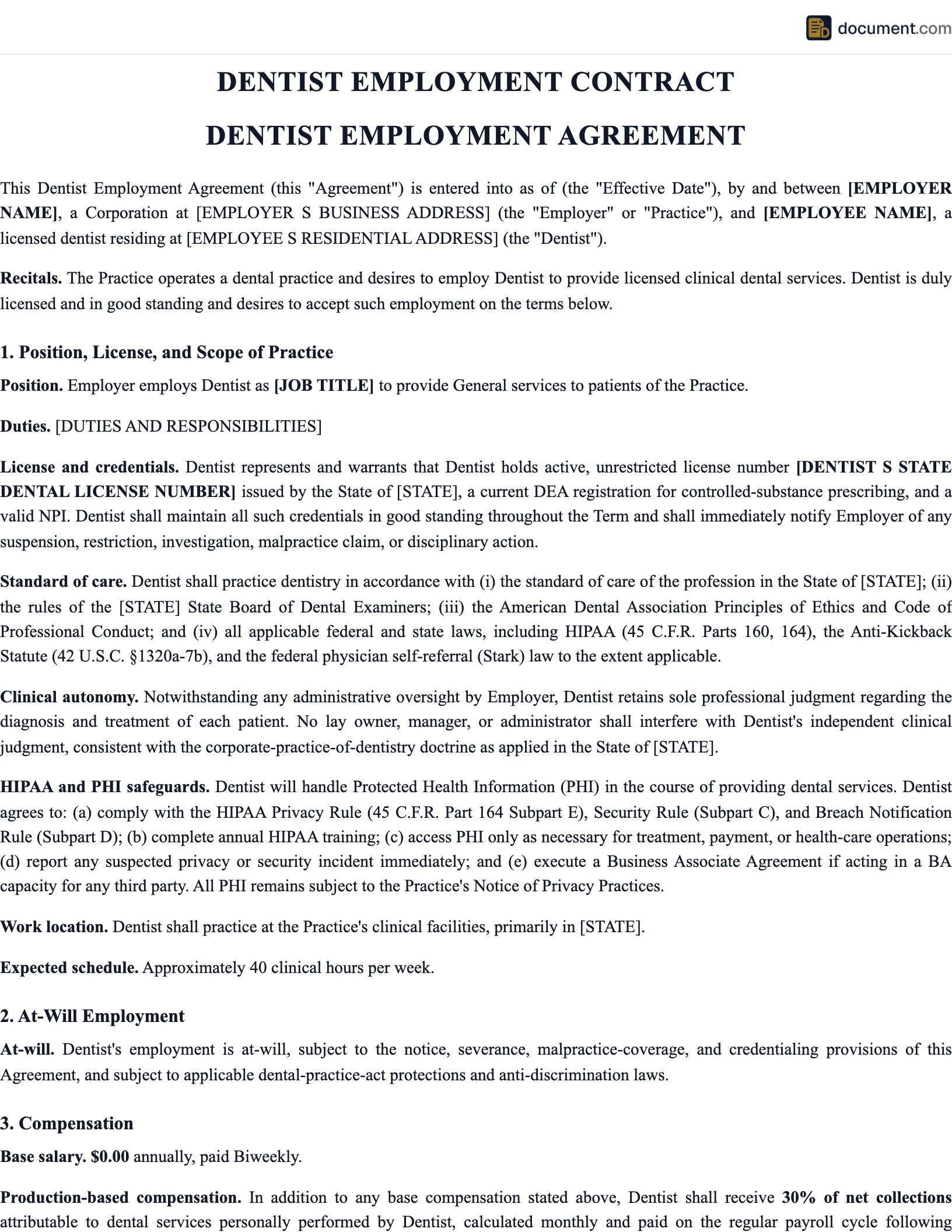



What Is a Dentist Employment Contract?
A dentist employment contract is a specialized professional services agreement that governs the relationship between a dental practice and an associate dentist. Unlike a general employment contract, it must address the clinical, regulatory, and economic realities of running a dental practice: production and collections compensation, ownership of patient records, corporate practice of dentistry (CPOD) compliance, malpractice insurance and tail coverage, HIPAA obligations, DEA registration, state licensure conditions, and restrictive covenants that are heavily scrutinized under state law.
The dental market in the United States has consolidated rapidly over the past decade. Roughly a quarter of all U.S. dental practices are now affiliated with a Dental Support Organization (DSO), and corporate-backed models continue to grow. That shift has made dental employment contracts both more sophisticated and more standardized. At the same time, independent practices continue to rely on associate contracts as the primary recruiting and retention tool — and as the foundation for buy-in and partnership pathways that lead to eventual practice ownership.
A well-drafted dentist employment contract protects both sides. For the practice owner, it secures patient relationships, defines clinical expectations, and ensures that an associate cannot open a competing practice across the street. For the associate dentist, it establishes predictable compensation, access to malpractice coverage, clarity on schedule and patient assignment, and a pathway to ownership or a clean exit. Ambiguity in any of these areas tends to produce disputes that end in litigation, license complaints, or damaged patient relationships.
Our attorney-reviewed templates cover the full spectrum of dental employment arrangements — from a straightforward associate role in an independent practice to a multi-location DSO employment agreement with corporate benefits and standardized non-competes. Each template is structured to comply with the state's corporate practice of dentistry doctrine, state dental practice act, and state-specific restrictive covenant rules.
Production & Collections
Defined formulas with guaranteed floors and bonus thresholds
Malpractice Coverage
Clear allocation of premium, deductible, and tail responsibility
Buy-In Pathway
Optional equity acquisition terms with defined valuation methodology
Form Preview
Our dentist employment contract templates are delivered as fillable PDF and Microsoft Word files. They include all of the clinical, financial, and regulatory clauses needed for an enforceable dental employment relationship.
Included Sections
- Parties, recitals, and effective date
- Clinical services and supervising relationships
- Compensation: production, collections, or base
- Schedule, PTO, and holiday coverage
- Malpractice and tail coverage
Also Included
- Non-compete and non-solicit clauses
- Buy-in and partnership option
- Patient records and HIPAA
- Termination for cause and without cause
- Accounts receivable wind-down
Dental Employment Models
The right contract depends on the employment model. Each of the structures below uses meaningfully different clauses for compensation, ownership, restrictive covenants, and termination.
Associate Dentist Employment
Standard W-2 associate role under an owner-dentist or group practice
DSO / Corporate Dental Agreement
Employment with a dental support organization or corporate practice model
Buy-In / Partnership Track
Associate agreement with a defined pathway to equity ownership and partnership
Independent Contractor Dentist
1099 engagement where the dentist controls clinical schedule and methods
Locum Tenens Dentist
Short-term coverage engagement for leave, vacation, or temporary staffing
Specialist Employment
Endodontist, orthodontist, periodontist, oral surgeon, or pediatric dentist roles
Compensation Structures
Dentist compensation is where most contract disputes originate. The three dominant structures are collections-based, production-based, and base-plus-bonus, and each creates different incentives and different risks.
Collections-Based (25-35%)
The associate is paid a percentage of cash actually received by the practice on procedures the associate performed. Aligns incentives with practice cash flow but exposes the associate to collection-cycle risk, insurance write-offs, and bad debt. The contract should define whether adjustments, refunds, and lab fees are deducted before or after the percentage is applied.
Production-Based (22-32%)
The associate is paid a percentage of the gross value of procedures performed, without regard to whether the practice collects. Rewards clinical throughput but creates tension when the practice writes off insurance contractual adjustments, provides complimentary services, or absorbs uncollected accounts. Typically lower percentage than collections to reflect risk.
Daily Guarantee with Floor
The associate receives the greater of a daily minimum (commonly $500-$800 per day) or a defined production/collections percentage. Protects new associates who are still building production and provides predictability during ramp-up. Most contracts phase out the guarantee after 12-24 months.
Base Salary Plus Bonus
A fixed annual salary supplemented by a bonus tied to production or collections above a threshold. Most common in DSO and FQHC settings. Provides stability but can underpay high producers and overpay underperformers.
DSO and Corporate Models
A Dental Support Organization (DSO) is a non-clinical company that provides business services — billing, HR, marketing, supplies, real estate, compliance, and technology — to dental practices. Because most states prohibit the corporate practice of dentistry by non-dentist entities, a DSO typically operates through two linked entities: a Professional Corporation (PC) or Professional LLC that is clinically owned by a licensed dentist and holds the practice license, and a management services organization (MSO) that provides administrative support under a long-term management services agreement.
When a dentist signs a DSO employment agreement, the employer of record is typically the PC, not the MSO. The agreement is drafted to preserve the PC's independent clinical judgment, protect patient records under HIPAA and state dental practice acts, and keep the MSO's fees at arm's length. DSO contracts are more standardized than independent practice contracts because the DSO must apply consistent terms across dozens or hundreds of locations.
State variation: California, New York, Texas, and Illinois have particularly strict corporate practice of dentistry doctrines. Contracts that bypass these rules can result in license discipline for the supervising dentist and voidability of fee-splitting arrangements. Always confirm the DSO structure complies with the state practice act where the office is located.
Associate Buy-In and Partnership
A buy-in is one of the most valuable features of an independent practice employment contract. It gives the associate a defined pathway to equity ownership, typically over 2 to 5 years, and gives the owner-dentist a succession plan. Buy-in structures vary widely and should be spelled out in writing before the associate starts — not negotiated in year two once expectations have formed.
Common buy-in structures include: (1) a lump-sum purchase of a defined equity percentage at a formula price (e.g., 50% of collections, 4x EBITDA, or independent appraisal); (2) a tranche-based purchase over 3-5 years; (3) an 'earn-in' where a portion of the associate's compensation is credited toward the purchase price; or (4) a partnership LLC where the associate purchases membership units directly. The employment contract should address the buy-in trigger, valuation methodology, financing options, operating agreement terms after buy-in, and the consequences if the buy-in does not close.
Non-Compete and Non-Solicit
Restrictive covenants are the most heavily negotiated — and most heavily litigated — clauses in dentist employment contracts. A non-compete restricts where and how the associate may practice dentistry after leaving; a non-solicit restricts the associate from contacting patients, staff, and referral sources.
Enforceability varies dramatically by state. California, North Dakota, Oklahoma, and Minnesota prohibit employee non-competes entirely. Most other states enforce them if reasonable in duration (typically 1-3 years), geographic scope (typically 5-15 mile radius from the practice), and scope of restricted activity. Courts treat dentistry as a professional service where patient continuity of care is a public-interest factor, so dental non-competes face closer scrutiny than non-competes in other industries.
Non-solicitation clauses generally survive even in jurisdictions that reject non-competes, because they protect legitimate business interests without preventing the associate from practicing at all. A well-drafted non-solicit typically covers active patients (last 12-24 months), referring specialists, and practice employees for a defined period after termination.
How to Create the Contract
- 1
Identify the employing entity
Confirm whether the employer is an independent PC, a DSO-affiliated PC, or a multi-location professional LLC, and that the structure complies with the state's CPOD rules.
- 2
Choose the compensation model
Decide between collections, production, daily guarantee, or base-plus-bonus. Define adjustments, lab fees, and bad-debt handling.
- 3
Set the schedule and patient assignment
Define the days and hours, the supervising dentist (if any), new-patient assignment rules, and hygiene check allocation.
- 4
Allocate malpractice and tail
State who pays the premium and who pays the tail endorsement on termination. Specify occurrence vs claims-made.
- 5
Draft restrictive covenants
Tailor the non-compete duration and geographic radius to the state's case law. Include a standalone non-solicit clause.
- 6
Include buy-in terms if applicable
Spell out the trigger, valuation, and financing for associates on a partnership track.
- 7
Add termination provisions
Cover without-cause notice, for-cause grounds, death/disability, and loss of license.
- 8
Sign and onboard
Execute the contract, complete HR paperwork, credential with payors, and add to malpractice policy.
Key Components
Parties and recitals
Legal name of the employing PC/LLC and the associate dentist, with recitals describing the clinical purpose.
Clinical services
Scope of dentistry permitted under state license, supervising relationships, and treatment standards.
Compensation
Formula, floor, bonus thresholds, pay frequency, and adjustment rules.
Benefits
Health insurance, retirement plan, PTO, holidays, and CE reimbursement.
Malpractice
Coverage limits, deductibles, and tail responsibility on termination.
Restrictive covenants
Non-compete, non-solicit, and confidentiality obligations.
Patient records
Ownership, HIPAA compliance, and post-termination access.
Buy-in option
Trigger, valuation, and partnership terms where applicable.
Termination
With-cause, without-cause, death, disability, and license loss.
Accounts receivable
Wind-down period for collections-based compensation after termination.
Malpractice and Tail Coverage
Professional liability insurance is non-negotiable for any practicing dentist. The employment contract should specify: (1) the policy type — claims-made or occurrence; (2) the coverage limits, typically $1 million per claim and $3 million aggregate; (3) who pays the premium; and (4) who pays the tail endorsement on termination.
The tail question is the most commonly overlooked. A claims-made policy covers only claims made during the active policy period. When the associate leaves, any claim brought after the policy terminates is uncovered unless a tail endorsement (also called an extended reporting endorsement) is purchased. Tail premiums typically run 150-300% of the final annual premium — sometimes $15,000 to $30,000 or more. Contracts should clearly state whether the practice pays the tail if the practice terminates without cause, whether the associate pays if they leave voluntarily, and how the obligation is split in other scenarios.
Sample Dentist Employment Contract
ASSOCIATE DENTIST EMPLOYMENT AGREEMENT
This Associate Dentist Employment Agreement ("Agreement") is made as of [EFFECTIVE DATE] between [PRACTICE NAME], P.C., a [STATE] professional corporation ("Practice"), and [DENTIST NAME], D.D.S./D.M.D., an individual licensed to practice dentistry in the State of [STATE] ("Associate").
1. Engagement.Practice hereby engages Associate to provide clinical dental services on behalf of Practice at the office(s) located at [ADDRESS]. Associate shall practice only within the scope of Associate's license and professional competence.
2. Term. The initial term is two (2) years beginning [START DATE], with automatic one-year renewals unless terminated in accordance with Section 9.
3. Compensation. Practice shall pay Associate the greater of (a) $[DAILY GUARANTEE] per full day worked, or (b) [PERCENTAGE]% of net collections on procedures personally performed by Associate, less laboratory fees and insurance adjustments. Compensation is paid on a bi-weekly basis.
4. Benefits. Associate is eligible for health insurance, 401(k) participation after 90 days, [NUMBER] days of paid time off per year, and up to $[AMOUNT] in annual CE reimbursement plus [NUMBER] paid CE days.
5. Malpractice Insurance. Practice shall maintain professional liability insurance covering Associate with limits of not less than $1,000,000 per claim and $3,000,000 aggregate. [Tail coverage allocation as negotiated.]
6. Confidentiality and Patient Records. All patient records and confidential business information are and shall remain the sole property of Practice. Associate shall comply with HIPAA and the state dental practice act at all times.
7. Non-Compete. For a period of [NUMBER] months after termination, Associate shall not practice general dentistry within a [NUMBER]-mile radius of any Practice office, to the extent such restriction is enforceable under applicable state law.
8. Non-Solicitation. For [NUMBER] months after termination, Associate shall not solicit any patient, employee, or referral source of Practice.
9. Termination.Either party may terminate without cause on ninety (90) days' written notice. Practice may terminate immediately for cause, including loss of license, DEA action, Medicare exclusion, or material breach.
_______________________________
Practice, by authorized officer / date
_______________________________
Associate Dentist / date
Frequently Asked Questions
Official Resources
Ready to draft your dentist employment contract?
Generate an attorney-reviewed contract for associate, DSO, or buy-in engagements.
Create Document