



What Is a Fixed-Term Employment Contract?
A fixed-term employment contract is a written agreement between an employer and an employee that specifies a defined duration for the employment relationship. Unlike the at-will employment arrangement that governs most U.S. jobs — under which either party can terminate the relationship at any time for any lawful reason — a fixed-term contract sets a specific end date or specific completion event that binds both parties. The employer agrees to employ and pay the worker through that date; the worker agrees to remain employed and perform the specified duties through that same date. Early termination by either side is permitted only on the grounds, and through the procedures, expressly set out in the contract.
Fixed-term employment is the dominant hiring model for certain classes of work. Higher education relies heavily on multi-year teaching, postdoctoral, and research appointments tied to academic calendars and external grant funding. Construction, film production, technology consulting, and professional services routinely use project-based fixed-term contracts tied to deliverables. Agriculture, retail, hospitality, and tourism use seasonal fixed-term contracts that recur year after year. Employers sponsoring H-1B, O-1, TN, or other work visas typically use fixed-term contracts aligned to the authorized period of stay. Interim positions covering parental leave, medical leave, or sabbaticals are also structured as fixed-term employment.
The core legal consequence of fixed-term employment is mutual commitment. At-will employment gives both parties flexibility at the cost of security; fixed-term employment provides security at the cost of flexibility. For the employee, a fixed-term contract guarantees a defined period of income and benefits, protects against termination without cause, and often provides a more generous compensation package than at-will alternatives. For the employer, a fixed-term contract secures the services of a specific worker for a specific period, which is valuable when the position requires specialized skills, project-specific knowledge, or team continuity. The trade-off is that both parties are exposed to breach damages if they terminate early without cause.
The drafting challenges of a fixed-term contract are different from those of an at-will agreement or an executive contract. The central issues are (1) defining the term with precision, including the start date, end date, and any project-completion triggers; (2) specifying the grounds for early termination and the resulting payment obligations; (3) addressing renewal and non-renewal, including any notice requirements and any automatic renewal clauses; (4) ensuring proper employment classification as W-2 rather than 1099 to avoid misclassification liability; (5) coordinating with immigration petitions for visa-sponsored roles; and (6) addressing benefit eligibility and ERISA coverage during the term and after expiration.
Whether you are a university HR director preparing a research appointment, a construction-company project manager onboarding a foreman for a 14-month build, a grant administrator drafting a contract tied to NIH funding, or an immigration attorney coordinating an H-1B sponsorship, our attorney-reviewed fixed-term employment contract templates give you a defensible starting point. Each template is customized for the specific use case with appropriate term, termination, and classification language.
Defined Duration
Clear start and end dates, project-completion triggers, and renewal mechanics
Mutual Protection
Employment security for the worker and workforce certainty for the employer
Classification Safe
Proper W-2 employment structure that avoids 1099 misclassification exposure
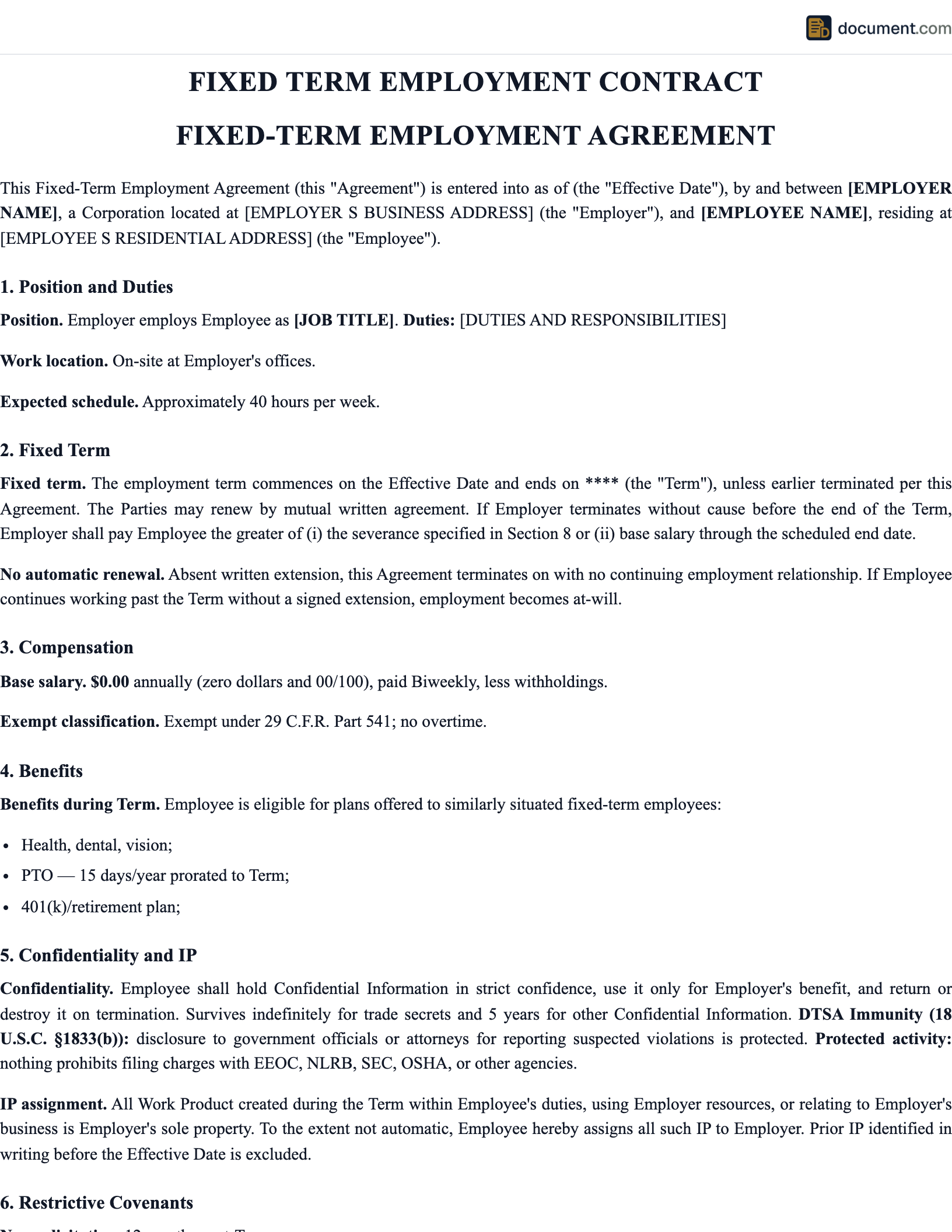
Fixed-Term Contract Form Preview
The preview below illustrates the sections of a standard fixed-term employment contract. Each field is configurable in our document builder.
Fixed-Term Employment Agreement
Project-Based Appointment
Section 1: Term
Section 2: Compensation
Section 3: Early Termination
Types of Fixed-Term Contracts
Fixed-term contracts take many forms depending on the industry and purpose. Choose the type that best matches your situation.
Project-Based Contract
Employment tied to the completion of a specific project or deliverable with defined scope
Academic / Research Appointment
Teaching, postdoctoral, or research appointments tied to grant funding or academic term
Seasonal Employment
Recurring seasonal positions in agriculture, retail, hospitality, and tourism
Interim / Replacement
Coverage for leave of absence, parental leave, medical leave, or sabbatical
Visa-Sponsored (H-1B / O-1)
Employment tied to an H-1B, O-1, TN, or other work-visa petition with specified end date
Grant-Funded Position
Position contingent on external grant funding from federal, state, or private sources
Fixed-Term vs. At-Will Employment
The choice between fixed-term and at-will employment is one of the most important early decisions in any hiring process. Each model distributes risk differently between employer and employee.
| Issue | Fixed-Term | At-Will |
|---|---|---|
| Duration | Defined end date or completion event | Indefinite |
| Termination | Only on contractual grounds | Any lawful reason, any time |
| Employer Exposure | Wages through end of term if breach | Generally limited to unused PTO |
| Employee Exposure | Breach damages, bonus clawback | Usually none |
| Best Fit | Projects, academia, visas, grants | Ongoing operational roles |
| Unemployment | Usually eligible at expiration | Eligible if no-fault separation |
Renewal & Non-Renewal
Renewal provisions deserve careful drafting. The contract should specify whether the term is eligible for renewal, the mechanism for renewal (mutual written agreement, employer option, automatic renewal unless notice is given), the notice period required for non-renewal (typically 30 to 90 days), and whether renewal creates a new contract or extends the existing contract. Automatic evergreen renewal is convenient but carries risk: continued employment past the end date without a new written agreement may default to at-will status or, in some jurisdictions, create an implied contract of continued employment.
Non-renewal is not termination. When a contract expires at the end of its term, the employment relationship simply ends by operation of the contract. No cause is required, and (unless the contract says otherwise) no severance is owed. However, repeated non-renewal of long-serving contract employees can create implied expectations of continued employment, and non-renewal decisions are subject to federal and state anti-discrimination laws. A non-renewal based on race, sex, age, religion, national origin, disability, pregnancy, or other protected characteristic can support a Title VII, ADEA, ADA, or FEHA claim just as a termination would.
Misclassification Risks
The most common legal risk in fixed-term contracts is misclassification — treating an employee as an independent contractor to avoid payroll taxes, benefits, and labor-law protections. The distinction matters because employees are W-2 workers subject to federal income tax withholding, FICA, FUTA, state unemployment tax, workers' compensation, ERISA coverage, FMLA, Title VII, the FLSA minimum wage and overtime rules, and state wage-hour laws. Independent contractors are 1099 workers subject to none of those obligations but also entitled to none of those protections.
Federal and state agencies apply different tests to evaluate classification. The IRS applies a 20-factor common-law test focused on behavioral control, financial control, and the nature of the relationship. The DOL applies an economic-realities test derived from FLSA case law, focused on whether the worker is economically dependent on the employer. Several states (California, Massachusetts, New Jersey, Illinois, and others) apply an ABC test that presumes employment unless the employer proves (A) absence of control, (B) work outside the usual course of business, and (C) an independently established trade. The ABC test is particularly difficult to satisfy and dramatically expands employee classification in covered states.
Classification Best Practice
If the worker is economically dependent on the employer, works under the employer's direction, uses the employer's tools and premises, or performs work that is part of the employer's usual business, classify as an employee and use a fixed-term W-2 contract rather than a 1099 independent-contractor arrangement. Misclassification can trigger back taxes, penalties, interest, and private rights of action.
How to Create a Fixed-Term Contract
Follow these eight steps to produce a solid, enforceable fixed-term employment contract.
Identify the use case
Academic, project-based, seasonal, interim, grant-funded, or visa-sponsored — each has specific drafting considerations.
Define the term precisely
Specify start date, end date, and any completion trigger. Tie to project milestones where applicable.
Draft compensation and benefits
Base salary, signing bonus, completion bonus, benefit eligibility, and end-of-term COBRA.
Specify early-termination grounds
Cause, death, disability, mutual agreement, and (optionally) no-cause buyout formula.
Address renewal and non-renewal
Renewal mechanism, notice period, and treatment of continued employment past end date.
Confirm W-2 classification
Document the facts supporting employee status to avoid misclassification exposure.
Add restrictive covenants if needed
Confidentiality, assignment of inventions, non-solicit, and (where enforceable) non-compete.
Execute and onboard
Both parties sign, HR files I-9 and tax forms, benefits enrollment begins, and project planning commences.
Key Components
Position and Duties
Title, reporting line, work location, and scope of responsibilities.
Term
Start date, end date, completion trigger, and probationary period.
Compensation
Base salary, signing bonus, completion bonus, and allowable deductions.
Benefits
Health, dental, vision, retirement, PTO, and ERISA plan participation.
Early Termination
Cause definition, notice requirements, and post-termination obligations.
Renewal
Notice period, mechanism, and treatment of continued work past end date.
Confidentiality
Protection of trade secrets and proprietary information.
Intellectual Property
Assignment of inventions, works made for hire, and moral rights waiver.
Return of Property
Laptops, badges, keys, and documents on separation.
Governing Law
Choice of law, venue, and dispute resolution.
Early Termination
Early termination of a fixed-term contract is the single biggest risk area for both parties. The contract should specify the exact grounds on which either party can end the relationship before the stated end date, the procedural steps required (notice, cure period, documentation), and the financial consequences. Common grounds include termination for cause (typically defined to include material breach of the contract, felony conviction, fraud or embezzlement, willful misconduct that materially harms the employer, repeated failure to perform duties after written notice, or violation of written company policies), termination on death or disability, and termination by mutual written agreement.
Some fixed-term contracts include a no-cause termination right for the employer in exchange for payment of a liquidated sum — often the remaining wages through the end of the term, or a defined buyout formula (for example, three months of base salary). This converts the contract into a hybrid of fixed-term and at-will, giving the employer flexibility while preserving the employee's downside protection.
Visa-Sponsored Employment
Fixed-term contracts are the standard structure for foreign national employees sponsored under H-1B, O-1, TN, E-3, and similar work visas. The contract term should align with the authorized period of stay in the visa petition — typically three years for H-1B (renewable for a second three-year period, with extensions beyond six years available under AC21 if a PERM application is pending), up to three years for O-1 (with one-year extensions), three years for TN (renewable indefinitely in one-year increments), and two years for E-3 (renewable indefinitely).
Special provisions are needed for visa-sponsored roles. The contract should address what happens if the visa petition is denied, revoked, or not extended; the employer's obligation to pay return transportation for terminated H-1B workers under 20 C.F.R. §655.731(c)(7); the employee's obligation to notify the employer of changes in immigration status; and the employer's ability to file an amended petition if duties or worksite change. Because H-1B wages are regulated by the Labor Condition Application, the contract must pay at least the prevailing wage determined by the DOL or the actual wage paid to similarly situated workers, whichever is higher.
Sample Fixed-Term Contract
FIXED-TERM EMPLOYMENT AGREEMENT
This Fixed-Term Employment Agreement (the "Agreement") is entered into as of [Effective Date] by and between [Employer Name] (the "Company") and [Employee Name] (the "Employee").
1. TERM
The Employee's employment under this Agreement shall commence on [Start Date] and shall terminate on the earlier of (a) [End Date] or (b) the completion of [Project/Event], unless earlier terminated in accordance with Section 5 of this Agreement.
2. POSITION AND DUTIES
The Employee shall serve as [Title], reporting to [Manager], and shall perform the duties customarily associated with that position and such additional duties as the Company may reasonably assign.
3. COMPENSATION
The Company shall pay the Employee a base salary at the annualized rate of $[Amount], payable in accordance with the Company's standard payroll practices, less applicable withholdings.
5. EARLY TERMINATION
This Agreement may be terminated before the end of the Term only for cause, on the death or permanent disability of the Employee, or by mutual written agreement of the parties. "Cause" means material breach of this Agreement, felony conviction, fraud or dishonesty, willful misconduct, or repeated failure to perform duties after written notice and a reasonable opportunity to cure.
6. NON-RENEWAL
This Agreement shall expire at the end of the Term without further notice. Any continuation of employment beyond the Term shall be at-will unless the parties execute a new written agreement.
Frequently Asked Questions
Official Resources
DOL - Fair Labor Standards Act
Federal wage and hour rules for all employees including fixed-term
DOL - Employment Relationship Fact Sheet
Classification test for employee versus independent contractor
IRS - Worker Classification
IRS 20-factor test for employee versus independent contractor
USCIS - Temporary Workers
H-1B, O-1, TN, and other work visa categories
DOL - H-1B Labor Condition Application
H-1B prevailing wage and LCA requirements
EEOC - Employer Resources
Anti-discrimination obligations in hiring, renewal, and non-renewal
NSF - Research Terms and Conditions
Federal grant-funded research employment guidelines
NIH - Grants and Funding
NIH grant-funded postdoctoral and research appointment guidance
Create your Fixed Term Employment Contract in under 10 minutes.
Answer a few questions and download a compliant, attorney-drafted document ready for your state.