



What Is a Commission Agreement?
A commission agreement is a written contract between a company and a salesperson — whether an employee or an independent sales representative — that defines exactly how the salesperson will be paid for the sales they generate. It is the single most important document in any sales compensation program because it controls everything from the rate of pay, to the timing of payment, to what happens to commissions when the relationship ends. A clear, well-drafted commission agreement prevents the kind of disputes that drive sales teams crazy and that fuel a steady stream of lawsuits in state courts under sales-rep protection statutes that often award double or triple damages and attorneys' fees to the rep.
At its heart, a commission agreement answers four practical questions. How much does the rep earn — flat percentage, tiered, or some combination of base salary and incentive? When is a commission earned — at booking, at invoicing, at collection, or some other milestone? How and when is the commission paid — monthly, biweekly, after a holdback period? And what happens at the end of the relationship — to deals in the pipeline, to residuals, to draws and clawbacks? Around those four pillars, a complete agreement layers in chargeback rules, modification rights, accounting obligations, dispute resolution, and the boilerplate every commercial contract needs.
Commission agreements come in two structurally different forms: those for employees and those for independent sales representatives. The employee version sits inside (or is referenced by) an employment agreement, includes withholding obligations, and is governed by federal and state wage-and-hour law including the Fair Labor Standards Act, the IRS supplemental wage rules, and state wage payment statutes. The independent sales rep version is a stand-alone commercial contract subject to state sales-rep protection laws, the IRS 1099 reporting rules, and the IRS and state worker-classification tests. The two forms look superficially similar but the legal exposures are different — and using the wrong template is one of the most common and expensive mistakes companies make in their sales compensation programs.
The legal stakes for getting commission agreements right are surprisingly high. Roughly 35 states have sales-rep protection statutes that require commission agreements to be in writing, set deadlines for paying commissions after termination (often 14-30 days), and impose penalties of double or triple damages plus attorneys' fees for unpaid commissions. California Labor Code Section 2751 requires employer commission agreements to be in writing, signed, and to spell out the method of computation. The U.S. Department of Labor and the IRS have stepped up enforcement against employers who misclassify sales reps as independent contractors to avoid payroll taxes and overtime. And the procuring-cause doctrine — the common-law rule that a rep is entitled to commission on sales they originated even if the deal closes after termination — applies in many states unless the agreement clearly says otherwise.
Whether you are hiring your first sales rep, restructuring an existing comp plan, papering an outside manufacturer's rep relationship, or fixing the legacy commission spreadsheet that has produced years of disputes, our attorney-reviewed templates give you a defensible starting point with the standard provisions courts expect — and the flexibility to customize the rate, the structure, the chargeback rules, and the post-termination provisions for your specific business.
Clear Pay Structure
Lock in rates, triggers, and timing so disputes never make it to court
State Law Compliance
Meet sales rep protection statutes and California Labor Code 2751 written-agreement rules
Termination Protection
Clearly define what happens to pipeline, residuals, and draws when the relationship ends
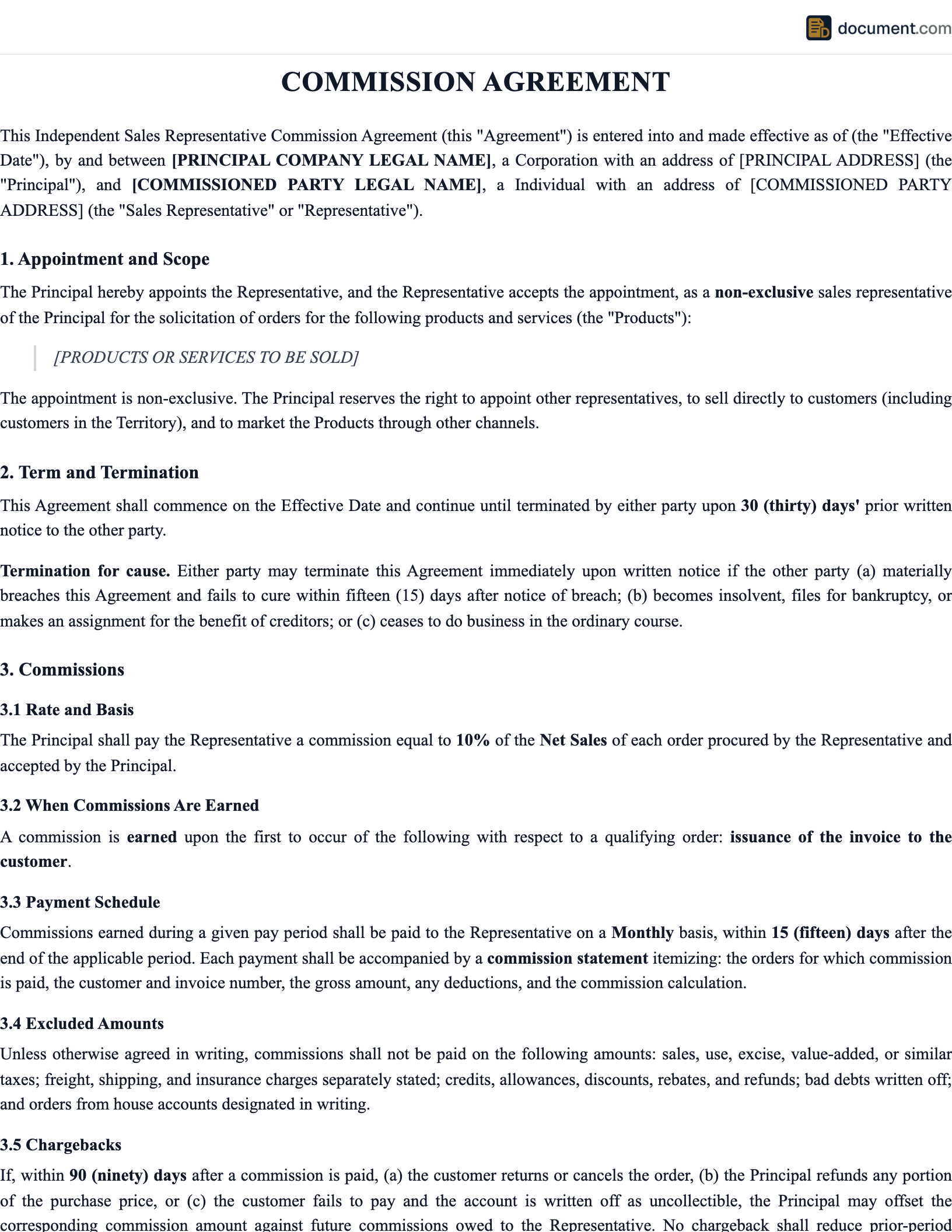
Commission Agreement Form Preview
Below is a visual preview of the sections and fields in a standard commission agreement. Your completed document will be customized for the structure and your jurisdiction.
Commission Agreement
Sales Compensation Plan
Section 1: Parties
Section 2: Commission Structure
Section 3: When Earned
Section 4: Chargebacks
Section 5: Payment Schedule
Section 6: Execution
Company Signature
Sales Rep Signature
Types of Commission Agreements
Commission agreements come in several common structures. Picking the right one depends on your sales cycle, the level of pipeline risk, and how much income predictability the rep needs.
Straight Commission Agreement
100% commission with no base salary, common for outside sales reps
Salary Plus Commission
Base salary supplemented by commission on closed sales
Tiered Commission Agreement
Commission rate increases as the rep crosses revenue thresholds
Draw Against Commission
Recoverable or non-recoverable advance against future commissions
Residual Commission Agreement
Recurring commission paid as long as the customer remains a client
Override Commission
Manager commission on the sales of reps under their supervision
Independent Sales Rep Agreement
Commission contract for outside reps representing manufacturers
Real Estate Commission Agreement
Commission split between brokerage, listing agent, and buyer's agent
Bonus Commission Agreement
Spiffs and bonuses tied to specific products or quarterly targets
Commission vs Other Pay Structures
Commission is one of several ways to pay sales people. Each structure has different legal, tax, and motivational consequences.
| Structure | Pay Driver | Income Stability | Best For |
|---|---|---|---|
| Straight Commission | 100% of pay tied to sales | Low | Outside reps, manufacturer reps |
| Salary + Commission | Mix of base and incentive | Medium | SaaS, B2B inside sales |
| Bonus Structure | Salary plus discretionary bonus | High | Account managers, CSMs |
| Tiered Commission | Rate increases at quota tiers | Low-medium | High-leverage hunters |
| Flat Salary | Fixed wage, no incentive | Highest | Customer support, ops |
| Profit Sharing | % of company profit | Medium | Partners and key employees |
How to Create a Commission Agreement
A defensible commission agreement is built in seven concrete steps. Working through them in order eliminates the gray areas that produce disputes.
Pick the structure
Decide whether you want straight commission, salary plus commission, tiered, residual, or some combination. Match the structure to your sales cycle and risk tolerance.
Define the commissionable event
State precisely when a commission is earned: at booking, at invoicing, at first customer payment, or at full collection. Vague language here is the most common source of disputes.
Set the rate and any tiers
Specify the percentage or flat amount, the basis (gross sales, net revenue, gross profit), and any tier thresholds. Worked examples in the agreement reduce arguments.
Spell out chargebacks and clawbacks
Define what triggers a chargeback (refund, cancellation, churn within X months), the lookback period, and how the chargeback is collected.
Address post-termination commissions
State what happens to pipeline deals at termination. Decide whether the procuring cause doctrine applies or whether commissions are forfeited if the rep is no longer with the company at payment.
Add modification and reservation language
Reserve the right to modify the plan prospectively with reasonable notice, but never retroactively. Get written acknowledgment of any changes.
Sign and provide a copy
California Labor Code 2751 and similar state laws require a signed copy be given to the rep. Keep the executed original in the personnel file and update it with each plan year.
Key Components
A complete commission agreement contains the following building blocks.
Parties and effective date
Full names of the company and the rep, plus the start of the plan period
Commission rate and structure
Percentages, tiers, thresholds, and basis for calculation
Quota and territory
Annual quota, account or territory assignment, and split rules
Commission earning event
Booking, billing, collection — when commission is earned and payable
Draws and advances
Recoverable or non-recoverable, draw amount, and recovery rules
Chargebacks and clawbacks
Triggers, lookback period, and collection mechanics
Modification rights
Company's right to modify the plan prospectively with notice
Termination provisions
Treatment of pipeline, residuals, and accrued commissions on termination
Confidentiality and non-solicit
Protection of customer lists, pricing, and the rep's customer relationships
Dispute resolution
Process for resolving commission disputes, often through mediation or arbitration
State Sales Representative Laws
Roughly 35 states have enacted sales-rep protection statutes that govern the commission relationship between manufacturers and independent sales reps. Almost all of them require commission terms to be in writing, set deadlines for paying commissions after termination, and impose statutory penalties for unpaid commissions.
Common features of state sales-rep statutes
- Commission agreement must be in writing and signed by both parties
- Commissions earned before termination must be paid within 14-30 days
- Penalties of double or triple damages for unpaid commissions
- Mandatory award of attorneys' fees and costs to a prevailing rep
- Choice-of-law provisions in the agreement may not be enforceable to evade the statute
- Coverage usually limited to outside (independent) sales reps, not employees
Legal Requirements
Commission agreements are governed by state contract law, federal and state wage statutes, sales-rep protection statutes, and tax law. The following requirements apply in most jurisdictions.
- Written agreement signed by both parties (required by California Labor Code 2751 and most state sales-rep statutes)
- Clear method of computing commissions including rates, tiers, and basis
- Specification of when commissions are earned and payable
- Compliance with the Fair Labor Standards Act for employee reps (overtime exemptions)
- Proper worker classification (employee vs independent contractor) under IRS and DOL tests
- Form W-2 reporting for employees and Form 1099-NEC for contractors over $600
- Compliance with state final-pay statutes on termination
- Compliance with state non-compete and non-solicitation enforceability rules
Sample Commission Agreement
Below is a condensed preview of our commission agreement template. Your final document will be customized for the structure, jurisdiction, and worker classification.
SALES COMMISSION AGREEMENT
Compensation Plan
This Sales Commission Agreement ("Agreement") is entered into as of[Date]between [Company]("Company") and [Sales Rep]("Sales Representative").
1. COMMISSION STRUCTURE
Sales Representative shall earn a commission of[%]of Net Revenue on each Qualifying Sale, subject to the tier structure described in Schedule A. "Net Revenue" means the customer's purchase price excluding taxes, shipping, discounts, refunds, and chargebacks.
2. WHEN COMMISSIONS ARE EARNED
Commissions are earned when (a) the customer signs a binding order; (b) Company receives the first payment; and (c) the customer remains in good standing through the end of the relevant chargeback period. Commissions on Qualifying Sales shall be paid on the 15th of the month following the month in which they are earned.
3. CHARGEBACKS
If a sale is canceled, refunded, charged back, or the customer churns within[months]months of the original sale, Company may reverse 100% of the commission and deduct the chargeback amount from future commission payments.
4. DRAW AGAINST COMMISSION
Company shall pay Sales Representative a non-recoverable draw of $[Amount]per pay period. The draw shall be applied against earned commissions; commissions earned in excess of the draw shall be paid in full.
5. POST-TERMINATION COMMISSIONS
On termination of this Agreement for any reason, Company shall pay Sales Representative all commissions earned through the date of termination. Commissions on deals booked before termination but paid after termination shall be paid within 30 days of receipt of payment from the customer.
6. MODIFICATION
Company reserves the right to modify the commission plan prospectively on 30 days' written notice. No modification shall reduce commissions on sales already earned at the time the modification takes effect.
7. NON-SOLICITATION
For a period of 12 months after termination, Sales Representative shall not solicit business from any customer that Sales Representative had contact with during the term of this Agreement.
8. CLASSIFICATION
Sales Representative is engaged as[employee/independent contractor]. For tax purposes, Company shall report compensation on Form[W-2/1099-NEC].
Frequently Asked Questions
Find answers to common questions about commission structures, draws, chargebacks, post-termination commissions, sales rep laws, and IRS treatment.
Official Resources
For additional information on sales compensation, worker classification, and state sales rep statutes, consult these official resources.
U.S. DOL - Fair Labor Standards Act
Federal wage-and-hour rules including outside-sales exemptions
IRS Form 1099-NEC
Reporting requirements for nonemployee compensation paid to sales reps
IRS Worker Classification
Tests for determining whether a sales rep is an employee or independent contractor
California DLSE - Commission Wages
California guidance on commission wages, including Labor Code 2751 written-agreement rules
MANA - Manufacturers' Agents National Association
Trade association for independent sales reps with state sales rep law summaries
SHRM - Society for Human Resource Management
HR best practices for sales compensation plan design and administration
Create your Commission Agreement in under 10 minutes.
Answer a few questions and download a compliant, attorney-drafted document ready for your state.