
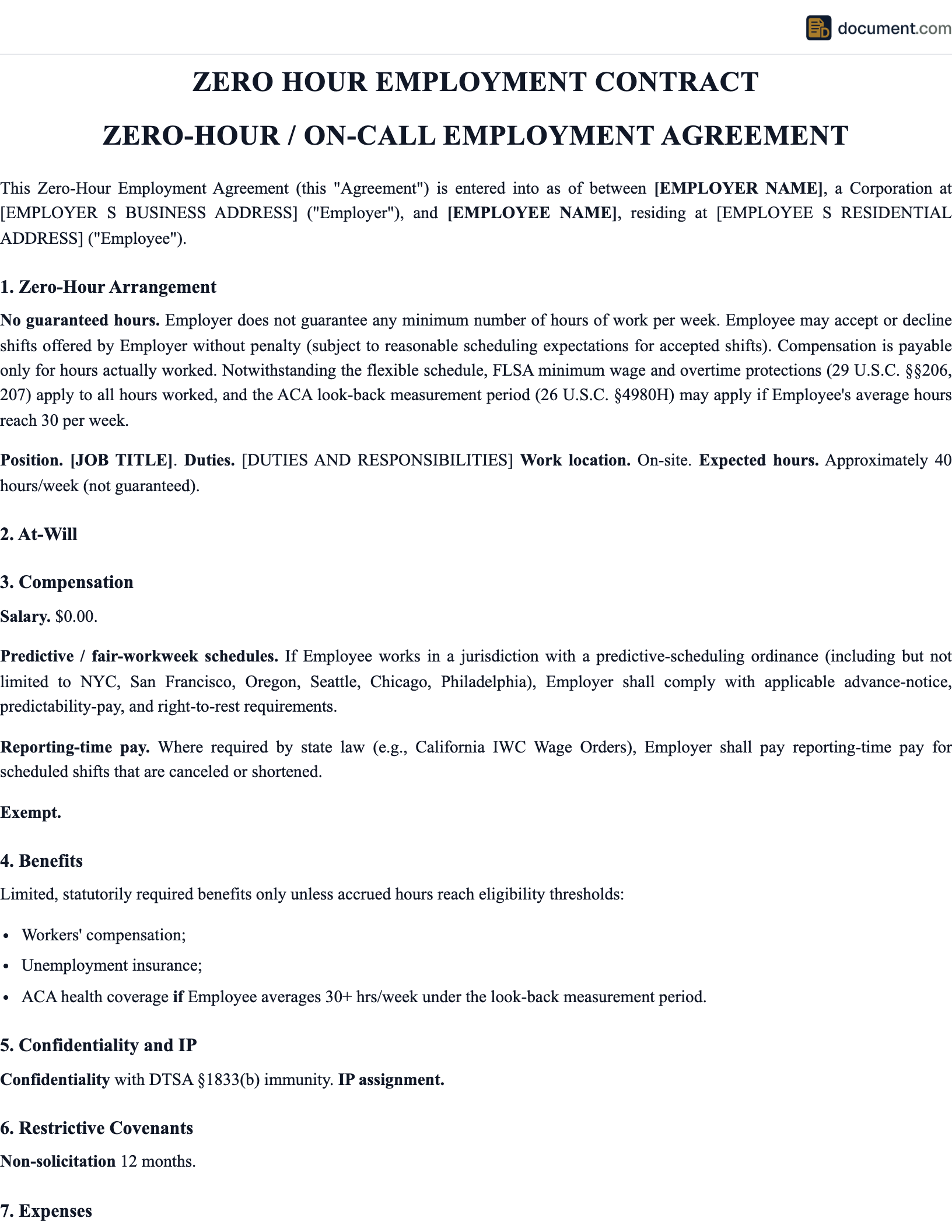



What Is a Zero-Hour Employment Contract?
A zero-hour employment contract is a written agreement under which the employer is not obligated to provide any specific number of work hours, and the worker is generally not obligated to accept the hours that are offered. The arrangement is referred to in the United States by several names — "on-call," "as-needed," "per diem," or in healthcare settings "PRN" (pro re nata, Latin for "as the situation demands"). Pay is provided only for hours actually worked, and the employee remains on the employer's active roster to be called when shifts become available.
Despite the lack of guaranteed hours, the worker is a W-2 employee — not an independent contractor — and is fully covered by the Fair Labor Standards Act, payroll tax withholding, workers' compensation, and unemployment insurance. The employer controls the work when the employee is on shift, withholds federal and state income tax, pays the employer share of Social Security and Medicare, and remits state unemployment insurance tax. Misclassifying a zero-hour employee as a 1099 contractor to avoid these obligations is a common and costly mistake — the IRS, the U.S. Department of Labor, and state agencies actively audit for misclassification.
Zero-hour arrangements are common in healthcare (per diem nurses, technicians, aides), education (substitute teachers and instructional aides), hospitality (banquet servers, bartenders, event crew), warehousing and logistics (surge labor for peak periods), and skilled trades (helpers and laborers brought in by the job). They give employers flexibility to staff up and down with demand, and they give workers flexibility to fit work around school, family, or another job. The trade-off is income unpredictability for the worker and potential compliance complexity for the employer — particularly in jurisdictions with predictive-scheduling laws or robust reporting-time pay rules.
Our zero-hour employment contract templates address all of the issues that arise in U.S. on-call arrangements: clear acknowledgment that no minimum hours are guaranteed, hourly wage compliance, on-call vs. paid-time distinctions, FLSA overtime, ACA classification under the look-back method, paid sick leave, predictive-scheduling acknowledgment in covered jurisdictions, and at-will status. Employers can use the same template for healthcare, education, hospitality, and event staffing roles, with state-specific adjustments built in.
No Guaranteed Hours
Employer offers shifts as needed; worker accepts or declines.
W-2 Status
Full FLSA, payroll tax, and workers' comp coverage.
Pay When Worked
Hourly wage paid only for hours actually worked.
Zero-Hour Contract Form Preview
Zero-Hour Employment Agreement
On-Call · Per Diem · PRN
Section 1: Parties & Position
Section 2: Compensation
Section 3: No Guaranteed Hours
Employer makes no guarantee of minimum hours. Employee may accept or decline shifts. Employment is at will.
Common Uses
Healthcare PRN Staff
Per diem nurses, technicians, and aides who fill open shifts as needed without a guaranteed schedule.
On-Call Substitutes
Substitute teachers, tutors, and instructional aides called in to cover absences on short notice.
Event & Hospitality
Banquet servers, bartenders, and event staff hired on a per-event basis with no guaranteed hours.
Warehouse Surge Labor
Logistics and fulfillment workers brought in for peak periods, returns, or unexpected demand spikes.
Trade Helpers
Skilled-trade helpers and laborers who work on a job-by-job basis when projects come in.
Pop-Up & Seasonal
Short-notice staffing for pop-up retail, holiday markets, festivals, and weather-dependent operations.
Zero-Hour vs Other Work Models
| Factor | Zero-Hour | Part-Time | 1099 Contractor |
|---|---|---|---|
| Guaranteed Hours | None | Yes | Per project |
| Tax Form | W-2 | W-2 | 1099-NEC |
| Withholding | Yes | Yes | No |
| FLSA Min Wage / OT | Yes | Yes | No |
| Workers' Comp | Yes | Yes | No |
| Schedule Control | Employer offers; worker accepts | Employer sets | Contractor sets |
How to Create a Zero-Hour Employment Contract
Identify the parties
Employer entity name and full legal name of the worker.
Define the position and nature of work
Job title, duties, qualifications required (license, certification), and standard work location.
Acknowledge no guaranteed hours
Explicit statement that the employer is not obligated to provide any minimum hours and the worker is not obligated to accept any particular shift.
Set the hourly wage
Hourly rate compliant with all applicable minimum-wage laws, plus shift differentials and overtime rules.
Address on-call vs paid time
Clarify when the worker is considered on-duty and entitled to pay versus simply available to receive shift offers.
Reference predictive scheduling
If operating in a covered jurisdiction (Oregon, Seattle, NYC, SF, Chicago, Philadelphia), reference compliance with the applicable fair-workweek law.
Include at-will and confidentiality terms
Standard at-will clause and confidentiality protections appropriate to the role.
Governing law and signatures
Specify governing state law and execute with both parties' signatures.
Key Components
Parties
Employer entity and worker.
Position
Job title, qualifications, and duties.
No Minimum Hours Clause
Express acknowledgment that no shifts are guaranteed.
Hourly Wage
Rate compliant with federal, state, and local law.
Shift Differentials
Premiums for nights, weekends, holidays, or specialty shifts.
Overtime
FLSA overtime at 1.5x over 40 hrs/week.
On-Call Pay Rules
When availability is paid versus unpaid.
Reporting-Time Pay
State-specific show-up pay obligations.
Predictive Scheduling
Compliance with applicable fair-workweek laws.
At-Will Clause
Either party may end the relationship at any time.
Roster Removal
When and how the employer may remove the worker from active roster.
Governing Law
State whose law governs the contract.
Zero-Hour Work in the U.S. Context
The term "zero-hour contract" comes from UK employment law, where it has a specific statutory meaning. In the United States, the same arrangement is more commonly referred to as on-call, per diem, PRN, or as-needed employment. There is no federal statute that uses the phrase, and there is no federal restriction on the use of zero-hour scheduling — but the work is fully covered by the Fair Labor Standards Act, the Affordable Care Act's look-back rules, federal payroll tax law, and a growing patchwork of state and local predictive-scheduling, paid sick leave, and reporting-time pay laws. Employers should treat zero-hour workers as W-2 employees in every respect, not as contractors.
Predictive Scheduling Laws
Several jurisdictions limit the use of zero-hour scheduling in covered industries:
Oregon (statewide)
First statewide fair-workweek law (2017). Covers retail, food service, and hospitality employers with 500+ employees worldwide.
Seattle, San Francisco, Berkeley, Emeryville
14-day advance notice and predictability pay for last-minute changes in retail and food-service sectors.
New York City
Fair Workweek Law covers fast food and retail employers with strict scheduling and on-call restrictions.
Chicago, Philadelphia, Los Angeles
Each has enacted predictive-scheduling ordinances with notice, posting, and predictability-pay requirements.
Risks and Best Practices
- Do not misclassify zero-hour workers as 1099 contractors — they are W-2 employees.
- Track hours precisely and pay overtime for any week over 40 hours.
- Audit ACA look-back periods to identify zero-hour workers who have crossed the 30-hour threshold and now require coverage.
- Comply with reporting-time pay rules in California, New York, Massachusetts, and other states with show-up pay laws.
- Comply with predictive-scheduling laws in covered industries and jurisdictions.
- Provide paid sick leave on a prorated basis where state or local law requires it.
- Maintain accurate records of shift offers, acceptances, and cancellations for at least three years.
- Avoid de facto exclusivity arrangements that could trigger employee-style obligations without the corresponding benefits.
Sample Zero-Hour Employment Agreement
ZERO-HOUR (PER DIEM / ON-CALL) EMPLOYMENT AGREEMENT
This Zero-Hour Employment Agreement ("Agreement") is entered into as of [Effective Date] between [Employer] ("Employer") and [Employee] ("Employee").
1. POSITION
Employer hires Employee as a per diem [Position]. Employee shall perform duties consistent with the position when called upon by Employer.
2. NO GUARANTEED HOURS
Employer makes no guarantee of any minimum number of work hours. Shifts will be offered to Employee on an as-needed basis. Employee is under no obligation to accept any particular shift, and Employer is under no obligation to offer Employee any particular shift. The relationship is at will and may be ended by either party at any time.
3. COMPENSATION
Employer shall pay Employee an hourly wage of $[Rate] for hours actually worked. Overtime at one-and-a-half times the regular rate shall be paid for hours worked in excess of 40 in any workweek as required by the Fair Labor Standards Act and applicable state law.
4. ON-CALL TIME
Time during which Employee is simply available to receive shift offers, but is not required to remain on Employer's premises and may freely engage in personal activities, is not compensable. Time spent at a designated location at Employer's direction shall be paid as worked time.
5. CLASSIFICATION
Employee is a W-2 employee for all purposes, including FLSA, payroll tax withholding, workers' compensation, and unemployment insurance. Employee is not an independent contractor.
6. GOVERNING LAW
This Agreement shall be governed by the laws of the State of [State].
Frequently Asked Questions
Official Resources
DOL — Fair Labor Standards Act
Federal minimum wage and overtime rules that govern zero-hour workers.
DOL Fact Sheet 22 — Hours Worked
Guidance on what counts as compensable on-call and waiting time under the FLSA.
IRS — Worker Classification
How the IRS distinguishes employees from independent contractors.
IRS — ACA Look-Back Method
How to apply the ACA look-back period to variable-hour workers.
Oregon BOLI — Predictive Scheduling
Oregon's statewide fair-workweek law for retail, food, and hospitality.
California DLSE — Reporting-Time Pay
California's show-up pay rules for employees sent home early.
EEOC
Federal anti-discrimination law covering on-call workers.
SSA — Employer Information
Social Security wage reporting for W-2 employees.
Create your Zero Hour Employment Contract in under 10 minutes.
Answer a few questions and download a compliant, attorney-drafted document ready for your state.