
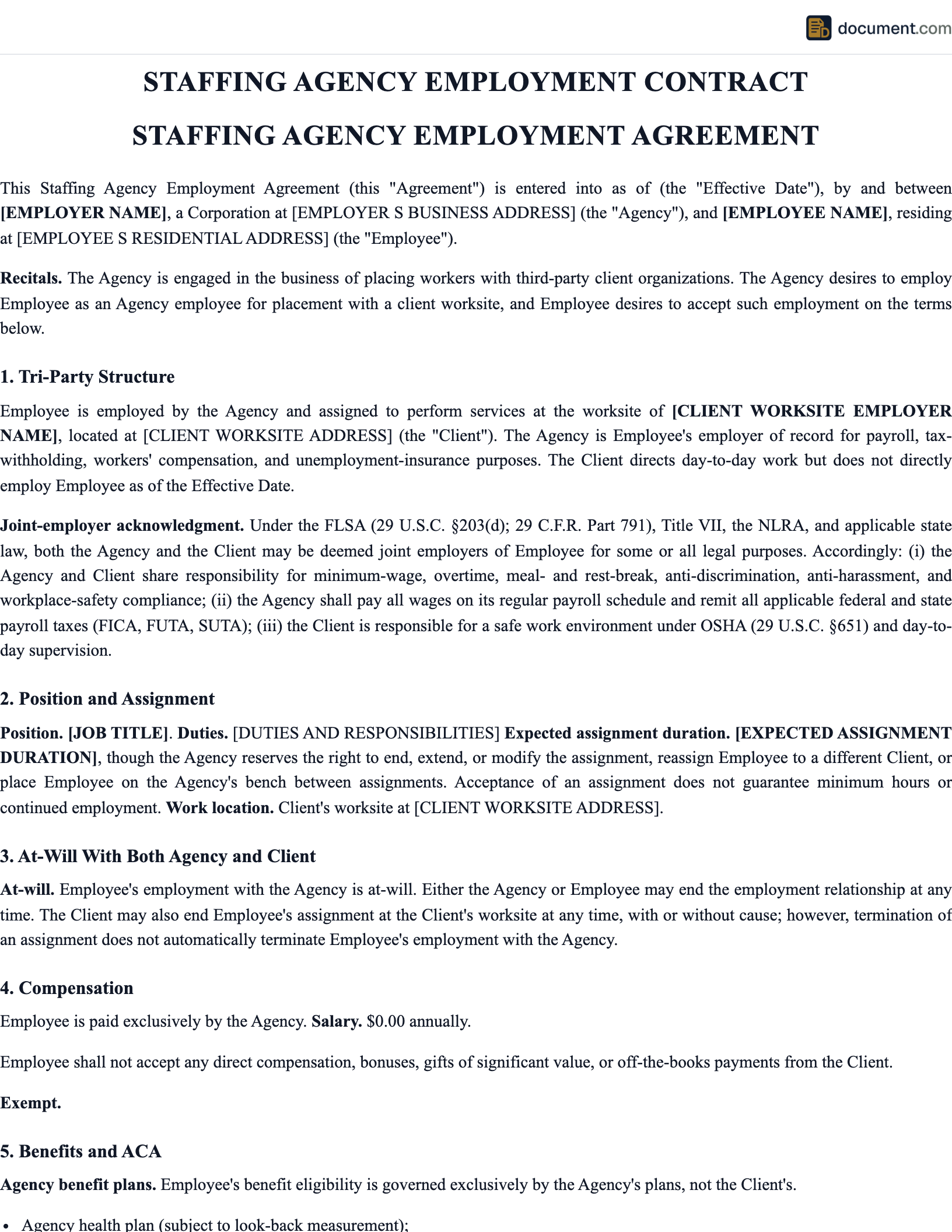



What Is a Staffing Agency Agreement?
A staffing agency agreement is a contract between a staffing firm and a client company that governs how the firm will supply contingent workers to the client's worksite. The agency recruits, screens, hires, and payrolls the workers; the client directs their day-to-day work and pays the agency an hourly bill rate for every hour the worker performs services. The arrangement is sometimes called temporary staffing, contract staffing, contingent workforce management, or agency labor. Variations include contract-to-hire (where the client may convert the worker to its own employee), payrolling (where the client sources the candidate and the agency simply runs payroll), and managed service provider (MSP) programs (where a single staffing partner manages a pool of vendors).
From a legal standpoint, staffing arrangements create a joint-employer relationship in which both the agency and the client have obligations and potential liability under federal and state employment law. The agency is typically the W-2 employer: it runs payroll, withholds taxes, pays the employer share of FICA and unemployment, provides workers' compensation, and administers any benefits. The client exercises direct day-to-day supervision, assigns work, sets performance expectations, and determines when the assignment ends. Both parties may be liable under the Fair Labor Standards Act, Title VII, the ADA, OSHA, the NLRA, and state equivalents. A well-drafted staffing agreement allocates responsibilities clearly and includes mutual indemnification for claims arising from the other party's conduct.
Beyond the legal allocation, the staffing agreement must address the commercial terms of the relationship: bill rates and markups, payment terms, conversion and buyout fees, invoicing and timesheet approval, insurance requirements, confidentiality, non-solicitation, and termination. Many staffing firms use a two-document structure: a master services agreement (MSA) that sets out the legal framework and a statement of work (SOW) or work order for each specific assignment. The MSA is negotiated once and lasts for years; the SOW is issued per assignment and contains the specific worker, role, rates, and dates.
Our staffing agency agreement templates include both the MSA and assignment-level work-order structure, with flexible language for temp, contract, contract-to-hire, IT, engineering, healthcare, light-industrial, and executive-search staffing. They include joint-employer allocations, insurance schedules, conversion fee structures, cross-indemnification, and termination rights appropriate for U.S. staffing relationships.
Clear Scope
Defines categories of workers, assignment terms, and work-order process.
Bill Rate Structure
Hourly pay, markup, bill rate, and conversion fees spelled out clearly.
Joint-Employer Allocation
Clear allocation of FLSA, safety, discrimination, and indemnity obligations.
Staffing Agreement Form Preview
Staffing Services Agreement
Master Services Agreement + Work Order
Section 1: Parties
Section 2: Rates & Markup
Section 3: Conversion Fee
If Client hires Worker during assignment or within 6 months of end, Client shall pay a conversion fee of 20% of first-year base salary.
Common Uses
Temp Staffing Firms
Traditional temp agencies placing clerical, light industrial, and administrative workers with client companies.
IT & Engineering Staffing
Specialized firms placing software engineers, DevOps, and IT professionals on project-based assignments.
Healthcare Staffing
Agencies providing travel nurses, allied health professionals, and locum tenens physicians to hospitals and clinics.
Light Industrial
Warehousing, manufacturing, and logistics staffing for surge periods and seasonal peaks.
Executive Search
Contingent and retained executive search firms placing senior leaders on a permanent or interim basis.
Payrolling Services
Employer of record and payrolling firms that onboard workers sourced directly by the client.
Joint Employment in Staffing
In most staffing arrangements, both the agency and the client are joint employers of the contingent worker for various legal purposes. This means both parties can be liable for wage-and-hour, discrimination, harassment, retaliation, and safety violations. Understanding and allocating these obligations is central to a well-drafted staffing agreement.
FLSA Wage and Hour
Both agency and client can be liable for minimum wage, overtime, and recordkeeping violations.
Title VII / ADA / ADEA
EEOC treats staffing firms and clients as joint employers for discrimination, harassment, and accommodation purposes.
OSHA Workplace Safety
OSHA's Temporary Worker Initiative holds both parties jointly responsible for safety training and hazard protection.
NLRA Collective Bargaining
NLRB standards for joint employment have shifted repeatedly; control over terms and conditions drives the analysis.
How to Create a Staffing Agency Agreement
Identify the parties
Agency entity and client entity, with correct legal names and addresses.
Define the scope of services
Categories of workers, geographic coverage, and the work-order or statement-of-work process.
Set bill rates and markups
Hourly pay rate, markup percentage, and resulting client bill rate, plus overtime bill rates.
Address invoicing and payment terms
Timesheet approval, invoice frequency, payment due date, and late-payment interest.
Include conversion and buyout fees
Amount, look-back period, and calculation method for converting contingent workers to client employees.
Allocate joint-employer obligations
Which party is responsible for FLSA compliance, safety, discrimination, and payroll.
Set insurance requirements
Workers' comp, employers' liability, general liability, EPLI, professional liability, certificates of insurance.
Include confidentiality and non-solicitation
Mutual confidentiality and restrictions on direct solicitation or hiring of candidates.
Address indemnification and limitation of liability
Mutual indemnification with caps appropriate to the nature of the services.
Governing law, termination, and signatures
State whose law governs, termination rights, and execution by both parties.
Key Components
Parties
Agency and client entities.
Scope of Services
Categories of workers and geographic coverage.
Work Order Process
How specific assignments are requested and documented.
Pay and Bill Rates
Worker pay, markup, and client bill rate.
Overtime Treatment
How OT is billed and allocated between parties.
Timesheets and Invoicing
Approval process and invoicing cadence.
Payment Terms
Due date, late fees, dispute procedures.
Conversion Fees
Amount, look-back period, calculation.
Joint-Employer Allocation
Responsibility for FLSA, safety, EEO compliance.
Insurance
Workers' comp, EPLI, liability coverage.
Confidentiality
Mutual protection of proprietary information.
Non-Solicitation
Limits on direct hiring and poaching.
Indemnification
Mutual cross-indemnification with caps.
Termination
Notice periods and end-of-assignment rights.
Governing Law
State whose law governs the agreement.
Signatures
Authorized officers of both parties.
Bill Rates and Markups
The bill rate is the hourly amount the client pays the agency. It equals the worker's pay rate plus the agency's markup, which covers payroll taxes (FICA 7.65%, FUTA, state unemployment), workers' compensation premiums (varying by class code and state), general and professional liability insurance, recruiting and onboarding costs, overhead, and profit. Typical markups range from 40% to 75% depending on industry, skill level, and assignment risk. For a worker paid $25/hour, a 55% markup produces a bill rate of $38.75/hour. The agreement should specify whether markups are fixed or floating, how overtime is billed (many agreements bill OT at 1.5x the straight-time bill rate), and how any statutory benefits (paid sick leave, mandatory retirement contributions) are handled.
Conversion and Buyout Fees
A conversion fee compensates the agency when the client hires the contingent worker as its own employee. Two common structures exist. The first is a declining-hours structure: the fee starts at a set amount and declines by a fixed amount for each hour the worker has been billed through the agency, eventually reaching zero after a set threshold (often 1,000 to 2,000 hours). The second is a percentage of salary: a percentage (typically 15% to 25%) of the worker's first-year base salary at the client. The agreement should specify the calculation method, any look-back period after the assignment ends, payment timing, and the consequences of direct hiring without notice.
Compliance Obligations
- Complete Form I-9 employment eligibility verification for every worker before starting work.
- Withhold federal income, Social Security, and Medicare taxes and remit to the IRS.
- Withhold and remit state income tax, state unemployment tax, and state disability insurance where applicable.
- Provide workers' compensation coverage at statutory limits in every state where workers are placed.
- Comply with FLSA minimum wage and overtime for all non-exempt workers.
- Post required federal and state labor-law notices and provide written wage notices where required.
- Satisfy OSHA Temporary Worker Initiative safety training and hazard communication duties jointly with the client.
- Maintain EEO-1 reporting and comply with Title VII, ADA, ADEA, and state equivalents.
- Comply with state and local paid sick leave laws on a prorated basis.
- Issue annual W-2 forms to each worker by January 31.
Sample Staffing Agency Agreement
STAFFING SERVICES AGREEMENT
This Staffing Services Agreement ("Agreement") is entered into as of [Effective Date] between [Agency] ("Agency") and [Client] ("Client").
1. SERVICES
Agency shall recruit, hire, payroll, and supply contingent workers to Client pursuant to individual Work Orders executed from time to time. Each Work Order shall specify the worker, assignment dates, role, pay rate, bill rate, and reporting structure.
2. RATES AND INVOICING
Client shall pay Agency the bill rates set forth in each Work Order for all hours worked. Agency shall invoice Client weekly based on Client-approved timesheets. Invoices are due net thirty (30) days from receipt. Overtime hours shall be billed at one-and-a-half times the straight-time bill rate.
3. EMPLOYMENT STATUS
Workers supplied by Agency are W-2 employees of Agency. Agency is responsible for payroll, tax withholding, workers' compensation, and unemployment insurance. Client is responsible for day-to-day supervision and workplace safety.
4. CONVERSION FEE
If Client hires any Worker (directly or through another staffing firm) during the assignment or within [6] months after the assignment ends, Client shall pay Agency a conversion fee equal to [20%] of the Worker's first-year base salary.
5. INSURANCE
Agency shall maintain workers' compensation at statutory limits, employers' liability ($1,000,000), commercial general liability ($2,000,000), and employment practices liability. Agency shall provide Client with certificates of insurance upon request.
6. INDEMNIFICATION
Each party shall indemnify the other for claims arising from its own negligent or wrongful acts. Agency indemnifies Client for payroll, tax, and workers' comp obligations; Client indemnifies Agency for workplace safety and supervision-related claims.
7. GOVERNING LAW
This Agreement shall be governed by the laws of the State of [State].
Frequently Asked Questions
Official Resources
DOL — Fair Labor Standards Act
Federal minimum wage and overtime rules that apply to staffing workers.
OSHA — Temporary Worker Initiative
Joint safety responsibilities between host employers and staffing agencies.
EEOC — Contingent Workers Guidance
EEOC enforcement guidance on staffing firms and host employers as joint employers.
NLRB — Joint Employer Standard
National Labor Relations Board rules on joint-employer status.
IRS — Worker Classification
Distinguishing employees from independent contractors.
American Staffing Association
Industry trade association with standards and best practices.
SSA — Employer Information
Social Security wage reporting for W-2 workers.
DOL — Misclassification
Worker-classification rules under the FLSA.
Create your Staffing Agency Employment Contract in under 10 minutes.
Answer a few questions and download a compliant, attorney-drafted document ready for your state.