
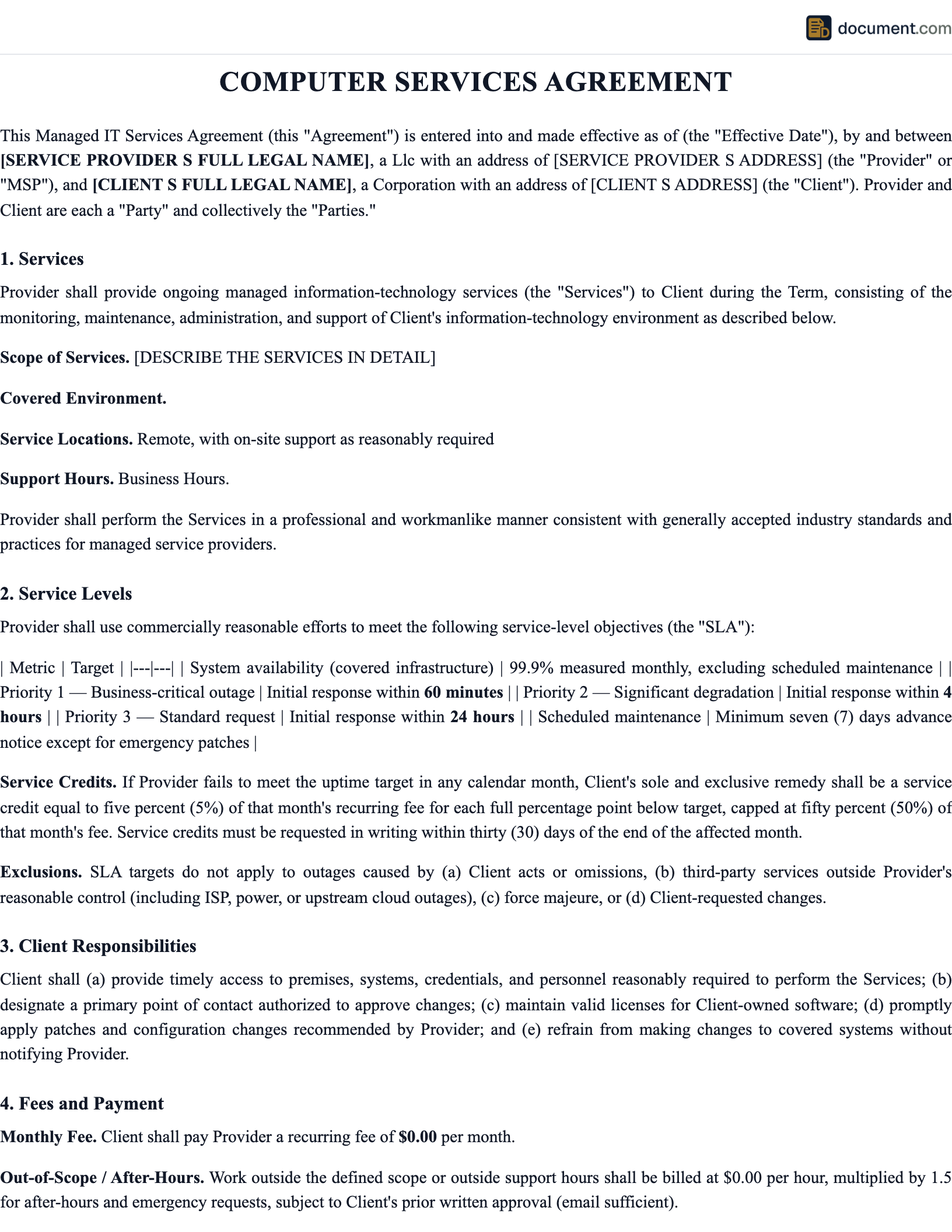



What Is a Computer Services Agreement?
A computer services agreement is a contract between an IT service provider and a client that defines what technology services will be delivered, how they will be measured, what security and confidentiality obligations apply, who owns the work product, and how the relationship can be terminated. It is the backbone document for any engagement where one party is paying another to build, fix, monitor, or manage computer systems, networks, software, or data infrastructure. Whether the engagement is a one-afternoon laptop repair or a multi-year managed services contract worth six figures, the computer services agreement is what turns a handshake into an enforceable set of obligations.
The IT services industry sits in a unique risk position because the provider almost always has privileged access to the client's most sensitive assets: customer databases, financial records, login credentials, proprietary source code, and internal communications. A single misconfiguration, a forgotten patch, or a careless file transfer can expose the client to a data breach that costs orders of magnitude more than the service contract itself. That asymmetry of risk is why computer services agreements tend to be more detailed than general service contracts. They need to address not just the work being done, but the security environment in which it is done, the data the provider will access, the compliance frameworks the client must satisfy, and the consequences if something goes wrong.
For the IT provider, the agreement serves as a scope boundary that protects against scope creep (the client expecting unlimited support for a fixed price), a liability shield that limits exposure to the fees actually paid, and a payment mechanism that ensures the provider gets paid on time for work delivered. For the client, it is a performance standard that defines what "good service" looks like in measurable terms, a security baseline that holds the provider accountable for protecting client data, and a transition plan that ensures the client is not locked in if the relationship does not work out.
The legal framework governing computer services agreements draws from general contract law, intellectual property law, data privacy statutes (HIPAA, state data breach notification laws, CCPA/CPRA in California, the SHIELD Act in New York), and industry-specific regulations like PCI DSS for payment card processing and SOC 2 for service organizations. The agreement itself is typically a master services agreement (MSA) with one or more statements of work (SOWs) attached as exhibits, each defining a specific project or service tier with its own scope, timeline, and pricing.
Our attorney-reviewed template covers the full lifecycle of an IT engagement: scope of services, service level agreements, data security and confidentiality, intellectual property ownership, pricing and payment, limitation of liability, termination and transition, and dispute resolution. It works for solo IT consultants, managed service providers, web development shops, cybersecurity firms, and any business that needs a professional framework for purchasing technology services.
Clear Scope
Define exactly what services are included and how out-of-scope requests are handled
Data Security
Confidentiality, encryption, breach notification, and compliance requirements
SLA Protection
Uptime guarantees, response times, and service credits for missed targets
Computer Services Agreement Form Preview
Below is a visual preview of the sections and fields included in a standard computer services agreement. Your completed document will be customized for your service type, pricing model, and compliance needs.
Computer Services Agreement
IT Professional Services Contract
Section 1: Parties
Section 2: Scope of Services
Network monitoring and management (24/7)
Help desk support (business hours, Tier 1-2)
Server patching and updates (monthly)
Data backup and disaster recovery
Section 3: Service Level Agreement
Section 4: Fees
Section 5: Execution
Provider Signature
Client Signature
How to Create a Computer Services Agreement
A solid computer services agreement follows seven steps, each addressing a different layer of the IT relationship. Skipping any one of them creates gaps that lead to scope disputes, security incidents, or collection problems down the road.
Define the scope of services
List the specific services the provider will deliver: network management, help desk, server administration, backup, cybersecurity, cloud management, hardware procurement, or project work. Be explicit about what is included and what falls outside the scope.
Set service level commitments
Define uptime guarantees, response time windows by severity level, resolution time targets, and the remedies (service credits) that apply when the provider misses a target. SLAs turn vague promises into measurable obligations.
Address data security and confidentiality
Specify how the provider will protect client data, what encryption and access control standards apply, what compliance frameworks the provider must follow (HIPAA, PCI DSS, SOC 2), and how breach notification works.
Establish intellectual property ownership
Decide who owns custom code, scripts, configurations, and documentation created during the engagement. Distinguish between the provider's pre-existing tools and newly created deliverables.
Lock in pricing and payment terms
Specify whether pricing is fixed monthly, hourly, per-device, per-user, or project-based. Define the billing cycle, payment terms (net-30 is typical), late fees, and the right to suspend services for non-payment.
Include termination and transition provisions
Define how either party can end the agreement, what notice period is required, whether early termination fees apply, and how the provider will assist with the transition to a new provider, including data export and credential handover.
Add liability limits and dispute resolution
Cap each party's liability at the fees paid during the preceding 12 months, exclude consequential damages, carve out exceptions for data breaches and IP infringement, and specify whether disputes go to mediation, arbitration, or court.
Key Components
Every computer services agreement should contain these building blocks, whether the engagement is a small break-fix job or an enterprise managed services contract.
Scope of services
Detailed description of the IT services included and excluded from the agreement
Service level agreement (SLA)
Uptime guarantees, response times, resolution targets, and service credits
Data security and confidentiality
Encryption, access controls, breach notification, and compliance obligations
Intellectual property
Ownership of custom code, scripts, and deliverables created during the engagement
Pricing and payment
Fee structure, billing cycle, payment terms, late fees, and suspension rights
Insurance requirements
Professional liability, cyber liability, and general liability minimums
Remote access provisions
Tools, security requirements, authorization, and audit trail for remote sessions
Backup and disaster recovery
Backup frequency, retention periods, recovery time objectives, and testing schedule
Limitation of liability
Liability cap, exclusion of consequential damages, and carve-outs for breaches
Termination and transition
Notice periods, early termination fees, data export, and credential handover
Types of IT Service Agreements
Computer services agreements take different forms depending on the engagement model. Choosing the right structure ensures the scope, pricing, and SLAs match the way the work actually gets delivered.
Managed Services Agreement
An ongoing contract where the provider proactively monitors, maintains, and supports the client's IT infrastructure for a flat monthly fee. Includes SLAs, help desk support, patching, backup, and network management. Best for businesses that need predictable IT costs and prefer outsourcing to hiring in-house staff.
Break-Fix Agreement
A reactive engagement where the provider responds to issues as they arise, billing on a time-and-materials basis. There is no monthly fee; the client pays only when something breaks. Break-fix works for businesses with simple IT needs and low tolerance for ongoing costs, but it offers no proactive monitoring or prevention.
Project-Based Agreement
A fixed-scope contract for a defined IT project: a network build-out, a cloud migration, a software deployment, or a security audit. Typically priced as a fixed fee with milestone payments. The agreement ends when the project deliverables are accepted.
Staff Augmentation Agreement
The provider supplies IT personnel who work under the client's direction, filling specific technical roles on a temporary or ongoing basis. The provider handles recruiting, payroll, and benefits; the client directs the day-to-day work. Commonly used for development teams, helpdesk staff, and specialized engineering roles.
Legal Requirements
Computer services agreements are governed by contract law, data privacy statutes, and industry-specific regulations. The requirements below apply to most IT engagements, with additional obligations depending on the client's industry.
- State data breach notification laws apply in all 50 states when the provider accesses personal information
- HIPAA Business Associate Agreement required when the provider handles protected health information
- PCI DSS compliance required when the provider processes, stores, or transmits payment card data
- CCPA/CPRA compliance required when the provider processes California consumer personal information
- New York SHIELD Act requires reasonable safeguards for private information of New York residents
- SOC 2 compliance increasingly expected by enterprise clients for managed service providers
- Worker classification under IRS and state tests when the provider supplies individual consultants
- State sales tax may apply to computer services depending on the state (taxability varies widely)
Sample Computer Services Agreement
Below is a condensed preview of our standard computer services agreement. Your final document will be customized for your service model, pricing structure, and compliance needs.
COMPUTER SERVICES AGREEMENT
IT Professional Services Contract
This Computer Services Agreement ("Agreement") is entered into as of[Date]between [Provider]("Provider") and [Client]("Client").
1. SERVICES
Provider shall perform the services described in the attached Statement of Work ("SOW"), which is incorporated by reference. Services not described in the SOW are out of scope and require a separate written authorization before Provider is obligated to perform them.
2. SERVICE LEVELS
Provider shall maintain [%]% uptime for managed systems. Critical issues shall receive a response within[minutes] minutes. For each month Provider fails to meet the uptime target, Client shall receive a service credit equal to [%]% of the monthly fee.
3. DATA SECURITY
Provider shall implement and maintain commercially reasonable administrative, technical, and physical safeguards to protect Client data. Provider shall notify Client within [hours]hours of discovering any actual or suspected data breach.
4. CONFIDENTIALITY
Each party shall protect the other's confidential information using at least the same degree of care it uses for its own confidential information, and in no event less than reasonable care. Confidentiality obligations survive termination for[years] years.
5. FEES AND PAYMENT
Client shall pay Provider $[amount]per month for managed services and $[rate]per hour for project work. Invoices are due net-30. Late payments accrue interest at 1.5% per month.
6. LIMITATION OF LIABILITY
Neither party's total liability shall exceed the fees paid under this Agreement during the 12 months preceding the claim. Neither party shall be liable for consequential, incidental, or punitive damages, except for breaches of data security or confidentiality obligations.
Frequently Asked Questions
Answers to common questions about computer services agreements, SLAs, data security, intellectual property, pricing models, and liability.
Official Resources
For additional information on IT service regulations, data privacy, and cybersecurity standards, consult these official resources.
CISA Cybersecurity Resources
Federal guidance on cybersecurity best practices and incident response
NIST Cybersecurity Framework
National Institute of Standards and Technology framework for managing cybersecurity risk
HHS HIPAA Resources
Health and Human Services guidance on HIPAA privacy and security requirements
PCI Security Standards Council
Payment card industry data security standards and compliance resources
California Attorney General - CCPA
California Consumer Privacy Act guidance and enforcement information
FTC Privacy and Security
Federal Trade Commission guidance on data privacy and business security practices
Create your Computer Services Agreement in under 10 minutes.
Answer a few questions and download a compliant, attorney-drafted document ready for your state.