



What Is an Odometer Disclosure Statement?
An odometer disclosure statement is a written certification from the seller of a motor vehicle to the buyer stating the exact mileage shown on the vehicle's odometer at the time of the sale. The disclosure is required by the federal Truth in Mileage Act (TIMA), which Congress passed in 1986 to combat the widespread practice of odometer fraud — rolling back the displayed mileage to make a high-mileage vehicle appear newer and more valuable than it actually is. According to the National Highway Traffic Safety Administration, odometer fraud costs American consumers more than $1 billion every year and affects an estimated 450,000 vehicles annually.
Federal law requires that the odometer disclosure be made in writing at the time of every motor vehicle transfer, with limited exceptions for very old or very heavy vehicles. The disclosure must include the vehicle identification number (VIN), make, model, year, body type, the current odometer reading, and a notation indicating whether the displayed reading reflects the actual mileage, has exceeded the mechanical limits of the odometer, or is not the actual mileage for some other reason. Both the seller and the buyer must sign the disclosure, and the document must be retained for at least five years.
In most states, the odometer disclosure is integrated directly into the title certificate — there is a designated section on the back of the title where the seller records the mileage and both parties sign. However, a separate odometer disclosure statement is required when the original title is being held by a lender, when the title has been lost and a duplicate is being applied for, when the title does not include a disclosure block, or when state law allows electronic title transfers that capture the disclosure separately. NHTSA approves separate disclosure forms as long as they include the same essential information that would appear on the title itself.
Knowingly providing a false odometer disclosure is a federal crime carrying both criminal and civil penalties. Civil penalties include treble damages (three times actual damages) or $10,000 per violation, whichever is greater, plus attorney's fees. Criminal penalties include fines of up to $250,000 for individuals and $500,000 for corporations, plus imprisonment for up to three years. NHTSA's Office of Odometer Fraud Investigation actively investigates odometer rollback cases, and state attorneys general also bring enforcement actions against dealers and private sellers.
Our attorney-reviewed odometer disclosure statement template captures all of the information required by federal law and state DMVs, with clear options for actual mileage, exceeds mechanical limits, and not actual mileage. Whether you are selling a car privately, transferring a title between family members, or completing a dealer transaction that requires a separate disclosure, our template provides a clean, legally compliant document that protects both parties from later disputes.
Federal Law
Required by the Truth in Mileage Act since 1986
Protects Buyers
Creates a written record of mileage at sale
Protects Sellers
Documents the mileage to defend against later claims
Form Preview
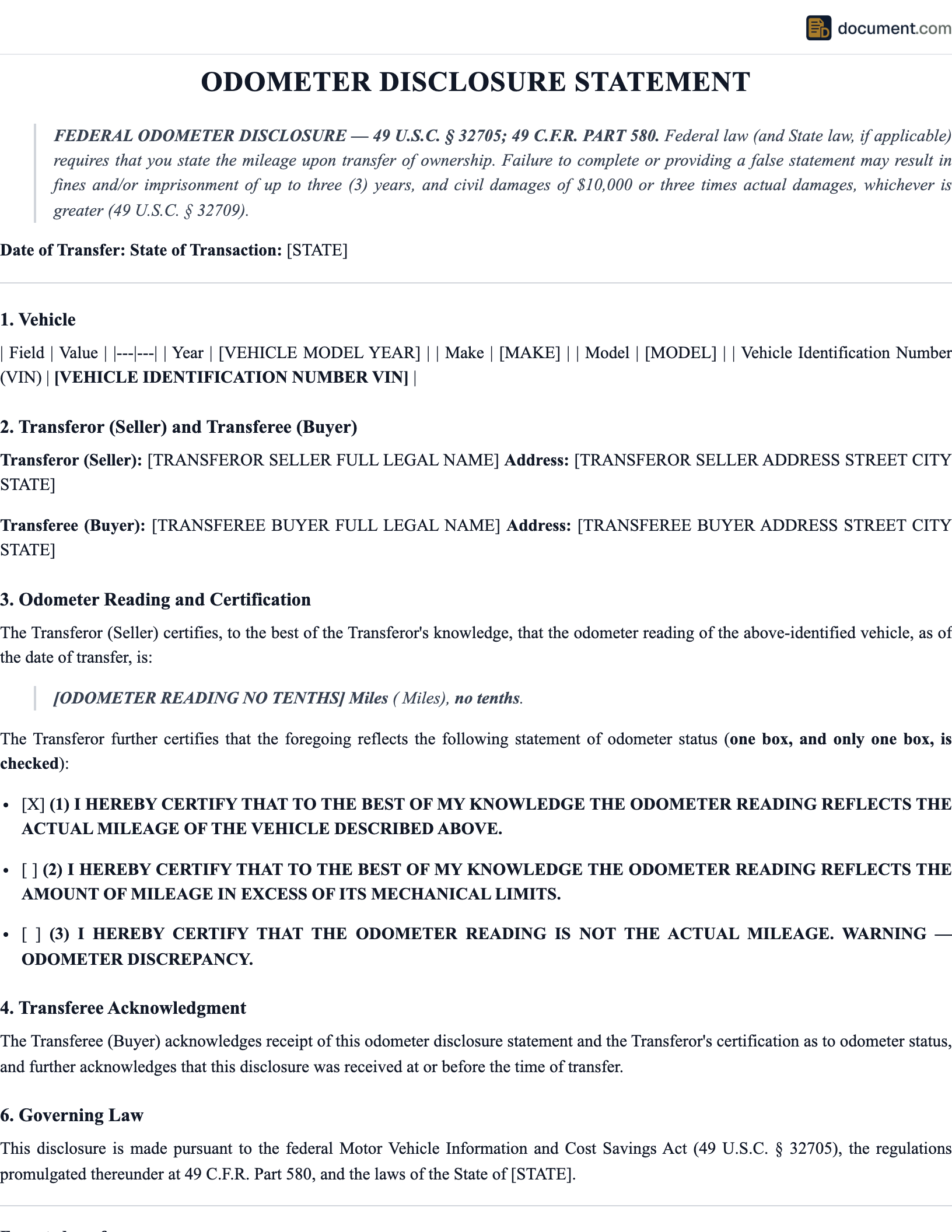
Our odometer disclosure statement is a single-page document with all of the elements required by NHTSA and state DMVs.
ODOMETER DISCLOSURE STATEMENT
Vehicle Year/Make/Model: ____________________
VIN: _____________________________________
Body Type: _______________________________
Odometer Reading (no tenths): __________ miles
[ ] Actual mileage
[ ] Exceeds mechanical limits
[ ] Not the actual mileage — WARNING ODOMETER DISCREPANCY
Seller Name & Signature: ________________
Buyer Name & Signature: _________________
Types of Odometer Disclosures
Several variations of odometer disclosure forms exist depending on the vehicle type and the circumstances of the transfer.
Mileage Categories Explained
Federal law recognizes three categories of mileage disclosure. Choosing the right one is essential to a valid disclosure.
| Category | Meaning | When to Use |
|---|---|---|
| Actual Mileage | Reading reflects the true total miles | Default for most modern vehicles |
| Exceeds Mechanical Limits | Real mileage is greater than the odometer can display | Older 5-digit odometers that have rolled over |
| Not Actual Mileage | True mileage cannot be verified | Broken or replaced odometer; tampering suspected |
How to Complete an Odometer Disclosure
Filling out an odometer disclosure correctly is straightforward, but the details matter. Follow these steps to ensure compliance.
Gather Vehicle Information
Collect the year, make, model, body type, and full 17-character VIN from the title or registration. Double-check the VIN against the vehicle itself.
Read the Odometer
Read the current odometer display carefully. Federal law requires the reading without tenths, so 87,432.6 miles is recorded as 87,432.
Choose the Mileage Category
Mark exactly one category: actual mileage, exceeds mechanical limits, or not actual mileage. Marking 'not actual mileage' will brand the title in many states.
Identify the Parties
Print the full legal names and addresses of both the seller and the buyer exactly as they appear on government-issued ID.
Date the Form
Use the actual date of the transfer. The disclosure date should match the bill of sale and the title transfer date.
Sign in Wet Ink (or Approved E-Signature)
Both the seller and the buyer must sign. In states that allow electronic disclosures, use the state-approved e-signature method.
Retain Copies
Both parties should keep a signed copy for at least five years. The buyer should attach the disclosure to the title transfer paperwork submitted to the DMV.
Key Components
Every valid odometer disclosure statement contains the same core elements required by federal regulation 49 C.F.R. Part 580.
- Vehicle Identification: Year, make, model, body type, and full 17-character VIN
- Current Mileage: The exact reading on the odometer at the time of transfer, without tenths
- Mileage Category: Actual / exceeds mechanical limits / not actual mileage
- Seller Name and Address: Full legal name and address of the transferor
- Buyer Name and Address: Full legal name and address of the transferee
- Date of Transfer: The actual date the vehicle changed hands
- Seller Signature: Handwritten or approved electronic signature certifying the mileage
- Buyer Signature: Handwritten or approved electronic signature acknowledging the disclosure
Vehicle Exemptions
Federal law exempts several categories of vehicles from the odometer disclosure requirement. Knowing whether your vehicle is exempt can save time and avoid unnecessary paperwork.
NHTSA 20-Year Rule
A 2019 NHTSA rule extended the disclosure requirement from 10 years to 20 years for vehicles model year 2011 and newer. Vehicles model year 2010 or older remain subject to the 10-year rule, meaning they are now generally exempt. The change reflects how much longer modern vehicles last on the road.
- Heavy Vehicles: Vehicles with a GVWR over 16,000 pounds (most heavy commercial trucks).
- Non-Self-Propelled Vehicles: Trailers, semi-trailers, and similar towed equipment.
- New Vehicles Pre-Sale: Vehicles being transferred from manufacturer to dealer prior to first retail sale.
- Older Vehicles: Vehicles model year 2010 or older (10-year rule); vehicles model year 2011+ remain subject to disclosure for 20 years.
Penalties for Odometer Fraud
Knowingly providing a false odometer disclosure or tampering with an odometer is a serious federal crime under 49 U.S.C. § 32709 with significant civil and criminal consequences.
Civil Damages
Treble damages (3x actual) or $10,000 per violation, whichever is greater, plus attorney's fees
Criminal Fines
Up to $250,000 for individuals and $500,000 for corporations
Imprisonment
Up to three years per violation in federal prison
Dealer License Loss
Permanent revocation of state dealer licenses
Sample Odometer Disclosure Statement
Below is a condensed preview of our odometer disclosure statement template. Your finished form will be customized for your specific vehicle and transaction.
FEDERAL ODOMETER DISCLOSURE STATEMENT
(49 U.S.C. § 32705 / 49 C.F.R. Part 580)
I, [Seller Full Name], state that the odometer of the following vehicle now reads [Mileage] miles (no tenths) and to the best of my knowledge it reflects the actual mileage of the vehicle described below, unless one of the following statements is checked.
VEHICLE DESCRIPTION
Year: [YYYY]
Make: [Make]
Model: [Model]
Body Type: [Body Type]
VIN: [17-Character VIN]
MILEAGE CATEGORY (CHECK ONE)
[ ] (1) ACTUAL MILEAGE
[ ] (2) THE MILEAGE STATED IS IN EXCESS OF ITS MECHANICAL LIMITS
[ ] (3) THE ODOMETER READING IS NOT THE ACTUAL MILEAGE — WARNING: ODOMETER DISCREPANCY
TRANSFER
Date of Transfer: [Date]
Seller (Transferor): [Name]
Seller Address: [Address]
Seller Signature:
Buyer (Transferee): [Name]
Buyer Address: [Address]
Buyer Signature:
Federal and state law requires that you state the mileage in connection with the transfer of ownership. Failure to complete or providing a false statement may result in fines and/or imprisonment.
Frequently Asked Questions
Common questions about the federal Truth in Mileage Act, exempt vehicles, electronic disclosures, and odometer fraud.
Official Resources
Federal and state resources for vehicle title transfers, odometer disclosure rules, and odometer fraud reporting.
NHTSA - Odometer Fraud
National Highway Traffic Safety Administration odometer fraud information and complaint portal
49 CFR Part 580 - Federal Regulation
Full text of the federal odometer disclosure regulations
49 U.S.C. § 32705 - Truth in Mileage Act
Federal statute requiring odometer disclosures on vehicle transfers
NHTSA - VIN Decoder
Free official VIN decoder for verifying vehicle information
NMVTIS - Vehicle History
National Motor Vehicle Title Information System used to detect title and odometer fraud
CFPB - Auto Loans
Consumer Financial Protection Bureau auto loan and purchase resources
FTC - Dealer Guide to Odometer Law
Federal Trade Commission guide for dealers on odometer disclosure compliance
USA.gov - Motor Vehicle Services
Find your state DMV for title transfer and odometer disclosure forms
Create your Odometer Disclosure Statement in under 10 minutes.
Answer a few questions and download a compliant, attorney-drafted document ready for your state.