
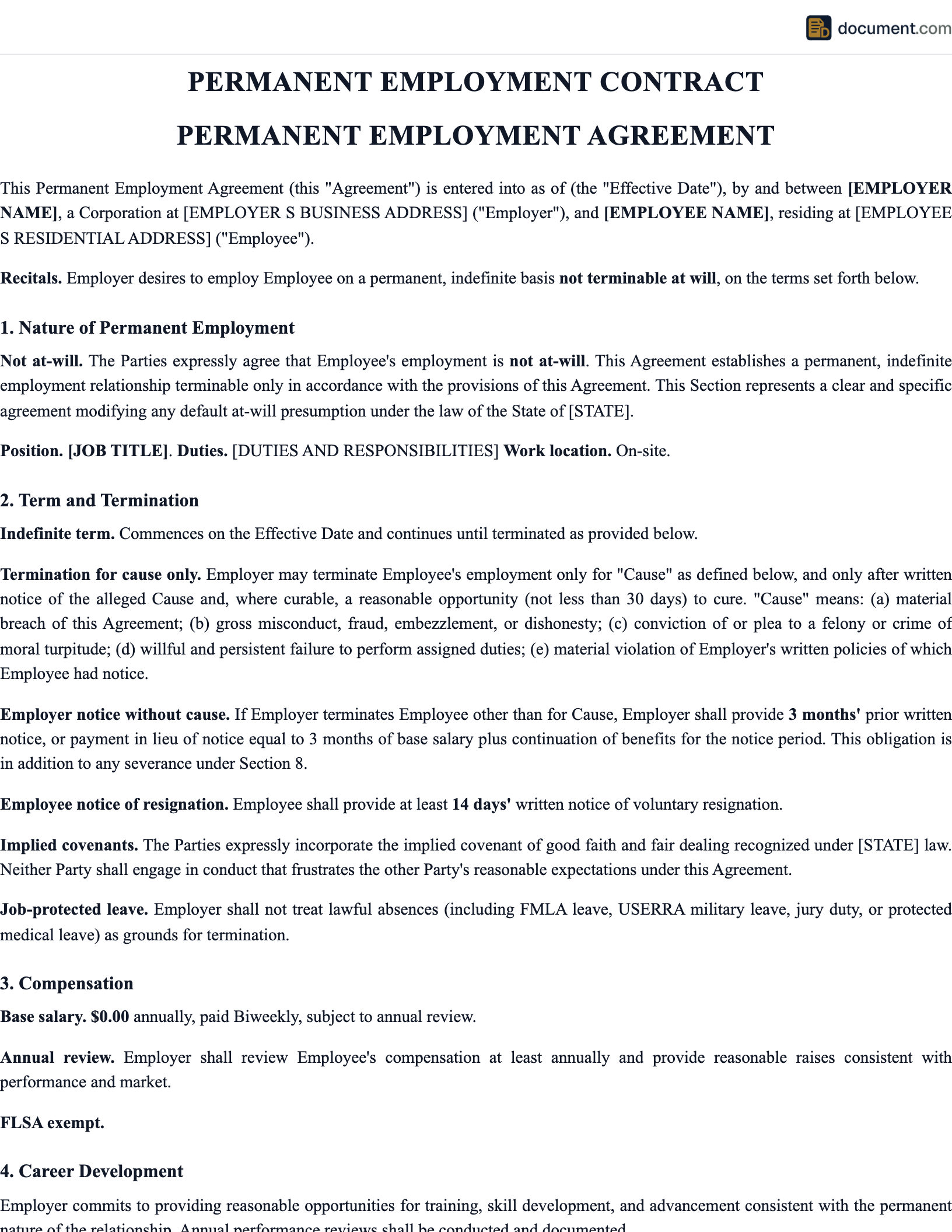



What Is a Permanent Employment Contract?
A permanent employment contract is a written agreement establishing an indefinite, ongoing employment relationship between an employer and a worker. "Permanent" in the American labor-law context does not mean guaranteed lifetime employment — it means that the employment is expected to continue indefinitely, without a predetermined end date, until either party decides to terminate the relationship in accordance with the contract and applicable law. This is the structure under which the vast majority of full-time U.S. jobs operate, whether the worker is an hourly manufacturing employee, a salaried office professional, a field sales representative, or a mid-level manager. For roles below the executive suite, a permanent contract is the workhorse document that governs day-to-day employment.
The defining characteristic of a permanent contract in the United States is its interaction with the at-will employment default. Every U.S. state except Montana follows the at-will rule, under which either party can terminate the employment relationship at any time, for any lawful reason, with or without notice or cause. A permanent contract does not automatically displace this default. Instead, it typically confirms at-will status while adding structure around compensation, benefits, duties, and post-employment obligations. Only if the contract includes specific language promising continued employment or limiting termination to just-cause does it override the at-will presumption.
The second defining characteristic is the comprehensive benefits package that accompanies most permanent positions. Unlike fixed-term contracts (which often exclude benefit eligibility) or independent-contractor arrangements (which categorically exclude employee benefits), permanent full-time positions typically include group health insurance, dental, vision, life insurance, short-term and long-term disability, a 401(k) retirement plan with employer match, paid time off, paid holidays, parental leave, and employee assistance programs. These benefits are governed by ERISA, the ACA employer mandate for applicable large employers, and a web of state and federal laws regulating paid leave, pregnancy accommodation, lactation breaks, and transgender-inclusive health coverage.
The contract must also address FLSA classification — a more consequential drafting decision than most employers realize. The Fair Labor Standards Act divides all employees into exempt and non-exempt categories. Non-exempt workers must be paid the federal minimum wage ($7.25 per hour, though most states set higher floors) and overtime at one-and-a-half times the regular rate for hours worked over 40 in a workweek. Exempt workers are paid a fixed salary regardless of hours and are not entitled to overtime. To qualify as exempt, the employee must be paid on a salary basis, meet the DOL minimum salary threshold, and satisfy the duties test for one of the enumerated exemption categories — executive, administrative, professional, computer, or outside sales.
Whether you are a human-resources director onboarding a new hire, a small-business owner drafting your first formal employment agreement, a startup founder hiring your first employees, or a general counsel standardizing employment documentation across a multi-state workforce, our attorney-reviewed permanent employment contract templates provide a compliant foundation. Each template includes FLSA classification language, ERISA benefit references, at-will acknowledgment (or just-cause protection where desired), state-specific wage-notice provisions, restrictive covenants tailored to the jurisdiction, and dispute resolution clauses.
Indefinite Employment
Ongoing relationship with no predetermined end date, preserving at-will flexibility
Full Benefits
Medical, dental, vision, 401(k), PTO, parental leave, and disability under ERISA-governed plans
FLSA Compliant
Proper exempt or non-exempt classification with duties-test-aligned job descriptions
Permanent Contract Form Preview
A structured view of the key fields in our permanent employment contract template.
Permanent Employment Agreement
Full-Time Salaried Position
Section 1: Position
Section 2: Compensation
Section 3: Benefits
Permanent Role Types
Our permanent employment contract templates are calibrated to the specific structure of each role type. Choose the category that matches your hire.
Full-Time Salaried Employee
Indefinite exempt salaried position with full benefits and career-path expectations
Full-Time Hourly Employee
Indefinite non-exempt hourly position with overtime eligibility under the FLSA
Management / Supervisor
Permanent management role with budget, team, and performance-review authority
Individual Contributor
Permanent technical or professional contributor without direct reports
Remote / Hybrid Worker
Permanent position with full remote or hybrid work arrangement and multi-state tax considerations
Unionized Position
Permanent role covered by collective bargaining agreement with CBA-derived rights
Permanent vs. At-Will Employment
The relationship between permanent employment and at-will status is the source of frequent confusion. "Permanent" refers to the expected duration of the relationship — indefinite, ongoing, without a predetermined end date. At-will refers to the legal rule governing termination — either party can end the relationship at any time for any lawful reason. Almost all permanent U.S. employment is also at-will, meaning the employment is expected to continue indefinitely but can be ended by either party at any time.
A permanent contract can override the at-will default only if it includes specific language promising continued employment or limiting termination to just-cause. Courts are reluctant to find just-cause protection absent clear language, so phrases like "permanent employee," "regular full-time," or "long-term employment" are generally not enough. Explicit just-cause language ("Employee may be terminated only for good cause as defined in Section 6") will override at-will. Many permanent contracts include an at-will acknowledgment — a clause in which the employee confirms that the employment is at-will and that no representation has been made to the contrary — to defeat later claims of implied contract based on handbook language or oral assurances.
FLSA Exempt vs. Non-Exempt Classification
The Fair Labor Standards Act (29 U.S.C. §201 et seq.) requires employers to pay non-exempt employees the federal minimum wage (currently $7.25 per hour, though most states set higher floors) and overtime at one-and-a-half times the regular rate for hours worked over 40 in a workweek. Exempt employees are not entitled to overtime. To qualify for exemption, the employee must meet three tests: (1) the salary-basis test — paid a predetermined fixed salary not subject to reduction based on quality or quantity of work; (2) the salary-level test — paid at least $684 per week ($35,568 per year) under the 2019 rule, subject to DOL rulemaking that may raise the threshold; and (3) the duties test — primary duties must match one of the enumerated exempt categories.
| Category | Primary Duty Requirement |
|---|---|
| Executive | Management of enterprise/department; direction of 2+ FTEs; authority to hire or fire |
| Administrative | Office work directly related to management; exercise of discretion and judgment on significant matters |
| Professional (Learned) | Advanced knowledge in a field of science or learning; typically requires prolonged specialized instruction |
| Professional (Creative) | Work requiring invention, imagination, originality, or talent in an artistic or creative field |
| Computer | Systems analysis, programming, software engineering; $27.63/hr or $684/wk minimum |
| Outside Sales | Sales away from employer's place of business; no salary minimum |
Benefits & ERISA
Permanent full-time employees in the U.S. typically receive a comprehensive benefits package that includes group health insurance under the Affordable Care Act, a 401(k) or similar retirement plan, group life and disability insurance, paid time off, and various other welfare benefits. All of these are governed by the Employee Retirement Income Security Act of 1974 (ERISA), which imposes fiduciary duties on plan administrators, requires written plan documents and summary plan descriptions, mandates annual reporting through Form 5500, and preempts state laws that relate to employee benefit plans.
The employer's benefit obligations begin with the ACA employer mandate: applicable large employers (50 or more full-time equivalents) must offer minimum essential coverage providing minimum value at affordable cost to at least 95% of full-time employees and their dependents, or face penalties under IRC §4980H. The employment contract should reference the employer's benefit plans rather than incorporate their terms, to preserve the employer's ability to modify plans without reopening individual employment agreements. It should also include a disclaimer that benefits are subject to the terms and conditions of the applicable plan documents, which control in the event of conflict.
How to Create a Permanent Contract
Define the position
Title, department, reporting line, work location, and FLSA classification.
Set compensation
Base salary or hourly rate, bonus target, signing bonus, and equity if applicable.
Reference benefits
Incorporate by reference the employer's health, retirement, and welfare plans.
Confirm at-will status
Include an at-will acknowledgment to defeat implied-contract claims.
Add confidentiality and IP
Protect trade secrets and assign work product to the employer.
Consider restrictive covenants
Non-compete (where enforceable), non-solicit, and non-disparagement.
Comply with state wage notices
New York, California, and several other states require written wage notices at hire.
Execute and onboard
Both parties sign, HR processes I-9, W-4, and benefit enrollments.
Key Components
Position and Duties
Title, department, reporting line, work location, and FLSA status.
Compensation
Base salary or hourly rate, bonus, equity, and pay schedule.
Benefits
Reference to ERISA plans, eligibility dates, and plan-document controls.
At-Will Acknowledgment
Clear statement that employment is at-will and handbooks are not contracts.
Confidentiality
Protection of trade secrets and proprietary information.
IP Assignment
Assignment of inventions, works made for hire, and pre-existing IP carve-outs.
Restrictive Covenants
Non-compete (if enforceable), non-solicit, and non-disparagement.
Return of Property
Laptops, badges, and documents on separation.
Dispute Resolution
Choice of law, venue, and arbitration (with EFAA carve-out).
Entire Agreement
Integration clause and severability.
Remote Work Considerations
Permanent remote and hybrid positions raise distinct legal issues that on-site employment does not. The employer's tax nexus, wage-hour compliance obligations, workers' compensation coverage, and anti-discrimination obligations are generally governed by the law of the state where the employee physically performs the work — not the state where the employer is headquartered. A fully remote employee in California working for a New York-headquartered company triggers California wage-hour law, California state income tax withholding, California workers' compensation, California FEHA anti-discrimination coverage, and California mandatory paid sick leave — even if the employer has no other presence in California.
Remote work contracts should specify the employee's authorized work location, require advance notice and approval before relocating to another state, address expense reimbursement for home-office equipment and internet service (mandatory in California, Illinois, Massachusetts, Pennsylvania, and several other states under Labor Code §2802 and similar statutes), set information-security and data-privacy expectations, and address the employer's right to terminate or modify the remote arrangement. The contract should also include a provision confirming that the employee's home office is a business location for workers' compensation purposes.
Termination Procedures
In an at-will permanent contract, the employer can terminate for any lawful reason without notice. However, sound practice is to document performance concerns, issue progressive discipline (verbal warning, written warning, performance improvement plan, termination), and conduct the termination meeting with an HR representative present. The contract should specify the employee's obligations on termination: return of company property, cooperation with transition, continued compliance with confidentiality and restrictive covenants, and any required notice period.
Several states require final wages to be paid immediately on termination. California Labor Code §201 requires payment at the time of termination for involuntary separations and within 72 hours for resignations. Massachusetts requires payment on the day of termination. Connecticut requires payment by the next business day. Failure to comply can trigger waiting-time penalties equal to the employee's daily wage for each day the final paycheck is late, up to 30 days.
Sample Permanent Contract
PERMANENT EMPLOYMENT AGREEMENT
This Permanent Employment Agreement (this "Agreement") is entered into between [Employer Name] (the "Company") and [Employee Name] (the "Employee"), effective as of [Start Date].
1. POSITION
The Company hereby employs the Employee in the position of [Title], reporting to [Manager Title]. Employee shall perform such duties as are customary for this position and as the Company may reasonably assign.
2. COMPENSATION
The Company shall pay Employee an annual base salary of $[Amount], payable in accordance with the Company's standard payroll practices, less applicable withholdings. Employee is classified as [Exempt/Non-Exempt] under the Fair Labor Standards Act.
3. BENEFITS
Employee shall be eligible to participate in the Company's employee benefit plans, including medical, dental, vision, 401(k), and paid time off, in accordance with the terms of the applicable plan documents. The Company reserves the right to modify, amend, or terminate its benefit plans at any time.
4. AT-WILL EMPLOYMENT
Employee's employment with the Company is at-will. Either party may terminate the employment relationship at any time, with or without cause and with or without notice. This at-will relationship may not be modified except by a written agreement signed by Employee and an authorized officer of the Company. Employee acknowledges that no oral statement, representation, or promise has been made by any employee or agent of the Company that alters this at-will status.
5. CONFIDENTIALITY
Employee acknowledges that during employment, Employee will have access to confidential and proprietary information of the Company. Employee agrees to hold such information in strict confidence and not to use or disclose it except as required in the course of employment.
Frequently Asked Questions
Official Resources
DOL - Fair Labor Standards Act
Federal minimum wage and overtime rules for non-exempt employees
DOL - Overtime Rulemaking
Current salary thresholds for the white-collar exemptions
DOL - Employee Benefits Security Administration
ERISA compliance for employee benefit plans
IRS - Form W-4
Federal tax withholding for new hires
USCIS - Form I-9
Employment Eligibility Verification requirements
EEOC - Employer Resources
Equal employment opportunity obligations
DOL - FMLA
Family and Medical Leave Act guidance
HealthCare.gov - Small Business
ACA employer mandate and small-business coverage
Create your Permanent Employment Contract in under 10 minutes.
Answer a few questions and download a compliant, attorney-drafted document ready for your state.