
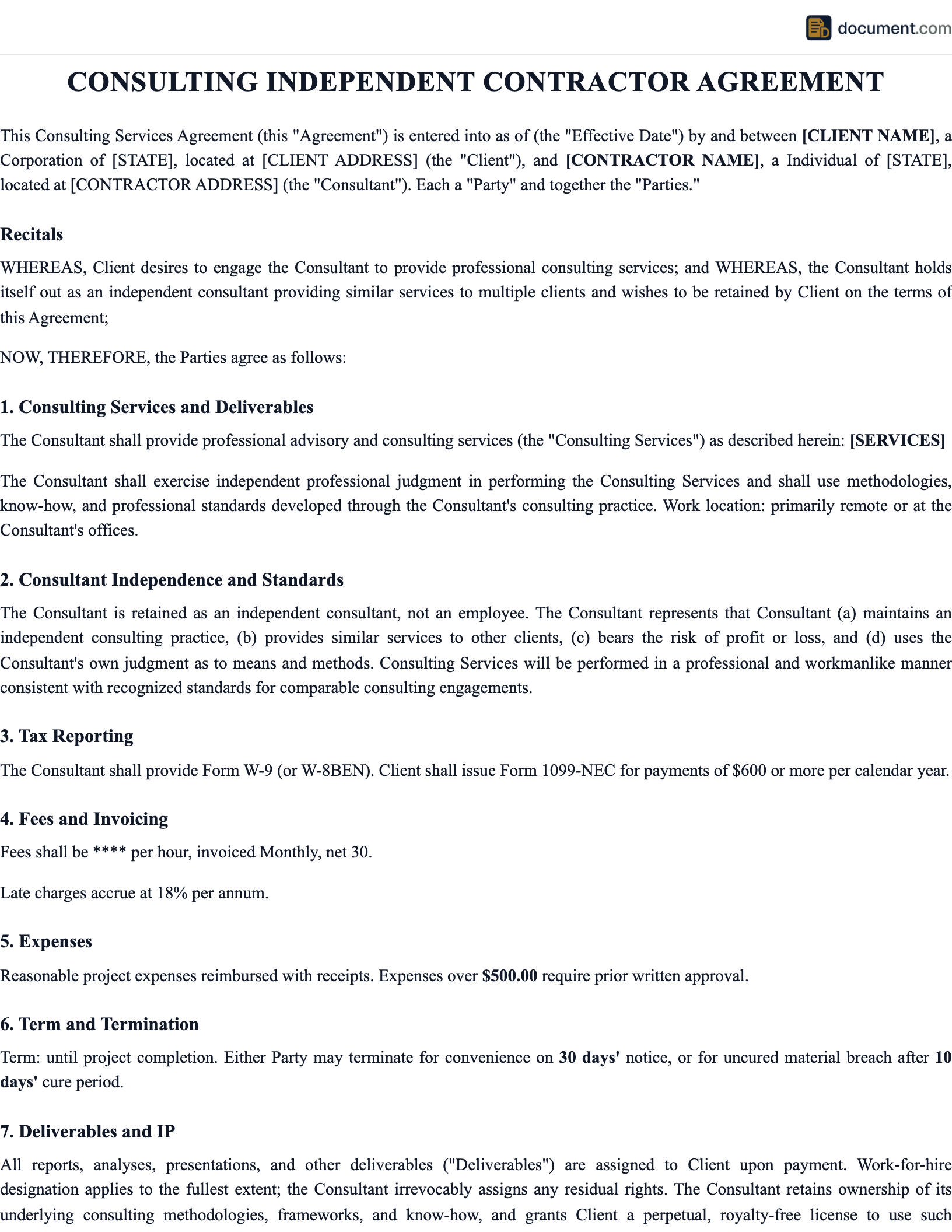



What Is a Consulting Agreement?
A consulting agreement is a contract between a client and a professional consultant that governs an advisory engagement. Unlike a general service agreement — which covers the delivery of a tangible output or physical service — a consulting agreement is structured around the provision of expert knowledge, strategic analysis, and professional recommendations. The consultant brings specialized expertise that the client's organization lacks internally, whether in management strategy, technology architecture, financial planning, regulatory compliance, or organizational transformation.
The legal framework governing consulting agreements intersects independent contractor law, intellectual property law, and professional services regulation. Because consultants are independent contractors — not employees — the agreement must establish the parameters that support proper worker classification under federal IRS standards and state-specific tests (including the ABC test used in California, New Jersey, Massachusetts, and other states). At the same time, the agreement must address the unique dynamics of a consulting relationship: the consultant's deep access to proprietary client information, the advisory (rather than directive) nature of the deliverables, the potential for conflicts of interest with competing clients, and the distinction between the consultant's pre-existing intellectual property and the work product created during the engagement.
Consulting agreements are used across every industry and functional area. A technology startup hires a fractional CTO to build out its engineering infrastructure. A manufacturing company engages a lean operations consultant to reduce waste across its production lines. A private equity firm retains an industry expert to perform commercial due diligence on an acquisition target. A hospital system brings in a compliance consultant to prepare for a Joint Commission accreditation survey. In each case, the consulting agreement defines the engagement boundaries, protects sensitive information, allocates intellectual property rights, and establishes the economic terms.
Our attorney-reviewed consulting agreement templates are built for the realities of professional advisory engagements. They include robust IP provisions that distinguish between the consultant's background IP and newly created deliverables, confidentiality terms calibrated for engagements involving access to trade secrets and strategic plans, fee structures that accommodate hourly, project-based, retainer, and contingency arrangements, and conflict-of-interest provisions that protect the client without unreasonably restricting the consultant's practice.
Defined Engagement
Clear scope, phases, deliverables, and acceptance criteria for the advisory engagement
IP Protection
Separate treatment of consultant's background IP and newly created work product
Confidentiality
Robust protections for strategic plans, financials, and trade secrets shared during advisory work
Consulting Agreement Form Preview
This visual preview illustrates the structure and detail of our consulting agreement template. Your completed document will be customized for your specific engagement type, industry, and fee structure.
Consulting Agreement
Professional Advisory Engagement
Section 1: Parties
Section 2: Scope of Engagement
Section 3: Fees and Payment
Section 4: Signatures
Client Authorized Signatory
Consultant Authorized Signatory
Types of Consulting Agreements
Consulting engagements vary significantly in structure, duration, and compensation model. Select the agreement type that matches your engagement to get a template with provisions specifically designed for that arrangement.
Contingency Fee Consulting Agreement
Performance-based consulting where compensation is tied to measurable outcomes, cost savings, or revenue targets achieved
Retainer Agreement
Ongoing engagement where the consultant reserves dedicated availability for a set number of hours per month or quarter
Consultant vs Employee: Key Distinctions
Hiring a consultant instead of an employee involves fundamentally different legal obligations, tax treatment, and management dynamics. Understanding these distinctions is critical for proper classification and avoiding misclassification penalties.
Employee
- - Works under employer's direction and supervision
- - Uses employer-provided tools, systems, and workspace
- - Works exclusively for one employer (typically)
- - Receives W-2 wages with tax withholding
- - Entitled to benefits, PTO, and protections
- - Work product automatically owned by employer
- - Integrated into company's organizational structure
- - Ongoing relationship with no defined end date
Consultant
- - Controls methodology and approach independently
- - Uses own tools, software, and research resources
- - Serves multiple clients simultaneously
- - Invoices for fees; receives 1099 with no withholding
- - No benefits; responsible for own insurance
- - Owns work product unless assigned by contract
- - Operates outside client's org chart
- - Defined engagement with clear end point
Key takeaway:A consultant advises and recommends — the client decides whether and how to implement. If the client directs the consultant's daily work like an employee, controls the methods used, and integrates the consultant into the company's regular operations, the relationship may be reclassified as employment regardless of what the contract says.
How to Draft a Consulting Agreement: A 7-Step Guide
A well-drafted consulting agreement prevents scope creep, protects intellectual property, ensures proper compensation, and supports independent contractor classification. Follow these seven steps to create an agreement that serves both the client and the consultant.
Define the Engagement Scope and Deliverables
Start by articulating exactly what the consultant will do and what the client will receive. Specify the business problem being addressed, the approach the consultant will take (assessment, analysis, strategy development, implementation support), the concrete deliverables (reports, presentations, models, recommendations), and the timeline including milestones. Describe the desired outcome, not the step-by-step process — prescribing the process undermines independent contractor status.
Select the Appropriate Fee Structure
Choose between hourly rates (best for advisory work with variable scope), fixed project fees (best for defined deliverables), retainers (best for ongoing availability), or contingency/success fees (best when value can be measured). Define payment milestones, invoicing procedures, expense reimbursement policies (with caps and pre-approval thresholds), and late payment terms. Avoid salary-like payment structures — regular bi-weekly payments without invoicing resemble employment.
Address Intellectual Property Ownership
Consulting engagements create a dual-IP challenge. The consultant brings pre-existing IP (frameworks, methodologies, analytical tools, proprietary databases) that should remain the consultant's property. The engagement produces new IP (client-specific analyses, customized strategies, tailored reports) that typically should belong to the client. The agreement must clearly delineate between these two categories and specify the license terms for any pre-existing IP incorporated into the deliverables.
Draft Confidentiality Provisions
Consultants typically gain access to a client's most sensitive information — strategic plans, financial projections, competitive intelligence, customer data, and trade secrets. The confidentiality section should broadly define confidential information, prohibit disclosure and unauthorized use, require secure handling and storage, mandate return or destruction upon engagement completion, and establish survival periods (typically 3-5 years for confidential information, indefinitely for trade secrets). Consider whether the consultant should be permitted to reference the engagement (without disclosing details) for marketing purposes.
Address Conflicts of Interest
Unlike employees, consultants serve multiple clients — which creates the potential for conflicts. The agreement should require the consultant to disclose any existing or potential conflicts, define what constitutes a conflict (simultaneously advising a direct competitor on the same business issue), and specify the remedy (typically, client consent or engagement termination). Avoid blanket non-compete provisions that prevent the consultant from working in their entire field — these are difficult to enforce for independent contractors and may undermine classification.
Include a Change Management Process
Scope creep destroys consulting engagements. Build in a formal process for handling changes: any work outside the original scope requires a written change order or statement of work amendment signed by both parties before work begins. The change order should describe the additional work, the impact on timeline and fees, and any modifications to existing deliverables. Set a materiality threshold below which minor adjustments do not require formal change orders.
Define Termination and Transition
Specify how either party can end the engagement and what happens afterward. Include termination for convenience (with 15-30 days notice), termination for cause (material breach, conflict of interest, breach of confidentiality), and natural completion. The transition provisions should require knowledge transfer, delivery of all work product and documentation, return of client materials and credentials, and final invoicing. Specify which provisions survive termination — confidentiality, IP assignment, indemnification, and non-solicitation typically continue post-termination.
Key Components of a Consulting Agreement
A comprehensive consulting agreement must address the specific dynamics of advisory engagements, from scope management to knowledge transfer. The table below outlines the essential provisions.
| Component | Description |
|---|---|
| Engagement Scope | Business problem, approach, specific deliverables, milestones, and acceptance criteria |
| Fee Structure | Hourly, project, retainer, or contingency; payment schedule; expenses; late payment terms |
| Term and Termination | Start and end dates, termination for convenience and cause, notice periods, transition obligations |
| Intellectual Property | Background IP vs engagement IP, assignment clauses, pre-existing tools license, moral rights waiver |
| Confidentiality | Definition, obligations, permitted disclosures, secure handling, return/destruction, survival period |
| Conflict of Interest | Disclosure requirements, definition of competing engagements, client consent process |
| Change Management | Change order process, scope amendment procedures, materiality thresholds, fee adjustments |
| Standard of Care | Professional standards commitment, industry best practices, qualifications representation |
| Insurance | Professional liability (E&O), general liability, coverage minimums, certificate requirements |
| Indemnification | Mutual indemnification, carve-outs for negligence and willful misconduct, defense obligations |
| Non-Solicitation | Restrictions on soliciting client's employees and customers for a defined post-engagement period |
| Dispute Resolution | Mediation, arbitration, or litigation; governing law; venue; fee-shifting provisions |
Consulting Fee Structures Compared
The fee structure you choose affects project economics, risk allocation, and the consultant's incentives. Each model has distinct advantages depending on the nature of the engagement.
Hourly Rate
Best for advisory work with evolving scope or uncertain duration. Client pays for actual hours worked.
- - Client bears overrun risk
- - Flexible scope adjustments
- - Requires time tracking and approval
- - Common rates: $150-$500+/hour
Fixed Project Fee
Best for defined deliverables with clear scope. Consultant bears the risk of cost overruns.
- - Consultant bears overrun risk
- - Predictable client budget
- - Requires precise scope definition
- - Milestone-based payments typical
Monthly Retainer
Best for ongoing advisory relationships where the client needs regular access to the consultant.
- - Guaranteed consultant availability
- - Predictable recurring revenue for consultant
- - Must define included hours and scope
- - Address rollover and overage policies
Contingency / Success Fee
Best when engagement value can be quantified — cost savings, revenue growth, deal closure.
- - Aligns consultant incentives with outcomes
- - Lower upfront cost for client
- - Must define measurable success metrics
- - Often combined with reduced base fee
Frequently Asked Questions
Find answers to common questions about consulting agreements, engagement structures, fee arrangements, and intellectual property in consulting relationships.
Official Resources
For additional guidance on consulting agreements, independent contractor classification, and professional services best practices, consult these official resources.
IRS - Worker Classification
IRS guidance on determining whether a worker is an employee or independent contractor
SBA - Hiring Guide
Small Business Administration guide to hiring employees and independent contractors
DOL - Misclassification
Department of Labor guidance on employee misclassification under the FLSA
IRS - Form 1099-NEC
Information on reporting non-employee compensation to independent contractors
FTC - Non-Compete Rules
Federal Trade Commission guidance on non-compete clause restrictions
U.S. Copyright Office - Work Made for Hire
Official circular on work-made-for-hire doctrine and independent contractor IP ownership
Ready to Create Your Consulting Agreement?
Select your engagement type, define your scope and fee structure, and download your attorney-reviewed consulting agreement in minutes. Customized for your industry, engagement model, and state requirements.
Create DocumentNo account required. Free to create and preview.