



What Is a Retainer Agreement?
A retainer agreement is a contract where a client pays a recurring fee to secure ongoing access to a consultant's expertise and availability. Unlike a project-based agreement that covers a single engagement with a defined scope and end date, a retainer establishes a continuing advisory relationship where the consultant is available to provide services on an as-needed basis within agreed parameters. The retainer model has its origins in the legal profession — where clients have historically paid attorneys a monthly fee to be "on retainer" for ongoing counsel — but has expanded to virtually every professional services field, from accounting and marketing to web development and business strategy.
The economic logic of a retainer benefits both parties. For the client, a retainer guarantees access to specialized expertise without the delay and transaction cost of negotiating a new contract for each request. When a compliance question arises at 4 PM on a Friday, the retained attorney can be reached immediately. When the website needs an emergency fix during a product launch, the retained developer is already familiar with the codebase and has committed availability. For the consultant, a retainer provides predictable recurring revenue, reduces the time spent on sales and proposals, and creates a deeper client relationship that leads to higher-value work over time.
The legal structure of a retainer agreement requires particular care because the ongoing, recurring nature of the relationship can blur the line between independent contractor and employee. A consultant who works 40 hours per week for a single client on an indefinite retainer, uses the client's tools, attends daily standups, and reports to a manager starts to look like a de facto employee regardless of what the contract says. To maintain independent contractor status, the retainer must preserve the consultant's autonomy over how work is performed, permit the consultant to serve other clients, and avoid employee-like control over schedule and methods.
Our retainer agreement templates address the specific challenges of ongoing advisory relationships: hour allocation and tracking, rollover and overage policies, scope boundary definition, rate adjustment mechanisms, renewal and termination provisions, and the classification-protective language that supports IC status in a continuing engagement. Templates are available for legal, accounting, marketing, web development, business development, and other common retainer categories.
Ongoing Access
Guaranteed consultant availability with defined monthly hours and priority response times
Predictable Costs
Fixed monthly fee with clear rollover, overage, and rate adjustment provisions
IC Classification
Structure that preserves independent contractor status despite the ongoing relationship
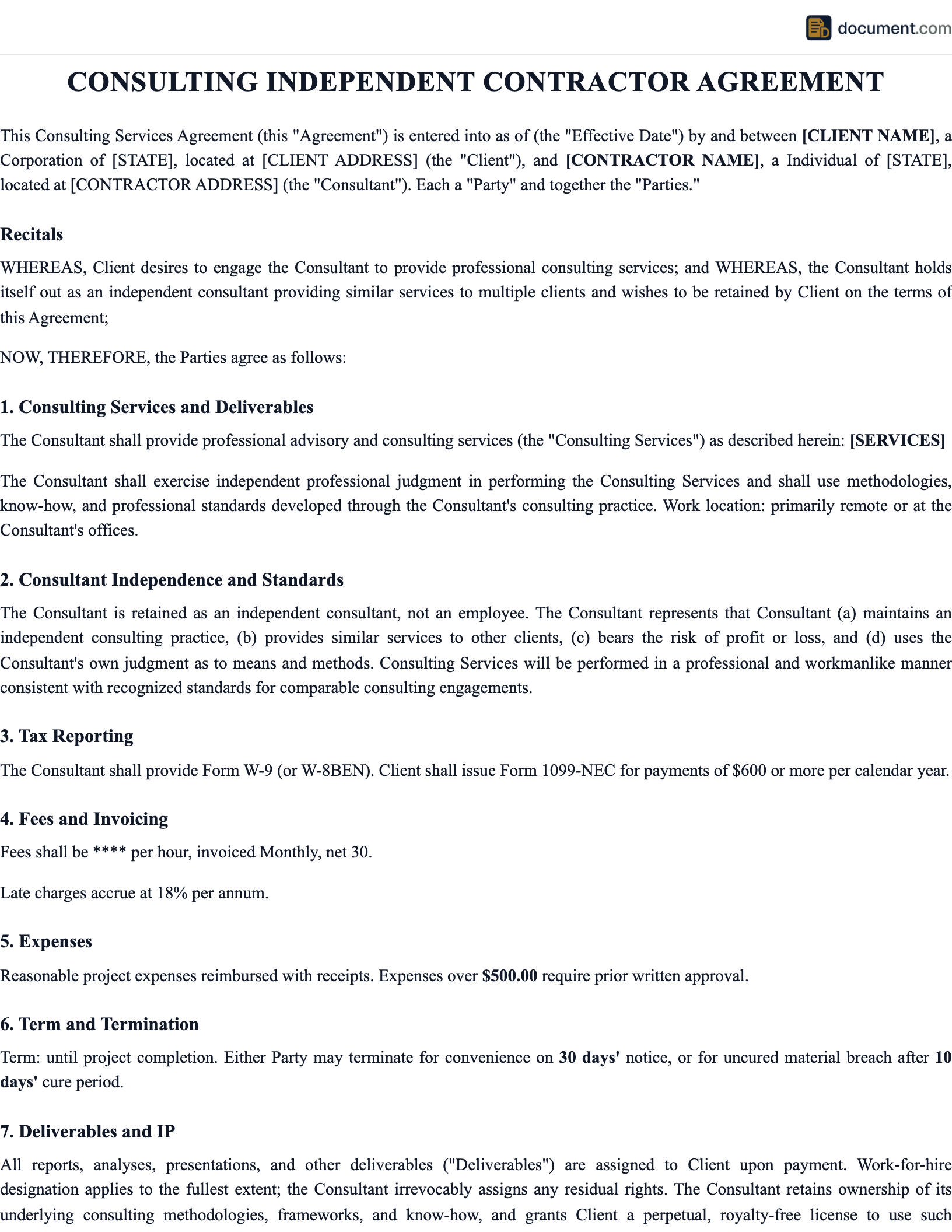
Retainer Agreement Form Preview
This visual preview illustrates the structure and detail of our retainer agreement template, including the hour allocation, fee, rollover, and renewal provisions that distinguish a retainer from a standard project-based agreement.
Retainer Agreement
Ongoing Consulting Engagement
Section 1: Parties
Section 2: Retainer Terms
Section 3: Scope of Services
Section 4: Signatures
Client Authorized Signatory
Consultant
Types of Retainer Agreements
Retainer agreements serve a wide range of professional services. Each type has unique scope definitions, deliverable expectations, and industry-specific provisions. Select the retainer type that matches your engagement.
Accounting Retainer
Ongoing accounting, bookkeeping, and financial reporting services on a monthly retainer basis
Advertising Agency Retainer
Agency retainer for campaign management, creative development, media buying, and brand strategy
Business Development Retainer
Ongoing business development, partnership cultivation, and revenue growth advisory on retainer
Expert Witness Retainer
Retainer for expert witness availability, case consultation, report preparation, and testimony
Freelance Retainer
General freelance retainer for ongoing creative, technical, or professional services
Interior Design Retainer
Ongoing interior design advisory, project management, and procurement on a retainer basis
Legal Retainer
Attorney retainer for ongoing legal counsel, contract review, and compliance advisory
Real Estate Retainer
Real estate consultant retainer for property analysis, market research, and transaction advisory
Web Design Retainer
Ongoing web design services including updates, new pages, design refresh, and UX improvements
Web Development Retainer
Ongoing web development, maintenance, feature development, and technical support on retainer
Retainer vs Project-Based Engagement
Choosing between a retainer and a project-based engagement depends on the nature of the work, the duration of the need, and the predictability of the scope. Each model has distinct advantages.
Retainer
- - Ongoing, open-ended advisory relationship
- - Work varies month to month based on need
- - Guaranteed consultant availability on demand
- - Fixed monthly fee for predictable budgeting
- - Deeper client knowledge over time
- - Faster response — no scoping delays
- - Risk: paying for unused hours
- - Best for: ongoing advisory, maintenance, support
Project-Based
- - Defined scope with clear start and end
- - Specific deliverables and milestones
- - Consultant availability not guaranteed between projects
- - Pay only for defined work performed
- - New contract needed for each engagement
- - Scoping and negotiation delay for each project
- - Risk: scope creep without change management
- - Best for: one-time projects, defined deliverables
Key takeaway:Use a retainer when you need ongoing, recurring access to a consultant's expertise and the specific tasks will vary over time. Use a project-based agreement when you have a defined deliverable with a clear endpoint and do not anticipate ongoing need for the consultant's services.
How to Structure a Retainer Agreement: A 7-Step Guide
A well-structured retainer provides ongoing advisory access while protecting both parties from scope ambiguity, billing disputes, and classification risk. Follow these steps to build a retainer that works.
Define the Scope Categories
Instead of defining a specific project scope, define the categories of work included in the retainer. For a legal retainer: contract review, employment law questions, vendor negotiations, regulatory compliance guidance. For a web development retainer: bug fixes, feature enhancements, performance optimization, security patches. Equally important, define what is not included — work that falls outside the retainer scope and requires a separate engagement or SOW addendum.
Set the Monthly Hour Allocation and Fee
Determine the monthly hour allocation based on anticipated demand — light advisory (5-10 hours), standard support (15-25 hours), or embedded engagement (30-60+ hours). The monthly fee should reflect the hourly rate multiplied by the allocation, typically at a 10-20% discount from the consultant's standard hourly rate to reflect the guaranteed volume and revenue predictability. Specify whether the retainer fee is earned upon receipt (classic retainer) or drawn down as hours are used (advance retainer). Include a ramp-up period of 2-3 months where the allocation can be adjusted as both parties calibrate actual demand.
Establish Rollover and Overage Policies
Define what happens to unused hours and how overages are handled. For rollover, choose between use-it-or-lose-it, limited rollover (cap at 25-50% of monthly allocation), or full rollover (with an expiration date, typically 90 days). For overages, define the overage rate (typically the standard hourly rate or 110-125% premium), the approval process (pre-approval required vs automatic billing with threshold notification), and whether the client can purchase additional hour blocks at a discounted rate. These provisions are among the most negotiated in retainer agreements — get them right upfront to avoid monthly billing disputes.
Define Response Times and Availability
One of the primary benefits of a retainer is guaranteed access. Define the consultant's availability commitments: business hours availability, response time for initial acknowledgment (typically 4-8 business hours), response time for substantive work (24-48 hours), and any emergency or after-hours provisions. Be specific but reasonable — avoid commitments that resemble an employee's schedule (daily standups, mandatory office hours, real-time availability requirements), which can undermine independent contractor classification. The consultant should control when and how they work within the response time framework.
Build in Reporting and Transparency
Require the consultant to provide regular utilization reports showing hours consumed, work completed, and remaining allocation. Monthly reports should include: detailed time entries by task or project, total hours used and remaining, any rollover hours carried forward, overage hours and charges, and a summary of key activities and outcomes. Some retainer agreements include a quarterly business review where both parties assess the engagement's value, adjust the scope or allocation if needed, and plan for the upcoming quarter.
Set the Term and Renewal Mechanism
Define the initial term (typically 3, 6, or 12 months) and the renewal mechanism. Auto-renewal with an opt-out notice period (30-60 days before the renewal date) is the most common approach. Include a rate adjustment provision allowing the consultant to propose fee changes at renewal with advance notice. If the retainer includes a volume commitment or term discount, specify what happens if the client terminates early — whether the discount is clawed back for the completed portion of the term. A mid-term review provision at the halfway point lets both parties recalibrate before committing to another full term.
Protect IC Classification in Ongoing Relationships
The ongoing nature of retainers creates heightened classification risk. Reinforce IC status by: preserving the consultant's control over methods and schedule, expressly permitting the consultant to serve other clients, avoiding employee-like control provisions (required attendance at meetings, mandatory use of client tools, performance reviews), and ensuring the consultant invoices for services rather than receiving salary-like payments. The agreement should not create an exclusive relationship, provide employee benefits, or integrate the consultant into the client's organizational reporting structure.
Warning: A high-hour retainer (30+ hours/month) with a single client, combined with exclusive arrangements and employee-like integration, is a significant misclassification risk — particularly in ABC-test states like California, New Jersey, and Massachusetts.
Key Components of a Retainer Agreement
A retainer agreement includes all the standard consulting agreement provisions plus retainer-specific terms for hours, rollover, renewal, and ongoing scope management.
| Component | Description |
|---|---|
| Hour Allocation | Monthly hours included, how hours are tracked, minimum billing increment |
| Retainer Fee | Monthly amount, payment due date, earned vs unearned treatment, payment method |
| Rollover Policy | Whether unused hours roll over, cap on banked hours, rollover expiration |
| Overage Terms | Rate for hours beyond allocation, pre-approval requirements, notification thresholds |
| Scope Categories | Types of work included and excluded, process for adding new scope categories |
| Availability and Response | Response time commitments, business hours availability, emergency provisions |
| Reporting | Monthly utilization reports, time tracking detail, quarterly reviews |
| Term and Renewal | Initial term, auto-renewal mechanism, opt-out notice period, rate adjustment |
| Confidentiality | Ongoing NDA obligations, handling of accumulated knowledge, survival period |
| IP and Work Product | Ownership of deliverables created under retainer, background IP license, knowledge base |
| Termination | Notice requirements, refund of prepaid fees, transition and knowledge transfer, wind-down |
| Non-Solicitation | Restrictions on hiring each other's employees during and after the retainer |
Rollover and Overage Policies Compared
How you handle unused and exceeded hours is one of the most commercially important provisions in a retainer agreement. The right policy depends on usage patterns and the balance of negotiating power.
Use-It-or-Lose-It
Unused hours expire at period end. Consultant is paid for availability, not just utilization.
- - Simplest to administer
- - Consultant bears no rollover demand risk
- - Client incentivized to fully utilize allocation
- - Most favorable to consultant
Limited Rollover
Unused hours roll forward with a cap — typically 25-50% of monthly allocation.
- - Most common compromise
- - Client flexibility for variable demand
- - Cap prevents excessive accumulation
- - Banked hours often expire after 60-90 days
Pre-Approved Overages
Client must approve additional hours before consultant exceeds the monthly allocation.
- - Client controls budget exposure
- - Consultant bills at standard or premium rate
- - Written approval creates audit trail
- - Prevents surprise invoices
Flex Band
Small overages and underages (within 10-15%) are absorbed, reducing administrative friction.
- - Reduces monthly billing discussions
- - Natural month-to-month variation absorbed
- - Pre-approval only for larger overages
- - Requires trust between parties
Frequently Asked Questions
Find answers to common questions about retainer agreements, hour management, fee structures, renewal, and how to maintain independent contractor status in ongoing consulting relationships.
Official Resources
For additional guidance on retainer agreements, independent contractor classification, and professional services contracting, consult these official resources.
IRS - Worker Classification
IRS guidance on independent contractor vs employee classification for ongoing engagements
ABA - Model Rules on Fees
American Bar Association rules on retainer fees, earned vs unearned, and trust accounts
SBA - Hiring Guide
Small Business Administration guide to hiring contractors on retainer
DOL - Misclassification
Department of Labor guidance on misclassification risks in ongoing contractor relationships
IRS - Form 1099-NEC
Reporting retainer payments and non-employee compensation to consultants
FTC - Non-Compete Rules
Federal guidance on non-compete and exclusivity restrictions in contractor agreements
Ready to Create Your Retainer Agreement?
Select your retainer type, define your hour allocation and fee structure, and download your attorney-reviewed retainer agreement in minutes. Includes rollover, overage, renewal, and classification-protective provisions.
Create DocumentNo account required. Free to create and preview.