
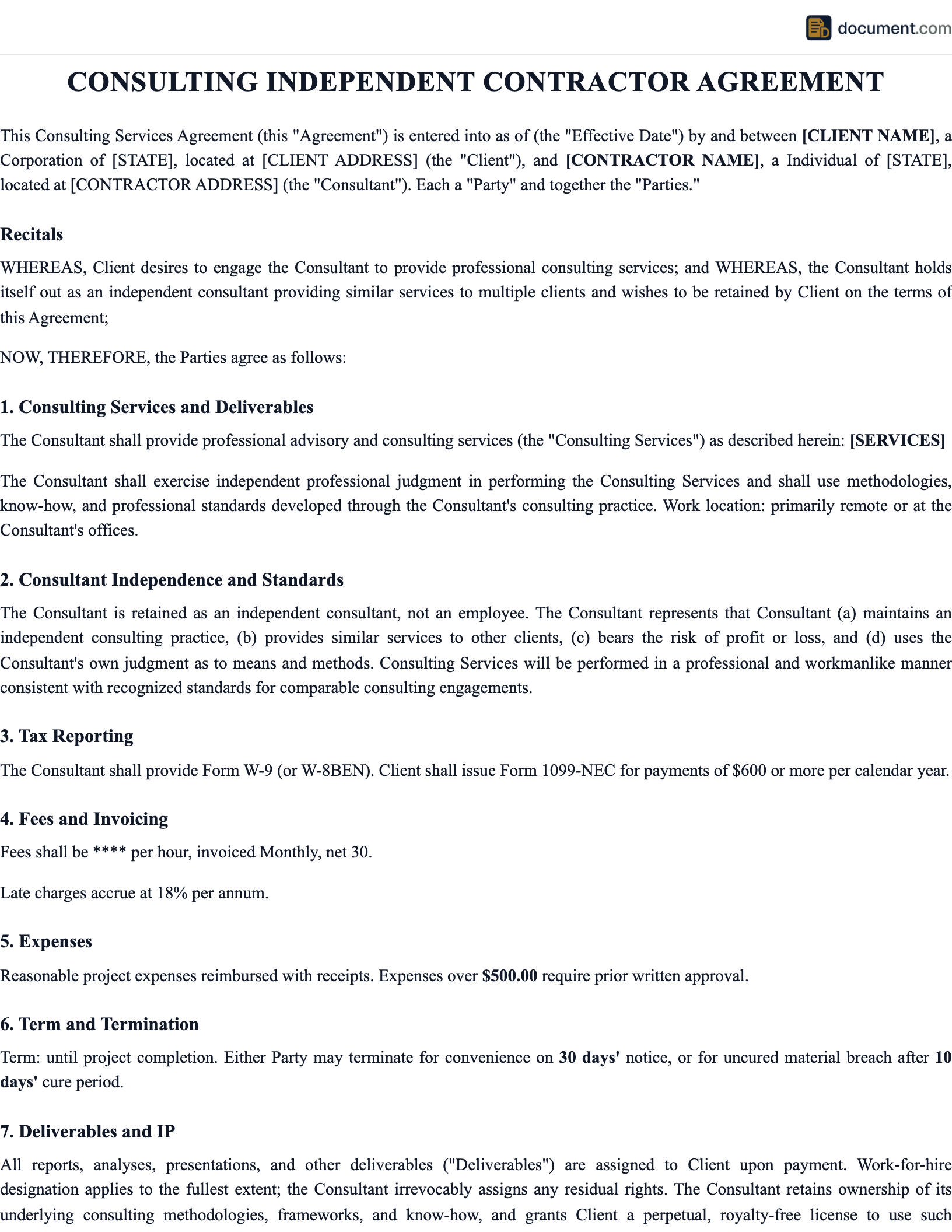



What Is a Business Development Retainer Agreement?
A business development retainer is a continuing services agreement engaging an outsourced growth executive (typically a fractional VP of Business Development or boutique advisory firm) on a defined hour bank per month, supplemented by commissions on closed deals. The instrument controls scope, monthly retainer fee, commission structure (flat, tiered, or residual), exclusivity around named competitors, lead and pipeline ownership, expense reimbursement, reporting cadence, tail-period commission rights protecting the consultant on deals that close after termination, and the worker classification recital required to keep the engagement outside employment statutes. Sales-rep commission rules are largely state-statutory: California Cal. Lab. Code § 2751 requires written commission agreements with all sales representatives; New York Labor Law § 191(c) regulates commission payment timing; and many states adopt some form of the Uniform Sales Representatives Act protecting independent reps.
BD work runs on long sales cycles (3 to 12 months for enterprise deals, longer for strategic partnerships and channel agreements). The retainer compensates ongoing effort (market research, executive introductions, pipeline cultivation) while the commission aligns long-cycle outcomes. Companies use BD retainers when they need senior growth expertise but cannot justify a full-time VP hire, when entering a new vertical without in-house relationships, or when supplementing internal sales with specialized sector knowledge. The contract should specify target markets, ICP (ideal customer profile), commission calculation methodology, lead ownership, attribution rules, minimum-pipeline thresholds where applicable, and the post-termination tail period.
Commission structures: flat, tiered, residual
Three commission structures dominate BD retainers. Flat percentage pays a fixed rate on first-year contract value (FYCV), typically 5 to 15 percent depending on deal size and complexity. Tiered escalates against quota: 5 percent on the first $250,000, 8 percent above $250,000, 12 percent above $1,000,000. Residual pays a smaller percentage (1 to 3 percent) on renewals and upsells in years 2 through 5, recognizing the consultant's relationship investment. The contract must state the basis (FYCV, total contract value, gross margin, net of cost-to-deliver), the accrual trigger (signed contract, invoice issued, payment received), and the clawback period (90 days for SaaS to recover commission on cancelled deals, 6 months for services). California Cal. Lab. Code § 2751 requires the commission formula and payment terms in writing signed by both parties.
Lead-source attribution and pipeline ownership
The most common BD dispute is whether a closed deal originated from the consultant's effort. Define attribution rules in writing using first-touch registration: the consultant must register each prospect in the client's CRM (Salesforce, HubSpot, Pipedrive) within 5 business days of first contact, naming the company, primary contact, and source of introduction. A prospect is owned by the consultant if they registered it first. Commissions accrue only on registered prospects that close within the term plus the tail period. All leads, prospect lists, pipeline opportunities, customer introductions, contact records, and CRM data created or developed during the engagement belong to the client; the consultant cannot maintain a parallel personal database. Customer lists qualify as trade secrets under the Defend Trade Secrets Act (18 U.S.C. § 1836) and state Uniform Trade Secrets Act adoptions if the company maintains reasonable secrecy measures.
Growth-Focused
Dedicated senior-level focus on pipeline, partnerships, and market expansion.
Aligned Incentives
Base retainer plus commission aligns effort with measurable revenue outcomes.
Market Access
Leverage the consultant's established industry relationships and network.
BD Retainer Form Preview
Business Development Retainer Agreement
Lead Generation, Partnerships & Revenue Growth
Section 1: Parties
Section 2: Services & Target Markets
Section 3: Compensation
Key Components
BD Scope & Target Markets
Industries, geographic regions, company-size tiers, and types of opportunities the consultant will pursue.
Monthly Retainer Fee
Guaranteed monthly fee, payment terms, and the minimum hours of BD effort reserved per month.
Commission Structure
Percentage of closed-deal revenue, calculation methodology, payment triggers, and split rules for co-sourced deals.
Tail-Period Commissions
Post-termination window (6-12 months) during which the consultant earns commissions on deals they originated.
Lead Ownership
All leads, pipeline data, and prospect introductions generated during the retainer belong to the client.
Exclusivity & Non-Compete
Named-competitor restrictions or industry-vertical exclusivity during the retainer term.
Reporting Requirements
Weekly pipeline updates, monthly activity reports, and quarterly business reviews with revenue attribution.
Expense Reimbursement
Travel, entertainment, and event expenses. Reimbursable categories, pre-approval thresholds, and documentation.
Confidentiality
Protection of client pricing, customer lists, product roadmaps, and strategic plans.
Termination
Notice period, final billing, commission settlement, and return of client materials.
How to Create a BD Retainer Agreement
Define the target market and BD objectives
Specify the industries, company-size tiers, geographic regions, and types of deals (new logos, partnerships, channel agreements) the consultant will pursue.
Set the retainer fee and hours
Establish the guaranteed monthly fee, the minimum hours of effort, and the hourly rate for work beyond the allotment.
Structure the commission model
Define the commission percentage, the revenue base (first-year ACV, total contract value, gross margin), payment timing, and whether renewals or upsells are commissionable.
Address lead ownership and CRM access
Require all leads and pipeline data to be entered in the client's CRM. Specify that contact information and prospect relationships belong to the client.
Include the tail period
Define the post-termination window (typically 6-12 months) during which the consultant earns commissions on deals they sourced. List the qualifying criteria.
Add confidentiality and non-compete terms
Protect client pricing, customer lists, and strategic plans. Include named-competitor restrictions if applicable.
Draft reporting and termination provisions
Specify reporting cadence, minimum report content, the notice period for termination, and the commission settlement process.
Compensation Models
| Model | Structure | Best For |
|---|---|---|
| Retainer Only | Fixed monthly fee with no commission | Strategic advisory, market research, partner identification |
| Retainer + Commission | Base fee plus 5-15% on closed deals | Most BD engagements; balances effort and outcomes |
| Retainer + Success Fee | Base fee plus flat bonus per deal milestone | Partnership development, channel agreements |
| Draw Against Commission | Monthly draw offset against future commissions | High-volume transactional BD with shorter sales cycles |
Exclusivity & Non-Compete Considerations
Exclusivity is a frequent negotiation point in BD retainer agreements. The client wants the consultant focused on their growth without splitting attention with competitors, while the consultant wants the freedom to diversify their revenue base. The agreement should address this tension explicitly.
Named-Competitor Restriction
The most common approach: the client identifies three to five specific competitors by name. The consultant agrees not to work with those companies during the retainer.
Vertical Exclusivity
Broader restriction preventing the consultant from working with any company in the client's industry vertical. Commands a premium retainer fee.
Post-Termination Non-Compete
Extension of the restriction after the retainer ends. Subject to state-law enforceability limits; unenforceable in California (Cal. Bus. & Prof. Code § 16600), Minnesota, Oklahoma (Okla. Stat. tit. 15 § 219A), and North Dakota (N.D. Cent. Code § 9-08-06).
Frequently Asked Questions
Official Resources
SBA - Small Business Administration
Business growth, market research, and partnership development resources.
IRS - Worker Classification
Independent contractor vs. employee classification guidance.
FTC - Business Guidance
Federal Trade Commission rules on business practices and competition.
DOL - Wage & Hour Division
Worker classification and wage requirements for independent contractors.
U.S. Chamber of Commerce
Business development resources and networking opportunities.
SCORE - Mentorship
Free business mentoring and growth planning resources.
Ready to Create Your BD Retainer Agreement?
Define your growth objectives, commission structure, and performance terms in minutes.
Create DocumentNo account required. Free to create and preview.