



What Is a Real Estate Retainer Agreement?
A real estate retainer is a continuing services agreement binding a property owner, investor, developer, or corporate real estate department (the client) and a real estate consultant, broker, or advisory firm. The instrument reserves the consultant's capacity for portfolio-level work and controls the scope of services, monthly fee, transaction commissions where licensure permits, exclusivity and territory, fiduciary duties under the licensing state's agency statutes, broker-of-record relationship, confidentiality of acquisition pipelines and rent rolls, and the tail-period commission rights protecting the consultant on deals sourced during the term that close after termination. The retainer fits institutional investors, family offices, corporate occupiers with multi-state portfolios, REITs, and active private investors closing multiple transactions per year.
Real estate brokerage is one of the most heavily regulated professional services in the United States. All 50 states require licensure to negotiate transactions for compensation, with civil and criminal penalties for unlicensed practice (California Cal. Bus. & Prof. Code § 10130, Texas Tex. Occ. Code § 1101.351, New York N.Y. Real Prop. Law § 440-a, Florida Fla. Stat. § 475.42). The retainer must clearly identify which services constitute licensed brokerage and which do not. Advisory work that stops short of negotiating with the counterparty (market analysis, underwriting, feasibility, asset management oversight) is generally exempt; the moment the consultant presents an offer or solicits a listing, licensure attaches.
License limitations and broker-of-record relationship
Real estate licensure attaches both to natural-person salespersons and brokers and to brokerage entities. Every salesperson must associate with a broker-of-record who supervises transactions, holds escrow funds in regulated trust accounts, and bears regulatory responsibility under state real estate commission rules. Texas (Tex. Occ. Code § 1101.451) and California (Cal. Bus. & Prof. Code § 10159.2) specifically require broker-of-record review and approval of all written brokerage agreements, including retainers. The contract must identify the broker-of-record by name and license number, describe the supervisory relationship, allocate the commission split between consultant and brokerage (typically 50/50 to 80/20 in favor of the consultant), and address what happens if the consultant changes brokerages mid-term. Misidentifying or omitting the broker-of-record is a license-suspension offense in most states.
Advisory fee vs commission and the dual-payment trap
The most common dispute in real estate retainers is whether the consultant earns both the monthly fee and a transaction commission. Three structures resolve the issue. Pure retainer pays the monthly fee and no commission; the consultant cannot earn brokerage fees. Retainer plus commission pays both with no offset, suitable when the retainer covers advisory work distinct from the brokered transaction. Retainer with commission credit applies the retainer against earned commissions so the consultant receives the larger of the two. Industry commission rates run 1 to 3 percent on acquisitions over $5 million (sliding to 0.5 to 1 percent above $50 million), 3 to 6 percent on leasing commissions paid by the landlord, and a flat consulting fee on advisory engagements. State the structure in writing; the statute of frauds (Cal. Civ. Code § 1624(a)(4) and parallel state statutes) requires brokerage commission agreements to be written.
Portfolio Strategy
Ongoing advisory across acquisitions, asset management, and dispositions.
Market Intelligence
Continuous access to deal flow, comparable data, and market trends.
Transaction Support
Deal sourcing, underwriting, negotiation, and closing coordination.
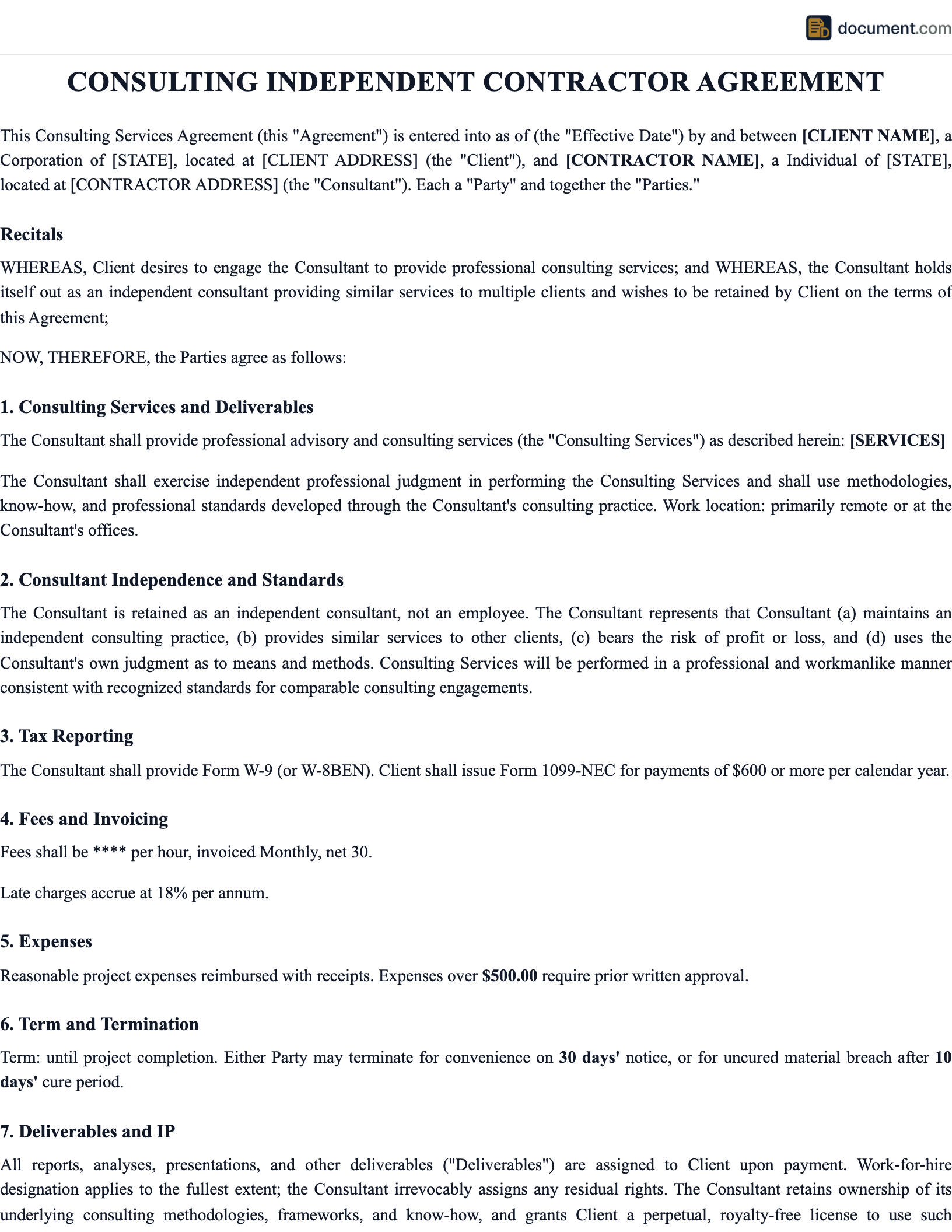
Real Estate Retainer Form Preview
Real Estate Retainer Agreement
Investment Advisory & Brokerage Services
Section 1: Parties
Section 2: Services
Section 3: Compensation
Key Components
Parties & Licensing
Legal names, broker license numbers, and state(s) of licensure for brokerage activities.
Scope of Services
Advisory, brokerage, asset management, development consulting with clear in-scope and out-of-scope boundaries.
Monthly Retainer Fee
Guaranteed monthly fee, included hours, and overage billing for additional advisory time.
Commission Structure
Transaction-based commission rates for acquisitions, dispositions, and leasing, with calculation methodology.
Exclusivity & Territory
Whether the consultant has exclusive rights within defined markets, property types, or geographic areas.
Tail-Period Rights
Post-termination window for commissions on deals sourced during the retainer.
Fiduciary Duties
Loyalty, disclosure, confidentiality, and accounting duties for licensed brokerage activities.
Confidentiality
Protection of portfolio data, investment criteria, cap rates, rent rolls, and negotiating positions.
Insurance
Professional liability, general liability, and state-required E&O coverage for licensed brokers.
Termination & Transition
Notice period, treatment of pending transactions, commission settlement, and file handoff.
How to Create a Real Estate Retainer Agreement
Identify the parties and licensing status
Include the client entity, the consultant/broker, broker license numbers, and the states in which the consultant is licensed.
Define advisory and brokerage services
List the specific services: deal sourcing, underwriting, market analysis, lease negotiation, asset management, disposition strategy.
Set the retainer fee and commission structure
Establish the monthly advisory fee, commission rates for different transaction types, the commission calculation base, and whether the retainer offsets commissions.
Address exclusivity and territory
Define whether the consultant has exclusive rights, the geographic scope, property types covered, and named-competitor restrictions.
Include fiduciary duty provisions
For licensed brokerage activities, specify the fiduciary duties owed, agency disclosures required by state law, and conflicts-of-interest procedures.
Add the tail period
Define the post-termination window (typically 6-12 months) during which the consultant earns commissions on deals they sourced.
Draft termination and transition mechanics
Notice period, treatment of pending transactions, commission settlement timeline, and return of confidential information.
Service Types
| Service | Description | License Required? |
|---|---|---|
| Investment Advisory | Deal sourcing, underwriting, market analysis, portfolio strategy | Generally no |
| Brokerage | Negotiating purchase, sale, or lease on behalf of client | Yes, all states |
| Asset Management | Financial reporting, capital planning, NOI optimization | Generally no |
| Development Consulting | Feasibility, entitlement, construction oversight | Generally no |
Licensing & Fiduciary Duties
Real estate consultants who broker transactions must hold a valid real estate license and comply with state-specific agency disclosure and fiduciary duty requirements. The retainer agreement should clearly delineate which services constitute licensed brokerage activity and which are unlicensed advisory.
State Licensing Requirements
Every state requires a real estate license for brokering transactions. License numbers and state(s) of licensure should be included in the retainer.
Fiduciary Duties
Licensed brokers owe loyalty, obedience, disclosure, confidentiality, accounting, and reasonable care to their clients.
Agency Disclosure
Most states require written agency disclosure at the outset of any brokerage relationship. The retainer should incorporate or reference this disclosure.
Frequently Asked Questions
Official Resources
NAR - National Association of Realtors
Industry standards, ethics code, and broker resources.
ARELLO
Association of Real Estate License Law Officials. Licensing requirements by state.
CCIM Institute
Commercial real estate investment and advisory certification.
SIOR
Society of Industrial and Office Realtors. Commercial brokerage standards.
IREM
Institute of Real Estate Management. Property management standards.
SBA - Financial Management
Business financial management and real estate investment resources.
Ready to Create Your Real Estate Retainer?
Define advisory scope, commission terms, and fiduciary duties in an attorney-reviewed retainer agreement.
Create DocumentNo account required. Free to create and preview.