



What Is a Property Management Agreement?
A property management agreement is a legally binding contract between a property owner (sometimes called the landlord, principal, or client) and a property manager (an individual or management company) that establishes the terms under which the manager will oversee, operate, and maintain the owner's real estate on the owner's behalf. The agreement functions as both a service contract and an agency authorization — it defines exactly what the manager is hired to do, how much they will be paid, what authority they have to act on the owner's behalf, and what happens if either party wants to end the relationship.
At its core, the agreement creates an agency relationship. The property manager becomes the owner's authorized representative for interacting with tenants, contractors, vendors, and sometimes government agencies. This means the manager can sign leases, collect rent, issue notices, hire repair contractors, and handle tenant disputes — all on the owner's behalf and within the limits set by the agreement. Because the manager is acting as the owner's agent, the owner is generally liable for the manager's actions taken within the scope of the agreement, which is why clearly defining that scope is so important.
Unlike an informal handshake arrangement, a written property management agreement protects both parties by establishing expectations upfront. For the owner, the agreement ensures that the manager will perform specific services at an agreed-upon price and holds the manager accountable for financial reporting, maintenance standards, and legal compliance. For the manager, the agreement confirms their authority to act, protects them from claims that they exceeded their mandate, and guarantees their compensation for services rendered. Courts and insurance companies both rely heavily on the written agreement when disputes arise, making a thorough, well-drafted contract essential.
Property management agreements are used for every type of investment real estate — single-family rental homes, duplexes and triplexes, apartment buildings, condominiums, commercial office buildings, retail centers, industrial properties, and vacation rentals. The specific provisions will vary based on the property type, but the fundamental structure remains the same: scope of services, fees, responsibilities, insurance, term, and termination.
Legal Protection
Define authority, liability, and indemnification so both owner and manager are protected
Fee Transparency
Lock in management fees, leasing fees, and maintenance markups before the relationship begins
Clear Expectations
Spell out exactly which services the manager will provide and what falls outside the scope
Property Management Agreement by State
Licensing requirements, fee caps, and trust-account rules for property managers vary by state. Select your state for an agreement template that aligns with your jurisdiction's real estate regulations.
Who Needs a Property Management Agreement?
Any property owner who hires someone else to manage their rental property should use a formal property management agreement. Without one, both parties are exposed to misunderstandings, financial disputes, and legal liability. The following situations make a written agreement especially important.
Rental Property Investors
Investors who own one or more rental properties and want professional management to handle tenant relations, rent collection, maintenance coordination, and legal compliance so they can focus on acquiring additional properties or managing other business interests. A management agreement ensures the investor retains control over major decisions while delegating day-to-day operations.
Out-of-State or Distant Owners
Property owners who live far from their rental properties and cannot feasibly handle tenant emergencies, maintenance calls, or lease signings in person. Distance makes it impractical to self-manage, and a local property manager with authority established by a written agreement can respond to issues promptly and represent the owner's interests on the ground.
Multi-Property Portfolio Owners
Owners who hold several properties across different locations and need consistent, professional management across their entire portfolio. A management agreement standardizes how each property is handled, ensures uniform financial reporting, and creates accountability for the manager across all units under management.
HOAs and Condo Associations
Homeowners associations and condominium associations that hire a management company to handle common-area maintenance, dues collection, vendor management, board meeting coordination, and enforcement of community rules. The management agreement defines the association's expectations, reporting requirements, and the manager's fiduciary duties to the membership.
Inherited or Accidental Landlords
People who inherit a rental property or who become landlords unintentionally — for example, by renting out a home they cannot sell — and who have no experience with tenant management, landlord-tenant law, or property maintenance. A property management agreement with an experienced manager provides the expertise and legal compliance these owners need.
Property Management Agreement Form Preview
Below is a visual preview of the sections and fields included in a standard property management agreement. This mockup illustrates the structure and level of detail our templates provide. Your completed document will be fully formatted, professionally styled, and customized for your property type and state requirements.
Property Management Agreement
Residential Property Management Contract
Section 1: Parties to the Agreement
Property Owner
Property Manager / Management Company
Section 2: Property Description
Section 3: Management Fees & Compensation
Section 4: Scope of Services
Section 5: Execution
Property Owner Signature
Property Manager Signature
Key Provisions Every Property Management Agreement Should Include
A well-drafted property management agreement addresses every aspect of the management relationship. Missing critical provisions can lead to financial disputes, unclear liability, and legal exposure for both the owner and the manager. The following components should appear in every agreement.
| Provision | Description |
|---|---|
| Scope of Authority | Defines exactly what the manager is authorized to do — leasing, maintenance, rent collection, evictions, accounting, and any activities outside of standard management |
| Management Fees | Typical residential fees range from 8% to 12% of collected rent; commercial properties from 4% to 8%. Specify whether the fee is based on collected rent or scheduled rent |
| Lease-Up / Placement Fees | One-time fee for finding and placing a new tenant, typically 50% to 100% of one month's rent. Covers advertising, showings, screening, and lease preparation |
| Maintenance Markup | Many managers add 10% to 20% to contractor invoices for coordinating and overseeing repairs. The agreement should disclose this markup and the spending authority threshold |
| Reserve Fund | A cash reserve (typically $500 to $2,500 per property) held by the manager to cover emergency repairs and expenses without waiting for owner authorization |
| Insurance Requirements | Minimum coverage amounts for both parties — general liability, professional liability / E&O, workers' comp, fidelity bond for the manager; property and landlord liability for the owner |
| Liability & Indemnification | Allocates risk between the parties. Typically, each party indemnifies the other for claims arising from their own negligence or breach of the agreement |
| Term & Termination | Initial term (commonly one to two years), auto-renewal provisions, notice requirements for termination (30 to 90 days), early termination fees, and grounds for immediate termination for cause |
| Owner Access to Records | Owner's right to inspect the manager's books, records, bank statements, and tenant files at reasonable times with reasonable notice |
| Financial Reporting | Monthly income/expense statements, tenant ledgers, vacancy reports, year-end tax summaries (including 1099), and copies of all paid invoices |
| Security Deposit Handling | Which party holds deposits, the trust account used, compliance with state deposit laws, and the transfer process when the management relationship ends |
| Eviction Authority | Whether the manager can initiate eviction proceedings independently or requires owner approval, who bears the legal costs, and coordination with legal counsel |
Types of Property Management Services
Not every property owner needs the same level of management. Some want a manager to handle everything from finding tenants to coordinating repairs, while others only need help with leasing or maintenance. Understanding the different service models helps you choose the arrangement that fits your needs and budget.
Full-Service Management
What's Included
- - Tenant marketing, screening, and placement
- - Lease preparation, execution, and enforcement
- - Rent collection and owner disbursement
- - Maintenance and repair coordination
- - Property inspections (move-in, quarterly, move-out)
- - Eviction proceedings and legal compliance
- - Financial reporting and year-end tax documentation
- - Security deposit administration
Best For
- - Out-of-state or distant property owners
- - Owners with multiple rental properties
- - Owners who want completely passive income
- - First-time landlords unfamiliar with regulations
Typical Cost: 8% to 12% of collected rent (residential) plus leasing fees, maintenance markup, and other add-on fees as applicable.
Leasing-Only Management
What's Included
- - Marketing the vacant property
- - Showing the property to prospective tenants
- - Screening applications (credit, background, income)
- - Preparing and executing the lease agreement
- - Conducting the move-in inspection
- - Collecting the first month's rent and deposit
Best For
- - Experienced landlords who self-manage day-to-day
- - Owners who find tenant placement the hardest part
- - Owners who want to save on ongoing management fees
Typical Cost:One-time placement fee of 50% to 100% of one month's rent. No ongoing monthly fee.
Maintenance-Only Management
What's Included
- - Responding to tenant maintenance requests
- - Hiring and supervising repair contractors
- - Conducting periodic property inspections
- - Coordinating preventive maintenance schedules
- - Managing emergency repairs (24/7 availability)
Best For
- - Owners who handle leasing and rent themselves
- - Owners who lack contractor relationships
- - Owners who want emergency coverage without full-service
Typical Cost: Flat monthly fee ($100 to $300) or a per-incident coordination fee, plus the actual cost of repairs with a 10% to 20% markup.
Fee Structures Explained
Understanding how property management fees work is essential before signing any agreement. Managers use several different pricing models, and the total cost of management depends not just on the headline percentage but on the combination of all fees charged. Here is a breakdown of the most common fee structures and their advantages and drawbacks.
Percentage of Rent
The most common model. The manager charges a fixed percentage (typically 8% to 12% for residential, 4% to 8% for commercial) of the rent actually collected each month.
- - Aligns manager's incentive with collecting rent
- - Scales with property value and rental income
- - No fee if property is vacant (collected-rent basis)
- - Watch for "scheduled rent" clauses that charge fees even on unpaid rent
Flat Fee
A fixed dollar amount per month regardless of rental income. Common for single-family homes or small properties. Typical range is $100 to $250 per unit per month.
- - Predictable, budget-friendly cost for the owner
- - May be charged even during vacancy periods
- - Less incentive for the manager to maximize rent
- - Best for lower-rent properties where a percentage fee is less economical for the manager
Hybrid Model
A combination of a lower base percentage fee plus fixed charges for specific services like lease-up, renewal, advertising, or inspections.
- - Lower headline management fee (5% to 7%)
- - A la carte pricing for specific services
- - Can be more or less expensive depending on turnover rate
- - Read the full fee schedule carefully to calculate true cost
Common Add-On Fees
Beyond the base management fee, watch for these additional charges that can significantly increase the total cost of professional management.
- - Lease-up fee: 50% to 100% of one month's rent
- - Lease renewal fee: $150 to $300
- - Maintenance markup: 10% to 20% on invoices
- - Vacancy fee: $50 to $100/month if property sits vacant
- - Eviction fee: $200 to $500 plus legal costs
- - Setup/onboarding fee: $200 to $500 one-time
- - Early termination fee: 1 to 3 months of management fees
Tip: When comparing property management companies, do not focus solely on the headline management fee percentage. Calculate the total annual cost by factoring in all add-on fees based on your expected turnover rate, maintenance volume, and vacancy history. A manager who charges 10% with no additional fees may cost less than one who charges 6% but loads up on add-on charges.
Property Manager Licensing Requirements
In most states, managing rental property on behalf of others is considered the practice of real estate and requires a real estate broker's license, a property management license, or supervision by a licensed broker. The licensing requirement exists because property managers handle significant financial responsibilities — collecting and disbursing rent, holding security deposits in trust, and negotiating and executing lease agreements on the owner's behalf — all of which carry fiduciary obligations and consumer protection implications.
The specific requirements vary from state to state. Most states require the property management company or its designated broker to hold a real estate broker's license issued by the state's real estate commission. Some states, such as Montana and Oregon, offer a dedicated property management license that is separate from the general real estate broker license. A few states exempt certain categories of property managers — for example, on-site managers who reside at the property they manage, managers who oversee properties owned by immediate family members, or managers of properties owned by a single entity for which the manager is an employee.
Consequences of Unlicensed Property Management
Hiring an unlicensed property manager — or managing property for others without the required license — can have serious consequences. In many states, unlicensed practice is a criminal offense (typically a misdemeanor). Lease agreements and management contracts entered into by unlicensed managers may be voidable. The manager may be unable to collect management fees or commissions. The owner may face liability for the unlicensed manager's actions without the protections that come with using a licensed professional. Always verify your property manager's license through your state's real estate commission website before signing a management agreement.
What to Verify Before Hiring a Property Manager
- Active License Status: Verify the manager's license is current and in good standing through your state's real estate commission. Look up the license number and check for any disciplinary actions or complaints.
- Insurance Coverage: Request certificates of insurance for general liability, professional liability (E&O), and a fidelity bond. Confirm the coverage amounts meet the minimums specified in your agreement.
- Trust Account: Confirm the manager maintains a separate trust or escrow account for tenant security deposits and owner funds, as required by state law and industry best practices.
- Professional Affiliations: Membership in organizations like NARPM (National Association of Residential Property Managers) or IREM (Institute of Real Estate Management) indicates a commitment to professional standards and continuing education.
- References and Track Record: Ask for references from current property owners and check online reviews. Inquire about the manager's average vacancy rate, tenant turnover rate, and eviction frequency for properties similar to yours.
Owner vs Manager Responsibilities
A property management agreement should clearly allocate responsibilities between the owner and the manager to prevent gaps, overlaps, and disputes. The table below shows how duties are typically divided in a full-service management arrangement.
| Responsibility | Owner | Manager |
|---|---|---|
| Set rental pricing and terms | Approves | Recommends |
| Market and advertise vacancies | — | Performs |
| Screen tenant applications | — | Performs |
| Execute lease agreements | May approve | Performs |
| Collect rent and late fees | — | Performs |
| Fund reserve account | Performs | — |
| Routine maintenance (< threshold) | Pays | Coordinates |
| Major repairs (> threshold) | Approves & pays | Gets bids & coordinates |
| Maintain property insurance | Performs | — |
| Maintain liability / E&O insurance | — | Performs |
| Eviction proceedings | Pays legal costs | Initiates & coordinates |
| Monthly financial reporting | Reviews | Prepares & delivers |
| Pay property taxes and mortgage | Performs | May assist |
| Capital improvements | Decides & funds | May manage project |
When to Hire a Property Manager vs Self-Managing
Deciding whether to hire a property manager or manage your rental yourself is one of the most consequential decisions a rental property owner makes. Both approaches have advantages, and the right choice depends on your portfolio size, location, experience, and how much time you can devote to management. Consider the following factors.
Hire a Property Manager When...
- You live far from the property and cannot respond to maintenance emergencies, conduct showings, or meet contractors in person without significant travel.
- You own multiple properties and the combined management burden exceeds the time you have available, or you want to scale your portfolio without scaling your personal workload.
- You are unfamiliar with landlord-tenant law, fair housing requirements, eviction procedures, or security deposit regulations in your state, and you want a licensed professional to handle legal compliance.
- You have a demanding full-time job or other obligations that prevent you from responding to tenant calls, coordinating repairs, and managing vacancies in a timely manner.
- The rental income from the property is sufficient to absorb the management fee (typically 8% to 12%) while still meeting your cash-flow and return targets.
Self-Manage When...
- You own one or two properties nearby and can handle maintenance, showings, and tenant communication without excessive time investment.
- You have strong knowledge of landlord-tenant law, fair housing requirements, and local building codes, or you are willing to learn and stay current.
- Your cash flow is tight and the 8% to 12% management fee would significantly reduce or eliminate your profit margin.
- You enjoy the hands-on aspects of property ownership and want direct relationships with your tenants and contractors.
- You have an established network of reliable contractors and vendors who can respond quickly to maintenance and repair needs.
How to Create a Property Management Agreement
Follow these three steps to create a comprehensive, enforceable property management agreement that protects both the property owner and the manager.
Gather Property and Management Details
Collect all essential information before drafting the agreement. This includes the full legal names and contact information for both the property owner and the property manager (or management company), the manager's real estate broker license number, the complete legal description and address of each property to be managed, and the property type (single-family, multi-family, commercial, etc.).
You will also need to determine the fee structure (percentage of rent, flat fee, or hybrid), the specific services to be included, the spending authority threshold for maintenance, the reserve fund amount, the initial term of the agreement, and the notice period required for termination. Having these details settled before you begin drafting avoids ambiguity and back-and-forth negotiations later.
Customize the Agreement for Your Situation
Use our attorney-reviewed template to build an agreement tailored to your property type, management needs, and state requirements. Define the scope of services, fee schedule, reporting obligations, insurance minimums, indemnification provisions, and termination terms. Pay particular attention to the maintenance spending authority, eviction procedures, security deposit handling, and lease-signing authority — these are the provisions most likely to cause disputes if left vague.
Review the agreement carefully with the property manager to ensure both parties understand and agree to every provision. If there are services you specifically want to exclude (such as capital improvement management or HOA coordination), note them explicitly in the agreement to avoid assumptions about what is included.
Execute and Distribute the Agreement
Both the property owner and the property manager (or an authorized officer of the management company) must sign and date the agreement. While notarization is not required for property management agreements in most states, it adds a layer of authentication that can be useful if disputes arise. Provide the initial reserve fund deposit, copies of any existing leases and tenant contact information, keys and access codes, and insurance certificates at the time of execution.
Each party should retain a signed original of the agreement. If the property is currently occupied, the manager should send a written notice to all existing tenants introducing themselves as the new management contact and providing instructions for future rent payments, maintenance requests, and emergency contacts.
Tip: Schedule a formal transition meeting with the property manager to walk through the property, review the condition of each unit, discuss any outstanding maintenance issues, and establish communication preferences and reporting expectations from day one.
Sample Property Management Agreement
Below is a condensed preview of our property management agreement template. This sample shows the structure, language, and sections included in our attorney-reviewed documents. Your completed agreement will be fully customized for your property type, fee structure, and state requirements.
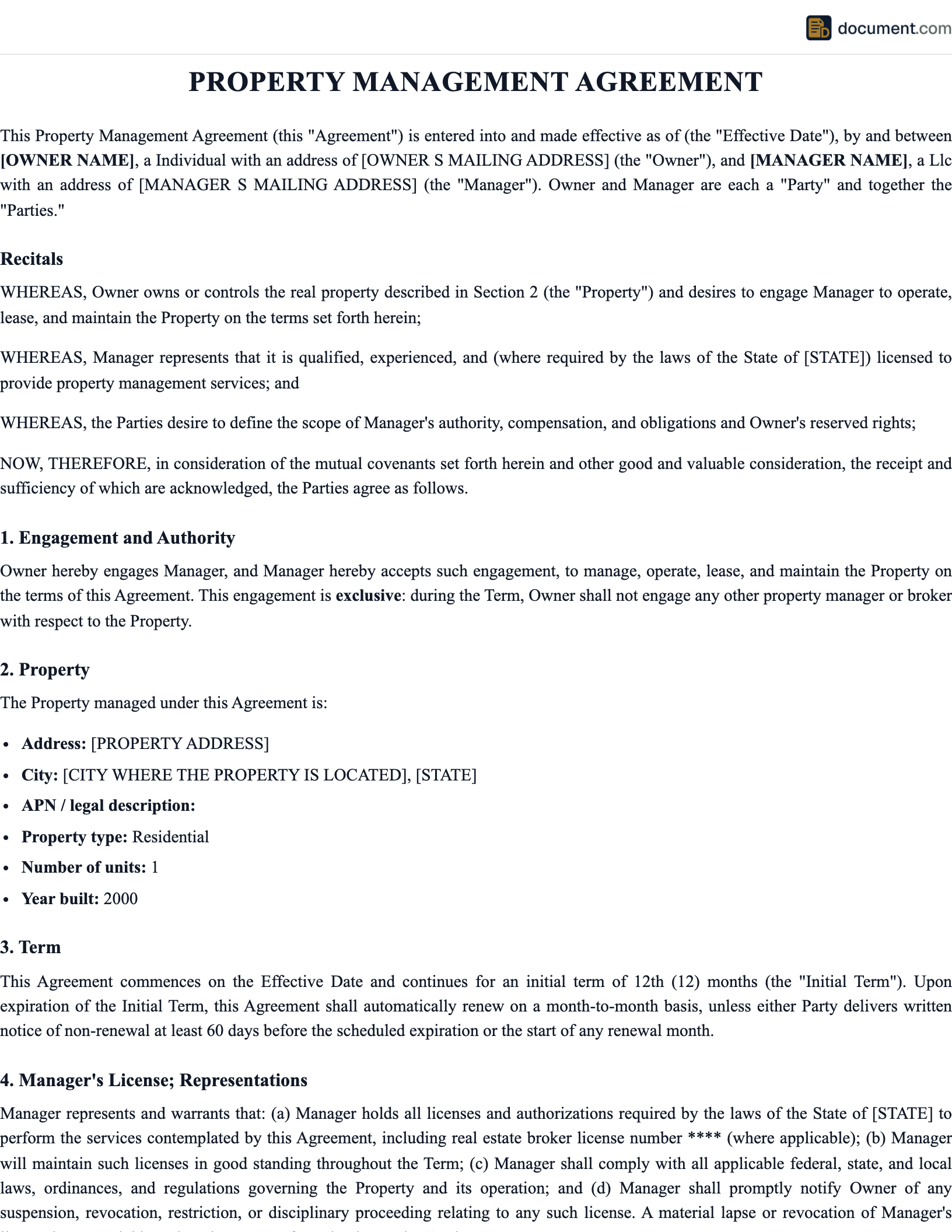
PROPERTY MANAGEMENT AGREEMENT
Residential Property Management Contract
This Property Management Agreement ("Agreement") is entered into as of[Date], by and between [Owner Name]("Owner") and [Manager Name]("Manager"), collectively referred to as the "Parties."
1. PROPERTY
Owner hereby engages Manager to manage the real property located at[Property Address], consisting of [#]residential unit(s), together with all improvements, fixtures, and common areas (collectively, the "Property").
2. TERM
The initial term of this Agreement shall begin on[Start Date]and shall continue for a period of[12/24] months, unless earlier terminated in accordance with Section 10 of this Agreement. Upon expiration, this Agreement shall automatically renew for successive one-year terms unless either party provides written notice of non-renewal at least[60] days prior to the expiration of the then-current term.
3. MANAGEMENT FEE
Owner shall pay Manager a monthly management fee equal to[10]% of gross rent collected from the Property each month. The management fee shall be deducted from collected rents before disbursement to Owner. If the Property is vacant, no management fee shall be due for the period of vacancy...
4. SCOPE OF SERVICES
Manager shall perform the following services on behalf of Owner:
- Market vacancies, screen applicants, and execute lease agreements
- Collect rent, enforce lease terms, and pursue delinquencies
- Coordinate maintenance and repairs within the spending authority
- Provide monthly financial statements and year-end tax documentation
- Initiate eviction proceedings when necessary with Owner notification
- Conduct move-in, quarterly, and move-out property inspections
- Administer security deposits in accordance with state law
5. MAINTENANCE AUTHORITY
Manager is authorized to make expenditures up to $[500]per incident for routine maintenance and emergency repairs without prior Owner approval. Expenditures exceeding this threshold shall require Owner's written approval, except in cases of emergency that threaten the safety of tenants or the structural integrity of the Property...
6. RESERVE FUND
Owner shall deposit the sum of $[1,500] with Manager as a reserve fund for repairs, maintenance, and other expenses. Manager shall replenish the reserve from collected rents when the balance falls below $[500]. Upon termination of this Agreement, any remaining reserve funds shall be returned to Owner within [30] days...
7. INDEMNIFICATION
Owner shall indemnify and hold Manager harmless from any claims, damages, or liabilities arising from the ownership, operation, or condition of the Property, except to the extent caused by Manager's negligence or willful misconduct. Manager shall indemnify and hold Owner harmless from any claims arising from Manager's negligence, breach of this Agreement, or actions outside the scope of authority granted herein...
Frequently Asked Questions
Find answers to common questions about property management agreements, fees, licensing, responsibilities, and how the management relationship works in practice.
Official Resources
For additional information on property management regulations, licensing requirements, landlord-tenant law, and industry best practices, consult these official and reputable resources.
NARPM
National Association of Residential Property Managers — industry standards and find a manager
IREM
Institute of Real Estate Management — professional certifications and education
HUD — Rental Resources
U.S. Department of Housing and Urban Development rental assistance and landlord resources
CFPB — Housing Resources
Consumer Financial Protection Bureau guides for landlords and property owners
Nolo — Property Management Law
Free legal encyclopedia covering landlord and property management topics
NAR — Property Management
National Association of Realtors property management resources and market data
FTC — Tenant Screening Guide
Federal Trade Commission guide on using consumer reports for tenant screening
HUD — Fair Housing
Fair housing laws and compliance guidance for landlords and property managers
Create your Property Management Agreement in under 10 minutes.
Answer a few questions and download a compliant, attorney-drafted document ready for your state.