



What Is a Legal Retainer Agreement?
A legal retainer agreement is a written engagement contract between an attorney or law firm and a client that establishes the terms of the legal representation. The agreement defines the scope of services, the attorney's hourly rate or fee structure, the initial retainer deposit, the trust-account handling required by ABA Model Rule 1.15 and parallel state rules, billing frequency and payment terms, conflict-of-interest disclosures and waivers under Model Rules 1.7 and 1.9, and the conditions under which either party may terminate the representation under Model Rule 1.16. ABA Model Rule 1.5(b) requires the basis of the fee to be communicated to the client preferably in writing within a reasonable time after commencing representation; ABA Model Rule 1.5(c) requires contingency-fee agreements to be in writing and signed by the client; many state variations (New York Judiciary Law § 487 and 22 NYCRR Part 1215) require written engagement letters for any matter where fees are reasonably expected to exceed $3,000.
Legal retainer agreements occupy a regulated position in contract law because the attorney-client relationship is fiduciary. The ABA Model Rules of Professional Conduct, adopted with state-specific variations in every U.S. jurisdiction, impose affirmative duties on the attorney to communicate fee terms clearly (Rule 1.5), safeguard client property and trust funds (Rule 1.15), keep the client reasonably informed about their matter and respond promptly to information requests (Rule 1.4), follow specific procedures on termination including return of unearned fees and the client file (Rule 1.16), and avoid current-client and former-client conflicts (Rules 1.7, 1.9). Violation of these rules is not merely a contractual deficiency. Disciplinary action follows from state bar grievance procedures with sanctions ranging from private reprimand to disbarment. Fee forfeiture and malpractice liability follow from civil litigation by the client. Cooperman v. New York, 83 N.Y.2d 465 (1994) prohibits nonrefundable retainers in New York; California limits them under Mathews v. State Bar, 49 Cal. 3d 596 (1989).
A properly drafted legal retainer addresses identification of the client (the named representative for an entity client must have authority under Model Rule 1.13), scope of representation with explicit carve-outs for services not included (Model Rule 1.2(c) permits limited-scope representation with informed consent), fee structure (hourly, flat, contingency, or hybrid) with the basis stated in writing, retainer deposit and trust-account handling under Model Rule 1.15, billing cadence (monthly statements with itemized time entries are standard), expense reimbursement procedure, conflict-of-interest disclosures and informed-consent waivers under Rules 1.7 and 1.9, prospective-conflict waivers (enforceable under Rule 1.7 Comment 22 with appropriate sophistication-of-client and scope), termination procedures, and the client's absolute right to discharge the attorney at any time under Rule 1.16(a)(3).
ABA Model Rule 1.5 reasonable-fee analysis
ABA Model Rule 1.5(a) prohibits unreasonable fees. The rule lists eight factors: time and labor required, novelty and difficulty of the questions involved, skill requisite to perform the legal service properly, likelihood of precluding other employment, customary fee in the locality for similar legal services, amount involved and results obtained, time limitations imposed by the client or the circumstances, nature and length of the professional relationship with the client, experience reputation and ability of the lawyer, and whether the fee is fixed or contingent. State variations modify the analysis: California Rule 1.5 lists similar factors with additional emphasis on disclosure timing; New York Code of Professional Responsibility DR 2-106 imposes parallel requirements with state-specific fee-arbitration availability under 22 NYCRR Part 137. Excessive fees face fee-arbitration challenges and disciplinary review. Document the basis for the fee in the retainer agreement: the hourly rate by attorney level, the flat fee for defined services, the contingency percentage with collection-cost treatment.
Trust-account compliance and IOLTA requirements
ABA Model Rule 1.15(a) requires lawyers to hold property of clients separate from the lawyer's own property in a separate trust account in the state where the lawyer's office is located. IOLTA (Interest on Lawyers' Trust Accounts) is mandatory in most jurisdictions for funds nominal in amount or short in duration; interest is remitted to the state IOLTA program funding legal aid and access-to-justice programs. The retainer agreement should reference the IOLTA account and confirm that advance-fee deposits will be held there until earned. Substantial deposits where individual interest would exceed administrative cost require a separate non-IOLTA trust account in the client's name with interest remitted to the client. State variations: California Rule 1.15 requires monthly trust-account reconciliations and an annual compliance certification; New York DR 9-102 requires quarterly reconciliations and 7-year record retention; Texas Rule 1.14 imposes separate trust-account requirements and requires "reasonable accounting" on request. Brown v. Legal Found. of Wash., 538 U.S. 216 (2003) upheld the IOLTA structure against Fifth Amendment takings challenge.
Ethics-Compliant
Aligned with ABA Model Rules and state bar ethics requirements.
Trust Account Terms
Proper IOLTA deposit, earned-fee transfers, and refund procedures.
Clear Scope
Defines exactly what legal services are and are not included.
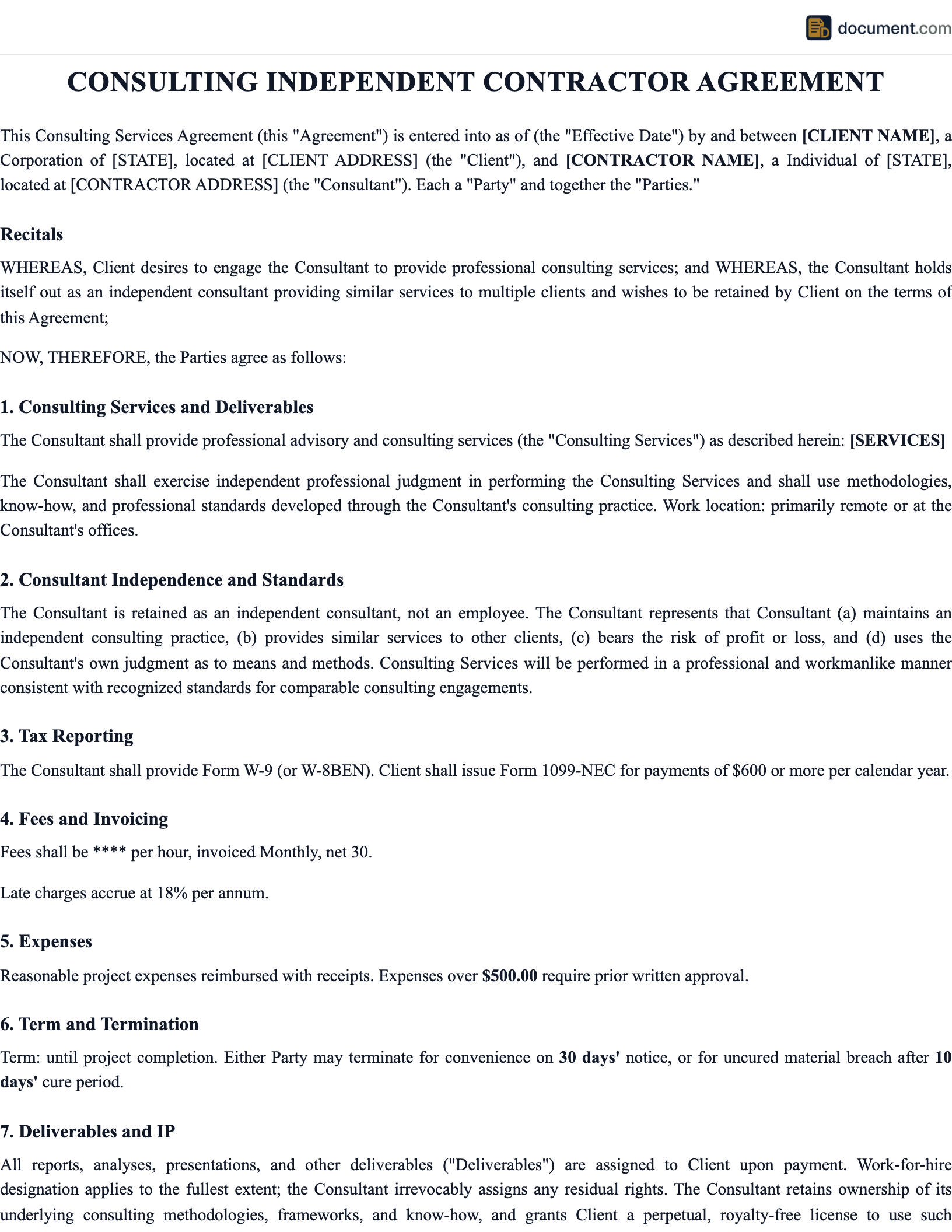
Legal Retainer Form Preview
Legal Retainer Agreement
Attorney-Client Engagement
Section 1: Parties & Matter
Section 2: Scope of Representation
Section 3: Fees & Trust Account
Key Components
Ten components convert an oral engagement into a Model Rules-compliant legal retainer. Each addresses an ABA Model Rule of Professional Conduct that would otherwise default to disciplinary jeopardy or fee forfeiture.
Conflict checking under Model Rules 1.7 and 1.9
Before signing the retainer, the firm runs a conflict check against current and former clients. Model Rule 1.7 prohibits representing a client when the representation is directly adverse to another current client (concurrent conflict) absent informed written consent and reasonable belief that the lawyer can provide competent and diligent representation. Model Rule 1.9 prohibits representing a new client against a former client in the same or substantially related matter where confidential information from the former representation is material absent informed written consent. Imputed conflicts under Model Rule 1.10 attach the conflict to the entire firm. Document the conflict-check procedure in the retainer (the firm will run a conflict check against current and former clients within the past 5 years before accepting the engagement; the firm will obtain informed written consent under Rules 1.7 or 1.9 if a waivable conflict exists and an informed-consent procedure follows). Side-switching produces immediate disqualification (Wang Labs. v. Toshiba, 762 F. Supp. 1246 (E.D. Va. 1991)) and frequently triggers state bar discipline.
Parties & Matter
Attorney/firm and client legal names, bar numbers, and a description of the matter or ongoing advisory scope.
Scope of Representation
Specific legal services included and explicit carve-outs for matters not covered by the retainer.
Fee Structure
Hourly rate by timekeeper (partner, associate, paralegal), flat-fee components, and billing increments.
Retainer Deposit & Trust Account
Initial deposit amount, IOLTA account deposit, earned-fee transfer methodology, and replenishment requirements.
Billing & Payment
Billing frequency (monthly), payment terms (net 30), and consequences of non-payment.
Expense Reimbursement
Reimbursable costs: filing fees, court reporters, expert witnesses, travel, copying, and research services.
Conflict of Interest
Disclosure of known conflicts, waiver provisions, and the procedure for future conflicts arising during representation.
Communication
Frequency and method of case updates, designated contacts, and response-time expectations.
Termination of Representation
Client's absolute right to discharge, attorney's right to withdraw per Rule 1.16, and file-return obligations.
Refund of Unearned Fees
Attorney must refund unearned retainer from trust account upon termination, with final accounting.
How to Create a Legal Retainer Agreement
Six steps in this order. The pre-engagement conflict check and fee-disclosure analysis under Model Rule 1.5 control whether the firm can accept the engagement at all without later disqualification or fee forfeiture.
Pre-engagement procedures
Before drafting the retainer: run conflict checks under Model Rules 1.7 and 1.9 against current and former clients within the past 5 years; verify the firm's competence under Model Rule 1.1 to handle the matter (specialized matters such as patent prosecution, securities work, or capital-defense litigation may require specialty bar admission or co-counsel arrangements); confirm the fee structure is reasonable under Model Rule 1.5(a) considering the eight enumerated factors; if the matter requires representation of multiple parties (joint representation), evaluate concurrent-conflict consent under Rule 1.7(b); for entity clients, identify the constituent person authorized to act under Rule 1.13 (typically the named officer or board member with authority); and document all pre-engagement analysis in writing for the engagement file.
Identify the attorney and client
Include the law firm name, attorney bar number(s), and the client's legal name. Specify the matter or type of ongoing advisory.
Define the scope of representation
List included services explicitly. Equally important, state what is excluded (litigation, appeals, regulatory proceedings, transactions over a defined dollar threshold) to prevent scope disputes under Model Rule 1.2(c) limited-scope representation principles.
Set the fee structure
Specify hourly rates for each timekeeper level, minimum billing increments (typically 0.1 or 0.25 hours), and any flat-fee components.
Establish trust account terms
State the retainer deposit amount, confirm IOLTA deposit, define the earned-fee transfer process (after billing statement), and set the replenishment threshold.
Include billing and payment terms
Monthly billing statements, net-30 payment terms, late-payment interest, and the attorney's right to withdraw for non-payment.
Address conflicts and confidentiality
Disclose any known conflicts, include waiver language where appropriate, and confirm attorney-client privilege protections.
Draft termination and refund provisions
Confirm the client's absolute right to terminate, the attorney's Rule 1.16 withdrawal rights, file-return obligations, and prompt refund of unearned trust funds.
Trust Account & IOLTA Rules
Trust account compliance is the single most important ethical obligation in any legal retainer arrangement. Mishandling client trust funds is the leading cause of attorney disciplinary action in the United States.
Deposit Requirement
All advance-fee retainers must be deposited into the attorney's client trust account (IOLTA). Never into the operating account.
No Commingling
Client funds and attorney funds must never be commingled. The attorney may only transfer earned fees after sending a billing statement.
Record Keeping
The attorney must maintain complete trust-account records and provide periodic accountings to the client showing deposits, disbursements, and balances.
Ethical Obligations
Legal retainer agreements are subject to a higher regulatory standard than any other type of professional retainer because the attorney-client relationship is a fiduciary relationship governed by professional conduct rules.
Rule 1.5: Reasonable Fees
Fees must be reasonable considering the time, labor, complexity, skill required, customary local rates, and the results obtained.
Rule 1.15: Safekeeping Property
Client funds must be held in a separate trust account, with complete records and periodic accountings.
Rule 1.16: Termination
The client may discharge the attorney at any time. The attorney must refund unearned fees and return the client's file.
Frequently Asked Questions
Official Resources
ABA Model Rules
ABA Model Rules of Professional Conduct governing attorney-client relationships.
ABA - Professional Responsibility
Ethics opinions, advisory resources, and disciplinary guidance.
National IOLTA
National Association of IOLTA Programs trust account requirements by state.
ABA - Bar Admissions
State bar admission and attorney licensing information.
U.S. Courts
Federal court system resources, filing fees, and court rules.
Cornell - Legal Ethics
State-by-state legal ethics rules and resources.
Ready to Create Your Legal Retainer Agreement?
Define your scope, fees, and trust account terms in an ethics-compliant legal retainer.
Create DocumentNo account required. Free to create and preview.