
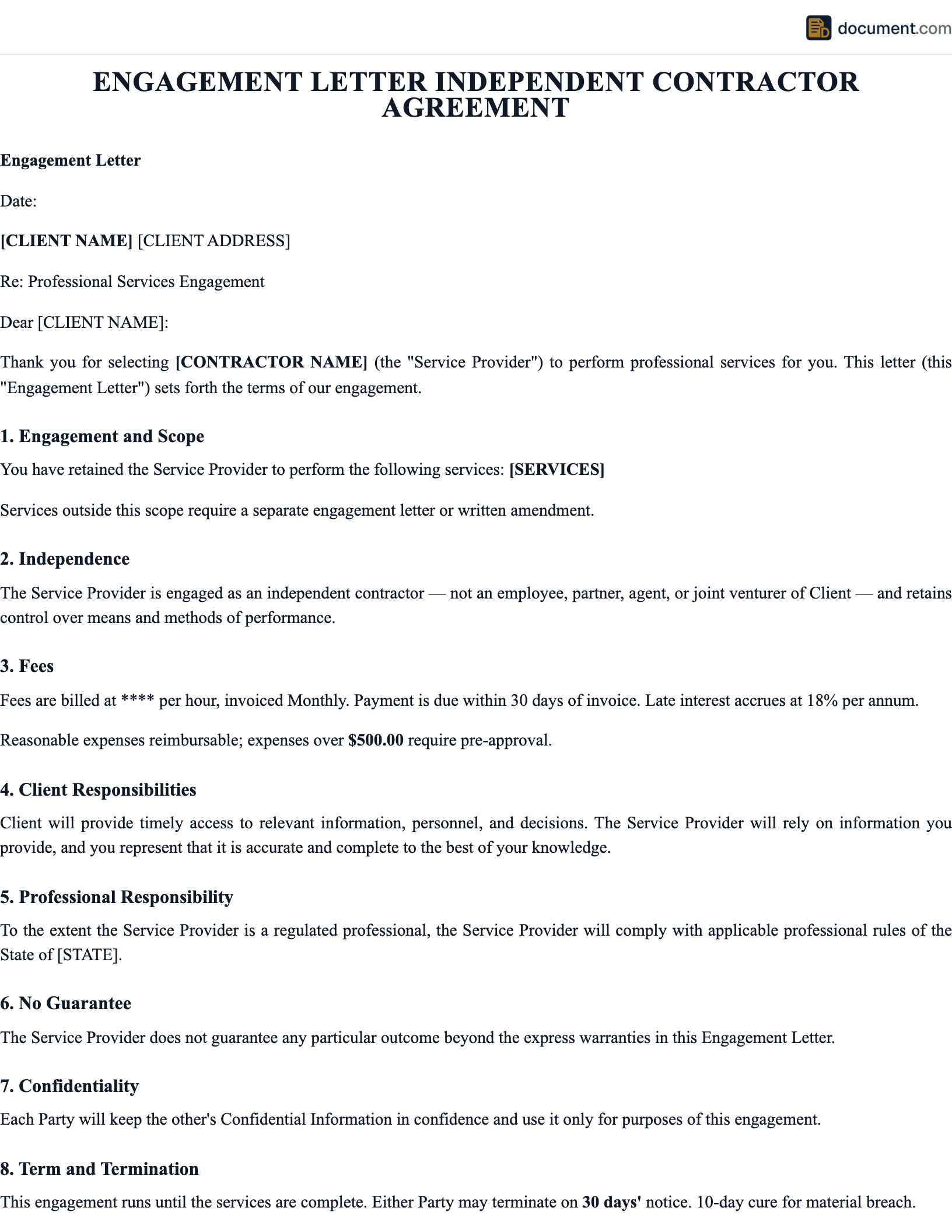



What Is an Engagement Letter?
An engagement letter is a formal written agreement — typically structured as a letter from the professional to the client — that establishes the terms of a professional services relationship. It is the standard form of client agreement used by attorneys, certified public accountants, management consultants, architects, engineers, and other licensed professionals. The engagement letter defines what the professional will do (and, critically, what they will not do), how they will be compensated, how expenses will be handled, and the conditions under which either party may terminate the relationship.
Although an engagement letter reads like a letter, it functions as a binding contract. Once signed by both parties, it creates enforceable obligations: the professional must perform the defined services with the care and skill expected of a reasonably competent practitioner in the same field, and the client must pay the agreed fees and cooperate with the professional's reasonable requests for information and documents. Courts routinely enforce engagement letters and treat them as the primary evidence of the parties' agreement regarding scope, fees, and liability.
The engagement letter is more than a billing formality — it is a risk-management tool. For the professional, a well-drafted engagement letter limits the scope of duty (preventing the client from later claiming that the professional was responsible for matters outside the defined scope), documents fee arrangements (preventing fee disputes), and may include liability limitations (where permitted by ethical rules and state law). For the client, the engagement letter provides transparency: it explains exactly what services will be performed, what they will cost, and how to end the relationship if expectations are not met.
Scope Definition
Precisely defines what the professional will and will not do, limiting exposure to scope-creep claims.
Fee Transparency
Documents rates, billing practices, retainers, and expense treatment to prevent fee disputes.
Ethical Compliance
Satisfies bar association, AICPA, and state licensing board requirements for written fee agreements.
Engagement Letter Form Preview
Engagement Letter
Professional Services Agreement
Section 1: Parties
Section 2: Scope of Services
Section 3: Fees & Billing
Section 4: Confidentiality
All client information will be held in strict confidence pursuant to applicable professional standards and law.
Key Components
| Component | What to Include |
|---|---|
| Parties | Professional firm name and responsible individual; client legal name and contact |
| Scope of Services | Specific services to be performed, matters covered, and explicit exclusions |
| Fee Structure | Hourly rates, flat fees, contingency percentage, retainer amount and treatment |
| Billing & Payment | Invoice frequency, payment due date, accepted methods, late-payment terms |
| Expenses | Reimbursable expenses, markup policy, pre-approval thresholds |
| Confidentiality | Professional duty of confidentiality, exceptions, data security measures |
| Conflict Disclosure | Known conflicts, consent language, ethical wall arrangements |
| Client Responsibilities | Cooperation, timely document production, truthful information |
| Liability Limitation | Liability cap (where permitted), waiver of consequential damages |
| Document Retention | Retention period, destruction policy, client file return |
| Termination | Right to withdraw, notice period, payment for work completed, file transfer |
| Signatures | Professional and client, with date; return instructions |
How to Create an Engagement Letter
An effective engagement letter balances legal precision with client accessibility. Follow these steps to draft one that meets professional standards and protects both parties.
Identify the parties and the matter
State the full legal name of the professional or firm and the client. Identify the specific matter or engagement by name, case number, or project description. If the firm has multiple practice areas, specify which professional will have primary responsibility.
Define the scope of services precisely
Describe what the professional will do in specific, bounded terms. Equally important, state what is excluded from the scope. For attorneys, identify the specific legal matter; for CPAs, identify the engagement type (audit, review, compilation, or tax preparation).
Set forth the fee arrangement
Specify the fee structure: hourly rates (for each billing professional), flat fees, contingency percentages, or retainer amounts. State how the retainer will be treated (earned on receipt vs. held in trust). Include expense reimbursement terms and any fee caps or estimates.
Address billing, payment, and collections
Define the billing cycle (monthly, upon completion, milestone-based), payment terms (net 30, due on receipt), accepted payment methods, and consequences of non-payment (interest charges, right to suspend services, withdrawal from representation).
Include confidentiality and conflict provisions
Reference the professional's duty of confidentiality under applicable ethical rules and law. Disclose any known conflicts of interest and obtain written consent where required. For CPAs, confirm independence (or disclose its absence) as required by professional standards.
Add termination, retention, and liability terms
Specify each party's right to terminate (with notice requirements), the professional's obligation to return client files, the document retention period, and any agreed liability limitation. For attorneys, include language about the client's right to terminate at any time.
Execute and confirm
Send the letter to the client with clear instructions for signing and returning. Many professionals include a countersignature block at the bottom. Do not begin substantive work until the signed engagement letter is in hand.
Sample Engagement Letter
ENGAGEMENT LETTER
Dear [Client Name],
Thank you for selecting [Firm Name] to assist you with [Matter Description]. This letter sets forth the terms of our engagement.
1. SCOPE OF SERVICES
We will provide the following services: [Description]. Our engagement does not include [Exclusions].
2. FEES
Our fees for this engagement will be based on [hourly rates / flat fee / contingency]. [Rate details]. We will bill you [monthly/upon completion], and payment is due within [30] days of the invoice date.
3. RETAINER
We request an initial retainer of $[Amount], which will be deposited into our [trust/operating] account and applied against fees and expenses as they are incurred.
4. CONFIDENTIALITY
All information you provide will be held in strict confidence in accordance with applicable professional standards and law.
5. TERMINATION
Either party may terminate this engagement upon [30] days' written notice. Upon termination, you will be responsible for fees and expenses incurred through the termination date.
6. GOVERNING LAW
This engagement will be governed by the laws of the State of [State].
If these terms are acceptable, please sign and return a copy of this letter.
Sincerely,
[Professional Name]
AGREED AND ACCEPTED:
[Client Signature] Date: [Date]
Frequently Asked Questions
Official Resources
ABA - Model Rules of Professional Conduct
Attorney ethical rules governing fee agreements, scope, and conflicts of interest.
AICPA - Professional Standards
CPA engagement letter requirements for audit, review, and compilation services.
IRS - Circular 230
Federal rules governing practice before the IRS, applicable to tax engagement letters.
SBA - Hiring Contractors
Small Business Administration guidance on engaging independent professionals.
Cornell LII - Legal Ethics
Legal Information Institute resources on professional responsibility and ethics.
NALA - Paralegal Association
National Association of Legal Assistants resources on professional engagement standards.
Ready to Formalize Your Professional Engagement?
Answer a few questions about your practice area and client, and download an attorney-reviewed engagement letter that meets professional standards.
Create DocumentNo account required. Free to create and preview.