
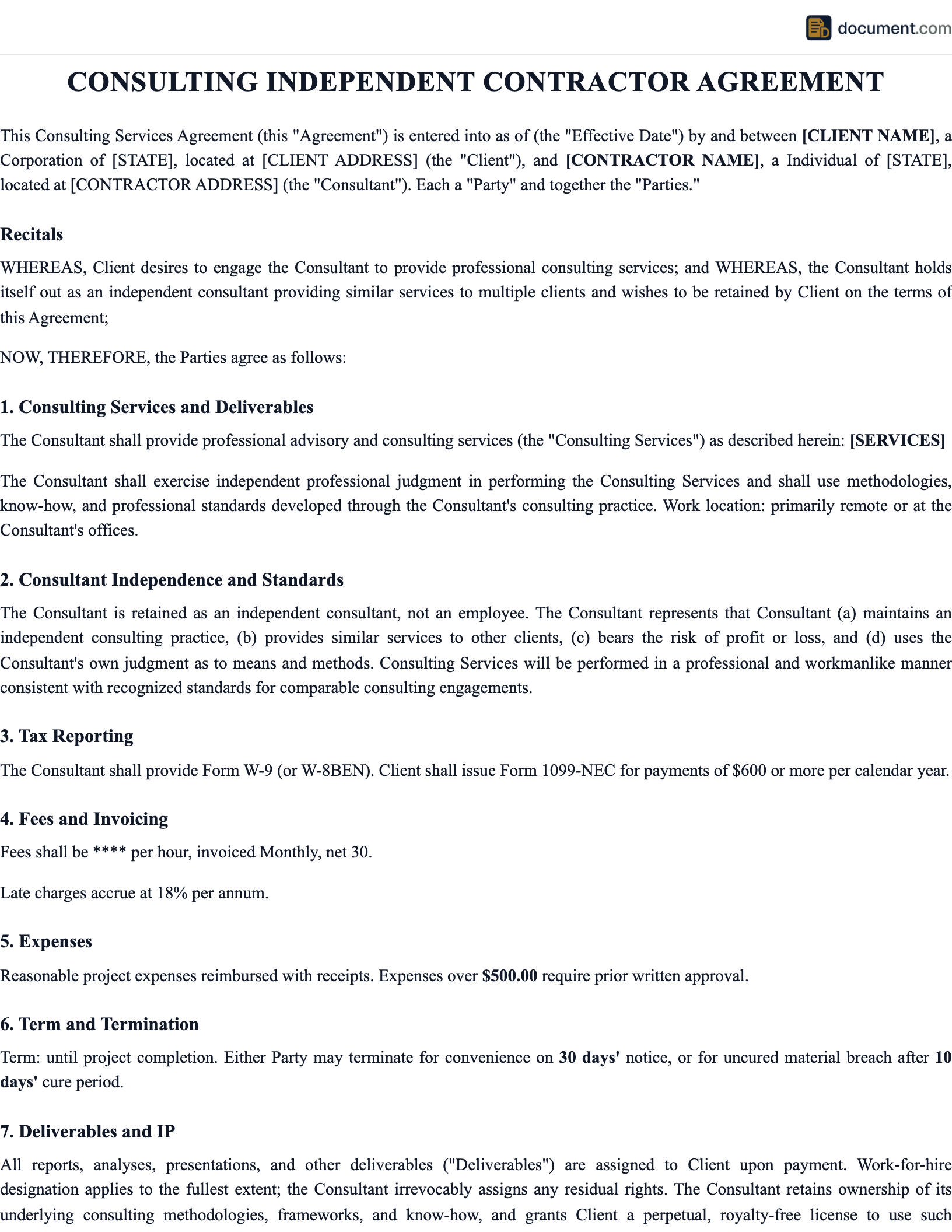



What Is an Expert Witness Retainer Agreement?
An expert witness retainer agreement is a contract between retaining counsel or a law firm and a qualified subject-matter expert engaged to provide opinions, analysis, written reports under Federal Rule of Civil Procedure 26(a)(2)(B), deposition testimony, and trial testimony in pending or anticipated litigation. The agreement differs from a standard consulting retainer in three structural ways: the expert's compensation must not be contingent on case outcome (ABA Model Rule 3.4(b) makes contingency-paid testimony evidence-excludable in nearly every U.S. jurisdiction); the retainer terms enter discovery under FRCP 26(a)(2)(B)(vi) requiring disclosure of compensation; and admissibility is gated by the trial court under Daubert v. Merrell Dow Pharms., 509 U.S. 579 (1993), Joiner, Kumho Tire, and the December 2023 amendment to FRE 702 requiring preponderance proof of reliability.
Expert witnesses are not advocates. They are retained for their specialized knowledge, training, and experience to provide opinions the trier of fact cannot reach unaided. The trial court acts as gatekeeper under FRE 702 (federal courts and 38 states applying Daubert), or under Frye v. United States, 293 F. 1013 (D.C. Cir. 1923) general-acceptance test (Florida, Pennsylvania, Maryland, Washington, Minnesota, and a handful of others). The retainer should identify which standard governs the case forum and require the expert to disclose any prior testimony excluded under either standard. FRCP 26(b)(4)(B) work-product protects draft reports from disclosure in federal court; FRCP 26(b)(4)(C) protects most attorney-expert communications except those concerning compensation, facts and data the attorney provided, or assumptions the attorney provided.
A properly drafted expert retainer addresses the expert's qualifications and prior excluded-testimony history, the specific subject matter of the assignment, tiered hourly rates for review, report preparation, deposition (typical 1.5x review rate), trial testimony (typical 2x), and travel, the initial retainer deposit ($5,000 to $25,000) and replenishment trigger, confidentiality obligations under FRCP 26(b)(4)(B) work-product, conflict checks against prior engagements (the "side-switching" problem), document retention and draft-report destruction policy, cancellation fees for scheduled testimony on a sliding scale (full rate within 7 days, 50 percent within 14, 25 percent within 30), and the independence of the expert's opinions from case outcome.
Daubert and FRE 702 admissibility framework
FRE 702 was substantially amended effective December 1, 2023 to clarify the trial court's gatekeeping role. The proponent must demonstrate by preponderance that (1) the expert is qualified by knowledge, skill, experience, training, or education in the relevant field; (2) the testimony is based on sufficient facts or data; (3) the testimony is the product of reliable principles and methods; and (4) the expert has reliably applied those principles and methods to the facts. The 2023 amendment overruled the prior practice in some circuits of treating reliability as a question for the jury rather than a prerequisite to admissibility. Daubert factors (testability, peer review, error rate, general acceptance) remain non-exhaustive. Joiner v. Gen. Elec. Co., 522 U.S. 136 (1997) confirms abuse-of-discretion review on appeal. Kumho Tire, 526 U.S. 137 (1999) extends Daubert to non-scientific specialized knowledge. The retainer should require the expert to maintain documentation of methodology choices and to identify any reliability concerns before drafting the report.
FRCP 26(a)(2)(B) report content and conflict-checking
Every retained testifying expert must provide a written report under FRCP 26(a)(2)(B) containing: a complete statement of all opinions and the basis and reasons for them; facts or data considered in forming the opinions; any exhibits used to summarize or support them; the expert's qualifications including a list of all publications authored in the previous 10 years; a list of all other cases in which the expert testified (deposition or trial) in the previous 4 years; and a statement of compensation paid for study and testimony in the case. Disclosure deadlines run from the Rule 16(b) scheduling order, typically 90 days before trial under FRCP 26(a)(2)(D). Before accepting the engagement, the expert must run a conflict check against prior retentions (the side-switching prohibition in Wang Labs. v. Toshiba, 762 F. Supp. 1246 (E.D. Va. 1991) and progeny disqualifies experts who switched sides on substantially the same matter); the retainer should warrant no conflict and require prompt disclosure if one emerges.
Litigation-Ready
Structured for discovery disclosure, Daubert compliance, and courtroom presentation.
Ethical Compliance
No contingency fees, outcome-independent compensation, and full transparency.
Tiered Rate Structure
Separate rates for file review, report writing, deposition, trial, and travel.
Expert Witness Retainer Form Preview
Expert Witness Retainer Agreement
Litigation Support, Reports & Testimony
Section 1: Parties & Case
Section 2: Scope of Assignment
Section 3: Fees & Retainer Deposit
Key Components
Ten components convert an oral fee discussion into an enforceable expert retainer that withstands FRCP 26(a)(2)(B) compensation disclosure and Daubert-motion scrutiny. Each addresses a question that would otherwise default to the expert's informal practice or opposing counsel's adverse interpretation.
Conflict-checking and side-switching prohibition
Before signing the retainer, the expert runs a conflict check against prior engagements. The federal courts disqualify experts who switch sides on substantially the same matter (Wang Labs. v. Toshiba, 762 F. Supp. 1246 (E.D. Va. 1991); Cordy v. Sherwin-Williams Co., 156 F.R.D. 575 (D.N.J. 1994)). The two-part test asks (1) whether the prior retaining attorney reasonably believed a confidential relationship existed and (2) whether confidential information of value to the current retention was actually disclosed. The retainer should warrant no current conflict, require prompt written disclosure of any conflict that emerges during the engagement, and authorize withdrawal without forfeiture of fees earned to date if a conflict requires disqualification. The expert maintains a conflict-check database covering all prior retentions for at least 5 years.
Expert Qualifications
Degrees, licenses, certifications, publications, and prior testimony history establishing the expert's credentials.
Scope of Assignment
Specific opinions the expert is retained to offer, the subject matter boundaries, and materials to be reviewed.
Tiered Fee Schedule
Separate hourly rates for file review, report preparation, deposition, trial testimony, and travel time.
Retainer Deposit
Initial advance payment, replenishment threshold, application against invoices, and refund of unused balance.
Cancellation Policy
Fees for cancelled depositions or trial appearances, with tiered penalties based on notice period.
Report Deadlines
Timeline for draft report delivery, attorney review period, and compliance with court scheduling orders.
Confidentiality
Protection of case materials, work product, and privileged communications with retaining counsel.
Document Retention
Retention and destruction of case files, draft reports, and communications per applicable rules.
Independence of Opinions
Express statement that compensation is for time and expertise, not for the substance of opinions rendered.
Termination
Either party may terminate with written notice; expert retains fees earned and may apply cancellation policy.
How to Create an Expert Witness Retainer Agreement
Six steps in this order. The pre-retention conflict check and qualifications review control whether the expert can accept the engagement at all without later disqualification under Daubert or the side-switching doctrine.
Pre-retention conflict and qualifications review
Before drafting the retainer: run a conflict check against all prior engagements in the past 5 years (Wang Labs. v. Toshiba, 762 F. Supp. 1246 (E.D. Va. 1991) disqualifies side-switchers); review the case scheduling order under FRCP 16(b) for the disclosure deadline (typical 90 days before trial under FRCP 26(a)(2)(D)) and confirm capacity to deliver the FRCP 26(a)(2)(B) report on time; identify any prior excluded testimony under Daubert, Frye, or as unreliable that must be disclosed in the retention; verify the qualifications match the case's specific subject matter (an automotive forensic engineer cannot opine on commercial truck rollover dynamics without specific commercial-vehicle credentials); document the engagement's alignment with the expert's stated specialty and the testimony admissibility framework that will govern.
Identify the expert and their qualifications
Include the expert's full name, professional designations, area of expertise, and a summary of qualifications relevant to the case.
Define the scope of the assignment
Specify the exact issues the expert will address, the materials they will review, and the opinions they are expected to form, without directing the substance of those opinions.
Set the tiered fee schedule
Establish separate rates for file review, report preparation, deposition testimony, trial testimony, travel time, and administrative tasks. Include minimum billing increments.
Establish the retainer deposit
Specify the initial deposit amount, the replenishment threshold, how the deposit is applied against invoices, and the refund policy for unused funds.
Include cancellation and scheduling provisions
Define fees for cancelled depositions and trial appearances based on notice period (e.g., full daily rate if cancelled within 7 days of the scheduled date).
Add confidentiality and document retention clauses
Require the expert to maintain confidentiality of all case materials and specify document retention and destruction policies consistent with applicable court rules.
Include the independence statement
Expressly state that the expert's compensation is based on time and expertise, not on the content of opinions or the outcome of the case.
Fee Structures & Deposits
| Activity | Typical Range | Notes |
|---|---|---|
| File Review | $300 - $800/hr | Review of documents, records, depositions, and evidence |
| Report Preparation | $300 - $1,000/hr | Drafting expert report per FRCP 26(a)(2)(B) |
| Deposition Testimony | $500 - $2,000/hr | Often billed at half-day or full-day minimums |
| Trial Testimony | $750 - $3,000/hr | Full-day minimum typical; includes preparation time |
| Travel Time | 50-100% of review rate | Plus actual travel expenses (airfare, hotel, meals) |
Daubert & Admissibility Considerations
The retainer agreement itself does not determine whether the expert's testimony will be admitted, but poorly drafted engagement terms can provide ammunition for a Daubert challenge. Opposing counsel routinely scrutinize the retainer agreement for any suggestion that the expert's opinions are directed, influenced, or contingent.
Independence Language
The agreement must clearly state that the expert forms opinions independently based on their professional judgment, not at the direction of counsel.
No Contingency Compensation
Any fee structure tied to case outcome will result in a Daubert challenge and likely exclusion of the expert's testimony.
Discoverability
Draft the agreement assuming opposing counsel will review it. Avoid language that implies advocacy or bias.
Frequently Asked Questions
Official Resources
Federal Rule of Evidence 702
Expert testimony admissibility standard under federal law.
FRCP Rule 26 - Expert Disclosures
Federal requirements for expert witness disclosures and reports.
U.S. Courts
Federal court system resources, rules, and scheduling order templates.
ABA - Litigation Section
Expert witness practice resources and ethical guidance.
SEAK - Expert Witness Training
Leading expert witness training organization and fee survey data.
Daubert Tracker
Database of Daubert challenges and expert exclusion decisions.
Ready to Create Your Expert Witness Retainer?
Define rates, deposit terms, and engagement scope in a litigation-ready expert witness retainer agreement.
Create DocumentNo account required. Free to create and preview.