
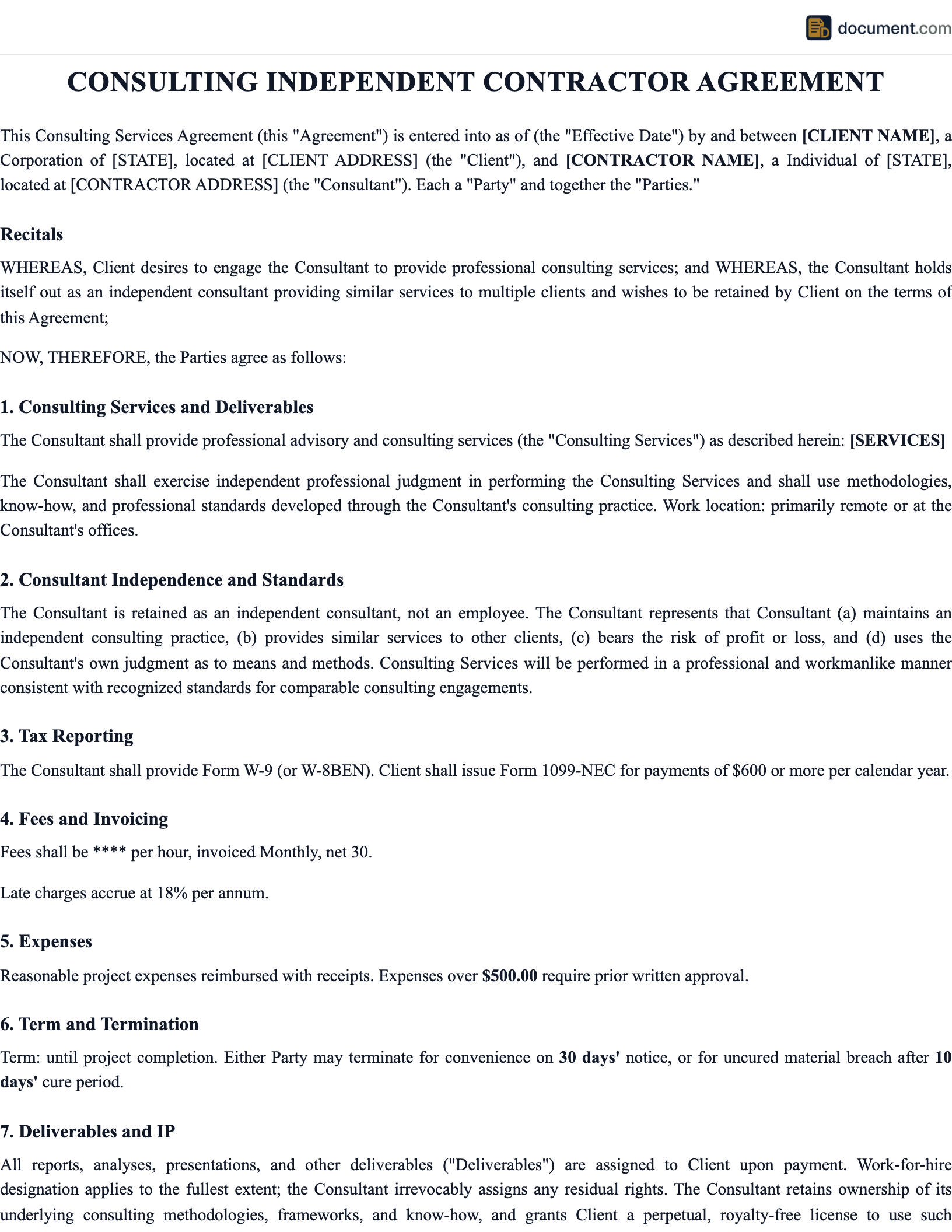



What Is an Accounting Retainer Agreement?
An accounting retainer agreement is a master services contract between a client and an accounting professional (CPA firm, enrolled agent, or bookkeeper) that reserves a fixed monthly block of the accountant's time for recurring financial services. The retainer replaces transactional engagement-by-engagement contracting with continuous engagement under a single MSA, with attached engagement letters scoping each attest service (audit, review, compilation under SSARS § 70/80/90), each tax return (under SSTS No. 8 effective January 1, 2024), and any non-attest service falling outside the retainer's recurring scope. The accountant commits to monthly capacity; the client commits to a minimum engagement term and a fixed monthly fee that does not vary with hour consumption inside the included allotment.
Retainers are common for outsourced bookkeeping, monthly close, payroll processing under IRS Circular 230 § 10.7, quarterly estimated-tax calculations, year-round tax planning, sales and use tax compliance across multi-state nexus, and fractional CFO advisory. Small and mid-market businesses use retainers to gain consistent access to senior financial professionals without the W-2 overhead of full-time hires. For the accounting firm, retainers smooth the seasonal revenue cliff (the historical CPA-firm pattern of February-April spikes followed by summer drought) and produce deeper client relationships that improve work quality and client-retention economics. AICPA SQMS No. 1 (effective December 15, 2025) requires firms to maintain a system of quality management addressing engagement acceptance and continuance; the retainer is the operational artifact through which acceptance and continuance procedures run.
A properly drafted accounting retainer addresses the scope of services with clear inclusion and exclusion lines, monthly hour allotment with rollover policy, fee structure with overage rate by staff level, confidentiality of financial records under IRC § 7216 and AICPA Code of Professional Conduct § 1.700.001, data-security standards (AES-256 encryption, TLS 1.2+, MFA, SOC 2-attested cloud tools), record retention obligations under SAS 103 (7 years), limitation of liability with state-specific carve-outs (California Civ. Code § 1668 voids exculpation for fraud and gross negligence), professional-standards compliance (AICPA, state CPA board, IRS Circular 230), and termination procedures including return of client records and transition assistance.
AICPA engagement-letter standards (SSARS, SAS, SSAE)
AICPA Statements on Standards for Accounting and Review Services (SSARS) require written engagement letters before any preparation (§ 70), compilation (§ 80), or review (§ 90) engagement. Statements on Auditing Standards (SAS) require written engagement letters under AU-C § 210 for audits. Statements on Standards for Attestation Engagements (SSAE) impose parallel requirements for attestation services. The retainer master agreement does not substitute for these engagement-specific letters; each attest service requires its own letter referencing the applicable standard, the responsibilities of management and the accountant, the scope and reporting framework (GAAP, IFRS, special purpose), the limitations of the engagement, and the firm's independence under AICPA Code of Professional Conduct § 1.200.001 (or § 1.295.140 for non-attest services performed for an attest client). Engagement-letter omissions are the leading source of CPA professional-liability claims.
IRS Circular 230 conflict-of-interest and Section 7216 disclosure
Treasury Department Circular 230 (31 C.F.R. Part 10) governs practice before the IRS by attorneys, CPAs, enrolled agents, and certain other tax practitioners. § 10.29 prohibits representing clients with directly adverse interests without informed written consent. § 10.33 imposes diligence-as-to-accuracy obligations. § 10.51 enumerates incompetence and disreputable conduct. Violations expose the practitioner to censure, suspension, or disbarment from IRS practice. IRC § 7216 makes it a criminal misdemeanor (up to $1,000 fine and one year imprisonment per disclosure) for a tax-return preparer to disclose taxpayer information without the taxpayer's prior written consent in IRS-prescribed format (Treas. Reg. § 301.7216-3). § 6713 imposes a civil $250 per-disclosure penalty in addition. The retainer should require the client to execute § 7216 consents for any third-party processor, cloud-based accounting tool, or referral arrangement.
Revenue Predictability
Guaranteed monthly income for the accountant and predictable costs for the client.
Reserved Capacity
The accountant blocks time each month, ensuring priority access during busy seasons.
Regulatory Compliance
Engagement terms aligned with AICPA standards, Circular 230, and state CPA board rules.
Accounting Retainer Form Preview
Accounting Retainer Agreement
Ongoing Bookkeeping, Tax & Advisory Services
Section 1: Parties
Section 2: Scope of Services
Section 3: Retainer Fee
Key Components
Ten components convert a casual referral into an enforceable accounting retainer. Each addresses a question that would otherwise default to the firm's informal practice or AICPA disciplinary review.
Peer review disclosure and quality-control system
AICPA peer review under PRP § 100 (effective for reviews commencing on or after May 1, 2022) requires every CPA firm performing audit, review, attestation, or compilation engagements to undergo independent peer review every three years. Firms performing only preparation engagements under SSARS § 70 are exempt. The peer review report (pass, pass with deficiencies, or fail) is filed with the AICPA Peer Review Board and the relevant state society. The retainer should disclose the firm's most recent peer review result; failure to disclose is grounds for state board discipline in many jurisdictions. AICPA SQMS No. 1 (effective December 15, 2025) requires every firm to maintain a system of quality management addressing engagement acceptance and continuance, leadership responsibility for quality, ethical requirements, human resources, engagement performance, monitoring, and remediation. The retainer is the operational artifact through which acceptance and continuance procedures run for the client.
Parties & Credentials
Legal names, CPA license numbers, enrolled agent status, and firm structure (PLLC, PC, sole proprietor).
Scope of Services
Exhaustive list of included services: bookkeeping, payroll, tax prep, advisory, financial reporting.
Monthly Hour Allotment
Number of hours reserved per month, with clear overage billing terms and advance-approval requirements.
Retainer Fee & Payment
Monthly fee, due date, accepted payment methods, late-payment penalties, and billing cycle.
Rollover Policy
Whether unused hours expire, roll forward for one month, or accumulate indefinitely.
Confidentiality & Data Security
Protection of financial records, tax data, and PII with encryption, access controls, and portal security.
Record Retention
Retention periods for work papers, tax returns, and financial statements per IRS and state requirements.
Professional Standards
Compliance with AICPA Code of Professional Conduct, IRS Circular 230, and state board rules.
Limitation of Liability
Cap on accountant's liability, typically set at 12 months of retainer fees, with carve-outs for fraud.
Termination & Transition
Notice period, return of client records, final billing, and cooperation with successor accountant.
Dispute Resolution
Mediation or arbitration before litigation, with venue and governing law provisions.
Signatures & Effective Date
Authorized signatories for both parties with execution date.
How to Create an Accounting Retainer Agreement
Six steps in this order. The pre-engagement procedures (independence evaluation under AICPA Code § 1.200.001, conflict check under Circular 230 § 10.29, peer-review disclosure) control whether the firm can accept the engagement at all.
Pre-engagement acceptance procedures
Before drafting the retainer: run the firm's engagement-acceptance checklist under AICPA SQMS No. 1; evaluate independence under AICPA Code of Professional Conduct § 1.200.001 and (for SEC-registrant clients) Rule 2-01 of Regulation S-X (17 C.F.R. § 210.2-01); run conflict check under Circular 230 § 10.29; obtain successor-auditor inquiry letter from the predecessor accountant under AU-C § 210.A2 if applicable; verify the client's integrity through public records review and entity due diligence; document the engagement's alignment with the firm's risk-acceptance criteria. AICPA SQMS No. 2 governs engagement quality reviews for higher-risk engagements (audits of public-interest entities, complex SEC filings).
Identify the parties and credentials
Use the full legal name of the client entity and the accounting firm. Include CPA license numbers, state board registration, and enrolled agent status where applicable.
Define the scope of services precisely
List every service included in the retainer: monthly close, bank reconciliation, accounts payable/receivable, payroll, quarterly estimates, annual returns. Specify what is excluded (audit, forensic accounting, litigation support) to prevent scope creep.
Set the hour allotment and overage terms
State the number of hours included per month, the hourly rate for additional work, and whether the client must pre-approve overages before they are incurred.
Establish the fee and payment schedule
Specify the monthly retainer amount, due date, accepted payment methods, and any late-payment interest or suspension-of-services policy.
Add confidentiality and data security provisions
Require the accountant to protect client financial data using industry-standard encryption, secure portals, and access controls. Address cloud-software data processing and third-party integrations.
Include liability and indemnification terms
Cap the accountant's liability at a reasonable multiple of fees paid. Require the client to provide accurate records and indemnify the accountant against losses caused by client misrepresentation.
Draft termination and transition provisions
Specify the notice period (typically 30-60 days), final billing, return of all client records, and cooperation with the successor accountant during the transition.
Service Tiers & Pricing Models
Accounting retainers are commonly structured in tiered packages that scale with the client's transaction volume, reporting complexity, and advisory needs. Understanding the typical tier structure helps both parties negotiate a fair retainer amount.
| Tier | Services | Typical Range |
|---|---|---|
| Bookkeeping Only | Monthly reconciliation, categorization, A/P, A/R | $500 - $1,500/mo |
| Full-Service | Bookkeeping + payroll + tax prep + quarterly estimates | $1,500 - $4,000/mo |
| Controller-Level | Full-service + financial reporting + budgeting + internal controls | $3,000 - $7,000/mo |
| Outsourced CFO | Controller-level + cash-flow forecasting + board reporting + capital strategy | $5,000 - $15,000/mo |
Ethical & Regulatory Obligations
Accountants operating under a retainer must comply with overlapping layers of professional regulation. The retainer agreement should reference these obligations and confirm that the engagement will be performed in accordance with applicable standards.
AICPA Code of Professional Conduct
Governs integrity, objectivity, independence, due care, and confidentiality for CPA members.
IRS Circular 230
Regulates practice before the IRS by CPAs, enrolled agents, and attorneys including due diligence, covered opinions, and advertising.
State Accountancy Board Rules
Each state's board of accountancy imposes licensing, CPE, peer review, and engagement documentation requirements.
Anti-Money Laundering (AML)
While the U.S. has not yet imposed full BSA/AML obligations on accountants, AICPA guidance recommends client due diligence and suspicious-activity awareness.
Frequently Asked Questions
Official Resources
AICPA
American Institute of CPAs professional standards and ethics guidance.
IRS - Enrolled Agents
Information on enrolled agent designation and practice before the IRS.
IRS Circular 230
Regulations governing practice before the Internal Revenue Service.
NASBA
National Association of State Boards of Accountancy.
SBA - Financial Management
Small Business Administration guidance on business finances and accounting.
IRS - Small Business
Tax guidance for small businesses and self-employed individuals.
Ready to Create Your Accounting Retainer Agreement?
Answer a few questions and generate an attorney-reviewed accounting retainer agreement in minutes.
Create DocumentNo account required. Free to create and preview.