
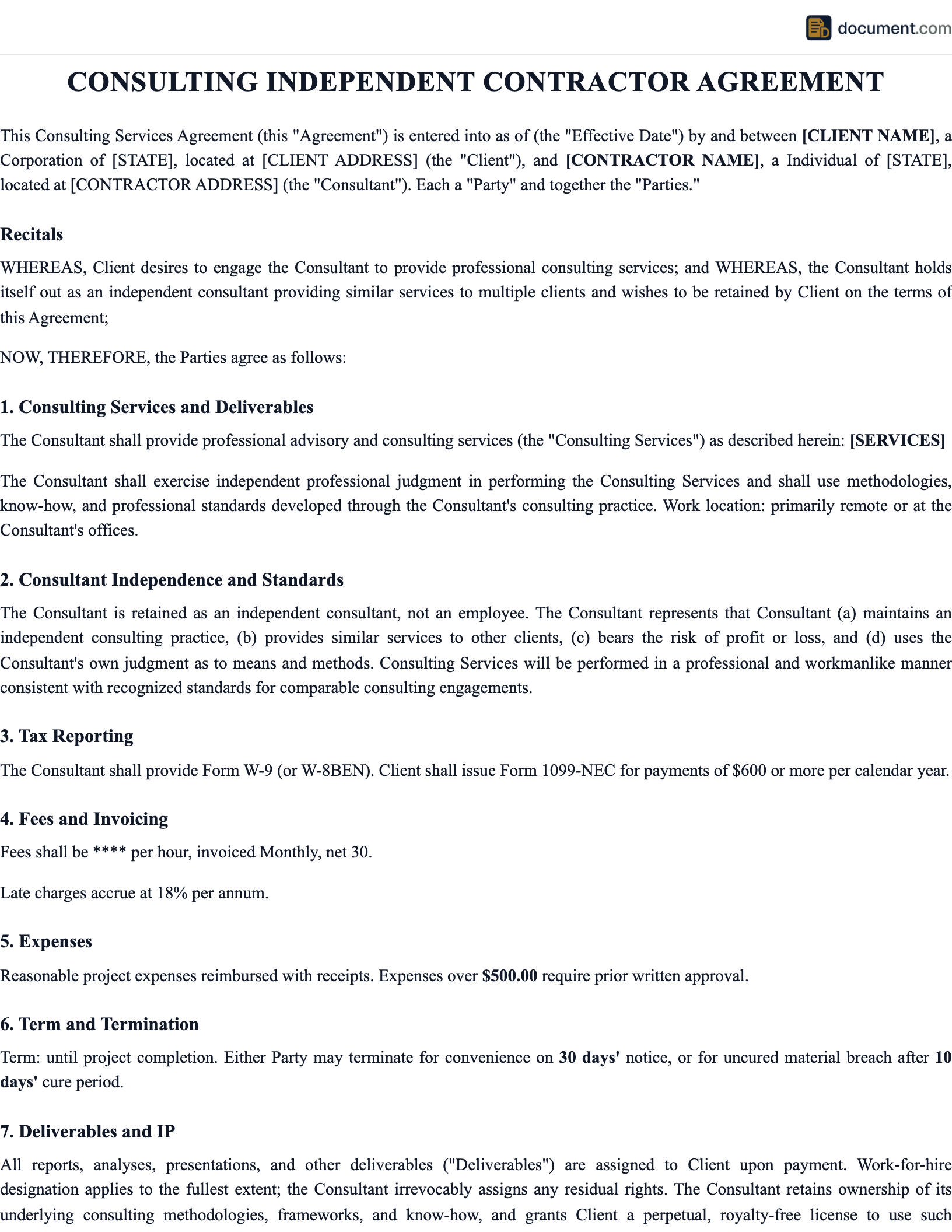



What Is a Freelance Retainer Agreement?
A freelance retainer is a continuing services agreement binding a client and an independent contractor (writer, designer, developer, strategist, marketer) to a recurring monthly engagement. The instrument reserves a defined hour bank or deliverable count per month in exchange for a fixed fee, controls scope, IP assignment, rollover, kill fees, rush surcharges, minimum term, and the worker classification recital required to keep the relationship outside the employment statutes. The client gets priority scheduling and a freelancer ramped on the brand and approval workflow; the freelancer gets revenue predictability and reduced sales overhead from constant proposal writing. The retainer fits clients with steady monthly demand: 4 blog posts per month, 8 social graphics per week, 20 hours of development per sprint, ongoing brand stewardship.
Freelance retainers occupy a regulatory pressure zone. The IRS evaluates the relationship under Rev. Rul. 87-41 and the common-law control test (behavioral control, financial control, type of relationship). The Department of Labor applies the totality test under 29 C.F.R. Part 795 (effective March 11, 2024), restoring the multi-factor economic-realities analysis. California, Massachusetts, New Jersey, and Connecticut apply the stricter ABC test; in California, Cal. Lab. Code § 2775 codifies Dynamex Operations W. v. Superior Ct., 4 Cal. 5th 903 (2018), requiring the hiring entity to prove (A) freedom from control, (B) work outside the usual course of business, and (C) engagement in an independently established trade. Misclassification triggers back wages, FICA, FUTA, state unemployment, and IRC § 3509 penalties up to 100 percent of unpaid taxes.
Monthly hours bank and rollover policy
Three rollover policies dominate the market. No rollover expires unused hours at month-end; the freelancer reserved capacity and earned the fee regardless of utilization. This is the cleanest structure and aligns with how retainers function economically. Limited rollover allows hours to carry forward one cycle and then expire; this is the most-negotiated compromise and the industry-standard middle ground. Unlimited rollover accumulates hours indefinitely; this creates a growing liability the freelancer cannot capacity-plan against and invites surge-demand abuse, where a client banks 60 hours over three months and demands them in a single week. The contract should cap rollover at one cycle and state the overage rate (typically the same hourly rate as the retainer for retainers under 40 hours).
Deliverable definitions and kill fees
Define each deliverable by type, format, length, and complexity. A blog post is "1,200 to 1,500 words, original research, two interviews, three rounds of revisions, delivered as a Google Doc with H1, H2, H3 markup and inline source citations." A social graphic is "1080x1080 PNG plus a 1080x1920 story version, brand-token color palette, native-font typography, two rounds of revisions." Vague definitions are the leading cause of retainer disputes. Kill fees compensate the freelancer when work is cancelled mid-stream: 25 percent before kickoff, 50 percent after first draft, 75 percent after revisions, 100 percent after final approval but before delivery. For early termination of a minimum-term retainer, the kill fee equals the unexpired retainer balance or a fixed termination fee of one to three months of retainer.
Predictable Income
Guaranteed monthly payment provides financial stability for the freelancer.
Priority Access
Retainer clients get first access to the freelancer's schedule and faster turnaround.
Reduced Overhead
No need to scope, propose, and negotiate every individual request.
Freelance Retainer Form Preview
Freelance Retainer Agreement
Ongoing Creative / Technical Services
Section 1: Parties
Section 2: Services
Section 3: Retainer Terms
Key Components
Scope of Services
Specific deliverables included: content types, design assets, development tasks, and strategic advisory.
Monthly Hours & Deliverables
Number of hours or deliverables per month, with clear definitions of what counts as one unit.
Retainer Fee & Payment
Monthly fee, due date, payment method, and late-payment penalties or service-suspension terms.
Rollover Policy
Whether unused hours expire, roll forward for one month, or accumulate, plus any cap on rollover.
Revision Rounds
Number of revision rounds included per deliverable and the hourly rate for additional revisions.
Turnaround & Rush Fees
Standard turnaround time and the premium charged for expedited requests.
IP Ownership
Client owns final approved deliverables; freelancer retains pre-existing assets and portfolio rights.
Kill Fee / Early Termination
Penalty for terminating before the minimum term expires, typically 1 to 3 months of retainer fees.
Confidentiality
Protection of client business information, unreleased content, and strategic plans.
Independent Contractor Status
Confirmation that the freelancer controls their schedule, tools, methods, and may work for other clients.
How to Create a Freelance Retainer Agreement
Identify the parties
Include the freelancer's legal name or business entity and the client's legal name. Specify contact information and primary points of contact.
Define services and deliverables
List every category of work included in the retainer. Be specific: '4 blog posts of 1,200-1,500 words each' is better than 'content writing.'
Set the retainer fee and hour allotment
Establish the monthly fee, the number of included hours, the overage hourly rate, and the payment schedule.
Choose a rollover policy
Decide whether unused hours expire, roll forward for one period, or accumulate. State the policy clearly and include any caps on banked hours.
Define revision rounds and turnaround times
Specify the number of free revision rounds per deliverable, the standard turnaround time, and the rush-fee multiplier for expedited work.
Address intellectual property ownership
Assign final deliverables to the client upon payment. Retain pre-existing IP for the freelancer. Define portfolio-use rights.
Include termination and kill-fee terms
Set the minimum commitment period, the notice required for non-renewal, and the kill-fee penalty for early termination.
Pricing & Rollover Models
| Model | How It Works | Best For |
|---|---|---|
| Hours-Based | Client buys a block of hours at a discounted rate; work is tracked against the bank | Variable scope across design, development, advisory |
| Deliverable-Based | Fixed number of deliverables per month (e.g., 8 blog posts, 20 social graphics) | Content, social media, email marketing |
| Hybrid | Core deliverables plus a smaller hour bank for ad-hoc requests | Clients with both recurring and variable needs |
| Value-Based | Flat monthly fee for unlimited requests within a defined scope (with queue limits) | Design subscriptions, ongoing brand support |
IP & Work Product Ownership
Intellectual property is the most consequential clause in any freelance retainer. Without clear contractual language, the freelancer retains copyright in everything they create under U.S. copyright law's default rules for independent contractors.
Final Deliverables
Client owns all final, approved work product upon full payment of the retainer fee. Include both work-for-hire and assignment provisions.
Pre-Existing Assets
Freelancer retains ownership of templates, code libraries, stock assets, and tools created before the engagement.
Source Files
Specify whether the client receives editable source files (Figma, PSD, AI, source code) or only final exports.
Portfolio Rights
Freelancers typically retain the right to display completed work in their portfolio, website, and case studies.
Frequently Asked Questions
Official Resources
IRS - Worker Classification
Independent contractor vs. employee classification guidance.
DOL - Wage & Hour Division
Federal worker classification and wage requirements.
U.S. Copyright Office
Copyright registration and work-for-hire rules for freelancers.
SBA - Business Structure
Business entity guidance for freelancers and sole proprietors.
Freelancers Union
Advocacy, resources, and contract templates for freelance workers.
FTC - Business Guidance
Federal Trade Commission consumer protection and advertising rules.
Ready to Create Your Freelance Retainer Agreement?
Define your services, hours, and terms in a professional freelance retainer in minutes.
Create DocumentNo account required. Free to create and preview.