



What Is a Web Development Retainer Agreement?
A web development retainer agreement is a fixed-fee contract between a client and an independent developer or agency that reserves a block of monthly development hours for ongoing coding, maintenance, and technical support. The retainer replaces the cycle of statement-of-work, proposal, and contract for each new feature with a continuous engagement under a single master agreement. The two-document structure is master services agreement plus statements of work (MSA + SOW): the MSA governs IP, confidentiality, liability cap, dispute resolution, and termination; each SOW or sprint plan defines the work for a specific period. The model gives the client a developer who already understands the codebase, eliminates the friction of cold-starting a new vendor for each task, and produces faster turnaround at lower marginal cost than project-based engagement.
The retainer suits businesses whose web application is revenue infrastructure: e-commerce, SaaS, marketplace, ad-supported media. These applications require continuous capacity for new features, regular security patches, dependency updates (npm and Composer audit cycles, framework version upgrades), performance tuning, and rapid response to production incidents. The retainer provides this capacity without the W-2 overhead of a full-time hire and without the contractor classification risk of a 40-hour-per-week single-client engagement. The IRS common-law control test (Rev. Rul. 87-41), the DOL economic-realities test (29 C.F.R. Part 795), and the California ABC test (Cal. Lab. Code § 2775) all examine the totality of the relationship; a retainer with multiple-client capacity, developer-controlled tools and methods, and project-based deliverables passes all three. A 40-hour single-client retainer with daily standups and direct supervision fails them all and reclassifies the developer as an employee with back FICA, FUTA, and state unemployment exposure.
A well-drafted retainer addresses the technology stack with change-control protocol, monthly hours with rollover and overage rates, four-tier SLA with response and resolution targets and coverage windows, version control and CI/CD deployment workflow, copyright assignment under 17 U.S.C. § 201(d) of all custom code with a license-back of pre-existing developer libraries, open-source license inventory and approval gate, staging-environment testing requirements, documentation deliverables, third-party service cost pass-through, GDPR (Arts. 28, 32) and CCPA (Cal. Civ. Code § 1798.140(ag)) data-handling clauses for any work touching personal data, and clean termination mechanics including 30-day wind-down, codebase handoff, credential transfer, and source-code escrow release.
Hourly bank versus flat retainer pricing models
Two pricing structures dominate. Hourly bank: client pre-purchases a monthly block of hours (typical 20, 40, 80) at the agreed hourly rate ($85 to $250 depending on developer tier and market), unused hours roll over for one month then expire, overage hours bill at the same rate or 1.25x for unscheduled work. Flat retainer: client pays a fixed monthly fee for a defined scope (security patches, dependency updates, monitoring response, two minor features per month) regardless of hours actually worked. Hourly bank protects the developer against scope creep but exposes the client to estimation variance; flat retainer protects the client's budget but exposes the developer to under-estimated months. Hybrid: flat retainer for defined recurring work plus hourly bank for ad-hoc development. Whatever the model, document the hourly rate explicitly so overages, after-hours work, and disputed hours have a clear unit price.
IP assignment under 17 U.S.C. § 201(d) versus work-for-hire
The Copyright Act provides two paths to transfer copyright from a developer to a client. Work-for-hire under 17 U.S.C. § 101 vests copyright in the client from creation, but applies to specially commissioned work only in nine enumerated categories (contribution to a collective work, motion picture, translation, supplementary work, compilation, instructional text, test, answer material, atlas). Computer code is not in the list. Cmty. for Creative Non-Violence v. Reid, 490 U.S. 730 (1989) confirmed that work-for-hire for non-employees requires both the enumerated category and a written agreement signed by both parties. Code does not qualify. The proper mechanism is express assignment under 17 U.S.C. § 201(d): "Developer hereby assigns to Client all right, title, and interest in and to the Custom Code." Use present-tense ("hereby assigns") not promissory ("agrees to assign"); the Federal Circuit in Stanford v. Roche, 563 U.S. 776 (2011) confirmed that "agrees to assign" transfers nothing without a separate execution. Pre-existing developer libraries and open-source contributions remain the developer's and are licensed to the client for use, modification, and distribution as part of the deliverables.
Continuous Development
Reserved monthly hours for features, fixes, and optimization.
SLA-Backed Support
Defined response times for critical, high, medium, and low issues.
Security & Updates
Regular dependency updates, security patches, and vulnerability scanning.
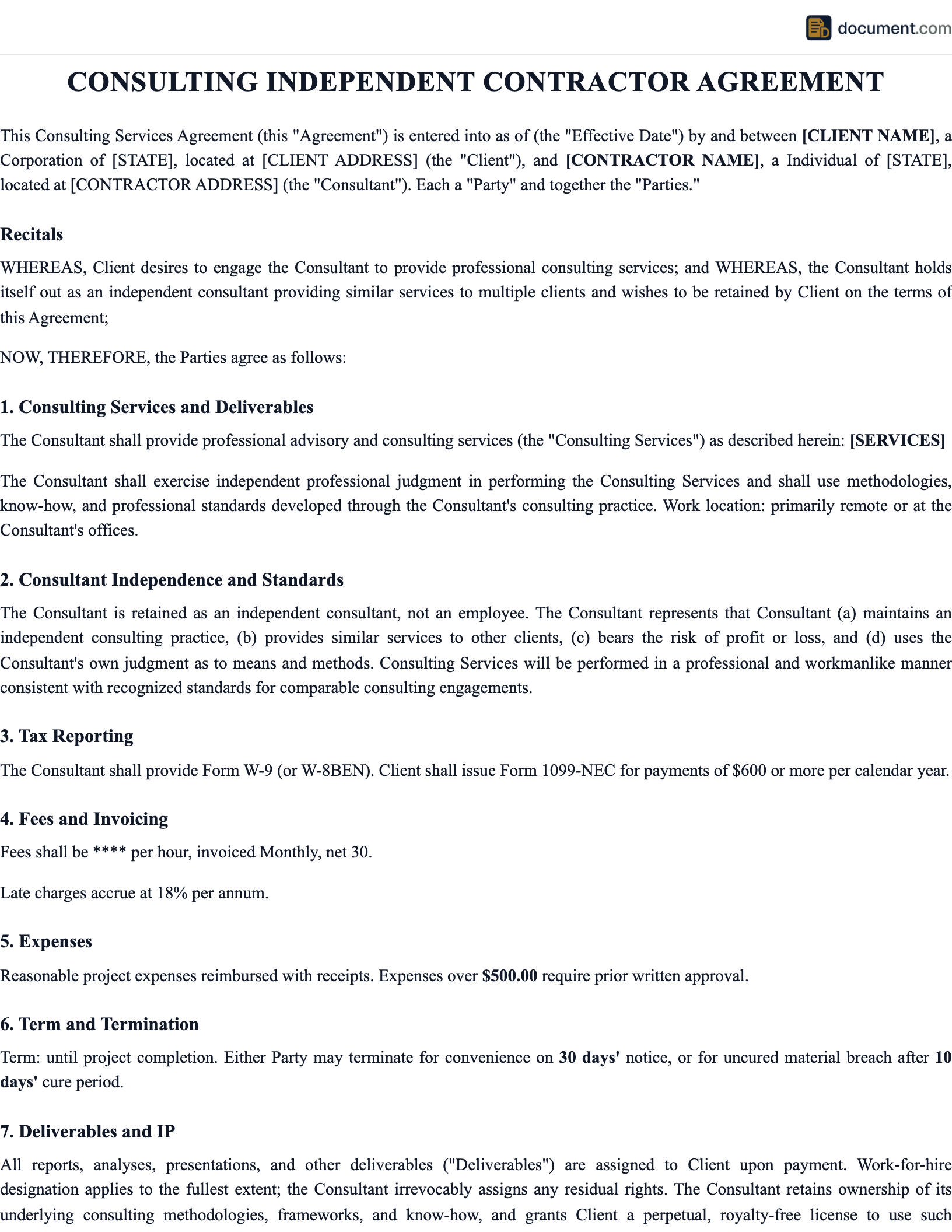
Web Development Retainer Form Preview
Web Development Retainer Agreement
Ongoing Development, Maintenance & Support
Section 1: Parties
Section 2: Services & Stack
Section 3: Terms & SLA
Key Components
Ten components convert a casual freelance arrangement into an enforceable retainer. Each addresses a question that would otherwise default to the developer's informal practice or the client's adverse interpretation.
Source-code escrow for mission-critical applications
For any production application that the client's business depends on (e-commerce, SaaS, internal operational tools), source-code escrow with a third-party agent (Iron Mountain, EscrowTech, Codekeeper) protects against developer disappearance. The escrow agent holds the latest source code, build instructions, and deployment credentials and releases them to the client on defined trigger events: developer bankruptcy filing, dissolution, material breach uncured for 30 days, failure to perform under the SLA for 60 consecutive days. Standard escrow cost runs $1,000 to $3,000 annually with quarterly deposit requirements. Without escrow, a developer death or business shutdown can leave the client unable to access, modify, or deploy their own application; the documented chain of custody resolves that exposure.
Technology Stack
Languages, frameworks, CMS, databases, and hosting platform with change-approval process for major stack decisions.
Monthly Hours & Fee
Retainer fee, included hours, overage rate, and rollover policy.
SLA Tiers
Response and resolution times for critical, high, medium, and low issues, with coverage hours and escalation paths.
Code Ownership
Client owns all custom code upon payment; developer retains pre-existing libraries and open-source contributions.
Version Control
Git-based workflow, branching strategy, code review requirements, and client access to the repository.
Deployment & Staging
CI/CD pipeline, staging environment testing, production deployment approval, and rollback procedures.
Security & Updates
Dependency update schedule, vulnerability scanning, security patch response time, and incident-response procedures.
Documentation
Developer's obligation to maintain technical documentation, deployment guides, and architecture diagrams.
Third-Party Services
Client responsibility for hosting, CDN, API, and SaaS subscription costs; credential management procedures.
Termination & Handoff
Codebase transfer, credential handoff, documentation delivery, and transition support period.
How to Create a Web Development Retainer Agreement
Seven steps in this order. The pre-contract worker-classification analysis controls everything downstream; a retainer that fails the IRS, DOL, or California ABC test reclassifies the developer as an employee with retroactive payroll-tax exposure for the client.
Worker-classification analysis
Before drafting, run the classification test for the client's state. The IRS common-law test (Rev. Rul. 87-41) weights behavioral control, financial control, and type of relationship. The DOL economic-realities test under 29 C.F.R. Part 795 (March 2024 final rule) reaches misclassified developers for back overtime under the FLSA. California, Massachusetts, New Jersey, and Connecticut apply the ABC test (Cal. Lab. Code § 2775): the developer is an employee unless the hiring entity proves freedom from control, work outside the usual course of business, and engagement in an independently established trade. Structure the retainer to pass: developer controls tools, methods, and work hours; developer maintains other clients; deliverables are project-based not hourly-supervised; developer carries own GL and E&O insurance; developer issues invoices and is paid net of withholding; engagement is term-limited and renewable rather than indefinite.
Identify the parties and technology stack
Include legal names, specify the tech stack (Next.js, React, Node.js, Python, PHP, etc.), and document the current architecture.
Define development services
List included services: feature development, bug fixes, security patches, performance optimization, deployment, and technical support.
Set the retainer fee, hours, and SLA
Monthly fee, included hours, overage rate, and SLA tiers with response/resolution times for each severity level.
Establish version control and deployment workflow
Git repository access, branching strategy, staging environment testing, deployment approval process, and rollback procedures.
Address code ownership and open-source licensing
Assign custom code to the client. Retain pre-existing developer IP. Document open-source dependencies and their licenses.
Include security and maintenance obligations
Dependency update schedule, vulnerability scanning, security patch response time, and incident-response procedures.
Draft termination and handoff provisions
Codebase transfer, credential handoff, documentation delivery, third-party account transition, and post-termination support.
SLA & Response Times
The service-level agreement is the most heavily negotiated provision in any web development retainer because it determines how quickly production issues are triaged and resolved. Each severity tier carries a response target (the developer acknowledges the ticket and begins work) and a resolution target (the production issue is fixed and verified). SLA breach remedies typically include service credits (pro-rated retainer refund for the breach period), termination rights without cure period for repeated breaches, and uncapped damages for breaches resulting in customer data exposure that triggers state breach-notification statutes.
Coverage windows determine the premium. Business-hours-only SLA (Monday through Friday 9am to 6pm in the developer's timezone) is the standard retainer. 24/7 coverage carries a 50 to 100 percent premium and requires either an in-house on-call rotation or a partnership with a third-party monitoring and incident-response provider (PagerDuty integrated with a managed services partner). Communication channels: ticketing system (Linear, Jira, Notion) for non-urgent, email for medium severity, Slack with PagerDuty paging for High and Critical. Specify the contact roster and the on-call escalation path; an SLA without a defined escalation path is unenforceable in practice.
| Severity | Examples | Response | Resolution |
|---|---|---|---|
| Critical | Site down, checkout broken, data breach | 1-2 hours | 4-8 hours |
| High | Major feature broken, severe performance issue | 4-8 hours | 24-48 hours |
| Medium | Minor bug, non-critical feature issue | 24 hours | 3-5 business days |
| Low | Enhancement request, cosmetic issue | 48 hours | Next sprint |
Code Ownership & Licensing
Code ownership is the most consequential intellectual-property provision in any web development retainer. The Copyright Act vests copyright in the author of original works of authorship under 17 U.S.C. § 102 from the moment of fixation in a tangible medium. For independent contractors, the developer is the author. Without a written copyright assignment under § 201(d), the client receives at most a non-exclusive implied license to use the code as delivered. The retainer must address custom code (assigned to client by present-tense § 201(d) assignment), pre-existing developer libraries (retained by developer, licensed to client under a perpetual royalty-free use license), and open-source dependencies (retained by their original authors, used by the project under their respective licenses).
Open-source license compliance is its own audit track. MIT and Apache 2.0 are permissive: use, modification, and redistribution allowed with attribution. GPL v2 and v3 are copyleft: any distributed combined work must be licensed under the GPL with full source code disclosure (impacts SaaS only when AGPL applies). LGPL allows linking proprietary code to LGPL libraries without GPL contamination. AGPL extends GPL obligations to network-service distribution, including SaaS. The retainer should require the developer to maintain a current Software Bill of Materials (SBOM) listing every dependency with its license; the client's legal team reviews the SBOM before any acquisition or redistribution event.
Custom Code
All code written specifically for the client under the retainer is assigned to the client upon payment. Include both work-for-hire and assignment language.
Pre-Existing Code
The developer retains ownership of libraries, frameworks, and tools created before or independently of the retainer. The client receives a perpetual, royalty-free license.
Open-Source Dependencies
Code licensed under MIT, Apache, GPL, or other open-source licenses is subject to its own license terms. The developer should document all open-source dependencies and their license types.
Frequently Asked Questions
Official Resources
IRS - Worker Classification
Independent contractor vs. employee classification guidance.
U.S. Copyright Office
Copyright registration for software and code.
OSI - Open Source Licenses
Open Source Initiative approved open-source license list.
W3C
World Wide Web Consortium web standards and accessibility.
CISA
Cybersecurity & Infrastructure Security Agency security best practices.
SBA
Small Business Administration resources for technology businesses.
Ready to Create Your Web Development Retainer?
Define your tech stack, SLA terms, and code ownership in an attorney-reviewed development retainer.
Create DocumentNo account required. Free to create and preview.