
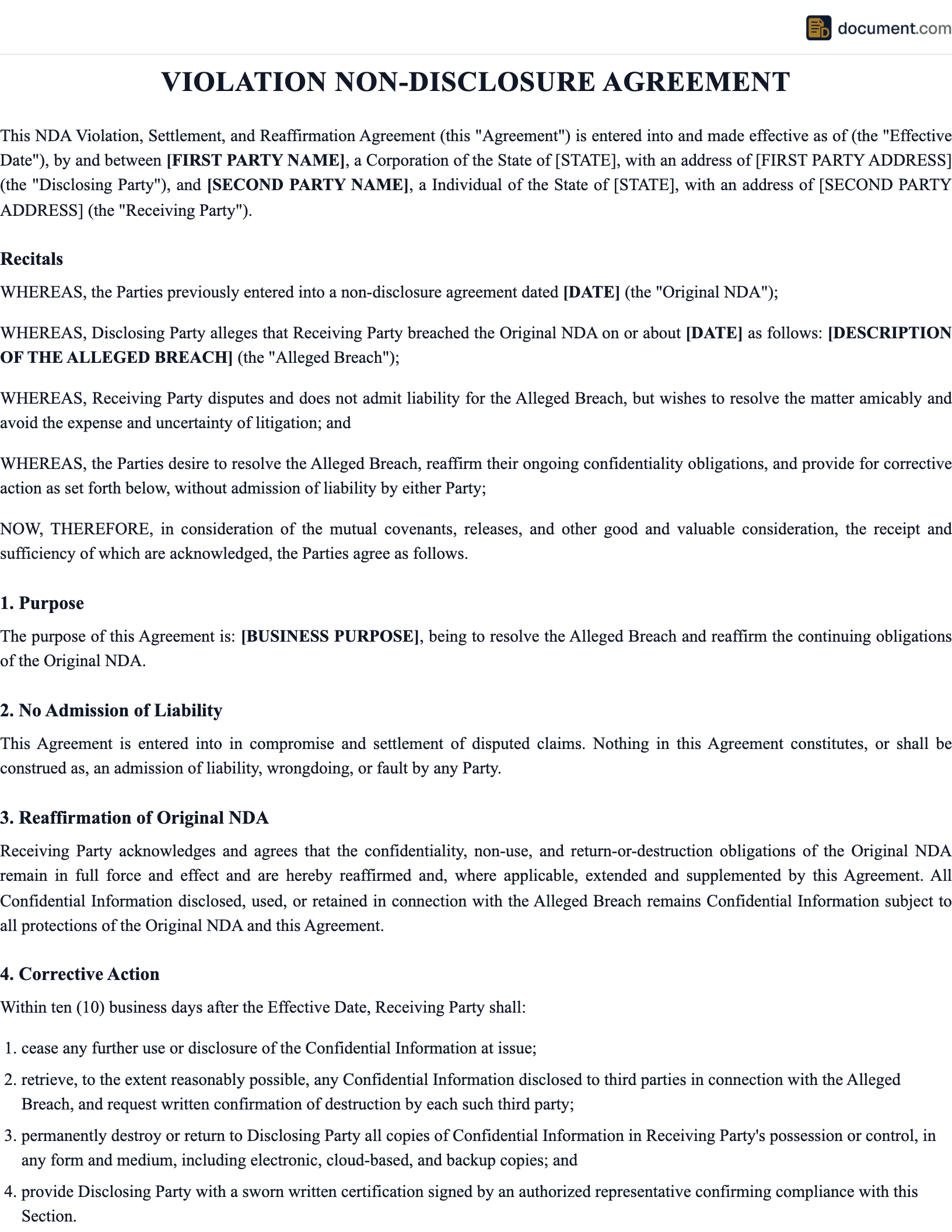



What Is an NDA Violation Cease and Desist Letter?
An NDA violation cease and desist letter is a formal written demand sent by the disclosing party of a non-disclosure agreement to a recipient who has breached — or is threatening to breach — the terms of that NDA. The letter identifies the original agreement, describes the unauthorized disclosure or misuse of confidential information, and demands that the recipient immediately stop the violating conduct, return or destroy the confidential materials, and refrain from further disclosure. It also serves as formal notice that continued violation will result in litigation seeking injunctive relief, monetary damages, and, where applicable, the enhanced remedies available under the federal Defend Trade Secrets Act of 2016.
The letter sits at a critical strategic point in any trade secret or confidentiality dispute. It is the first formal step in enforcement, and in many cases it is the only step that turns out to be necessary. A well-drafted, credible cease and desist letter often persuades the recipient to comply without the expense and uncertainty of litigation. It also creates a clear documentary record of the violation, the demand, and any response — a record that becomes critical evidence if the dispute escalates to court.
Time is usually of the essence. Trade secrets and confidential information lose value quickly once they are disclosed, and courts evaluating requests for preliminary injunctions look closely at whether the plaintiff acted promptly to protect the information. Sending a cease and desist letter immediately after discovering a breach demonstrates seriousness, preserves remedies, and often stops the harm before it spreads.
Stop the Breach
Demand immediate cessation of disclosure or misuse
Preserve Remedies
Document the violation and protect your right to sue
Avoid Litigation
Resolve disputes before incurring the cost of court
Letter Form Preview
Cease and Desist Letter
Re: Violation of Non-Disclosure Agreement
Sender Information
Recipient Information
Original NDA
Description of Violation
Demands
Reservation of Rights
Key Components
Sender and Recipient Identification
Full legal names and addresses of both parties, ensuring there is no ambiguity about who is sending and receiving the letter.
Reference to Original NDA
The exact title, date, and parties of the original non-disclosure agreement, with attached copy if appropriate.
Description of Confidential Information
A clear (but not over-disclosing) description of the specific confidential information at issue and its categorization under the NDA.
Description of the Violation
Specific facts: when the violation occurred, how it was discovered, what was disclosed, and to whom.
Citation to NDA Provisions
Specific sections of the NDA that have been breached, quoted verbatim where helpful.
Explicit Demands
Cease the conduct, return or destroy confidential materials, identify third parties, and provide written certification of compliance.
Deadline for Response
A reasonable deadline (typically 7-14 days) for the recipient to comply or respond.
Reservation of Rights
An express statement that the sender reserves all legal remedies, including injunctive relief and damages under DTSA and state law.
Warning of Litigation
A clear statement that failure to comply will result in immediate legal action.
Signature and Date
Signed by the sender or sender's attorney; ideally on letterhead.
When to Send a Violation Letter
Former Employee Joins Competitor
An ex-employee who signed an NDA accepts a position with a direct competitor and begins working in a similar role.
Trade Secret Disclosure on Social Media
A recipient publishes confidential business strategies, product details, or pricing information on LinkedIn, Twitter, or industry forums.
Vendor or Contractor Misuse
A vendor or contractor reuses your confidential materials, methodologies, or client lists for another client.
Failed M&A Discussions
A potential acquirer learns confidential information during due diligence, then uses it to launch a competing offering.
Investor Leak
A prospective investor shares your pitch deck, financial projections, or product roadmap with portfolio companies or third parties.
Joint Venture Breakdown
A joint venture partner uses confidential information for purposes outside the scope of the partnership.
How to Draft and Send
- 1
Locate the original NDA and confirm it is still in effect (most NDAs have a confidentiality term of 2-5 years).
- 2
Document the violation with specific dates, evidence, and witnesses. Take screenshots of public disclosures before they are deleted.
- 3
Identify exactly which provisions of the NDA were breached and quote the relevant language.
- 4
Calculate (or at least describe) the actual or threatened harm caused by the breach.
- 5
Draft the letter using our attorney-reviewed template, including all required components.
- 6
Set a reasonable response deadline (typically 7-14 days, shorter for ongoing harm).
- 7
Have an attorney review the letter if the stakes are significant or trade secrets are involved.
- 8
Send the letter by certified mail with return receipt, plus email confirmation. Retain copies of all delivery records.
- 9
Track the response. If the recipient complies, document the resolution. If not, prepare for litigation.
Available Legal Remedies
When an NDA is breached, courts can order a range of remedies depending on the nature of the violation and the terms of the agreement. The Defend Trade Secrets Act of 2016 (18 U.S.C. §1836) created a federal cause of action for trade secret misappropriation and significantly enhanced the available remedies. State trade secret laws — most based on the Uniform Trade Secrets Act — provide parallel state-court remedies.
| Remedy | Description |
|---|---|
| Injunctive Relief | Court order requiring the recipient to stop using or disclosing the information |
| Actual Damages | Lost profits, lost competitive advantage, and remediation costs |
| Disgorgement | Recovery of any profits the breaching party earned from the misuse |
| Liquidated Damages | Pre-agreed amount specified in the NDA |
| Exemplary Damages | Up to 2x actual damages for willful and malicious misappropriation under DTSA |
| Attorney's Fees | Available under DTSA and many state trade secret laws for bad-faith conduct |
Sample Cease and Desist Letter
[Sender Letterhead]
April 7, 2026
VIA CERTIFIED MAIL AND EMAIL
Jordan Mitchell
47 Cypress Lane
Palo Alto, CA 94301
Re: Violation of Non-Disclosure Agreement dated March 3, 2023 — DEMAND TO CEASE AND DESIST
Dear Mr. Mitchell:
This firm represents Acme Innovations LLC ("Acme") in connection with your breach of the Mutual Non-Disclosure Agreement dated March 3, 2023 (the "NDA"). On April 1, 2026, you posted on LinkedIn detailed information about Acme's proprietary machine-learning training pipeline, including dataset sources, model architecture, and training methodology. This information constitutes Confidential Information as defined in Section 2 of the NDA, and your disclosure violates Sections 3 (Non-Disclosure) and 5 (Restrictions on Use).
Acme demands that you immediately: (1) cease all further disclosure or use of any Confidential Information; (2) remove the offending LinkedIn post and any related content within 48 hours; (3) return or destroy all Confidential Information in your possession, custody, or control; (4) identify in writing every third party to whom you have disclosed any Confidential Information; and (5) provide written certification of your compliance with these demands within ten (10) days of receipt of this letter.
Acme reserves all rights and remedies available under the NDA, the federal Defend Trade Secrets Act of 2016 (18 U.S.C. §1836), the California Uniform Trade Secrets Act (Cal. Civ. Code §3426 et seq.), and applicable common law, including injunctive relief, actual damages, disgorgement of profits, exemplary damages, and attorney's fees. If you fail to comply with these demands by the deadline above, Acme will take immediate legal action without further notice.
Govern yourself accordingly.
Sincerely,
[Attorney Name]
Counsel for Acme Innovations LLC
Frequently Asked Questions
Official Resources
Send Your Cease and Desist Letter Today
Attorney-reviewed, ready in minutes.
Create Letter