



Oklahoma Non-Compete Agreement Overview
Non-Competes Are Banned in Oklahoma
Oklahoma prohibits non-compete agreements for employees. Any such agreement is void and unenforceable under state law. The only exception is non-competes entered into in connection with the sale of a business. Employers should use non-disclosure agreements (NDAs) and non-solicitation agreements instead.
Oklahoma prohibits non-compete agreements for employees under Title 15, Section 219A of the Oklahoma Statutes. The statute declares that a person who makes an agreement not to compete with a former employer shall be permitted to engage in the same business or profession as the former employer. Oklahoma is one of only four states (along with California, North Dakota, and Minnesota) that bans employee non-competes almost entirely.
The only exception in Oklahoma is for non-competes entered into in connection with the sale of a business or the dissolution of a partnership. In these contexts, the seller or departing partner may agree not to compete within a reasonable geographic area for a reasonable period. Oklahoma does allow non-solicitation agreements that prevent former employees from directly soliciting the employer's established customers, but these must be limited to customers with whom the employee had significant contact. Oklahoma courts strictly construe any restrictive covenant and will void agreements that effectively function as non-competes disguised as non-solicitation clauses.
Banned
Enforceability
N/A — Non-competes are void for employees
Max duration
N/A
Blue-pencil
N/A
Consideration
Oklahoma Enforceability Requirements
Oklahoma prohibits most non-compete agreements. However, understanding what is and is not permitted helps employers and employees navigate the state's restrictions.
Key Provisions
- Employee non-compete agreements are PROHIBITED under Tit. 15 Section 219A
- Employers CANNOT restrict employees from working in the same business or profession after leaving
- Exception: non-competes in connection with sale of business or partnership dissolution
- Non-solicitation agreements are permitted but must be limited to established customers the employee directly served
- Non-disclosure agreements are enforceable to protect trade secrets
- Courts strictly construe restrictive covenants and will void disguised non-competes
Alternatives to Non-Competes in Oklahoma
Since Oklahoma bans non-competes, employers should use these alternative restrictive covenants to protect their business interests.
Use Non-Disclosure Agreements
Draft comprehensive NDAs to protect trade secrets, confidential information, and proprietary business data. NDAs are enforceable in all 50 states including Oklahoma.
Implement Non-Solicitation Agreements
Non-solicitation agreements prevent former employees from soliciting your clients or recruiting your employees. These are generally enforceable in Oklahoma when reasonable in scope.
Strengthen Trade Secret Protections
Leverage the Uniform Trade Secrets Act and the federal Defend Trade Secrets Act to protect proprietary information through legal action rather than restrictive covenants.
Use Confidentiality Agreements
Confidentiality agreements protect specific categories of proprietary information and are enforceable in Oklahoma. They offer strong protection without restricting where the employee can work.
Document Intellectual Property Ownership
Use invention assignment agreements and work-for-hire clauses to ensure the company owns all intellectual property created during the employment relationship.
Recent Legal Changes in Oklahoma
Oklahoma's statutory prohibition has been in place for many years and has been consistently upheld by Oklahoma courts. There have been no significant recent changes to the state's non-compete law.
Employer Tips for Oklahoma
Do not use non-compete agreements for Oklahoma employees — they are void. Use non-solicitation agreements limited to established customers the employee directly served, and NDAs to protect confidential information and trade secrets.
Employee Rights in Oklahoma
Oklahoma employees cannot be required to sign non-compete agreements. If your employer is attempting to enforce one, it is likely void under Oklahoma law. Non-solicitation agreements may be enforceable if limited in scope, but overbroad restrictions will be struck down.
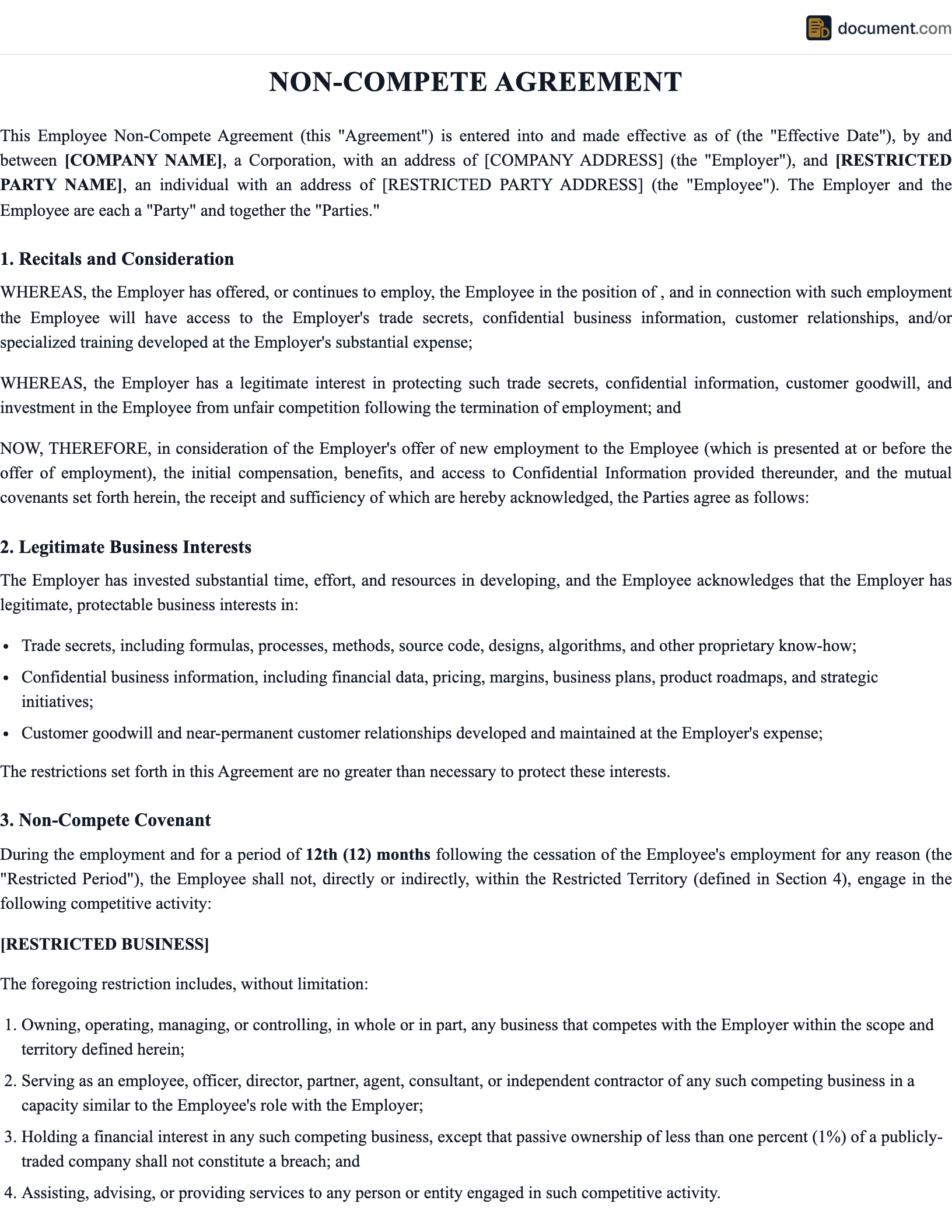
Sample Oklahoma Non-Compete Agreement
Below is a preview of our Oklahoma-specific non-compete agreement. Your customized document will include all provisions required for enforceability in Oklahoma.
NON-COMPETE AGREEMENT
STATE OF OKLAHOMA
Covenant Not to Compete
EMPLOYER:
Company Name: [Legal Entity Name]
Address: [Oklahoma Address]
Business Type: [Industry]
EMPLOYEE:
Name: [Full Legal Name]
Position: [Job Title]
Start Date: [Date]
NON-COMPETE TERMS
Restricted Activities: [Specific Activities]
Geographic Scope: [Area]
Duration: [Time Period] following termination
Consideration: [What Employee Receives]
Governing Law: State of Oklahoma
Oklahoma Non-Compete Agreement FAQ
Answers to common questions about non-compete agreements in Oklahoma, including enforceability, duration limits, and employee rights.
Official Oklahoma Resources
Use these official resources to verify Oklahoma non-compete enforceability rules and access state employment law information.
Oklahoma Department of Labor
State labor law information and employment resources
Oklahoma Attorney General
Consumer protection and employment law guidance
FTC Non-Compete Rulemaking
Federal non-compete rule status and developments
ABA Labor and Employment Law
American Bar Association employment law resources
Related Oklahoma Documents
Depending on your situation, you may need additional documents alongside your Oklahoma non-compete agreement.
Oklahoma Non-Disclosure Agreement
Protect confidential information and trade secrets
Oklahoma Non-Solicitation Agreement
Prevent poaching of clients and employees
Oklahoma Employment Agreement
Comprehensive employment terms and conditions
Oklahoma Severance Agreement
Separation terms with non-compete provisions
Create your Oklahoma Non Compete Agreement in under 5 minutes.
Answer a few questions and download a Oklahoma-compliant document, ready for the state agency.