



What Is a Sale-of-Business Non-Compete?
A sale-of-business non-compete agreement is a restrictive covenant entered into in connection with the purchase and sale of a business or a substantial ownership interest in a business. The seller agrees that, for a defined period after the closing, they will not engage in activities that would compete with the business being sold. The fundamental purpose is to protect the goodwill of the business — the intangible value that flows from customer relationships, reputation, employee continuity, vendor relationships, brand recognition, and accumulated know-how — which the buyer is paying for as part of the transaction.
Sale-of-business non-competes are categorically different from employee non-competes in their legal treatment. Whereas employee non-competes are subject to strict scrutiny because of concerns about unequal bargaining power and the worker's right to earn a living, sale-of-business non-competes are recognized as essential to commercial transactions and are enforceable in all 50 states. Even California — the state most hostile to employee non-competes — explicitly permits sale-of-business non-competes by statute (California Business and Professions Code Section 16601). North Dakota, Oklahoma, and Minnesota have similar statutory exceptions.
The rationale is straightforward. When a buyer acquires a business, a substantial portion of the purchase price typically reflects goodwill rather than tangible assets. If the seller could immediately open a competing business and divert customers and employees, the goodwill would be destroyed and the buyer would have effectively received nothing for the goodwill component of the price. Allowing this would discourage business sales, harm both parties, and undermine the ability of business owners to monetize the value they have created. The sale-of-business non-compete is the contract mechanism that makes goodwill transferable.
Sale-of-business non-competes vary in form depending on the structure of the transaction. In an asset purchase, the agreement typically binds the selling entity and its principal owners. In a stock purchase, the agreement binds the selling shareholders. In transactions where the seller will continue working for the buyer for some period (an "earnout" or transition arrangement), the non-compete may run from the end of the seller's employment rather than from the closing date. The duration, geographic scope, and activity restrictions are tailored to the specific business and the deal structure.
Goodwill Protection
Preserves the intangible value the buyer is paying for
Customer Continuity
Prevents the seller from immediately recapturing customers
Deal Value
Allows the buyer to capture the full value of the transaction
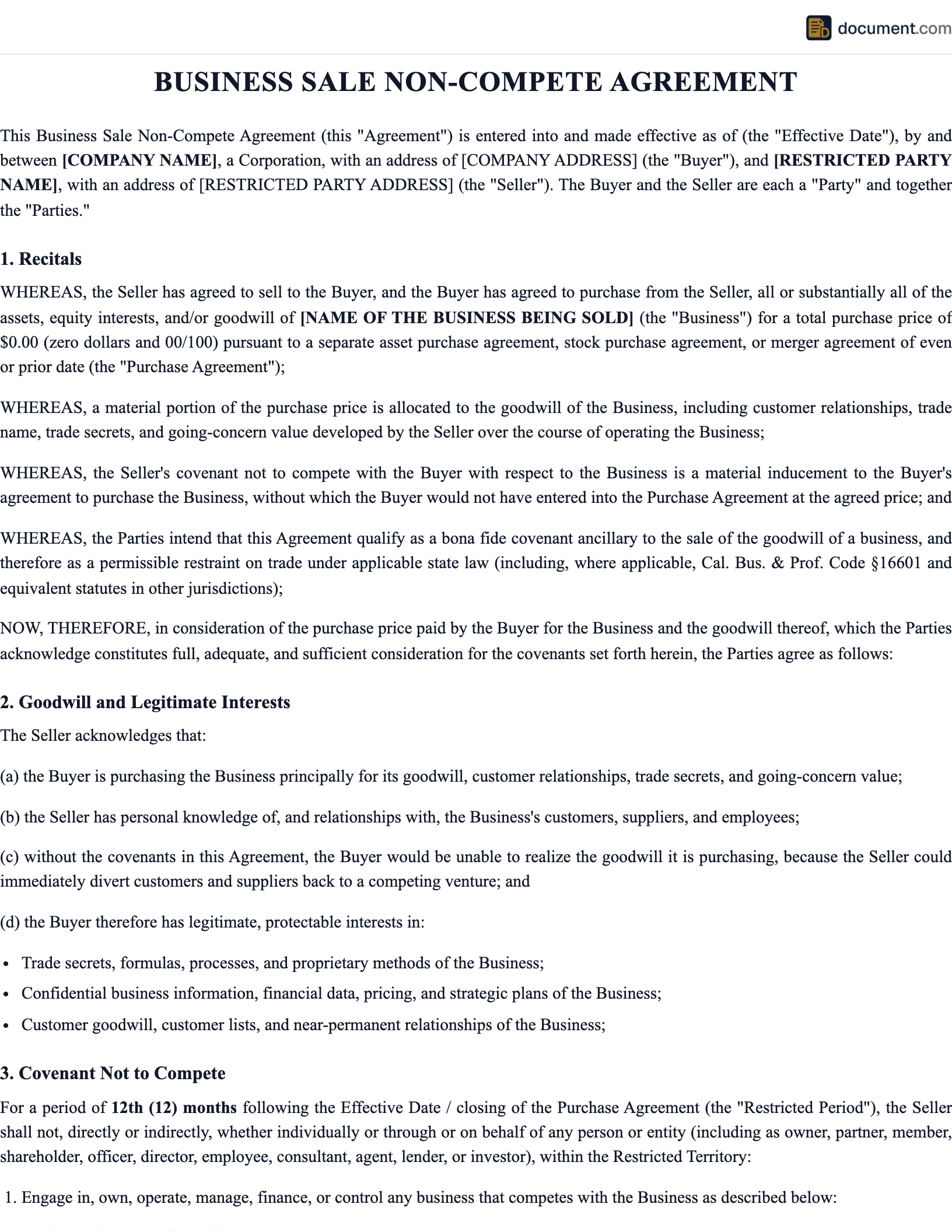
Sale-of-Business Non-Compete Form Preview
A preview of the structure and fields included in our sale-of-business non-compete template.
Sale of Business Non-Compete
Restrictive Covenant in Connection with Acquisition
Section 1: Parties
Section 2: Restricted Activities
Section 3: Duration and Scope
Section 4: Consideration
Why Sale-of-Business Non-Competes Are More Enforceable
Courts and legislatures across the country distinguish between sale-of-business non-competes and employee non-competes for several reasons. Understanding these reasons helps explain why the former are enforced even in jurisdictions that prohibit the latter.
First, the parties to a business sale are sophisticated commercial actors negotiating at arm's length, not workers facing a take-it-or-leave-it offer of employment. The seller has the option of declining the sale, negotiating different terms, or pursuing other buyers. The bargaining power imbalance that justifies skepticism of employee non-competes is largely absent.
Second, the seller is receiving substantial consideration in exchange for the restriction. The purchase price reflects payment for both tangible assets and intangible goodwill, and the non-compete is the mechanism by which the seller delivers the goodwill component of the value. Without a non-compete, the seller would effectively be receiving payment for goodwill that they immediately destroy through competitive activity.
Third, the public interest favors business sales. Allowing business owners to monetize the value they have created encourages entrepreneurship, supports succession planning, and facilitates the efficient allocation of capital. A legal regime that made business sales effectively impossible by refusing to enforce sale-of-business non-competes would harm both individual sellers and the broader economy.
Fourth, the seller's ability to earn a living is generally not impaired in a meaningful way. The seller has just received the proceeds of the sale and can use them to pursue other opportunities, retire, invest in different industries, or work for a non-competing business. The "livelihood" concern that animates skepticism of employee non-competes is much weaker.
Sale vs. Employment Non-Compete
| Issue | Employee | Sale of Business |
|---|---|---|
| Standard of Review | Strict scrutiny | Relaxed, favorable to enforcement |
| Typical Duration | 6-12 months | 3-7 years |
| Geographic Scope | Limited to employee work area | Wherever business operates |
| California Enforceability | Generally void | Explicitly permitted by statute |
| Required Consideration | Sometimes garden leave | Purchase price itself |
| Public Policy Concern | Worker livelihood | Goodwill transferability |
How to Create the Agreement
Identify the Business and Goodwill
Define the business being sold with precision, including its product lines, geographic markets, customer base, and any specific intellectual property. The non-compete should reference these specifics.
Identify the Parties
List the buyer (and any affiliates), the selling entity, and the individual owners who will be bound by the non-compete. In many transactions, the principal owners sign the non-compete personally in addition to the selling entity.
Define Restricted Activities
Describe the activities the seller is prohibited from undertaking, including ownership of competing businesses, employment with competitors, solicitation of customers and employees, and use of trade names or trademarks.
Set Geographic Scope
Define the geographic area within which the restriction applies. The scope should reflect the actual operating area of the business being sold, plus any planned expansion areas.
Set Duration
Choose a duration that reflects the time the buyer reasonably needs to absorb the goodwill of the acquired business. Five years is a common starting point for business sales, with longer durations for larger transactions.
Add Carve-Outs
Include carve-outs for activities that should be permitted, such as passive investment in publicly traded competitors, work in unrelated business lines, or pre-existing investments.
Address Family Members
Consider whether to extend the restrictions to family members and other related parties who could foreseeably be involved in competitive activities.
Allocate Purchase Price (Optional)
Decide whether to allocate a specific portion of the purchase price to the non-compete for tax purposes. Discuss with tax advisors before making this decision.
Specify Remedies
Address injunctive relief, damages, attorneys' fees, and any liquidated damages provisions. Sale-of-business non-competes often include broader remedies than employee non-competes.
Include Standard Contract Provisions
Add governing law, dispute resolution, severability, assignment, and entire agreement provisions to ensure the document functions as a complete contract.
Key Components
| Component | Description |
|---|---|
| Identification of Parties | Legal names of buyer, selling entity, and individual owners |
| Description of Business | Specific identification of the business and goodwill being acquired |
| Recital of Consideration | Reference to the purchase price and any specific allocation to the non-compete |
| Restricted Activities | Detailed list of prohibited post-closing activities |
| Geographic Scope | Defined territorial area |
| Duration | Length of restriction period |
| Permitted Activities | Carve-outs for activities not subject to the restriction |
| Family Member Provisions | Extensions or limitations regarding related parties |
| Remedies | Injunctive relief, damages, fees, liquidated damages |
| Assignment Rights | Rights of the buyer to assign the agreement to subsequent purchasers |
Scope and Duration
The reasonableness analysis for sale-of-business non-competes is more permissive than for employee non-competes, but the scope and duration must still be tailored to the legitimate interest being protected. Courts will not enforce a non-compete that goes beyond what is necessary to protect the goodwill of the acquired business.
For most business sales, a duration of three to five years is presumptively reasonable. Larger transactions involving substantial goodwill often justify durations of five to seven years. Restrictions of more than seven years should be supported by specific evidence of why such a long restriction is needed.
Geographic scope should reflect the actual operating area of the business plus any planned expansion areas. For a local business, the scope might be limited to a single county or city. For a regional business, the scope might cover several states. For a national or global business, the scope might be nationwide or worldwide. Courts have approved very broad geographic scopes when supported by the buyer's actual market reach.
Allocating Purchase Price to Goodwill
Many business sales allocate a specific portion of the purchase price to the non-compete for tax purposes. This allocation has significant tax consequences for both buyer and seller, and it should be made only after consultation with qualified tax advisors.
From the buyer's perspective, amounts allocated to a non-compete are generally amortizable over fifteen years under Section 197 of the Internal Revenue Code, the same treatment as goodwill. From the seller's perspective, amounts allocated to a non-compete are generally taxed as ordinary income, while amounts allocated to goodwill or capital assets are generally taxed at more favorable capital gains rates. As a result, sellers typically prefer to allocate as little as possible to the non-compete, while buyers may be indifferent or favor a higher allocation depending on their specific tax situation.
The IRS requires the buyer and seller to use consistent allocations, and Form 8594 must be filed by both parties to report the allocation. Allocating too little to a non-compete can raise IRS scrutiny if the agreement is clearly a substantive part of the transaction. Allocating too much can produce unfavorable tax results for the seller. The allocation is a negotiated point with significant economic implications.
Legal Requirements
Sale-of-business non-competes are governed by state law and are enforceable in all 50 states, including states that prohibit employee non-competes. Each state recognizes the legitimacy of the buyer's interest in protecting acquired goodwill, and statutory exceptions exist in the states with the most restrictive employee non-compete regimes.
California Business and Professions Code Section 16601 permits non-competes signed in connection with the sale of substantially all of the assets of a business or all of the ownership interests of a business entity, provided the seller agrees not to carry on a similar business within a specified geographic area. North Dakota, Oklahoma, and Minnesota have similar statutory provisions.
Outside these states, sale-of-business non-competes are evaluated under common-law reasonableness standards that give substantial deference to the parties' freedom of contract. Courts will enforce reasonable restrictions and, in many states, will reform unreasonable restrictions to make them enforceable.
Sample Agreement
SALE OF BUSINESS NON-COMPETE AGREEMENT
This Non-Compete Agreement is made as of [Closing Date] by and between [Seller Name] (the "Seller") and [Buyer Name] (the "Buyer") in connection with the sale of [Business Name] (the "Business").
RECITALS
A. Pursuant to that certain Purchase Agreement dated [Date], the Buyer is acquiring the Business from the Seller, including all goodwill associated with the Business.
B. As a material inducement to the Buyer's agreement to acquire the Business and to protect the goodwill being transferred, the Seller has agreed to the restrictions set forth in this Agreement.
1. NON-COMPETE COVENANT
For a period of [Duration] following the Closing Date, the Seller shall not, directly or indirectly, engage in or have any interest in any business that competes with the Business within the Restricted Area.
2. NON-SOLICITATION
During the Restriction Period, the Seller shall not solicit any customer of the Business or any employee of the Business or the Buyer.
3. RESTRICTED AREA
"Restricted Area" means [Geographic Description].
4. CONSIDERATION
The Seller acknowledges that the consideration paid by the Buyer under the Purchase Agreement, including any portion specifically allocated to this Agreement, constitutes adequate and sufficient consideration for the restrictions set forth herein.
5. REMEDIES
The Seller acknowledges that breach of this Agreement will cause irreparable harm to the Buyer and that the Buyer shall be entitled to injunctive relief, monetary damages, and recovery of attorneys' fees in addition to any other remedies available at law or in equity.
6. ASSIGNMENT
This Agreement may be assigned by the Buyer to any successor in interest to the Business without the consent of the Seller.
Frequently Asked Questions
Official Resources
IRS — Form 8594, Asset Acquisition Statement
Federal allocation reporting requirements for business sales
SBA — Buying an Existing Business
Small Business Administration resources on business acquisitions
FTC — Competition Guidance
Federal Trade Commission resources on competition and antitrust law
U.S. Courts
Federal court resources on contract enforcement
ABA — Business Law Section
American Bar Association resources on M&A and commercial transactions
Uniform Law Commission
Model legislation on business transactions and restrictive covenants
Create your Business Sale Non Compete Agreement in under 10 minutes.
Answer a few questions and download a compliant, attorney-drafted document ready for your state.