


Colorado Non-Compete Agreement Overview
Colorado Restricts Non-Compete Agreements
Colorado places significant restrictions on non-compete agreements. Not all employees can be subject to non-competes. Review the state-specific requirements below to determine whether your agreement is enforceable.
Colorado’s C.R.S. Section 8-2-113 generally prohibits worker noncompetes. The trade-secret exception requires annualized cash compensation at or above the highly compensated worker threshold at signing and enforcement, and a restriction no broader than reasonably necessary to protect trade secrets. The threshold is $130,014 for 2026 ($127,091 in 2025; $123,750 in 2024). Business-sale and training-cost provisions have separate statutory conditions.
The employer must give a separate, clear notice, signed by the worker, identifying the agreement and restrictive sections and supplying a copy. Prospective workers must receive it before accepting an offer; current workers must receive it at least 14 days before the earlier relevant effective date. A paragraph inside the agreement is not the separate notice. From August 6, 2025, the compensation exceptions for noncompetes and customer non-solicitation do not authorize restrictions on medicine, dentistry, or advanced practice registered nursing.
Restricted
Enforceability
No statutory cap for permitted agreements
Max duration
Yes
Blue-pencil
Required for existing employees
Consideration
Colorado Enforceability Requirements
Understanding Colorado's specific rules is essential for drafting an enforceable non-compete agreement. The following provisions apply in Colorado.
Key Provisions
- The 2026 trade-secret exception requires at least $130,014 annualized cash compensation at signing and the applicable threshold at enforcement
- Non-competes for qualifying high-earners must be reasonable in scope, duration, and geography
- Employer must provide written notice of the non-compete to the worker
- Separate signed notice: before offer acceptance for prospective workers; 14-day timing for current workers
- Business-sale, trade-secret and training-cost provisions have separate statutory conditions
- Violations: $5,000 penalty per worker, voided agreement, actual damages, attorney's fees
How to Draft a Non-Compete in Colorado
Follow these steps to create an enforceable non-compete agreement that complies with Colorado law.
Verify State Requirements
Confirm that your non-compete complies with Colorado's enforceability standards, including any income thresholds, duration caps, and procedural requirements.
Define Restricted Activities Narrowly
Be specific about what activities are restricted. Broad prohibitions are more likely to be struck down or modified by Colorado courts.
Set Reasonable Geographic Scope
Limit the geographic restriction to areas where your company actually operates or where the employee had client responsibility in Colorado.
Provide Adequate Consideration
Ensure the employee receives adequate consideration for the non-compete restriction. In Colorado, required for existing employees.
Include Severability and Signatures
Add a severability clause and get proper signatures from both parties. In Colorado, this helps protect the enforceable portions of the agreement if any provision is found overbroad.
Recent Legal Changes in Colorado
The Worker's Right to Non-Compete law (HB 22-1317) took effect August 10, 2022, and fundamentally changed Colorado's approach to non-competes. The income threshold is adjusted annually. Employers must comply with new notice and review period requirements.
Employer Tips for Colorado
Verify compensation and trade-secret scope before using a worker covenant. Follow the separate-notice requirements for the worker’s situation. Healthcare, business-sale, training-cost, confidentiality and non-solicitation provisions each require their own analysis; none is an automatic workaround for an invalid noncompete.
Employee Rights in Colorado
Earnings above the threshold do not by themselves make a covenant enforceable. Check trade-secret scope, signing and enforcement compensation, separate notice, healthcare coverage and the date of the agreement. The statute provides remedies for violations; obtain advice on your particular restriction before acting.
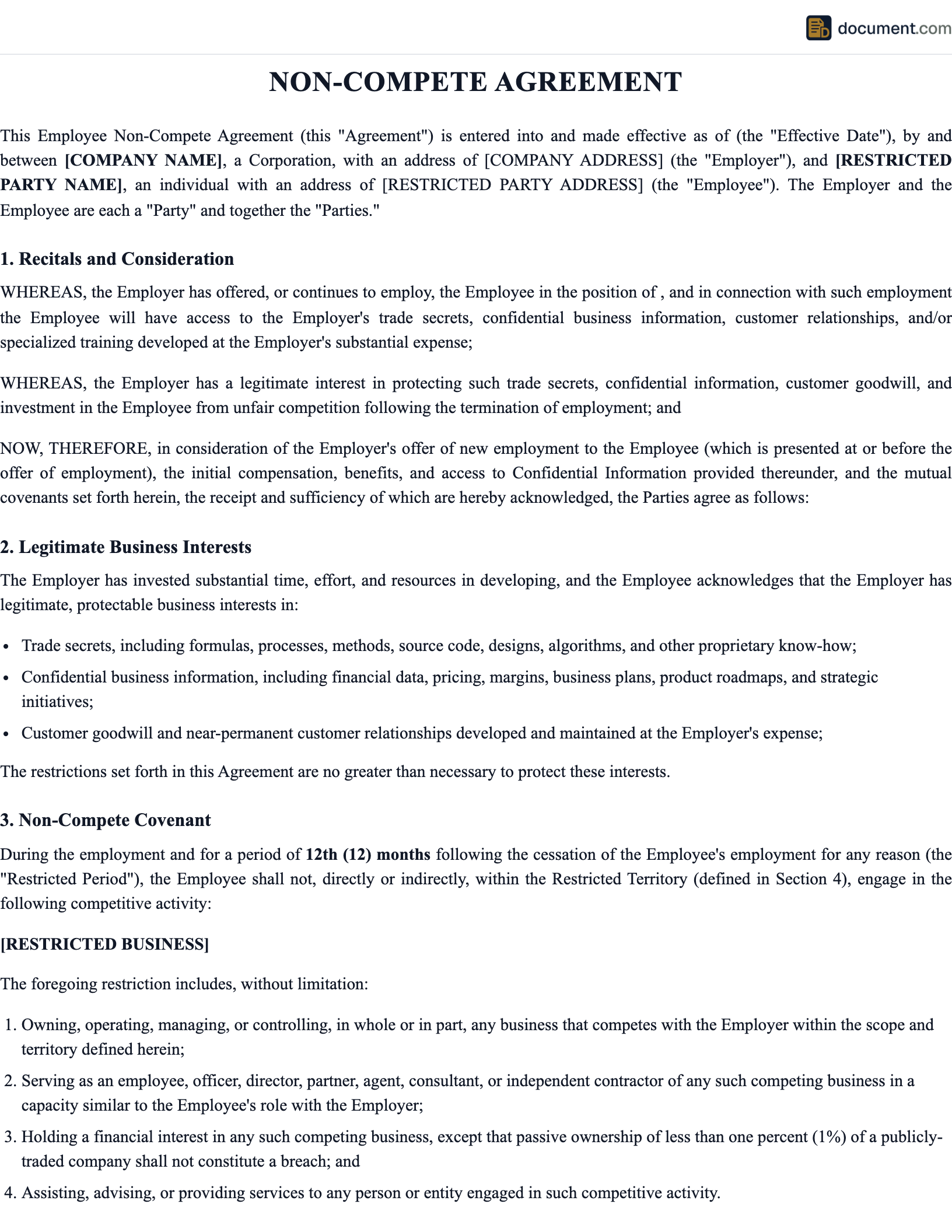
Sample Colorado Non-Compete Agreement
Below is a preview of our Colorado-specific non-compete agreement. Your customized document will include all provisions required for enforceability in Colorado.
NON-COMPETE AGREEMENT
STATE OF COLORADO
Covenant Not to Compete
EMPLOYER:
Company Name: [Legal Entity Name]
Address: [Colorado Address]
Business Type: [Industry]
EMPLOYEE:
Name: [Full Legal Name]
Position: [Job Title]
Start Date: [Date]
NON-COMPETE TERMS
Restricted Activities: [Specific Activities]
Geographic Scope: [Area]
Duration: [Time Period] following termination
Consideration: [What Employee Receives]
Governing Law: State of Colorado
Colorado Non-Compete Agreement FAQ
Answers to common questions about non-compete agreements in Colorado, including enforceability, duration limits, and employee rights.
Official Colorado Resources
Use these official resources to verify Colorado non-compete enforceability rules and access state employment law information.
Colorado Department of Labor
State labor law information and employment resources
Colorado Attorney General
Consumer protection and employment law guidance
FTC Non-Compete Rulemaking
Federal non-compete rule status and developments
ABA Labor and Employment Law
American Bar Association employment law resources
Related Colorado Documents
Depending on your situation, you may need additional documents alongside your Colorado non-compete agreement.
Colorado Non-Disclosure Agreement
Protect confidential information and trade secrets
Colorado Non-Solicitation Agreement
Prevent poaching of clients and employees
Colorado Employment Agreement
Comprehensive employment terms and conditions
Colorado Severance Agreement
Separation terms with non-compete provisions
Create your Colorado Non Compete Agreement in under 5 minutes.
Answer a few questions and download a Colorado-compliant document, ready for the state agency.