
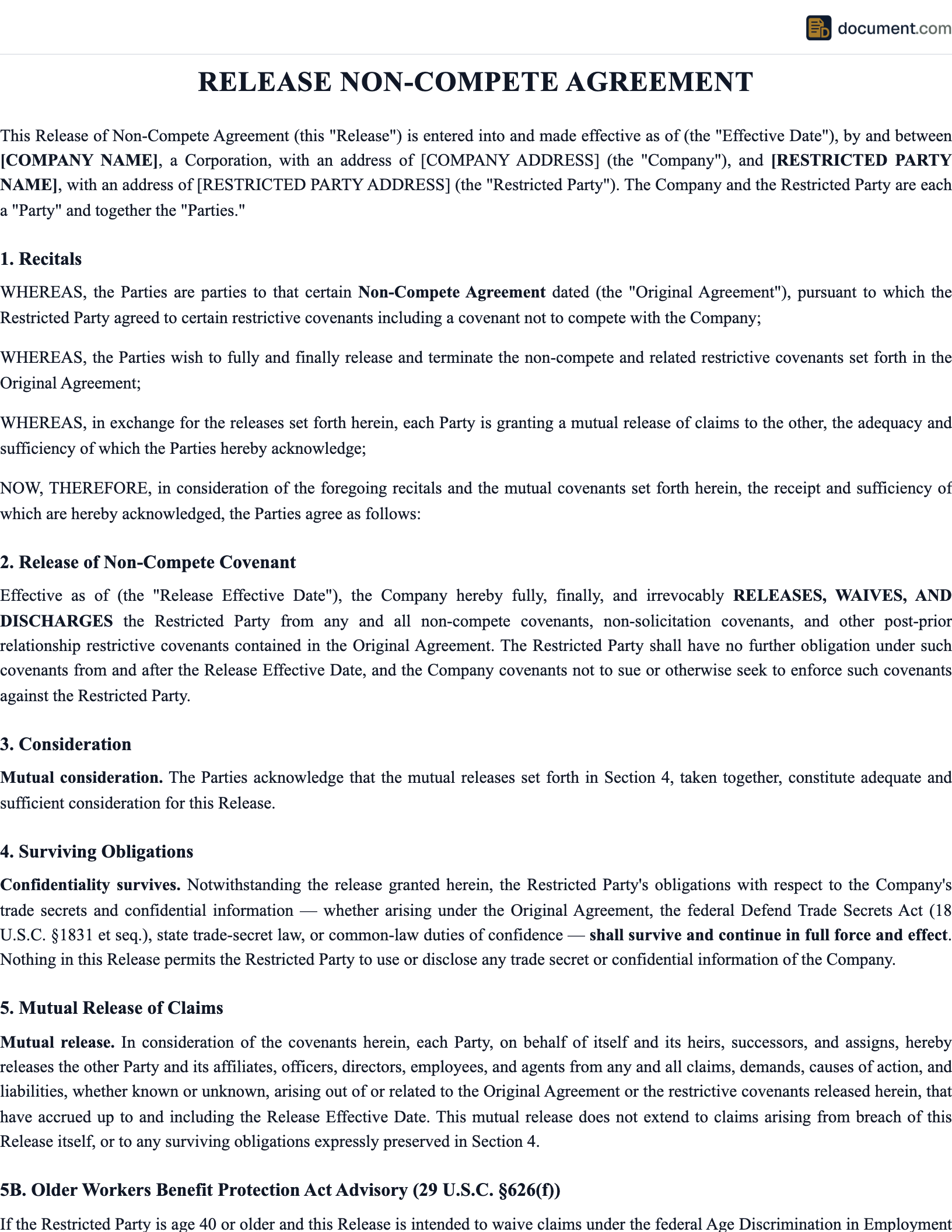



What Is a Release of Non-Compete?
A release of non-compete agreement is a written legal instrument by which the party that benefits from a non-compete — most commonly an employer, but also possibly a buyer of a business or other contractual counterparty — formally discharges the restricted party from the obligations of the underlying agreement. The release converts a restrictive covenant from an active legal limitation into an extinguished one, freeing the released party to engage in activities that were previously prohibited.
Releases of non-compete agreements arise in many practical situations. A departing employee may request a release as part of a separation agreement to ensure that they can pursue new opportunities without litigation risk. A laid-off employee may seek a release on the basis that the employer has effectively chosen to release them by terminating the relationship without cause. A former employee facing a job offer at a competitor may approach the prior employer for a release in exchange for payment, a continued non-solicit, or other consideration. A buyer in an asset purchase may release the sellers from a non-compete after the buyer concludes that the restriction is no longer commercially valuable.
The legal effect of a release depends entirely on its drafting. A narrow release may discharge only the non-compete itself, leaving other restrictive covenants — non-solicitation, confidentiality, invention assignment — in full force. A broad release may discharge all restrictive covenants and any related claims. The released party should ensure that the document clearly identifies which obligations are discharged, whether the discharge applies to past as well as future conduct, and whether any conditions must be satisfied before the release becomes effective.
Like all contract modifications, a release generally requires consideration to be enforceable. Consideration can be monetary (a payment from the released party to the releasing party, or vice versa), service-based (an agreement to continue consulting or to provide an orderly transition), or relational (a mutual release of claims, an agreement to maintain confidentiality, or an ongoing non-solicitation commitment). The form of consideration is less important than the fact that it is identified clearly and supported by the surrounding circumstances.
Career Freedom
Removes legal barriers to new opportunities at competitors or in adjacent fields
Litigation Avoidance
Eliminates the risk of injunctive relief or damages claims under the original agreement
Documentation
Provides evidence to new employers that the restriction has been formally lifted
Release Form Preview
A preview of the structure and fields included in our release template.
Release of Non-Compete
Discharge of Restrictive Covenant
Section 1: Parties
Section 2: Original Agreement
Section 3: Scope of Release
When You Need a Release
New Job Offer at a Competitor
A former employee receives an offer from a competitor and needs assurance that the new employment will not draw a lawsuit from the former employer.
Layoff or Termination Without Cause
An employee who has been laid off or terminated without cause may request a release on equitable grounds.
Negotiated Departure
As part of a separation agreement, the employer agrees to release the non-compete in exchange for the employee's release of other claims and an orderly transition.
Move to a Different Industry
The employee is moving to a non-competing role and seeks confirmation that the prior restriction does not apply.
Settlement of a Dispute
The release accompanies the settlement of pending litigation between the parties.
Sale or Restructuring of the Business
The employer is selling its business or restructuring its operations, and existing non-competes are no longer commercially valuable.
Negotiating the Release
Negotiating a release of non-compete requires understanding both your leverage and the employer's. The employer's leverage comes from the legal cost and uncertainty the employee would face in challenging the agreement, plus the risk of injunctive relief that could prevent the employee from taking a new role for the duration of the litigation. The employee's leverage comes from the cost the employer would incur in pursuing enforcement, the possibility that the agreement is unenforceable as drafted, the relationship history between the parties, and the practical reality that the employee will move on regardless.
Open the conversation with a written request that explains the situation, identifies the new role or activity, and explains why granting the release would be reasonable from the employer's perspective. Emphasize the absence of harm to the employer's legitimate interests and offer meaningful concessions: an extended customer non-solicit, an extended confidentiality commitment, a payment to the employer, or an agreement to refrain from working in specific product lines.
If the initial response is rejection, escalate respectfully to a more senior decision-maker, ask for the specific basis of the concern, and propose modifications that address the concern. Many releases that are initially refused are eventually granted after the parties have had time to understand each other's positions and negotiate around the perceived risks.
How to Create the Release
Locate the Original Agreement
Pull the underlying non-compete and any related agreements (employment contract, severance agreement, equity award documents) so the release can reference them precisely.
Identify What to Release
Decide which restrictive covenants will be released and which (if any) will remain in effect. The release should be specific.
Define the Effective Date
Determine whether the release becomes effective immediately upon execution or only after specified conditions are met.
Negotiate Consideration
Identify what each party will give in exchange for the release. Document the consideration in the release itself.
Draft the Release Language
Use clear operative language: 'releases, acquits, and forever discharges' the released party from the identified restrictions.
Address Past and Future
Specify whether the release covers past conduct, future obligations, or both.
Add Representations and Warranties
Include representations from both parties about authority to sign and the absence of assignment.
Include Severability and Entire Agreement
Standard contract provisions help ensure the release will be enforced as written.
Execute and Notarize
Both parties should sign the release. Notarization is recommended for evidentiary value.
Retain Records
Keep the executed original in permanent records and provide a copy to any third parties (such as a new employer) who may need confirmation that the restriction has been lifted.
Key Components
| Component | Description |
|---|---|
| Identification of Parties | Legal names of releasing and released parties |
| Recital of Original Agreement | Reference to the date and terms of the non-compete being released |
| Recital of Consideration | Statement of what is being exchanged for the release |
| Operative Release | Clear discharge language identifying which restrictions are released |
| Preserved Obligations | Specific identification of any restrictions that remain in effect |
| Conditions to Effectiveness | Any events that must occur before the release becomes effective |
| Scope of Discharge | Whether past, present, and future conduct is covered |
| Representations | Confirmations of authority and absence of assignment |
| Governing Law | State law governing interpretation and enforcement |
| Execution Block | Signature lines and notary acknowledgment |
Consideration for the Release
Consideration is the value exchanged between the parties to make the release legally enforceable. The form of consideration depends on the negotiation and the broader context.
- Monetary Payment: A payment from the employee to the employer (or vice versa) in connection with the release.
- Severance or Separation Payment: Payments made as part of an overall separation agreement that includes the release as one element.
- Consulting Arrangement: An agreement by the employee to provide ongoing consulting services in exchange for the release.
- Mutual Release: Each party releases the other from claims, providing mutual consideration.
- Continued Restrictions: The employee's agreement to extend or strengthen confidentiality, non-solicitation, or other obligations.
Scope and Effect
The scope of the release determines exactly which obligations are discharged and which remain in effect. A complete release of all restrictive covenants is sometimes appropriate, but more often the parties agree to release the non-compete while preserving other obligations such as confidentiality and invention assignment that serve different purposes.
The release should also clearly state whether it covers past conduct (any breach that may have occurred before the release), present conduct (current activities), and future conduct (anything the employee may do after the release). A comprehensive release covers all three.
Legal Requirements
Releases of non-compete agreements are governed by general contract principles in all 50 states. The release must be in writing, signed by the releasing party, supported by consideration, and clear in its operative language.
Several states impose additional requirements when the release is part of a separation agreement that also waives age discrimination claims under the federal Older Workers Benefit Protection Act (OWBPA). For employees over 40, the release of age claims must comply with specific requirements including a 21-day consideration period and a 7-day revocation period after signing. These requirements do not apply to the non-compete release itself but may apply to a broader separation agreement that includes the release.
Sample Release
RELEASE OF NON-COMPETE AGREEMENT
This Release is made as of [Date] by [Releasing Party] in favor of [Released Party].
RECITALS
A. The Released Party previously executed a Non-Compete Agreement dated [Date] in favor of the Releasing Party (the "Original Agreement").
B. The parties have agreed that the Releasing Party will release the Released Party from the restrictions of the Original Agreement on the terms set forth herein.
1. RELEASE
In consideration of [Description of Consideration], the Releasing Party hereby releases, acquits, and forever discharges the Released Party from any and all obligations, restrictions, claims, and causes of action arising under or related to the non-compete provisions of the Original Agreement.
2. PRESERVED OBLIGATIONS
Notwithstanding the foregoing, the Released Party's obligations regarding confidentiality and invention assignment under the Original Agreement shall remain in full force and effect.
3. SCOPE
This Release applies to past, present, and future conduct and bars any claim by the Releasing Party against the Released Party arising from the released restrictions.
4. GOVERNING LAW
This Release shall be governed by the laws of the State of [State].
Frequently Asked Questions
Official Resources
EEOC — Age Discrimination in Employment Act
Federal information on OWBPA requirements for releases involving employees over 40
U.S. Department of Labor
Federal employment law guidance and resources
FTC — Non-Compete Rulemaking
Federal Trade Commission's non-compete rule and supporting analysis
ABA — Labor & Employment Section
Resources on restrictive covenants and separation agreements
U.S. Courts
Federal court resources on contract enforcement and dispute resolution
Uniform Law Commission
Model legislation on restrictive covenants and contract law
Create your Release Non Compete Agreement in under 10 minutes.
Answer a few questions and download a compliant, attorney-drafted document ready for your state.