



What Is an Employee Non-Compete Agreement?
An employee non-compete agreement is a contract between an employer and a worker that restricts the worker's ability to engage in competitive activities for a defined period after the employment relationship ends. Unlike non-competes signed in connection with the sale of a business or by independent contractors negotiating at arm's length, an employee non-compete arises in the context of an employment relationship where the employer typically holds significantly more bargaining power. For this reason, courts and state legislatures have subjected employee non-competes to much stricter scrutiny than other forms of restrictive covenants, and the trend over the past decade has been toward limiting their use.
The legitimate purpose of an employee non-compete is to protect specific business interests that the employer has invested in developing — trade secrets and confidential information disclosed to the employee in the course of employment, customer relationships built up at the employer's expense, specialized training provided to the employee, and goodwill associated with the employee's role. When the agreement targets these specific interests with narrowly tailored restrictions, it stands a reasonable chance of being enforced. When the agreement is drafted as a blanket prohibition on competition without reference to a particular protected interest, courts are far more likely to refuse enforcement on the grounds that the agreement is an impermissible restraint of trade.
A typical employee non-compete addresses three key dimensions of the restriction: the scope of activities prohibited (working for a competitor, starting a competing business, soliciting employees, soliciting customers), the geographic area within which the restriction applies (a specific city, state, region, or worldwide), and the durationof the restriction (typically six months to two years after separation). The combination of these three elements determines whether the restriction is reasonable. A narrow activity restriction may justify a broader geographic scope; a longer duration may require a narrower geographic area; and so on. The drafter must balance the employer's need for protection against the employee's right to earn a living.
Employee non-competes are governed by state law, and the variation among states is dramatic. California, North Dakota, Oklahoma, and Minnesota are the four states that effectively prohibit employee non-competes outright. Many other states impose specific statutory requirements such as minimum compensation thresholds, advance notice requirements, garden leave compensation obligations, and limitations on enforceability against terminated employees. Before drafting or signing any employee non-compete, the parties must understand the law of the state where the employee primarily works.
Trade Secret Protection
Prevents departing employees from using confidential information to benefit a competitor
Customer Goodwill
Protects long-term customer relationships from being immediately diverted
Investment Recovery
Allows the employer to recoup investment in specialized training and onboarding
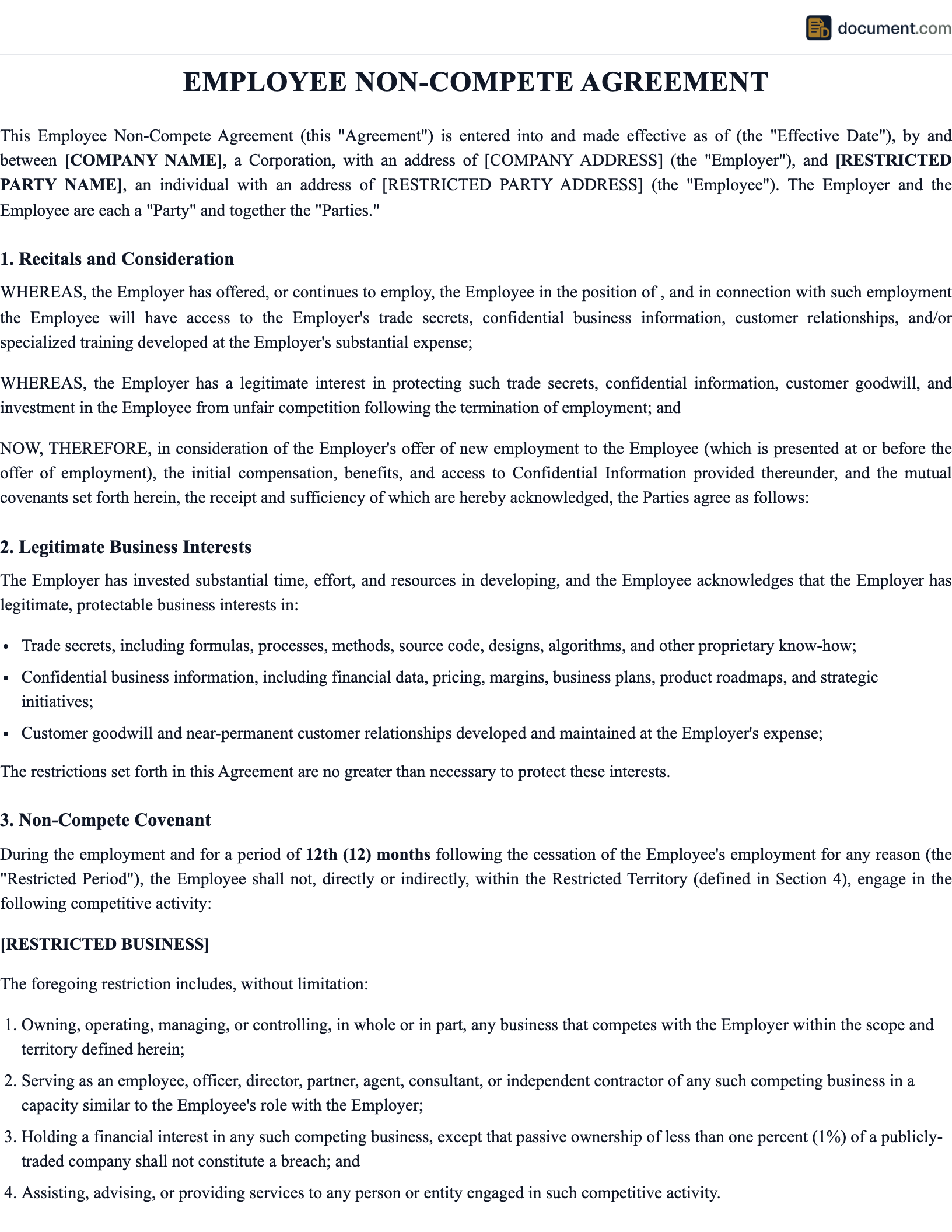
Employee Non-Compete Form Preview
The structure and fields below illustrate our employee non-compete template. Your finished document is fully formatted and tailored to your jurisdiction.
Employee Non-Compete Agreement
Restrictive Covenant
Section 1: Parties
Section 2: Scope of Restrictions
Section 3: Geographic Area
Section 4: Duration
Section 5: Consideration
When Employee Non-Competes Are Enforceable
Enforceability turns on three central questions: Does the employer have a legitimate business interest worth protecting? Is the scope of the restriction reasonable in relation to that interest? And does the agreement comply with the specific statutory requirements of the state where the employee primarily works?
Legitimate Business Interest
Trade secrets, confidential business information, customer relationships developed at the employer's expense, and specialized training are all recognized as legitimate interests. Generic business interests — like preventing a competitor from hiring talented employees — are not.
Reasonable Scope
A reasonable scope means the restriction is no broader than necessary to protect the employer's interest. A non-compete that prohibits the employee from working in any capacity, anywhere, for any employer in the broader industry is almost always overbroad.
Adequate Consideration
Many states require additional consideration beyond continued at-will employment. Examples include a sign-on bonus, a promotion, additional equity, garden leave compensation, or access to new confidential information.
Compliance with Statutory Requirements
Massachusetts, Illinois, Oregon, Washington, Maine, New Hampshire, Rhode Island, Virginia, Colorado, and several other states have specific statutes governing employee non-competes. Compliance with these statutes is mandatory.
Non-Compete vs. NDA vs. Non-Solicitation
Employers often use a combination of restrictive covenants. Each addresses a distinct concern.
| Restriction | What It Prohibits | Enforceability |
|---|---|---|
| Non-Compete | Working for or starting a competing business | Most scrutinized; barred entirely in some states |
| Non-Solicitation (Customers) | Soliciting the employer's customers or clients | More broadly enforceable; still requires reasonableness |
| Non-Solicitation (Employees) | Recruiting the employer's other employees | Generally enforceable in most states |
| NDA / Confidentiality | Disclosing or using confidential information | Most broadly enforceable across all states |
How to Create an Employee Non-Compete
Identify the Protected Interest
Articulate clearly which trade secrets, customer relationships, or specialized training the agreement is meant to protect. The articulation will guide the scope of the restriction and provide the foundation for any future enforcement action.
Define Competitive Activities
Describe with specificity what the employee is prohibited from doing — working for a named competitor, holding a specific role at any competitor, providing services in a specific product line, soliciting specified customers.
Set Geographic Scope
Limit the restriction to areas where the employer actually does business and where the employee's activities could harm the employer's legitimate interests. Avoid worldwide restrictions unless the employer truly competes globally and the employee held a global role.
Set Duration
Choose the shortest duration that meaningfully protects the interest. For most employees, 6 to 12 months is sufficient. Longer durations should be reserved for senior executives, sales leaders, and employees with deep customer relationships.
Provide Consideration
Offer something of value: a sign-on bonus, a salary increase, a promotion, equity, or garden leave compensation. Continued at-will employment alone is insufficient in many states.
Comply with State Notice Requirements
Several states require advance written notice before the agreement is signed. Massachusetts and Illinois both require at least 10 to 14 days for the employee to review the agreement and consult counsel.
Add Carve-Outs
Include carve-outs for activities that should not be prohibited — for example, passive investment in publicly traded competitors, or working in a different product line.
Specify Remedies
Identify the remedies available for breach, including injunctive relief, monetary damages, and recovery of attorneys' fees if the employer prevails.
Include Severability
A severability clause allows a court to enforce the remainder of the agreement even if one provision is found unenforceable. In states that allow blue-penciling or reformation, this clause can be the difference between a partially enforceable agreement and a void one.
Execute Properly
Both parties should sign the agreement, with witness signatures or notarization where appropriate. Maintain the executed original in the employee's personnel file.
Key Components
| Component | Description |
|---|---|
| Recital of Interest | Statement identifying the legitimate business interest the agreement is designed to protect |
| Definition of Competition | Specific description of the businesses, roles, and activities that constitute competition |
| Geographic Scope | The territorial limits of the restriction |
| Duration | The length of the post-employment restriction period |
| Consideration | Description of the value provided in exchange for the restriction |
| Carve-Outs | Explicit exceptions for permitted activities |
| Remedies | Injunctive relief, damages, and recovery of fees in case of breach |
| Severability and Reformation | Clauses allowing courts to modify or sever invalid provisions |
| Governing Law | The state law that governs interpretation and enforcement |
| Acknowledgment | Employee's acknowledgment that the restrictions are reasonable and necessary |
Reasonable Scope and Duration
The single most common reason employee non-competes are struck down is that they are drafted too broadly. Employers often default to maximalist language in the hope that a court will narrow the agreement to a reasonable scope, but this strategy backfires in jurisdictions that refuse to blue pencil or reform overbroad agreements. The better approach is to draft narrowly from the beginning.
For most employees, a 6-month restriction limited to direct competitors within a 25-mile radius of the employee's primary work location will be presumptively reasonable. For senior executives and sales representatives with deep customer relationships, restrictions of 12 months and a broader geographic area may be appropriate. For research scientists and other employees with access to highly sensitive trade secrets, longer durations and narrower activity restrictions can often be justified.
Avoid restrictions that prohibit the employee from working in "any capacity" for "any company" in the "same industry." Such language is the hallmark of an overbroad agreement and will draw immediate skepticism from a reviewing court.
Federal Regulation and the FTC Rule
In April 2024, the Federal Trade Commission issued a final rule that would have banned most employee non-competes nationwide and required employers to notify existing workers that their non-competes were no longer enforceable. The rule was scheduled to take effect on September 4, 2024.
The rule was challenged in federal court almost immediately. In August 2024, the United States District Court for the Northern District of Texas issued a nationwide injunction setting aside the rule before it took effect, holding that the FTC lacked statutory authority to issue such a sweeping prohibition. As of the most recent guidance, the rule remains enjoined and is not in force.
Employers should monitor the situation carefully because the FTC may pursue further regulatory action and Congress may consider legislation. In the interim, state law continues to govern enforceability, and the trend in many states is toward stricter limits on employee non-competes even without federal intervention.
Legal Requirements
States That Prohibit Employee Non-Competes
California, North Dakota, Oklahoma, and Minnesota effectively prohibit employee non-competes outright, with limited exceptions for non-competes signed in connection with the sale of a business or the dissolution of a partnership. Employers should not rely on employee non-competes with respect to workers based in these states.
States with Specific Statutes
Massachusetts, Illinois, Washington, Oregon, Maine, New Hampshire, Rhode Island, Virginia, and Colorado have enacted statutes that impose specific requirements such as minimum compensation thresholds, advance notice periods, garden leave compensation obligations, and limits on enforceability against terminated employees. Compliance with these statutes is essential.
Common-Law States
In states without specific non-compete statutes, enforceability is governed by common-law principles. Courts generally apply a reasonableness test that examines the legitimacy of the business interest, the reasonableness of the scope and duration, and the balance of harm to the employee and the public.
Sample Employee Non-Compete
EMPLOYEE NON-COMPETE AGREEMENT
This Employee Non-Compete Agreement is made as of [Date] by and between [Employer Name] (the "Employer") and [Employee Name] (the "Employee").
1. PROTECTED INTEREST
The Employer has invested substantial resources in developing trade secrets, confidential information, customer relationships, and specialized employee training. The Employee will be exposed to such interests in the course of employment, and the restrictions in this Agreement are necessary to protect them.
2. NON-COMPETE COVENANT
During employment and for a period of [Duration] following the termination of employment for any reason, the Employee shall not, directly or indirectly, as an owner, employee, consultant, or otherwise, engage in any Competing Business within the Restricted Area.
3. DEFINITIONS
"Competing Business" means any business that [Description]. "Restricted Area" means [Geographic Description].
4. CONSIDERATION
In consideration for the restrictions set forth herein, the Employer shall pay the Employee [Description of Payment].
5. REMEDIES
The Employee acknowledges that breach of this Agreement will cause irreparable harm and that the Employer shall be entitled to injunctive relief in addition to any other remedies available at law or in equity.
6. SEVERABILITY AND REFORMATION
If any provision of this Agreement is found unenforceable, the remaining provisions shall continue in full force and effect, and the unenforceable provision shall be reformed to the extent necessary to render it enforceable.
Frequently Asked Questions
Official Resources
FTC — Non-Compete Rulemaking
Federal Trade Commission's non-compete rule and supporting analysis
U.S. Department of Labor
Federal employment law guidance and worker rights resources
U.S. EEOC
Equal Employment Opportunity Commission worker protection resources
USPTO — Trade Secret Policy
Federal information on trade secret protection under the Defend Trade Secrets Act
ABA — Labor & Employment Section
American Bar Association resources on restrictive covenants and employment law
Uniform Restrictive Employment Agreement Act
Uniform Law Commission's model legislation on employee restrictive covenants
Create your Employee Non Compete Agreement in under 10 minutes.
Answer a few questions and download a compliant, attorney-drafted document ready for your state.