



What Is a Caregiver Contract?
A caregiver contract is a formal written agreement that documents the terms of an in-home care arrangement between a care recipient — typically an elderly person, a person with disabilities, or someone recovering from surgery or illness — and a caregiver who provides personal assistance, companionship, and daily living support. The contract serves dual purposes: it governs the practical aspects of the care relationship (duties, schedule, compensation, boundaries), and it creates a legal and financial record that is critical for tax compliance, insurance claims, and Medicaid eligibility planning.
The in-home care industry is one of the fastest-growing segments of the U.S. labor market, driven by an aging population (the 65+ demographic is projected to reach 80 million by 2040), a strong preference among seniors to age in place rather than move to institutional care, and the increasing cost of nursing home care (the national median for a private nursing home room exceeds $9,700/month). Many families hire independent caregivers directly rather than going through a home care agency, saving 30-50% on hourly costs but taking on the legal responsibilities of the employer-caregiver relationship. A written caregiver contract is the foundation of this private arrangement.
From a legal perspective, caregiver contracts occupy a uniquely regulated space. They intersect with elder law (Medicaid planning, guardianship, power of attorney), employment law (household employer obligations, FLSA domestic worker protections), tax law (household employment taxes, the "nanny tax"), healthcare law (HIPAA-adjacent privacy considerations, medication management restrictions), and insurance law (homeowner's liability, workers' compensation, auto insurance for patient transport). A properly drafted contract addresses all of these intersections and creates a documented record that protects the care recipient, the caregiver, and the family.
Compassionate Care
Defines dignified care duties covering ADLs, IADLs, and companionship.
Medicaid Compliant
Structured to withstand Medicaid look-back period scrutiny.
Privacy Protected
Covers health information confidentiality and personal dignity.
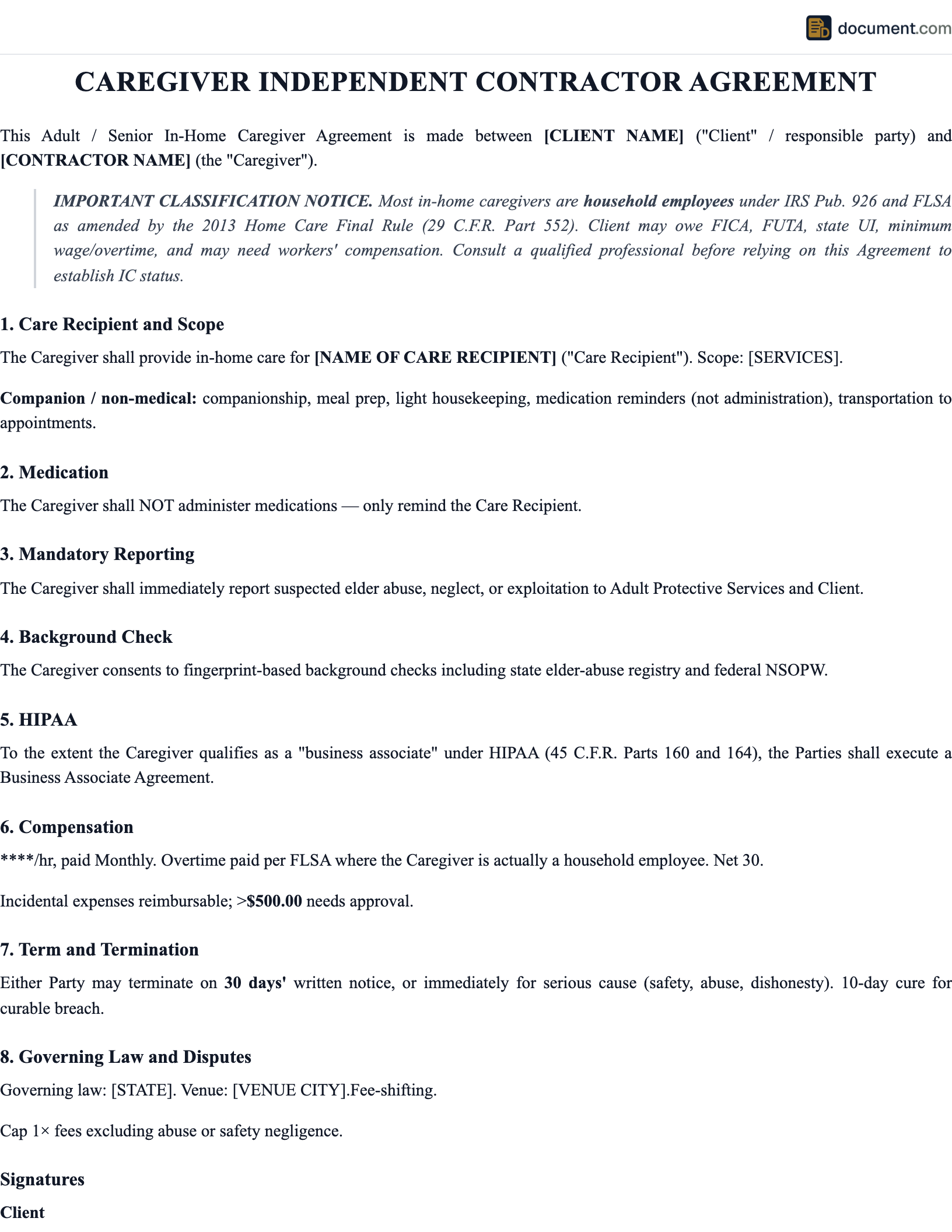
Caregiver Contract Form Preview
Personal Care Agreement
In-Home Caregiver Services
1. PARTIES
This Personal Care Agreement is entered into between ("Care Recipient") and/or their authorized representative , and ("Caregiver").
2. CARE DUTIES
Caregiver shall provide the following services: personal hygiene assistance, meal preparation, medication reminders, light housekeeping, companionship, and transportation to medical appointments as detailed in the attached Care Plan.
3. SCHEDULE AND COMPENSATION
Caregiver shall provide services hours per week at a rate of $ per hour, consistent with the fair market rate for in-home caregiving services in County.
CARE RECIPIENT / REPRESENTATIVE
CAREGIVER
Key Components
| Component | Purpose | Key Details |
|---|---|---|
| Care Plan | Defines specific care duties | ADLs, IADLs, medication schedule, mobility needs, dietary requirements |
| Schedule | Sets working hours and availability | Days, hours, overnight/live-in terms, on-call expectations, substitute protocols |
| Compensation | Documents fair market rate payments | Hourly rate, overtime, holiday pay, mileage, room/board value (live-in), payment method |
| Emergency Protocols | Ensures safety in medical crises | Emergency contacts, physician info, hospital preference, advance directives, DNR status |
| Privacy & Confidentiality | Protects medical and personal information | Health information, financial details, personal habits, visitor restrictions |
| Liability & Insurance | Allocates risk appropriately | Workers' comp, homeowner's insurance, auto liability, professional liability |
| Medicaid Documentation | Supports eligibility planning | Fair market rate justification, contemporaneous time records, care need documentation |
| Termination | Governs transition of care | Notice period, transition support, return of keys/access, final payment |
How to Create a Caregiver Contract
Assess Care Needs
Conduct a comprehensive assessment of the care recipient's needs: physical capabilities (mobility, balance, strength), cognitive status (memory, orientation, decision-making ability), medical conditions and medications, personal care requirements (bathing, dressing, continence), nutrition needs (dietary restrictions, cooking ability, feeding assistance), and social needs (companionship, activities, community engagement). Many families work with the care recipient's physician or a geriatric care manager to develop this assessment.
Develop the Care Plan
Translate the needs assessment into a detailed care plan that specifies daily tasks, weekly tasks, and periodic tasks. Include wake-up and bedtime routines, meal schedules and dietary requirements, medication schedules with names, dosages, and administration instructions, exercise or physical therapy activities, personal hygiene protocols, and companionship activities. The care plan should be attached as an exhibit to the contract and updated as the care recipient's needs change.
Determine Fair Market Compensation
Research the prevailing rate for in-home caregiving services in the care recipient's area. Sources include the Genworth Cost of Care Survey, local home care agency rates, state Medicaid waiver program rates, and the Department of Labor's wage data. Document the rate justification in the contract — this is critical for Medicaid planning because the state will compare the contract rate to market rates during the look-back review.
Establish Recordkeeping Requirements
Create a system for contemporaneous time records that document when the caregiver worked and what services they provided. Daily care logs are ideal — they should record arrival and departure times, specific duties performed, medication reminders given, meals prepared, observations about the care recipient's condition, and any incidents. These records serve dual purposes: they document the quality of care and they provide evidence of services rendered to support Medicaid eligibility.
Address Legal Capacity and Authorization
Determine who has legal authority to sign the contract on behalf of the care recipient. If the care recipient has capacity, they sign. If capacity is diminished or absent, the contract must be signed by an agent under a durable power of attorney, a court-appointed guardian or conservator, or a representative payee. Attach a copy of the authorizing document to the contract.
Include Emergency and End-of-Life Provisions
Document the care recipient's advance directives (living will, healthcare proxy, DNR order), emergency contacts in priority order, physician and specialist contact information, preferred hospital and pharmacy, and the caregiver's scope of authority in emergencies. Specify what the caregiver should do if they discover the care recipient unresponsive, in pain, or exhibiting signs of a stroke, heart attack, or fall.
Medicaid & Elder Law Considerations
The caregiver contract's role in Medicaid planning cannot be overstated. When a person applies for Medicaid long-term care benefits, the state Medicaid agency conducts a look-back review of all asset transfers during the preceding 60 months (five years in most states; 36 months in California, which is transitioning to 60 months). Any transfer of assets for less than fair market value — including payments to family members without adequate documentation — creates a transfer penalty that delays Medicaid eligibility. The penalty period is calculated by dividing the total uncompensated transfers by the average monthly cost of nursing home care in the state (ranging from roughly $6,000/month in some Southern states to $15,000+/month in the Northeast).
A properly structured caregiver contract converts what would otherwise be disqualifying gifts into legitimate payments for services rendered. To survive Medicaid scrutiny, the contract must: be executed before the services are provided (not retroactively); reflect fair market compensation for the services described (rates should be comparable to what a home care agency would charge); describe the services in sufficient detail to justify the compensation; be supported by contemporaneous time records documenting the hours worked and duties performed; and result in actual payments that are consistent with the contract terms (regular, documented payments — not lump sums that look like asset transfers).
Elder law attorneys strongly recommend that families consult with a qualified elder law attorney before entering into a caregiver contract that will be part of a Medicaid planning strategy. The attorney can ensure that the contract complies with the specific state's Medicaid rules (which vary significantly), coordinate the contract with other planning tools (irrevocable trusts, spend-down strategies, spousal protections), and advise on whether the caregiver should be classified as an independent contractor or a household employee based on the state's enforcement priorities.
Family Caregiver Warning
When a family member (adult child, sibling, niece/nephew) serves as the caregiver, Medicaid agencies scrutinize the arrangement more closely because of the potential for collusion to shelter assets. The contract must demonstrate that the services are genuine, the compensation reflects fair market value, the care recipient actually needs the services (documented by a physician or geriatric assessment), and the caregiver would otherwise have been hired from the open market. Family caregiver contracts that appear to be asset-protection mechanisms rather than genuine care arrangements will be disallowed.
Scope of Care Services
The scope of care in a caregiver contract is organized around two internationally recognized frameworks used by healthcare professionals to assess functional ability: Activities of Daily Living (ADLs) and Instrumental Activities of Daily Living (IADLs). ADLs are the fundamental self-care tasks that a person must perform daily to maintain personal health and hygiene, while IADLs are the more complex activities required for independent living in the community. A caregiver contract should specify which ADLs and IADLs the caregiver will assist with, the level of assistance required (supervision only, hands-on assistance, or full performance), and any tasks that are explicitly excluded from the caregiver's scope.
| Category | Included Activities | Assistance Level |
|---|---|---|
| Personal Hygiene (ADL) | Bathing, grooming, oral care, hair care, skin care | Ranges from verbal cues to full hands-on assistance |
| Dressing (ADL) | Selecting clothing, dressing/undressing, managing fasteners | Lay out clothes, assist with buttons/zippers, full dressing |
| Mobility (ADL) | Transfers, walking, wheelchair assistance, fall prevention | Standby assist, gait belt use, two-person transfers if needed |
| Meal Prep (IADL) | Menu planning, cooking, serving, feeding assistance | Cook from scratch, reheat prepared meals, or assist with eating |
| Transportation (IADL) | Medical appointments, pharmacy, grocery, social outings | Drive in caregiver's or care recipient's vehicle |
| Medication (IADL) | Reminders, organizing pillbox, refill coordination | Reminders only; administration may require licensed personnel |
Frequently Asked Questions
Official Resources
Authoritative resources on home care, elder law, Medicaid planning, and caregiver support.
Medicaid.gov
Official federal Medicaid resource with state program information and eligibility guidelines.
Eldercare Locator
Administration for Community Living resource connecting families with local aging services.
AARP Caregiving Resources
Comprehensive caregiving guides, tools, and support for family caregivers.
Family Caregiver Alliance
National center on caregiving providing information, support, and policy resources.
DOL - Domestic Service Workers
Department of Labor guidance on FLSA protections for in-home care workers.
National Academy of Elder Law Attorneys
Find qualified elder law attorneys and resources on Medicaid planning and caregiver contracts.
Create Your Caregiver Contract
Document care duties, compensation, and protections in a Medicaid-compliant caregiver agreement.
Create DocumentNo account required. Free to create and preview.