
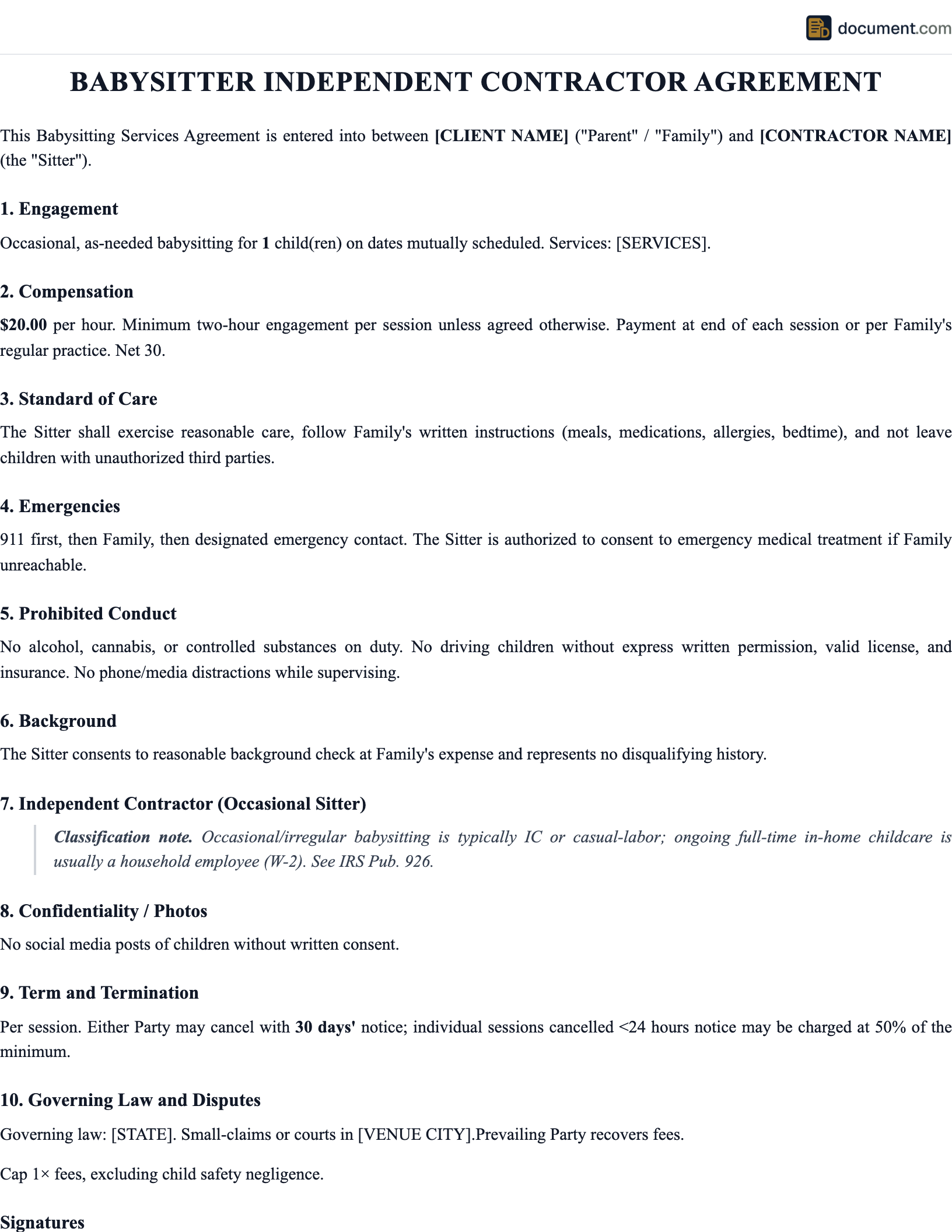



What Is a Babysitting Contract?
A babysitting contract is a written agreement that formalizes the relationship between a parent or legal guardian and a babysitter who provides childcare services on a regular or recurring basis. While many families rely on informal arrangements for occasional babysitting, a written contract becomes essential when the babysitter works regularly (weekly date nights, after-school coverage, summer breaks), cares for children with medical needs or allergies, drives the children, or earns enough to trigger household employment tax obligations. The contract transforms an informal handshake into a documented arrangement that protects both the family and the babysitter.
The distinction between a babysitting contract and a nanny contract is primarily one of scope and regularity. A nanny typically works full-time or near-full-time, is deeply integrated into the household routine, and is almost always classified as a household employee. A babysitter typically works part-time or on an as-needed basis, maintains independence over how they care for the children, works for multiple families, and may qualify as an independent contractor depending on the specific arrangement. This contract is designed for the latter scenario — a babysitter engaged as an independent contractor — and addresses the classification, tax, liability, and practical considerations unique to that arrangement.
From a legal perspective, childcare arrangements involve heightened duty-of-care standards because the babysitter is responsible for the safety and welfare of minors. Courts hold caregivers to the standard of a "reasonably prudent parent" — a higher standard than the "reasonably prudent person" applied in other negligence contexts. This means that the contract's safety provisions, emergency protocols, and liability clauses carry particular legal weight. A well-drafted babysitting contract addresses these issues directly and provides both parties with clear documentation of their rights and obligations.
Child Safety First
Covers medical authorization, allergies, emergency contacts, and safety rules.
Clear Pay Terms
Documents rates, overtime, cancellation fees, and payment methods.
Liability Protection
Addresses insurance, waivers, and duty-of-care standards.
Babysitting Contract Form Preview
Babysitting Service Agreement
Independent Contractor Arrangement
1. PARTIES
This Agreement is entered into between ("Parent/Guardian") and ("Babysitter") for childcare services for the following child(ren): .
2. SCHEDULE AND COMPENSATION
Babysitter shall provide childcare services on the following schedule: . Compensation shall be $ per hour, payable .
3. EMERGENCY CONTACTS AND MEDICAL AUTHORIZATION
Parent/Guardian authorizes Babysitter to consent to emergency medical treatment for the child(ren) listed above in the event that Parent/Guardian cannot be reached.
PARENT/GUARDIAN
BABYSITTER
Key Components
A comprehensive babysitting contract covers these essential areas to protect both the family and the caregiver:
| Component | Purpose | Key Details |
|---|---|---|
| Child Information | Identifies children and special needs | Names, ages, allergies, medical conditions, dietary restrictions, pediatrician contact |
| Compensation | Documents pay structure | Hourly rate, multi-child premium, late fees, holiday rates, payment method and timing |
| Schedule | Sets expectations for availability | Regular days/times, booking process, minimum notice for requests, maximum hours |
| Emergency Protocols | Ensures child safety | Emergency contacts, medical authorization, hospital preference, insurance info, poison control |
| House Rules | Prevents misunderstandings | Screen time limits, meal guidelines, bedtime routine, discipline methods, visitor policy |
| Transportation | Addresses vehicle use and liability | Driving authorization, car seat requirements, insurance verification, approved destinations |
| Cancellation Policy | Protects both parties from lost time/income | Notice period, cancellation fees, illness exceptions, no-show compensation |
| Liability & Insurance | Allocates risk appropriately | Liability waiver scope, homeowner's insurance, auto insurance, workers' comp considerations |
How to Create a Babysitting Contract
Gather Child Information
Compile each child's full name, date of birth, known allergies (food, medication, environmental), current medications and dosages, pediatrician name and phone number, health insurance policy number, and any behavioral or developmental considerations the babysitter should know about.
Define the Schedule and Pay
Document the regular babysitting schedule, hourly rate for one child and the per-child premium, late-pickup rates, holiday premiums, and payment method. Specify whether the babysitter is expected to be available on-call and what compensation applies for on-call availability versus active care.
Establish House Rules
Write out expectations for meals and snacks (including any dietary restrictions), screen time limits by age, bedtime routines and times, approved activities and play areas, discipline approach (time-outs, redirection, loss of privileges), homework expectations, and rules about visitors and phone use.
Create Emergency Protocols
Prepare a medical authorization form, list emergency contacts in priority order, note the nearest emergency room and urgent care addresses, document the home address clearly for 911 calls, and include instructions for fire evacuation routes and severe weather procedures.
Address Transportation and Outings
Decide whether the babysitter may drive with the children, require proof of valid license and auto insurance, specify car seat requirements, list approved destinations (parks, library, friend's houses), and determine whether ride-share services are permitted.
Set Cancellation and Termination Terms
Establish the notice period for cancellations (24-48 hours is standard), cancellation fee amounts, sick-day policies for both babysitter and child, and the process for ending the ongoing arrangement (typically 2 weeks' notice from either party).
Review Tax Obligations
Determine whether the arrangement crosses the IRS household employer threshold ($2,700 in 2024). If the babysitter is classified as an independent contractor, plan to issue a 1099-NEC for payments of $600+. Consider consulting a tax professional if the classification is borderline.
Independent Contractor vs Employee Babysitter
The classification of a babysitter as an independent contractor or household employee has significant tax and legal consequences. The IRS uses its standard control test, and many states (California, New Jersey, Massachusetts) apply more stringent ABC tests that presume employment status. Understanding the distinctions is critical for proper tax compliance:
| Factor | Independent Contractor | Household Employee |
|---|---|---|
| Schedule | Sets own availability; accepts/declines bookings | Works a fixed schedule set by the family |
| Multiple Families | Works for several families regularly | Works exclusively or primarily for one family |
| Methods | Determines how to care for children (within safety) | Follows detailed parental instructions |
| Supplies | Brings own activities, games, and materials | Uses family-provided supplies exclusively |
| Tax Forms | 1099-NEC (if $600+); pays self-employment tax | W-2; employer pays FICA; Schedule H filing |
| Hours | Part-time, irregular, on-demand | Regular, consistent, often 20+ hours/week |
Safety & Emergency Protocols
The safety section of a babysitting contract deserves particular attention because it directly addresses the welfare of children. Courts hold caregivers to a heightened standard of care, and well-documented safety protocols protect both the children and the babysitter in the event of an incident. The contract should include a comprehensive emergency information sheet that the babysitter can access immediately during an emergency, not buried in the middle of a multi-page agreement.
Beyond emergency medical situations, the contract should address everyday safety practices: pool and water safety rules (never leave children unattended near water, even for a moment), kitchen safety (age-appropriate cooking involvement, knife and appliance rules), outdoor play boundaries (fenced yard only, or specific park areas), stranger and door-answering policies (do not open the door to anyone not on the approved list), and fire safety (location of extinguishers, smoke detectors, and evacuation routes). For babysitters caring for infants, the contract should specify safe sleep practices (back to sleep, no loose bedding, firm mattress) consistent with AAP guidelines.
Background Check Consideration
While not legally required in most states for informal babysitting arrangements, many families request a background check before engaging a regular babysitter. Services like Care.com, SitterCity, and state criminal record databases offer background screening options. Some states restrict what background information can be used in hiring decisions and require disclosure to the babysitter. The contract should document whether a background check has been completed and the babysitter's consent to the check.
Frequently Asked Questions
Official Resources
Authoritative resources on household employment, childcare safety, and babysitting best practices.
IRS Publication 926 - Household Employer's Tax Guide
Complete IRS guide to household employment taxes, thresholds, and filing requirements.
American Red Cross - Babysitting Training
Red Cross babysitting certification course covering first aid, CPR, and child safety.
AAP - Children and Media
American Academy of Pediatrics screen time guidelines by age group.
Safe Kids Worldwide
Evidence-based child safety resources covering car seats, water safety, and injury prevention.
DOL - Domestic Service Workers
Department of Labor guidance on FLSA coverage for domestic service workers.
American Association of Poison Control Centers
24/7 poison control hotline (1-800-222-1222) and safety resources for caregivers.
Create Your Babysitting Contract
Document pay rates, house rules, emergency protocols, and liability protections in a professional babysitting agreement.
Create DocumentNo account required. Free to create and preview.