



What Is a Delivery Service Agreement?
A delivery service agreement is a contract governing the relationship between a business that needs goods transported to customers and an independent driver who provides that transportation service using their own vehicle. This model has become the backbone of modern last-mile logistics, powering everything from restaurant food delivery and grocery delivery to pharmaceutical distribution, medical supply transport, and e-commerce fulfillment. The independent driver model allows businesses to scale delivery capacity without the capital expenditure of maintaining a vehicle fleet, hiring W-2 drivers, and managing the associated insurance, maintenance, and fuel costs.
The legal landscape for delivery driver agreements has shifted dramatically since 2018, when the California Supreme Court's Dynamex decision adopted the ABC test for worker classification, followed by the passage of AB5 in 2019 and Proposition 22 in 2020 (which created a carve-out for app-based delivery and rideshare drivers). Other states have followed with their own legislative and judicial responses: Massachusetts, New Jersey, and Illinois apply versions of the ABC test; the federal DOL finalized a new rule in 2024 returning to the economic reality test; and the NLRB has issued guidance applying its own right-to-control standard. The result is a patchwork of classification rules that vary by state, by the agency enforcing them, and by the specific facts of the delivery arrangement. A well-drafted delivery service agreement must address this complexity directly.
Beyond classification, delivery agreements involve unique operational, insurance, and liability considerations. The driver operates a motor vehicle on public roads, creating exposure to traffic accidents, cargo damage, and third-party injury claims. The driver handles the client's merchandise and interacts with the client's customers, creating brand representation and customer experience issues. And the driver uses their personal vehicle for commercial purposes, which voids most personal auto insurance policies unless a commercial endorsement or separate commercial policy is in place. The contract must address all of these risks with specific, enforceable provisions.
Route Flexibility
Driver controls route planning and delivery sequence within windows.
Insurance Compliant
Requires commercial auto, cargo, and general liability coverage.
Fair Compensation
Per-delivery, per-mile, or hybrid pay structures with fuel provisions.
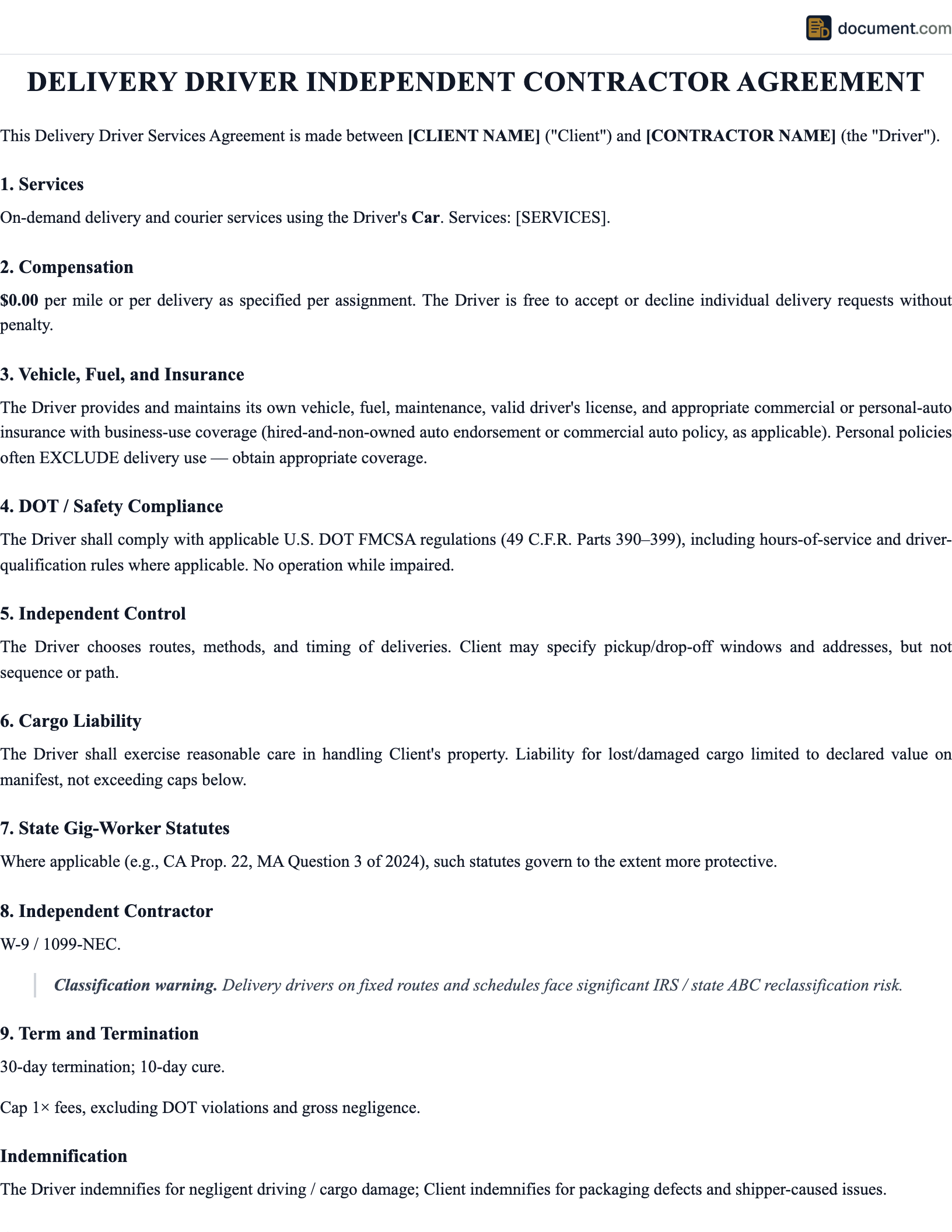
Delivery Service Agreement Form Preview
Delivery Service Agreement
Independent Contractor Driver
1. SERVICE TERRITORY
Driver shall provide delivery services within the following service area: . Driver retains sole discretion over the route, sequence, and method of completing deliveries within the designated delivery windows.
2. VEHICLE AND INSURANCE
Driver shall provide a vehicle meeting the specifications in Exhibit A and shall maintain commercial auto insurance with minimum limits of $ combined single limit and cargo insurance of $ .
3. COMPENSATION
Client shall pay Driver $ per completed delivery, plus $ per mile for distances exceeding miles from the pickup location.
CLIENT SIGNATURE
DRIVER SIGNATURE
Key Components
| Component | Purpose | Key Details |
|---|---|---|
| Service Territory | Defines the delivery area | Geographic boundaries, zip codes, delivery radius, exclusion zones |
| Vehicle Requirements | Establishes minimum vehicle standards | Vehicle type, cargo capacity, registration, inspection, maintenance standards |
| Insurance | Ensures adequate coverage | Commercial auto, cargo, general liability, additional insured requirements |
| Compensation | Documents payment structure | Per-delivery, per-mile, zone-based, fuel surcharges, peak pricing |
| Cargo Liability | Allocates risk for goods in transit | Liability cap, damage inspection, claims process, force majeure exclusions |
| Delivery Standards | Sets performance expectations | Time windows, proof of delivery, customer interaction, failed delivery protocol |
| IC Classification | Supports contractor status | Route discretion, multi-client right, own vehicle, own schedule, no uniform |
| Termination | Governs contract end | Notice period, equipment return, final payment, non-solicitation |
How to Create a Delivery Service Agreement
Define the Service Territory and Scope
Establish the geographic delivery area by defining boundaries, zip codes, or a radius from a central pickup location. Specify the types of goods to be delivered (food, packages, medical supplies, furniture) and any special handling requirements (temperature control, fragile items, hazmat). Define delivery windows rather than exact times to preserve the driver's route discretion.
Set Vehicle and Equipment Standards
Document the minimum vehicle requirements: type (car, SUV, cargo van, box truck), model year or condition standards, cargo space dimensions, required equipment (insulated bags for food, tie-downs for furniture, GPS navigation), and cleanliness standards. Specify that the driver provides their own vehicle and is responsible for all maintenance, fuel, and operating costs.
Establish Insurance Requirements
Require commercial auto insurance with specified minimum limits (typically $1M combined single limit for commercial operations), cargo insurance matching the expected cargo value, and general liability insurance. Require certificates of insurance naming the client as additional insured. Mandate immediate notification of any policy cancellation or lapse.
Structure Compensation
Select a pay model that incentivizes efficiency while supporting IC classification. Per-delivery flat rates are strongest for IC status because the driver profits from working efficiently. Include fuel surcharges pegged to a benchmark (DOE weekly average), peak-demand premiums for holidays and weather events, and failed-delivery compensation policies.
Address Classification Explicitly
Include provisions that support IC status: the driver controls route and delivery sequence, may work for multiple clients simultaneously, uses their own vehicle, sets their own schedule within delivery windows, may hire helpers or subcontractors, and is not required to attend company meetings, wear uniforms, or display branding. Avoid any provisions that suggest behavioral or financial control.
Execute and Verify Compliance
Before the driver begins deliveries: verify their driver's license and driving record (MVR check), confirm commercial auto and cargo insurance is in force, collect a signed W-9, and ensure the driver understands the delivery standards and cargo handling procedures. Update insurance certificates annually and MVR checks at least every 12 months.
Vehicle & Insurance Requirements
Vehicle and insurance requirements are the most operationally critical provisions in a delivery service agreement. A personal auto insurance policy explicitly excludes commercial use — if a delivery driver is involved in an accident while making a delivery and carries only personal auto insurance, the claim will be denied, leaving both the driver and the delivery client exposed to uninsured liability. This gap has resulted in countless lawsuits against both gig economy platforms and small businesses that failed to require commercial coverage.
The contract should require three distinct insurance coverages: commercial auto insurance (covering bodily injury and property damage to third parties arising from the driver's operation of their vehicle during commercial deliveries), cargo insurance (covering loss or damage to goods in the driver's custody during transit), and commercial general liability insurance (covering third-party claims for bodily injury or property damage arising from the driver's delivery activities that are not related to the operation of the vehicle — for example, a delivery person who damages a customer's property while carrying a package inside). Each coverage serves a distinct purpose, and all three are necessary for comprehensive risk management.
Personal Auto Insurance Exclusion
Nearly all personal auto insurance policies contain a "business use" or "commercial activity" exclusion that voids coverage when the vehicle is used for deliveries. Some insurers offer a ride-share or delivery endorsement that extends personal coverage to gig work, but these endorsements vary widely in scope and limits. The contract should require the driver to verify with their insurer that their specific delivery activities are covered, and to provide written confirmation from the insurer — not just a generic certificate of insurance.
Gig Economy Classification Issues
The classification of delivery drivers as independent contractors versus employees is the defining legal issue of the gig economy. Since the Dynamex decision in 2018, California has applied the ABC test, which presumes workers are employees unless the hiring entity proves all three prongs: (A) the worker is free from control and direction; (B) the work is outside the usual course of the hiring entity's business; and (C) the worker has an independently established trade or business. For delivery companies whose core business IS delivery, Prong B is extremely difficult to satisfy.
California's Proposition 22 (2020) created a narrow carve-out for app-based transportation and delivery companies, classifying their drivers as independent contractors with certain guaranteed benefits (earnings floor, mileage reimbursement, healthcare subsidy). However, Prop 22 applies only to app-based platforms — traditional delivery businesses that dispatch drivers directly are still subject to the full ABC test. Other states have followed California's lead: Massachusetts, New Jersey, and Illinois apply ABC-style tests, while states like Texas, Florida, and Georgia continue to apply the more employer-friendly common-law control test. The federal DOL's 2024 rule adopts the economic reality test with six non-exhaustive factors. The bottom line: delivery driver classification must be analyzed under the specific test applied by the state where the driver operates, and the contract must be structured to satisfy that test.
Frequently Asked Questions
Official Resources
Authoritative resources on delivery operations, driver classification, and transportation regulations.
FMCSA - Federal Motor Carrier Safety Administration
Federal regulations for commercial motor vehicles, driver licensing, and safety standards.
IRS - Worker Classification
IRS guidance on determining independent contractor vs. employee status.
DOL - Employment Relationship Under FLSA
Department of Labor guidance on the economic reality test for worker classification.
BLS - Delivery Drivers
Bureau of Labor Statistics occupational outlook for delivery truck drivers.
NHTSA - National Highway Traffic Safety Administration
Vehicle safety standards, recalls, and commercial vehicle regulations.
SBA - Business Insurance Guide
Small Business Administration guide to commercial auto, cargo, and liability insurance.
Create Your Delivery Service Agreement
Draft a compliant delivery contract with vehicle requirements, insurance provisions, and classification protections.
Create DocumentNo account required. Free to create and preview.