
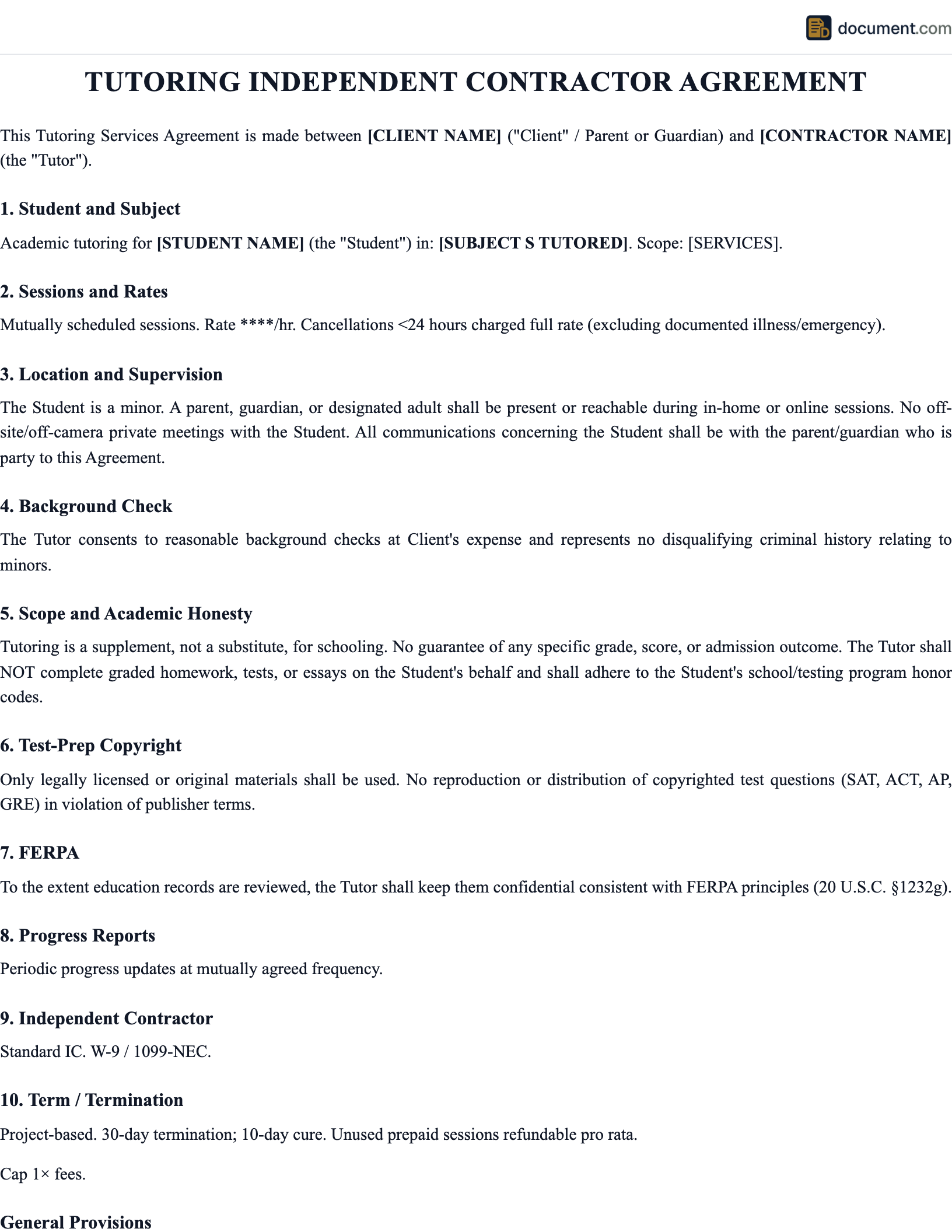



What Is a Tutoring Contract?
A tutoring contract is a written agreement between a private tutor and a client — usually a parent, guardian, or adult learner — that defines every material term of the tutoring engagement. Unlike an informal handshake arrangement, a written tutoring contract creates enforceable obligations on both sides: the tutor commits to providing instruction at specified times, in defined subject areas, using agreed-upon methods, and the client commits to paying on schedule, providing a suitable learning environment, and following the cancellation and rescheduling policy.
The contract also establishes the tutor's status as an independent contractor rather than an employee. This classification is critical because it determines tax treatment (the tutor receives a 1099-NEC rather than a W-2 and is responsible for self-employment taxes), insurance obligations (the tutor carries their own liability coverage), and the absence of employment benefits. A properly drafted agreement reinforces independent contractor status by emphasizing that the tutor controls their own schedule, chooses their own instructional methods, supplies their own materials, and is free to work with other clients.
Private tutoring is a $12+ billion industry in the United States, spanning K-12 academic support, standardized test preparation (SAT, ACT, GRE, LSAT, MCAT), college admissions coaching, English as a second language instruction, music lessons, and adult continuing education. Whether you are a solo tutor working with a handful of families or a client hiring your first tutor, a written contract is the foundation of a professional relationship that protects both parties and sets clear expectations from the first session.
Clear Expectations
Define subjects, learning goals, session frequency, and measurable progress benchmarks.
Payment Protection
Lock in rates, payment schedules, late fees, and prepaid package terms in writing.
Liability Limits
No guarantee of specific grades or scores; limits tutor liability to gross negligence.
Tutoring Contract Form Preview
Private Tutoring Agreement
Independent Contractor Engagement
Section 1: Parties & Student
Section 2: Subject & Schedule
Section 3: Compensation
Section 4: Cancellation Policy
24-hour notice required. Late cancellations billed at full rate. No-shows billed at full rate with no reschedule credit.
Key Components
| Component | What to Include |
|---|---|
| Parties | Tutor legal name, client (parent/guardian) name, student name and age |
| Subject Areas | Specific subjects, grade level or test name, learning objectives |
| Schedule | Days, times, session duration, in-person or online, location |
| Compensation | Hourly rate, package pricing, payment method, due dates, late fees |
| Cancellation Policy | Notice period, late-cancel billing, no-show policy, tutor cancellations |
| Progress Reporting | Frequency, format, parent communication channel, conferences |
| Materials & IP | Who provides materials, ownership of custom worksheets, distribution restrictions |
| Liability Limitation | No guarantee of outcomes, liability cap, indemnification |
| Confidentiality | Student records, grades, learning disabilities kept confidential |
| IC Status | Express statement of independent contractor relationship, tax responsibility |
| Termination | Notice period, refund of prepaid sessions, return of materials |
| Signatures | Tutor and client (parent/guardian), with date |
How to Create a Tutoring Contract
Building a tutoring contract requires attention to both the educational and business dimensions of the relationship. Follow these steps to create a comprehensive agreement that works for tutors and families alike.
Identify the parties and the student
Include the tutor's full legal name and business name (if applicable), the client's name (the parent or guardian if the student is a minor), and the student's name and age. If the student is 18 or older, they may be the contracting party directly.
Define subject areas and learning objectives
Specify the exact subjects (AP Calculus, SAT Reading, Spanish II), the student's current level, and measurable goals (improve grade from C to B, increase SAT score by 100 points). Clear objectives help both parties evaluate progress.
Set the schedule and location
Define the days, times, and duration of each session, whether sessions are in-person or online, and the physical location or video platform. Include provisions for rescheduling due to holidays, school breaks, or illness.
Establish compensation and payment terms
State the hourly rate or package price, the payment method, the billing cycle, and any late-payment penalties. If offering packages, specify whether unused sessions are refundable and the expiration period.
Draft the cancellation and no-show policy
Require 24–48 hours notice for cancellations. Specify billing consequences for late cancellations and no-shows. Include the tutor's obligations for their own cancellations.
Add progress reporting, confidentiality, and liability provisions
Define how and when the tutor will communicate progress, protect student information, and limit liability for academic outcomes. Include a statement that the tutor is an independent contractor.
Include termination, governing law, and signatures
Allow either party to terminate with written notice (7–14 days). Specify refund treatment for prepaid sessions. Choose governing state law and have both parties sign and date the agreement.
Sample Tutoring Contract
PRIVATE TUTORING AGREEMENT
This Private Tutoring Agreement ("Agreement") is entered into as of [Date] between [Tutor Name] ("Tutor") and [Parent/Guardian Name] ("Client"), on behalf of [Student Name] ("Student").
1. SERVICES
Tutor shall provide private instruction in [Subject(s)] to Student. Sessions will be [duration] minutes, held [frequency] at [location/platform].
2. COMPENSATION
Client shall pay Tutor $[Rate] per hour. Payment is due [billing terms]. A late fee of $[Amount] applies to payments received more than 7 days after the due date.
3. CANCELLATION POLICY
Either party may cancel a session with at least 24 hours' notice at no charge. Sessions cancelled with less than 24 hours' notice or missed without notice will be billed at the full session rate.
4. INDEPENDENT CONTRACTOR STATUS
Tutor is an independent contractor and not an employee of Client. Tutor is solely responsible for all federal, state, and local taxes arising from compensation received under this Agreement.
5. LIMITATION OF LIABILITY
Tutor does not guarantee specific academic outcomes, including but not limited to grades, test scores, or school admissions. Tutor's liability is limited to the fees paid for the most recent billing period.
6. TERMINATION
Either party may terminate this Agreement with [7/14] days' written notice. Upon termination, Client shall pay for all sessions completed and any sessions within the notice period.
7. GOVERNING LAW
This Agreement shall be governed by the laws of the State of [State].
Frequently Asked Questions
Official Resources
IRS - IC vs Employee
IRS guidance on independent contractor classification and tax obligations.
DOL - Fair Labor Standards Act
Federal wage and hour law applicable to tutoring businesses with employees.
FTC - COPPA Compliance
Children's Online Privacy Protection Act rules for online tutoring platforms.
NEA - National Education Association
Resources for educators including private tutoring standards and ethics.
SBA - Business Structure
Small Business Administration guidance for tutors starting a formal business.
ED.gov - Homework Resources
U.S. Department of Education parent resources on supplemental education.
Ready to Formalize Your Tutoring Engagement?
Answer a few questions about the tutoring arrangement, select your state, and download a professional tutoring contract in minutes.
Create DocumentNo account required. Free to create and preview.