
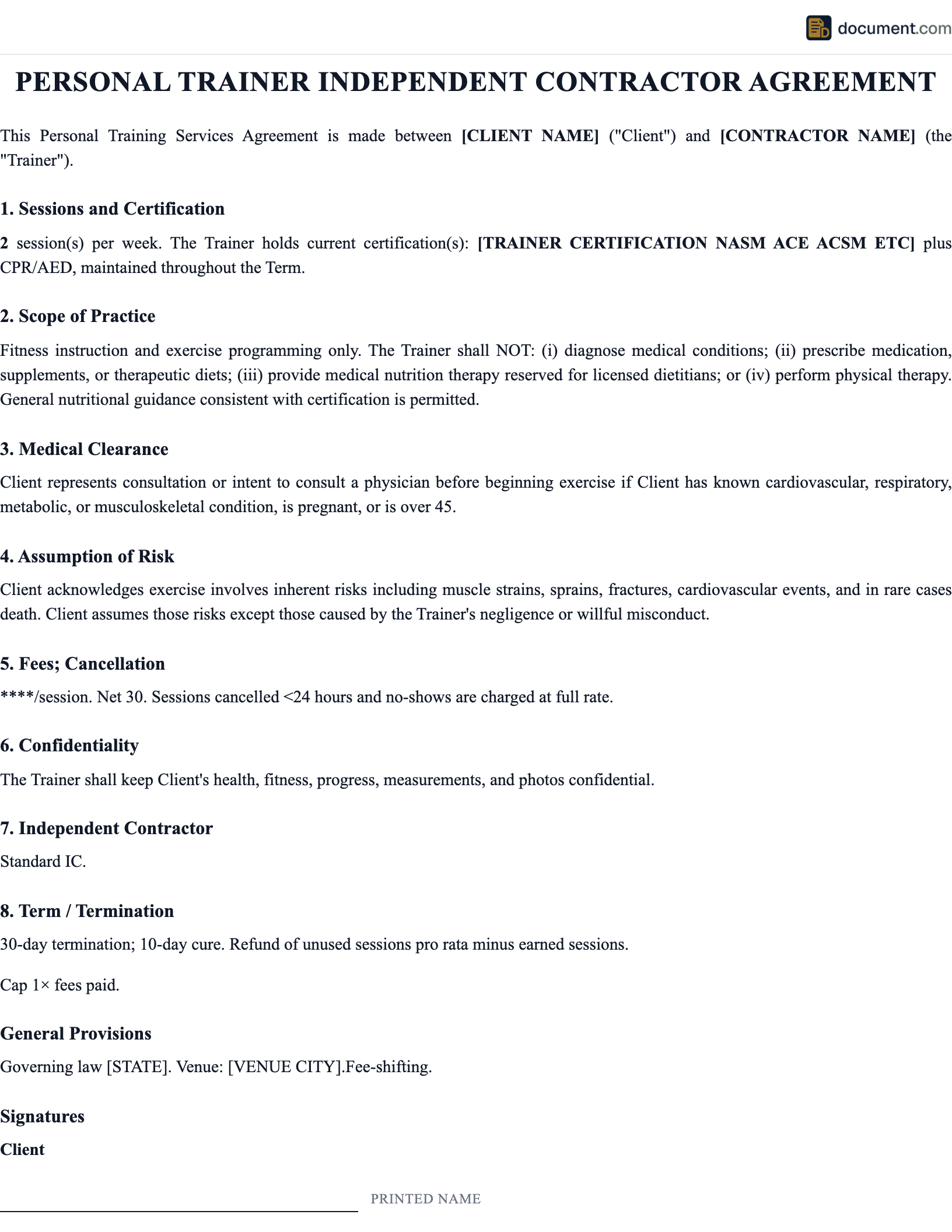



What Is a Personal Training Contract?
A personal training contract is the written services agreement between a certified fitness professional and the entity engaging the trainer's services: an individual client, a commercial gym, a boutique studio, or a corporate wellness program. The instrument addresses three categories of risk that recur in the fitness industry. First, bodily-injury liability arising from exercise (the ACSM Guidelines for Exercise Testing and Prescription document the medical risks). Second, worker-classification exposure when the trainer operates as an IC at a gym (audits by the IRS and state labor agencies have produced multi-million-dollar settlements). Third, IP ownership of custom workout programs and educational materials under 17 U.S.C. § 102 and § 201.
Personal training is a regulated profession only in the District of Columbia (D.C. Code § 3-1207.30), which licenses trainers under the Health Occupations Revision Act. Elsewhere the industry is self-regulated through certification bodies accredited by the National Commission for Certifying Agencies (NCCA): NSCA, ACE, NASM, ACSM, ISSA. The contract should state each certification the trainer holds, the expiration date, and the trainer's duty to maintain through continuing-education units (typically 20 CEUs every two years). For specialty populations, additional credentials apply: NSCA-CSCS for athletic strength and conditioning, ACSM-CEP for clinical populations, and ACE-MES for medical-exercise specialists.
The contract also addresses the operational mechanics: session pricing ($50 to $250 per 60-minute session depending on market and credentials), package structures (5, 10, 20-session blocks at discount rates), package expiration (typically 60 to 90 days), monthly retainers, cancellation policies (24 to 48 hours notice for no-charge cancellation), no-show fees, and rescheduling rules. For gym-based ICs, the contract addresses facility access, equipment use, client-ownership rules, and non-solicitation covenants subject to state enforceability (California voids non-competes under Bus. & Prof. Code § 16600).
Tunkl factors and the limits of liability waivers
Liability waivers are central to personal training, but their enforceability is uneven. California applies the six-factor test from Tunkl v. Regents, 60 Cal. 2d 92 (1963): the transaction must not be a service of great public importance, the public must not have practical necessity to enter, the party seeking exculpation must not hold a decisive bargaining advantage. Private voluntary fitness training generally satisfies Tunkl as enforceable. Most states enforce waivers of ordinary negligence in fitness settings (Stelluti v. Casapenn Enters., 203 N.J. 286 (2010); Tayar v. Camelback Ski Corp., 47 A.3d 1190 (Pa. 2012)). No state enforces waivers of gross negligence. Louisiana voids contractual immunity for one's own negligence under Civ. Code art. 2004; Virginia disfavors negligence waivers (Hiett v. Lake Barcroft Cmty. Ass'n, 244 Va. 191 (1992)).
Facility-rental versus employee classification
The structure of the trainer-gym relationship determines classification under the IRS, DOL, and state ABC tests. Facility-rental: the trainer pays the gym a monthly rent or per-session fee for space and equipment access, sets own client pricing, collects directly, and operates as a true independent business. This structure cleanly satisfies all three tests for IC status. Revenue-share IC: the gym refers clients and the gross revenue splits 50/50 to 70/30 between trainer and gym; this structure fails ABC prong B (work outside the usual course of the hiring party's business) in California, New Jersey, and Massachusetts. Employee-trainer: hourly wage plus per-session commissions, W-2 withholding, full benefits. Each model carries distinct tax, payroll, and classification consequences that the contract must address explicitly.
Health Screening
PAR-Q+ questionnaire and medical clearance for at-risk clients.
Liability Protection
Assumption of risk, liability waiver, and professional insurance requirements.
Certified Professionals
NCCA-accredited certification verification and CE maintenance.
Personal Training Contract Form Preview
Personal Training Agreement
Independent Contractor for Fitness Services
Section 1: Parties
Section 2: Sessions & Pricing
Section 3: Cancellation Policy
24-hour cancellation notice required. Late cancellations and no-shows are charged at the full session rate.
Key Components
| Component | Description |
|---|---|
| Parties & Credentials | Legal names, trainer certification number, and training location |
| Services | Session types (1-on-1, group, virtual), duration, and specializations |
| Pricing & Packages | Per-session rates, package discounts, expiration periods, and refund policy |
| Scheduling & Cancellation | Booking process, notice period, no-show fees, and rescheduling rules |
| Health Screening | PAR-Q+ requirement, medical clearance triggers, and ongoing health disclosure |
| Assumption of Risk | Client acknowledges inherent risks of physical exercise and voluntarily participates |
| Insurance | Professional liability minimums, GL coverage, and certificate of insurance |
| Scope of Practice | Trainer may not diagnose, prescribe, treat, or provide nutritional counseling beyond scope |
| IC Classification | Independent contractor acknowledgment, tax obligations, no employee benefits |
| Termination | Notice period, unused session refund/credit, and post-termination non-solicitation |
How to Create a Personal Training Contract
Verify certifications
Confirm the trainer holds a current NCCA-accredited certification (NSCA, ACE, NASM, ACSM). Record the certification number and expiration date.
Define training services
Specify session types (1-on-1, partner, small group, virtual), duration (30, 45, 60 min), specializations, and training location.
Set pricing and packages
Single-session rates, package pricing with quantity discounts, expiration periods (60-90 days), and the refund policy for unused sessions.
Establish scheduling and cancellation
Booking method, 24-48 hour cancellation notice, no-show charge, and rescheduling rules.
Require health screening
PAR-Q+ completion before the first session, physician clearance for clients with medical conditions, and ongoing obligation to report health changes.
Include liability and insurance provisions
Assumption-of-risk acknowledgment, liability waiver (separate document for the client), trainer's professional liability insurance ($1M/$3M minimum).
Add termination and non-solicitation
Notice period (14-30 days), unused session credit/refund, and restriction on soliciting facility clients post-termination.
Certifications & Qualifications
The personal training industry is self-regulated through certification bodies accredited by the National Commission for Certifying Agencies (NCCA), the recognized accreditor under the Institute for Credentialing Excellence. NCCA accreditation requires a scientifically validated exam developed under the NCCA Standards for the Accreditation of Certification Programs (2021 ed.), a published job-task analysis, periodic exam-content review, and continuing- education recertification. Most reputable gyms and insurance carriers require trainers to hold NCCA-accredited certifications. The District of Columbia is the only U.S. jurisdiction that licenses personal trainers by statute under the Health Occupations Revision Act, D.C. Code § 3-1207.30.
| Certification | Organization | NCCA Accredited |
|---|---|---|
| NSCA-CPT | National Strength & Conditioning Association | Yes |
| ACE-CPT | American Council on Exercise | Yes |
| NASM-CPT | National Academy of Sports Medicine | Yes |
| ACSM-CPT | American College of Sports Medicine | Yes |
| ISSA-CPT | International Sports Sciences Association | Yes |
Liability Waivers
Liability waivers (also called assumption-of-risk waivers or release-of-liability agreements) are a critical companion document to the personal training contract. The waiver is a separate document signed by the client that acknowledges the inherent physical risks of exercise and releases the trainer from liability for injuries that are not the result of gross negligence.
Assumption of Risk
Client acknowledges that exercise involves risks including muscle strain, joint injury, cardiovascular events, falls, and equipment-related injury.
Voluntary Participation
Client confirms participation is voluntary and they may stop any exercise at any time if they feel pain, discomfort, or distress.
State Law Limitations
Liability waivers are not enforceable in every state or for every type of claim. They generally do not protect against gross negligence or willful misconduct. Consult state law.
Frequently Asked Questions
Official Resources
NSCA - National Strength & Conditioning Association
CPT certification, research, and professional development.
ACE - American Council on Exercise
Certification, continuing education, and liability insurance.
NASM - National Academy of Sports Medicine
CPT certification and corrective exercise specialization.
ACSM - American College of Sports Medicine
Evidence-based fitness guidelines and professional certification.
IRS - Independent Contractor Defined
Worker classification guidance for fitness professionals.
NCCA - National Commission for Certifying Agencies
Accreditation standards for personal training certifications.
Create Your Personal Training Contract
Answer a few questions and download a professional personal training agreement tailored to your practice.
Create DocumentNo account required. Free to create and preview.