



What Is a Massage Therapist Contract?
A massage therapist contract is a legally binding independent contractor agreement between a licensed massage therapist and the entity engaging their services — typically a day spa, medical spa, wellness center, chiropractic office, physical therapy clinic, resort, fitness facility, or corporate wellness program. The contract establishes that the therapist operates as a self-employed professional rather than an employee, and it defines every material term of the working relationship.
The massage therapy industry employs over 460,000 practitioners in the United States, and a substantial percentage work as independent contractors who serve multiple facilities or maintain a mobile practice. The independent contractor model is well-suited to massage therapy because therapists are licensed professionals who have completed specialized training, maintain their own credentials and continuing education, often specialize in particular modalities, and exercise independent clinical judgment during each session. However, the IC classification requires a contract that properly structures the relationship to withstand IRS and state labor department scrutiny.
Beyond worker classification, the contract addresses industry-specific concerns that are not covered by a generic IC agreement: licensing verification, professional liability insurance, client health screening obligations, HIPAA compliance for therapists working in healthcare settings, scope-of-practice boundaries, client confidentiality, and the allocation of liability for treatment-related injuries. A well-drafted massage therapist contract protects both the therapist's professional independence and the facility's legal and operational interests.
Licensed Practice
Verifies state licensure, CE compliance, and scope-of-practice boundaries.
Insurance Coverage
Professional liability and general liability with facility named as additional insured.
Client Confidentiality
HIPAA-compliant privacy protections for client health information.
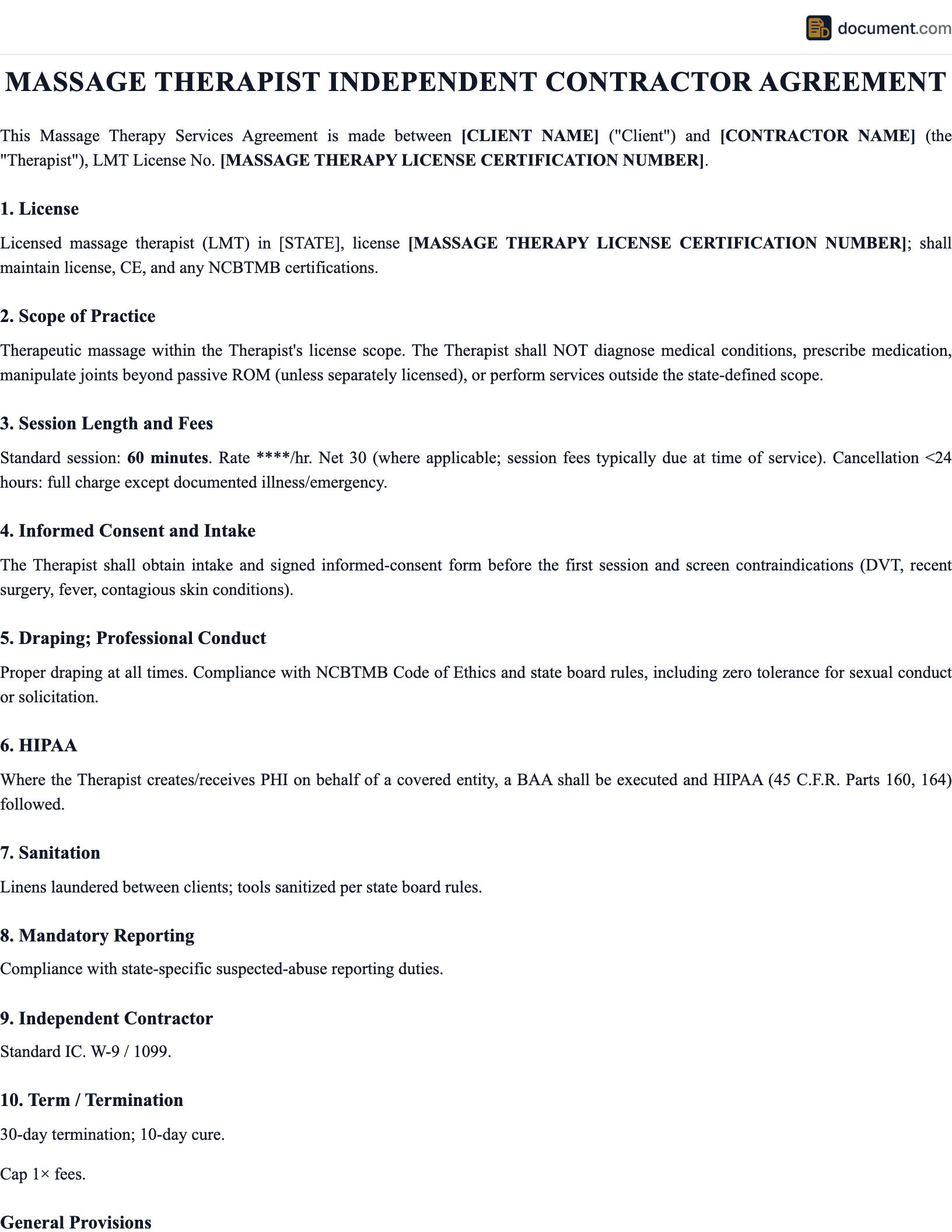
Massage Therapist Contract Form Preview
Massage Therapist Independent Contractor Agreement
Spa / Wellness Facility
Section 1: Parties
Section 2: Compensation
Section 3: Insurance
Therapist shall maintain professional liability insurance with minimum coverage of $1,000,000 per occurrence / $3,000,000 aggregate.
Key Components
| Component | Description |
|---|---|
| Parties & Licensing | Legal names, therapist license number, state of licensure, and modalities authorized |
| Services & Modalities | Specific massage types offered, session durations, and scope-of-practice limitations |
| Compensation | Per-session rates, percentage splits, gratuity policy, and payment schedule |
| Scheduling | Availability windows, minimum/maximum sessions, cancellation and no-show policies |
| Insurance Requirements | Professional liability minimums, GL coverage, additional insured requirements |
| Client Confidentiality | Health information privacy, HIPAA compliance, intake form handling |
| Equipment & Supplies | Who provides table, linens, oils, and specialty equipment; product approval process |
| IC Classification | Independent contractor status acknowledgment, tax obligations (1099), no benefits |
| Non-Solicitation | Restrictions on soliciting facility clients after contract termination |
| Termination | Notice period, for-cause triggers, and post-termination obligations |
How to Create a Massage Therapist Contract
Verify licensing and credentials
Confirm the therapist holds a current, valid massage therapy license in the state where services will be performed. Record the license number and expiration date in the contract.
Define services and modalities
List the specific massage modalities the therapist is authorized to perform at the facility (Swedish, deep tissue, sports, prenatal, etc.) and any scope-of-practice restrictions.
Set compensation and payment terms
Define per-session rates by duration, percentage splits, gratuity retention, payment frequency, and invoicing requirements.
Establish scheduling and availability
Specify available days/hours, minimum session commitments, booking lead time, and policies for cancellations, no-shows, and client rescheduling.
Require insurance coverage
Mandate professional liability ($1M/$3M minimum), general liability, and name the facility as additional insured. Require certificate of insurance before first session.
Address confidentiality and HIPAA
Include client health information confidentiality obligations, intake form handling procedures, and HIPAA Business Associate Agreement if applicable.
Add termination and non-solicitation
Define notice period (14-30 days), for-cause termination triggers (license lapse, insurance lapse, client complaint), and reasonable non-solicitation of facility clients.
Licensing Requirements
Massage therapy is one of the most heavily regulated wellness professions in the United States. Licensing requirements exist to protect public safety and ensure practitioners have completed adequate training in anatomy, physiology, pathology, kinesiology, ethics, and hands-on technique.
Education Requirements
Most states require 500-1,000 hours of instruction from an accredited massage therapy program. Some states require specific coursework in anatomy, physiology, and pathology.
Examination
The MBLEx (Massage and Bodywork Licensing Examination) is the standard licensing exam accepted in all regulated states. Some states previously accepted the NCETMB or NCETM exams.
Background Check
Most states require a criminal background check as part of the license application process. Certain convictions may disqualify an applicant.
Continuing Education
Typically 12-24 CE hours per renewal cycle (1-2 years). Topics may include ethics, safety, technique advancement, and scope-of-practice updates.
Liability & Insurance
Professional liability insurance is not merely a contractual requirement — it is the financial safety net that protects both the therapist and the facility against the inherent risks of hands-on bodywork. Even with proper training and technique, injuries can occur: muscle strains, nerve compression, aggravation of pre-existing conditions, and allergic reactions to oils or lotions.
Professional Liability
Covers claims of injury from treatment — improper technique, excessive pressure, failure to screen for contraindications. Minimum $1M per occurrence / $3M aggregate.
General Liability
Covers slip-and-fall, property damage, and third-party bodily injury unrelated to treatment. Essential for mobile therapists.
Product Liability
Covers allergic reactions or adverse effects from oils, lotions, and topical products applied during sessions.
Additional Insured
The facility should be named as additional insured on the therapist's policy to receive coverage under the therapist's policy for claims arising from the therapist's services.
Frequently Asked Questions
Official Resources
FSMTB - Federation of State Massage Therapy Boards
National licensing examination (MBLEx) and state board directory.
AMTA - American Massage Therapy Association
Professional membership, liability insurance, and continuing education.
ABMP - Associated Bodywork & Massage Professionals
Liability insurance, practice resources, and professional support.
NCBTMB - National Certification Board
Board certification and approved continuing education providers.
IRS - Independent Contractor Defined
Worker classification guidance for massage therapists.
HHS - HIPAA Information
Health information privacy requirements for healthcare-adjacent practitioners.
Create Your Massage Therapist Contract
Answer a few questions and download a professional massage therapist IC agreement tailored to your state's licensing requirements.
Create DocumentNo account required. Free to create and preview.