



What Is a Hairstylist Contract?
A hairstylist contract governs the business relationship between a salon owner and a hairstylist who operates as an independent contractor, most commonly through a booth rental or suite rental arrangement. The beauty industry has a unique business structure: the majority of hairstylists in the United States work as independent contractors who rent a station within a salon, set their own prices, maintain their own clientele, choose their own products, and keep 100% of their service revenue after paying rent. This model developed because the personal nature of hair services creates strong stylist-client bonds that travel with the stylist, making the stylist's book of business their most valuable asset.
The salon booth rental model creates a hybrid relationship that has elements of both a lease agreement and a services contract. The salon provides the physical space, utilities, reception services, and common amenities, while the stylist provides all labor, products, tools, and client development. The contract must navigate this hybrid nature while clearly establishing independent contractor status — a classification that is increasingly scrutinized by the IRS, state tax agencies, and state labor departments. Misclassification of salon employees as booth renters is one of the most common worker classification violations in the personal services industry.
Beyond classification, the contract addresses issues that are unique to the beauty industry: cosmetology licensing requirements, state board of barbering and cosmetology regulations, sanitation and hygiene standards, chemical safety (many hair products contain formaldehyde, ammonia, and other regulated substances), product liability for chemical treatments, and the commercially critical question of client ownership — who "owns" the client list when the stylist leaves the salon.
Booth Rental Terms
Defines rent, included amenities, and station specifications.
Client Ownership
Clarifies who owns client relationships and data.
Board Compliant
Addresses cosmetology licensing and sanitation standards.
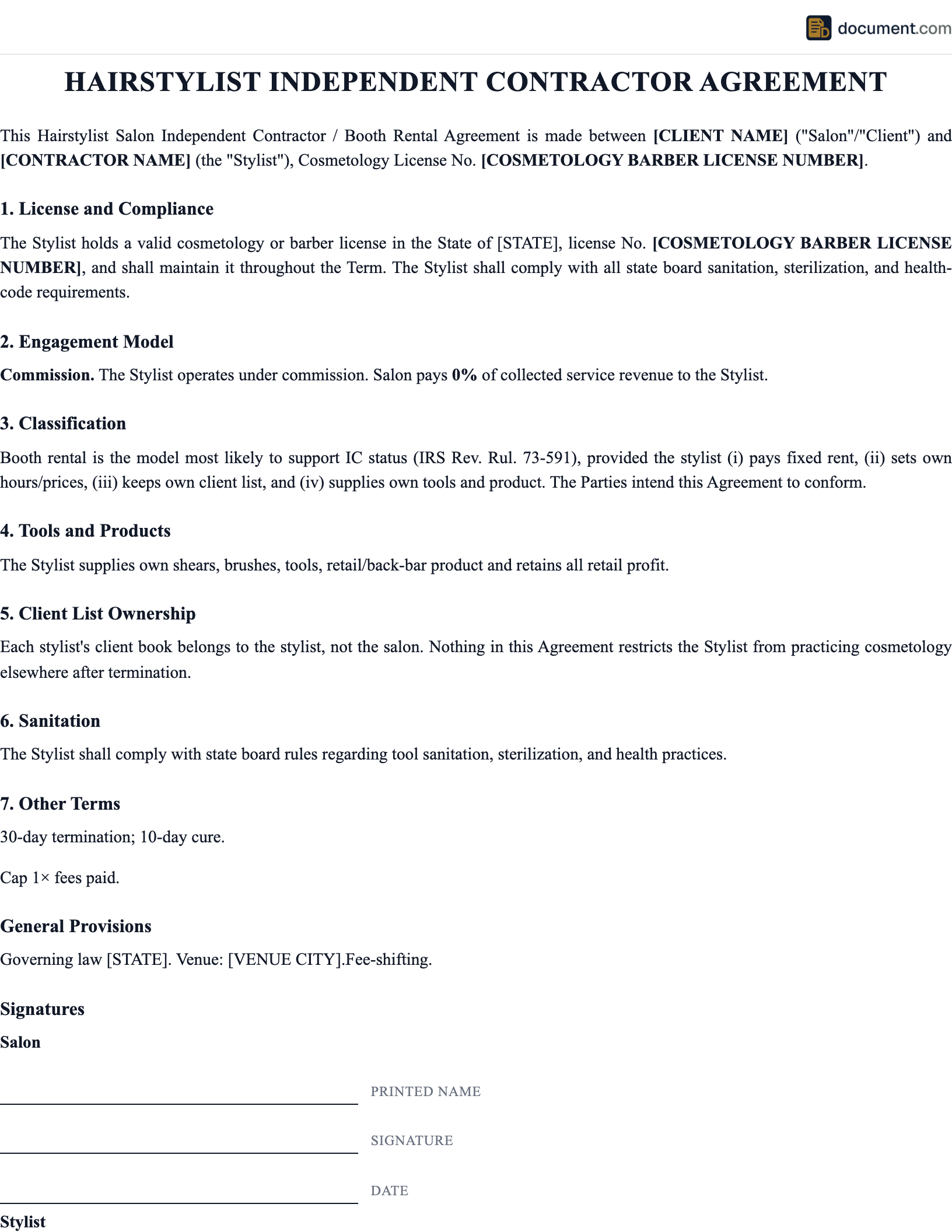
Hairstylist Contract Form Preview
Booth Rental Agreement
Salon Independent Contractor
1. BOOTH RENTAL
Salon grants Stylist the non-exclusive right to use Station # at ("Salon"). Weekly booth rent is $ , due every .
2. INDEPENDENT CONTRACTOR STATUS
Stylist is an independent contractor and not an employee of Salon. Stylist shall set their own prices, maintain their own schedule during Salon's operating hours, provide their own products and tools, and retain 100% of service and retail revenue.
3. LICENSING
Stylist represents that they hold a valid cosmetology license issued by the Board of Cosmetology, License No. .
SALON OWNER
STYLIST
Key Components
| Component | Purpose | Key Details |
|---|---|---|
| Booth Rental Terms | Defines the rental arrangement | Station assignment, rent amount, payment schedule, included amenities, rent increases |
| Schedule & Access | Sets operating parameters | Salon hours, after-hours access, key/alarm procedures, holiday closures |
| Products & Supplies | Clarifies supply responsibilities | Who provides products, brand restrictions, retail sales rights, storage |
| Client Ownership | Determines client data rights | Client list ownership, booking data, departure rights, non-solicitation |
| Licensing | Ensures regulatory compliance | Cosmetology license, continuing education, license display, sanitation standards |
| Insurance | Allocates liability risk | Professional liability, general liability, product liability, property coverage |
| Salon Policies | Maintains salon standards | Cleanliness, noise levels, dress code (if any), client behavior, parking |
| Termination | Governs departure process | Notice period, client data transfer, key return, final rent, non-solicitation period |
How to Create a Hairstylist Contract
Verify Cosmetology License
Confirm the stylist holds a valid, current cosmetology or hairstyling license in the state where the salon operates. Check the state cosmetology board's online license verification system. Document the license number, expiration date, and any specialty endorsements (esthetics, nail technology, barbering) in the contract.
Define the Booth Rental Terms
Specify the station assignment, weekly or monthly rent, payment due date, acceptable payment methods, late payment penalties, security deposit amount (typically one month's rent), and what the rent includes (utilities, water, Wi-Fi, reception desk, waiting area, common-area maintenance). Clearly state what is NOT included and will be charged separately.
Establish IC Classification Provisions
Include explicit provisions that support independent contractor status: the stylist sets their own prices, chooses their own products, maintains their own schedule within the salon's operating hours, markets their own services, maintains their own client records, and is not required to attend salon meetings, follow a dress code, or use specific product lines.
Address Client Ownership
State clearly that the stylist owns their client relationships and client contact information. If you include a non-solicitation clause, limit it to a reasonable scope (typically 6-12 months, within a 5-15 mile radius) and verify enforceability under the applicable state law. Do not include non-compete clauses in California, Minnesota, North Dakota, or Oklahoma.
Require Insurance and Indemnification
Require the stylist to carry professional liability insurance with minimum limits of $1 million per occurrence. Require a certificate of insurance naming the salon as an additional insured. Include mutual indemnification provisions: the stylist indemnifies the salon for claims arising from the stylist's services, and the salon indemnifies the stylist for claims arising from the salon's premises or operations.
Set Termination and Transition Terms
Establish a notice period (typically 30 days from either party), the process for the stylist to export their client data from the salon's booking system, the timeline for returning keys and access codes, and the final rent payment. Address what happens to active client appointments scheduled after the departure date.
Booth Rental vs Commission Models
Choosing between booth rental and commission has significant legal, tax, and business implications for both the salon and the stylist:
| Factor | Booth Rental (IC) | Commission (Employee) |
|---|---|---|
| Revenue | Stylist keeps 100% minus rent | Stylist receives 40-60% commission |
| Pricing | Set by stylist | Set by salon |
| Schedule | Stylist's discretion within salon hours | Set by salon manager |
| Products | Provided and chosen by stylist | Provided by salon |
| Taxes | Stylist pays self-employment tax; 1099-NEC | Salon withholds taxes; W-2 |
| Walk-ins | Not typically assigned by salon | Assigned by salon on rotation |
Client Ownership & Non-Solicitation
Client ownership is the central business issue in any hairstylist contract because a stylist's book of business is their primary economic asset. A stylist with a full book of regular clients generating $100,000+ in annual revenue has a portable, valuable business that they can take to any salon. Salon owners, understandably, want to protect against a departing stylist taking all of their clients to a competitor across the street.
The legal framework for resolving this tension varies dramatically by state. In California, non-compete agreements are void under Business and Professions Code Section 16600, and even non-solicitation clauses are subject to challenge (though narrowly drafted non-solicitation provisions may be enforceable). In Texas, non-competes are enforceable if they are ancillary to an otherwise enforceable agreement, are supported by consideration, and contain reasonable limitations on time, geographic area, and scope of activity. In New York, non-competes are enforceable but must be reasonable and necessary to protect the salon's legitimate interests (trade secrets, not merely preventing competition). The contract must be drafted with the specific state's law in mind — a non-compete clause that is enforceable in Florida may be void in California and unenforceable in its current form in New York.
California AB5 & Salon Workers
California's AB5 applies the ABC test to worker classification, and Prong B (the worker performs work outside the usual course of the hiring entity's business) would seemingly prevent any salon from classifying hairstylists as independent contractors, since hairstyling IS the salon's business. However, California Business and Professions Code Section 7397 provides a specific exemption for licensed barbers and cosmetologists, allowing them to work as booth renters if they set their own rates, control their own schedule, maintain their own book of business, and hold their own business license. This exemption does not exist in other ABC-test states, making the classification analysis state-specific.
Frequently Asked Questions
Official Resources
Authoritative resources on cosmetology licensing, salon regulations, and beauty industry standards.
Beauty Schools Directory - State Licensing
Comprehensive guide to cosmetology licensing requirements for every U.S. state.
IRS - Worker Classification
IRS guidance on independent contractor vs. employee classification.
OSHA - Hair Salons
OSHA guidance on chemical safety, ventilation, and ergonomic hazards in salons.
SBA - Business Structure
Guide for independent stylists choosing between sole proprietorship, LLC, and other structures.
Professional Beauty Association
Industry association providing business resources, advocacy, and education for beauty professionals.
DOL - Fair Labor Standards Act
Federal wage and hour law resources relevant to salon employee classification.
Create Your Hairstylist Contract
Protect your chair, your clients, and your business with a professional booth rental agreement.
Create DocumentNo account required. Free to create and preview.