
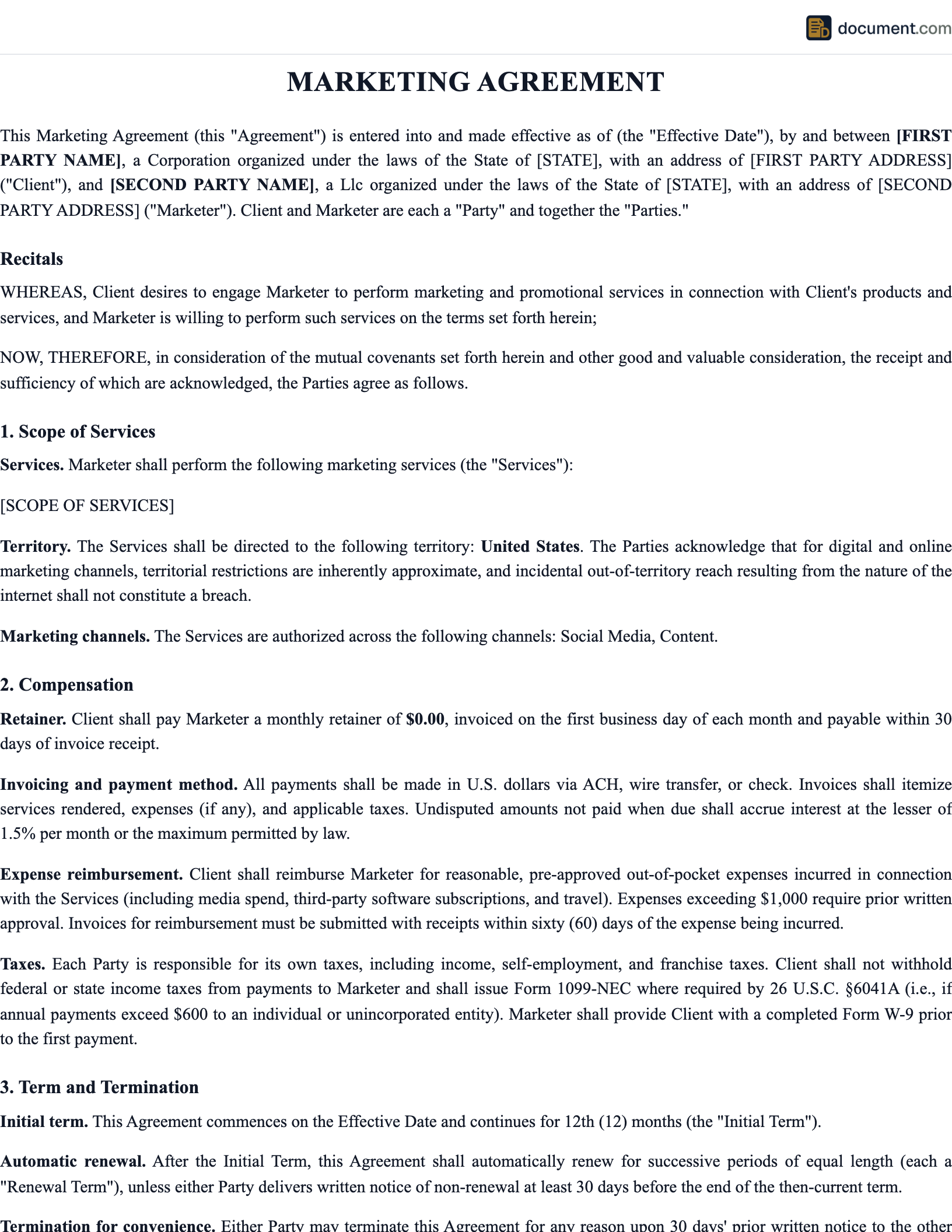



What Is a Marketing Agreement?
A marketing agreement is a contract between a business (the client) and a marketing services provider (the agency, consultant, or freelancer) that defines the scope of marketing services to be performed, the deliverables, the compensation, the timeline, and the ownership of creative work product. It establishes the legal framework for the entire working relationship, from the first strategy session through final reporting.
Marketing agreements matter because the marketing relationship is inherently collaborative and creative, which makes it prone to misunderstandings. Without a written contract, disputes over scope, deliverables, and ownership tend to surface at the worst possible time: when a campaign underperforms, when the client wants to use creative assets with a different agency, or when the agency realizes it is doing substantially more work than it priced for.
The agreement also allocates risk. Marketing involves handling brand assets, customer data, competitive intelligence, and advertising claims that may be subject to FTC regulations, state consumer protection laws, and industry-specific compliance requirements. A well-drafted agreement specifies who is responsible for ensuring advertising compliance, who bears liability for misleading claims, and how customer data will be handled under applicable privacy laws.
Whether you are hiring a full-service agency for a year-long retainer, contracting with a freelance designer for a one-time project, or engaging a performance marketing firm on a results-based compensation model, a marketing agreement protects both sides by making expectations explicit and enforceable.
Clear Deliverables
Specific scope of work prevents scope creep and misaligned expectations
IP Ownership
Define who owns logos, copy, designs, and campaign assets from day one
Performance Metrics
Measurable KPIs and reporting requirements keep the agency accountable
Marketing Agreement Form Preview
Preview of the core sections in our marketing agreement template.
Marketing Services Agreement
Agency Retainer
Section 1: Parties
Section 2: Scope of Services
Section 3: Compensation
Monthly Retainer: $12,000/month
Media Budget: Client-funded, managed by Agency
Performance Bonus: 10% of retainer if monthly lead target exceeded by 25%+
Types of Marketing Agreements
Marketing relationships come in several shapes. The right agreement depends on the scope, duration, and compensation model of the engagement.
Agency Retainer Agreement
The most common structure for ongoing agency relationships. The client pays a fixed monthly fee in exchange for a defined scope of services. The retainer covers strategy, execution, and reporting across one or more marketing channels. Well-drafted retainers include a detailed scope of work exhibit, change order procedures for out-of-scope requests, and quarterly business reviews where the scope can be adjusted.
Freelancer / Contractor Agreement
Used when hiring individual freelancers for copywriting, design, photography, videography, or other specialized marketing tasks. These agreements are typically project-based with flat fees, and they must clearly address IP ownership since the default under copyright law favors the freelancer. Include work-for-hire language where applicable and an express assignment clause as a fallback.
Performance Marketing Agreement
Compensation is tied to measurable outcomes: leads, conversions, revenue, or other KPIs. Common in affiliate marketing, lead generation, and paid media management. The agreement needs precise definitions of what counts as a qualifying lead or conversion, the tracking methodology, the attribution model, the payment calculation, and reconciliation procedures. Include minimum performance thresholds and a claw-back provision for fraudulent or low-quality leads.
Influencer / Creator Agreement
Governs the relationship between a brand and a social media influencer or content creator. Key provisions include content requirements, posting schedule, platform specifications, FTC disclosure compliance (the influencer must clearly disclose the paid relationship), exclusivity restrictions, usage rights for the brand to repurpose the content, and cancellation fees if the influencer fails to post or the content does not meet brand guidelines.
How to Create a Marketing Agreement: 8 Steps
Whether you are the client or the agency, these steps walk through the critical decisions in building a marketing agreement that works for both sides.
Define the Scope of Services
List every service the agency will provide: strategy development, content creation, media buying, SEO, social media management, email marketing, analytics, and reporting. Be specific about volume (number of posts, articles, campaigns per month), channels, and what is excluded. Attach a scope of work exhibit that can be updated by mutual agreement without amending the entire contract.
Specify Deliverables and Timelines
For each service, define the concrete deliverables, quality standards, and deadlines. Include revision rounds, approval workflows, and turnaround times. Specify the format for deliverables (file types, dimensions, platforms) and the process for client review and approval. Build in a reasonable feedback window so neither party is waiting indefinitely.
Set the Compensation Model
Choose retainer, project, hourly, performance-based, or hybrid. Define the fee amount or calculation, payment schedule, invoicing process, payment terms, late fees, and expense reimbursement policy. If media spend is involved, clarify whether the client pays the platforms directly or funds the agency to pay on its behalf, and who keeps any agency commissions or rebates.
Allocate Intellectual Property Rights
Specify that all deliverables (copy, designs, code, video) become the client's property upon full payment. Include a work-for-hire clause and a fallback assignment for work that does not qualify as work-for-hire. Allow the agency to retain a portfolio license to showcase the work in pitches and case studies. Address pre-existing agency tools and templates that the agency may incorporate into deliverables.
Establish Performance Metrics and Reporting
Define the KPIs the agency is accountable for, the reporting frequency (weekly, monthly, quarterly), the format and content of reports, and the tools used for measurement. Set expectations about what the agency controls (ad creative, targeting, content quality) versus what it does not (product quality, pricing, market conditions) so performance discussions stay productive.
Address Confidentiality and Data Privacy
Protect the client's business information, customer data, marketing strategies, and financial data. If the agency will handle personal information (email lists, customer databases, website analytics), include a data processing addendum addressing CCPA, GDPR, and CAN-SPAM obligations. Specify data security requirements, breach notification procedures, and return or destruction of data at termination.
Draft Termination and Transition Provisions
Specify the initial term, renewal mechanics, termination for convenience (with notice period), and termination for cause. Address what happens at termination: transfer of accounts, logins, and assets to the client; completion of in-progress work; final invoicing; and a transition period. Require the agency to cooperate with a successor agency for a reasonable period after termination.
Include Compliance and Indemnification
Allocate responsibility for advertising compliance (FTC guidelines, state consumer protection laws, industry regulations). Require mutual indemnification: the agency indemnifies the client for claims arising from the agency's negligence or IP infringement, and the client indemnifies the agency for claims arising from the client's products, services, or instructions. Include a limitation of liability capped at fees paid.
Key Components
A comprehensive marketing agreement covers all of these elements.
| Component | Description |
|---|---|
| Scope of Services | Detailed description of marketing services, channels, and volume |
| Deliverables | Specific outputs, formats, revision rounds, and quality standards |
| Compensation | Fee structure, payment schedule, expenses, and performance bonuses |
| Term and Renewal | Contract duration, automatic renewal, and notice requirements |
| IP Ownership | Work-for-hire designation, assignment of rights, and portfolio license |
| Performance Metrics | KPIs, reporting frequency, measurement tools, and benchmarks |
| Confidentiality | Protection of business information, strategies, and customer data |
| Data Privacy | CCPA/GDPR compliance, data processing terms, and breach notification |
| Advertising Compliance | FTC guidelines, endorsement disclosures, and substantiation |
| Non-Solicitation | Restrictions on hiring each other's employees during and after the term |
| Indemnification | Mutual indemnity for third-party claims, IP infringement, and negligence |
| Limitation of Liability | Aggregate cap and exclusion of consequential damages |
| Termination | For convenience, for cause, early termination fees, and transition |
| Governing Law | Choice of law, venue, and dispute resolution mechanism |
Legal Requirements and Considerations
Marketing agreements intersect with advertising law, intellectual property law, privacy law, and employment law. These are the key regulatory issues to address.
FTC Endorsement Guidelines
The FTC's Guides Concerning the Use of Endorsements and Testimonials in Advertising (16 C.F.R. Part 255) require clear and conspicuous disclosure of material connections between endorsers and advertisers. If the marketing agreement involves influencer partnerships, testimonials, or sponsored content, the agreement should require the service provider to comply with FTC disclosure rules and specify the acceptable disclosure language and placement. The FTC updated these guidelines in 2023 to add personal liability for individual influencers and to address virtual influencers and social media platforms.
Copyright and Work-for-Hire
Under 17 U.S.C. 101, a "work made for hire" is either a work prepared by an employee within the scope of employment or a work specially ordered or commissioned for use in one of nine enumerated categories, provided the parties expressly agree in writing. Most marketing deliverables (social posts, blog articles, ad copy, graphic designs) do not fit the nine categories unless they qualify as contributions to a collective work or supplementary works. Include both a work-for-hire clause and a belt-and-suspenders assignment to ensure the client owns all deliverables.
Independent Contractor Misclassification
If the client exercises too much control over how the marketing work is performed (as opposed to what is delivered), the agency or freelancer may be reclassified as an employee, triggering tax withholding, benefits, and labor law obligations. California's ABC test under AB 5 is particularly strict. The agreement should emphasize the agency's independence: control over methods and tools, ability to work for other clients, provision of its own equipment, and responsibility for its own taxes and insurance.
Privacy and Data Protection
- CAN-SPAM: Email marketing must comply with the CAN-SPAM Act, including accurate subject lines, physical address, and one-click unsubscribe.
- TCPA: Text message marketing requires prior express written consent under the Telephone Consumer Protection Act.
- CCPA/CPRA: Sharing consumer personal information with a marketing agency may constitute a "sale" or "sharing" under California law, requiring consumer opt-out rights.
Sample Marketing Agreement
Condensed preview of our marketing agreement template.
MARKETING SERVICES AGREEMENT
[Client Name] and [Agency Name]
This Marketing Services Agreement is entered into between[Client] and[Agency] for the provision of marketing services as described in the Scope of Work attached as Exhibit A.
1. SERVICES
Agency shall provide the marketing services described in Exhibit A in a professional and workmanlike manner consistent with industry standards.
2. COMPENSATION
Client shall pay Agency a monthly retainer of[$], due on the first business day of each month. Agency shall invoice for approved expenses with supporting documentation.
3. INTELLECTUAL PROPERTY
All deliverables created by Agency under this Agreement shall be works made for hire owned by Client. To the extent any deliverable does not qualify as a work made for hire, Agency hereby assigns to Client all right, title, and interest therein.
4. CONFIDENTIALITY
Each party shall maintain the confidentiality of the other party's Confidential Information and shall not disclose it to any third party without prior written consent.
5. TERM AND TERMINATION
This Agreement shall commence on the Effective Date and continue for an initial term of [months]. Either party may terminate with thirty (30) days written notice.
Frequently Asked Questions
Common questions about marketing agreements, IP ownership, and performance accountability.
Official Resources
Authoritative sources on advertising law, IP, and marketing compliance.
FTC Advertising Guidance
Federal Trade Commission advertising and marketing compliance resources
FTC Endorsement Guides
Guidelines on endorsements, testimonials, and influencer disclosures
U.S. Copyright Office
Copyright registration, work-for-hire rules, and ownership guidance
NAD (BBB)
National Advertising Division self-regulatory review of advertising claims
California CCPA/CPRA
California Consumer Privacy Act resources for marketing data compliance
CAN-SPAM Act
FCC guidance on commercial email compliance and requirements
Create your Marketing Agreement in under 10 minutes.
Answer a few questions and download a compliant, attorney-drafted document ready for your state.