



What Is a Vendor Agreement?
A vendor agreement is a master contract between a buyer and a supplier that establishes the terms under which the vendor will provide goods, services, or both over a period of time. It creates the framework for the entire commercial relationship: pricing, ordering procedures, delivery logistics, quality standards, payment terms, warranties, insurance requirements, confidentiality, liability allocation, and termination. Individual purchase orders issued under the agreement specify the details of each transaction.
Vendor agreements are essential for businesses that depend on external suppliers for raw materials, components, finished goods, technology, or services. Without a written agreement, the relationship defaults to the Uniform Commercial Code (UCC) for sales of goods and common law for services, which may not reflect the parties' actual intentions. UCC default rules on warranty, risk of loss, and remedies are reasonable starting points but rarely match the specific needs of a particular buyer-vendor relationship.
A well-drafted vendor agreement reduces supply chain risk. It ensures the vendor meets defined quality standards, delivers on schedule, maintains adequate insurance, complies with applicable laws (including labor, environmental, and product safety regulations), and protects the buyer's confidential information. It also gives both parties a clear dispute resolution mechanism and a predictable process for ending the relationship when business needs change.
Whether you are sourcing components for manufacturing, hiring an IT managed services provider, onboarding a logistics partner, or setting up a preferred supplier arrangement, a vendor agreement puts the relationship on solid contractual footing from day one.
Quality Standards
Define specifications, defect rates, and inspection procedures from the start
Delivery Terms
Clear delivery schedules, shipping terms, and liquidated damages for late shipments
Risk Allocation
Warranties, indemnification, insurance, and liability caps protect both parties
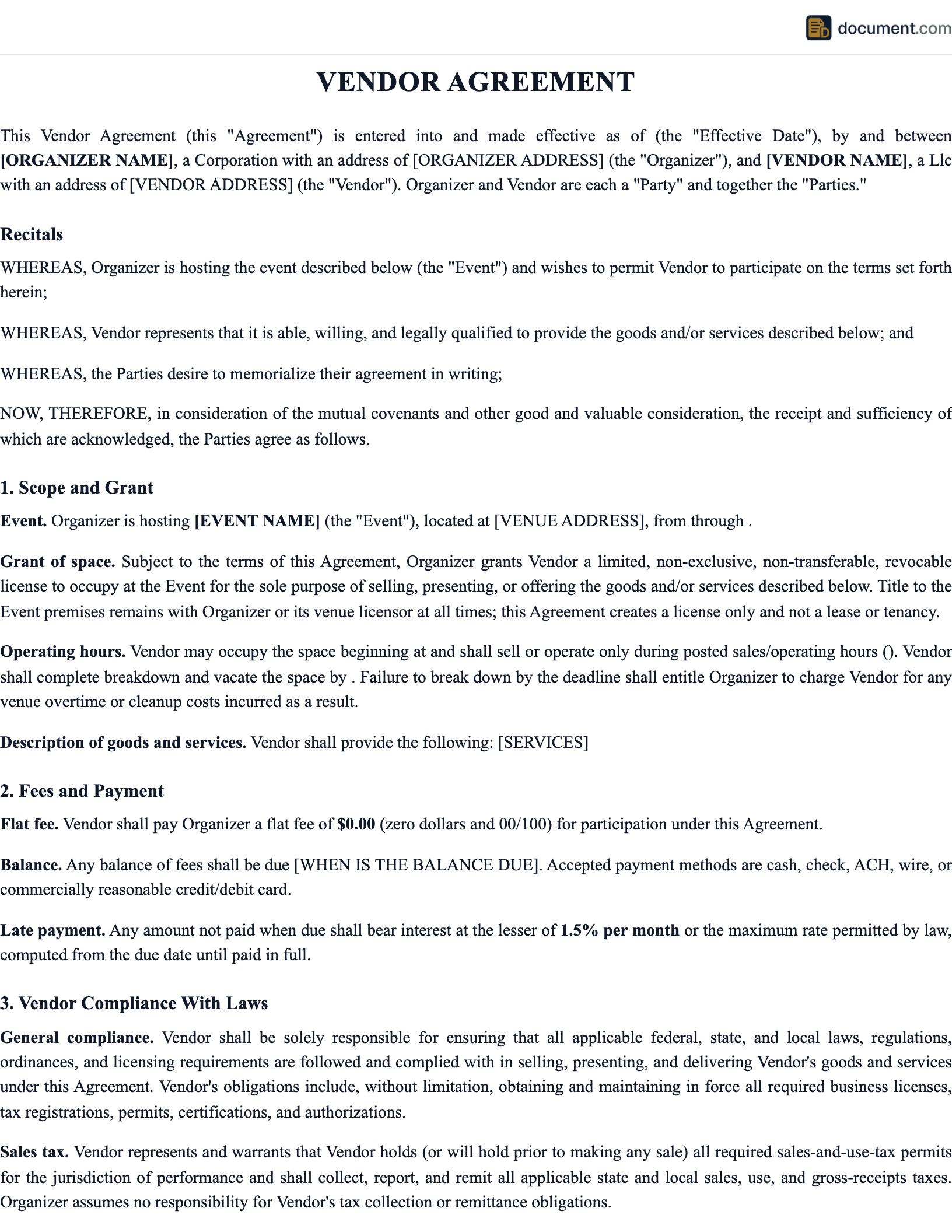
Vendor Agreement Form Preview
Preview of the core sections in our vendor agreement template.
Master Vendor Agreement
Goods and Services Supply
Section 1: Parties
Section 2: Products / Services
Section 3: Pricing
Unit Price: $14.50 per unit (lots of 1,000+)
Payment Terms: Net 30 from invoice date
Early Payment Discount: 2% if paid within 10 days
Section 4: Delivery
Types of Vendor Agreements
Vendor agreements come in several forms depending on the nature of the supply relationship.
Goods Supply Agreement
Covers the sale and delivery of physical goods: raw materials, components, finished products, or inventory. Governed primarily by UCC Article 2 (sales of goods). Key provisions include product specifications, pricing and volume commitments, delivery terms (FOB, CIF, DDP), inspection and acceptance, warranty, and risk of loss. For manufacturing inputs, the agreement should address tooling ownership, safety stock requirements, and last-time-buy rights if the vendor discontinues a product.
Managed Services Agreement
Covers ongoing services delivered by the vendor: IT managed services, facilities management, staffing, logistics, or professional services. Governed by common law rather than the UCC. The agreement should define the scope of services, service levels (response times, resolution times, availability), staffing requirements, key personnel provisions, transition assistance at termination, and the standard of care (professional and workmanlike manner consistent with industry standards).
Preferred Vendor Agreement
Establishes the vendor as a preferred supplier for a category of goods or services. The buyer commits to directing a minimum percentage or volume of purchases to the preferred vendor in exchange for preferential pricing, priority delivery, dedicated support, or other benefits. These agreements typically include minimum purchase commitments (or best-efforts language if the buyer does not want a hard commitment), volume-based pricing tiers, performance scorecards, and quarterly business reviews.
Consignment Agreement
The vendor places inventory at the buyer's location, and the buyer pays only for units consumed or sold. The vendor retains title to the goods until consumption. These arrangements reduce the buyer's working capital requirements but create complex accounting, insurance, and risk-of-loss issues. The agreement should address inventory management, cycle counts, reporting requirements, obsolescence risk, and who insures the consigned goods while they are at the buyer's facility.
How to Create a Vendor Agreement: 8 Steps
Building a vendor agreement that works for both buyer and vendor requires working through the commercial, operational, and legal terms in sequence.
Define the Products or Services
Describe what the vendor will supply in precise, measurable terms. For goods, reference product specifications, drawings, samples, or industry standards. For services, define the scope of work, deliverables, acceptance criteria, and performance standards. Attach specifications as exhibits so they can be updated by mutual agreement without amending the entire contract.
Set Pricing and Volume Terms
Document the pricing structure: fixed unit prices, cost-plus, volume-based tiers, or formula-based (tied to raw material indices). Specify whether the buyer commits to minimum purchase volumes and what happens if minimums are not met (shortfall fees, price adjustments, or termination rights). Address price increases: fixed for the initial term, subject to a cap, or adjustable with advance notice and the buyer's right to terminate if the increase exceeds a threshold.
Establish Delivery and Logistics
Specify delivery terms using Incoterms (FOB, CIF, DDP, EXW) or UCC shipping terms. Define lead times from PO acceptance, acceptable delivery windows, partial shipment rules, and the vendor's obligation to notify the buyer of anticipated delays. Address packaging, labeling, and shipping documentation requirements. For international vendors, address customs, duties, tariffs, and import compliance.
Define Quality and Inspection Procedures
Set product specifications, acceptable defect rates, and required certifications (ISO, FDA, UL). Define the buyer's right to inspect incoming goods, the acceptance/rejection window, the process for returning non-conforming goods, and the vendor's obligation to replace or credit rejected goods. Include a corrective action process for recurring quality issues and the buyer's right to audit the vendor's quality systems and facilities.
Draft Payment Terms and Invoicing
Specify payment timing (net 30, net 45, net 60), early payment discounts, late payment penalties, invoicing requirements (PO reference, itemization, supporting documentation), and any set-off or withholding rights. For international vendors, address currency, exchange rate risk, and wire transfer fees. Clarify whether taxes, duties, and shipping costs are included in or added to the unit price.
Address Warranties and Remedies
Define the vendor's product and service warranties, the warranty period, and the available remedies (repair, replacement, refund, or re-performance at the buyer's election). Decide whether the UCC implied warranties of merchantability and fitness for a particular purpose apply or are disclaimed. Address the vendor's obligation to indemnify the buyer for product liability claims and IP infringement claims arising from the vendor's goods.
Specify Insurance and Compliance
List the vendor's required insurance coverages and minimum limits: CGL, workers' comp, auto, product liability, professional liability (if applicable), and umbrella. Require the buyer to be named as additional insured. Address the vendor's compliance with applicable laws: labor, environmental, anti-corruption (FCPA if international), product safety, export controls, and conflict minerals (Dodd-Frank Section 1502 for certain manufacturers).
Include Term, Termination, and Transition
Set the initial term and renewal mechanics (auto-renewal with notice, annual renewal, or evergreen). Define termination rights: for convenience with notice (typically 30 to 90 days), for cause with cure period, and immediate termination for insolvency or material breach. Address transition assistance: the vendor's obligation to continue filling orders during a transition period, cooperate with a replacement vendor, and return the buyer's tooling, materials, and confidential information.
Key Components
A comprehensive vendor agreement covers all of these elements.
| Component | Description |
|---|---|
| Products / Services | Detailed specifications, scope, and acceptance criteria |
| Pricing | Unit prices, volume tiers, price adjustments, and discount structures |
| Ordering Process | PO mechanics, lead times, minimum order quantities, and forecasting |
| Delivery | Incoterms, shipping requirements, packaging, and late delivery remedies |
| Quality Standards | Specifications, defect rates, certifications, and inspection rights |
| Payment Terms | Invoicing, payment timing, discounts, penalties, and set-off rights |
| Warranties | Product warranties, service warranties, and warranty remedies |
| Indemnification | Product liability, IP infringement, and third-party claims |
| Insurance | Required coverages, minimum limits, and additional insured requirements |
| Confidentiality | Protection of buyer's business information and vendor's proprietary data |
| Compliance | Labor, environmental, anti-corruption, and product safety laws |
| Limitation of Liability | Aggregate cap and exclusion of consequential damages |
| Term and Termination | Duration, renewal, termination rights, and transition assistance |
| Governing Law | Choice of law, venue, and dispute resolution mechanism |
Legal Requirements and Considerations
Vendor agreements involve UCC sales law, product liability, employment law, and regulatory compliance. These are the key legal considerations.
UCC Article 2 and the Battle of the Forms
When a buyer sends a purchase order and a vendor responds with an acknowledgment or invoice that contains different or additional terms, UCC Section 2-207 (the "battle of the forms" provision) determines which terms govern the contract. Under the UCC, the additional terms become part of the contract between merchants unless they materially alter the contract, the offer expressly limits acceptance to its terms, or the other party objects within a reasonable time. A master vendor agreement avoids the battle of the forms entirely by establishing the governing terms in advance, with purchase orders incorporating those terms by reference.
Product Liability
If the vendor supplies defective goods that cause injury or property damage, both the vendor and the buyer may face product liability claims under strict liability, negligence, and warranty theories. The vendor agreement should require the vendor to indemnify the buyer for product liability claims arising from defects in the vendor's goods, carry adequate product liability insurance, cooperate in product recalls, and maintain records sufficient to trace defective products. For consumer products, address compliance with the Consumer Product Safety Act and CPSC reporting requirements.
Supply Chain Due Diligence
Increasing regulatory focus on supply chain responsibility means buyers must vet their vendors for compliance with labor laws (including forced labor and child labor prohibitions), environmental regulations, anti-corruption laws (FCPA, UK Bribery Act), conflict minerals reporting (Dodd-Frank Section 1502), and sanctions compliance (OFAC). The vendor agreement should include representations on compliance with these laws, the buyer's right to audit, and termination rights for material compliance failures. The Uyghur Forced Labor Prevention Act (2022) creates a presumption that goods from China's Xinjiang region are made with forced labor unless proven otherwise.
Regulatory Compliance
- FDA: Food, drug, medical device, and cosmetic vendors must comply with FDA manufacturing, labeling, and reporting requirements.
- Environmental: Vendors handling hazardous materials must comply with EPA regulations, RCRA, and state environmental laws.
- Import/Export: International vendor relationships must address customs compliance, export controls (EAR, ITAR), and tariff classifications.
Sample Vendor Agreement
Condensed preview of our vendor agreement template.
MASTER VENDOR AGREEMENT
[Buyer] and [Vendor]
This Master Vendor Agreement is entered into between[Buyer] and[Vendor] for the supply of goods and/or services as described in purchase orders issued hereunder.
1. SUPPLY OBLIGATION
Vendor shall supply the Products and/or Services described in each Purchase Order in accordance with the specifications, quantities, and delivery dates set forth therein.
2. PRICING AND PAYMENT
Prices are set forth in Exhibit A and are firm for the Initial Term. Buyer shall pay undisputed invoices within [days]of receipt. A discount of [%]applies if paid within [days].
3. QUALITY AND INSPECTION
All Products shall conform to the specifications in Exhibit A and be free from defects in materials and workmanship. Buyer may inspect Products within ten (10) business days of delivery and reject non-conforming Products.
4. WARRANTIES
Vendor warrants that Products are merchantable, fit for their intended purpose, free from defects, and do not infringe any third-party intellectual property rights. Warranty period: [months]from acceptance.
5. TERMINATION
Either party may terminate for convenience upon sixty (60) days written notice. Either party may terminate for material breach upon thirty (30) days written notice and an opportunity to cure.
Frequently Asked Questions
Common questions about vendor agreements, quality standards, and supply chain management.
Official Resources
Authoritative sources on vendor management, UCC sales law, and supply chain compliance.
UCC Article 2
Uniform Commercial Code provisions governing sales of goods
ISO 9001
Quality management system standard for vendor certification
CPSC
Consumer Product Safety Commission product safety and recall guidance
FDA Industry Guidance
FDA manufacturing, labeling, and compliance resources for regulated products
SBA Supply Chain Guide
Small Business Administration guidance on vendor management and supply chain resilience
ICC Incoterms
International Chamber of Commerce trade terms for delivery and risk of loss
Create your Vendor Agreement in under 10 minutes.
Answer a few questions and download a compliant, attorney-drafted document ready for your state.