
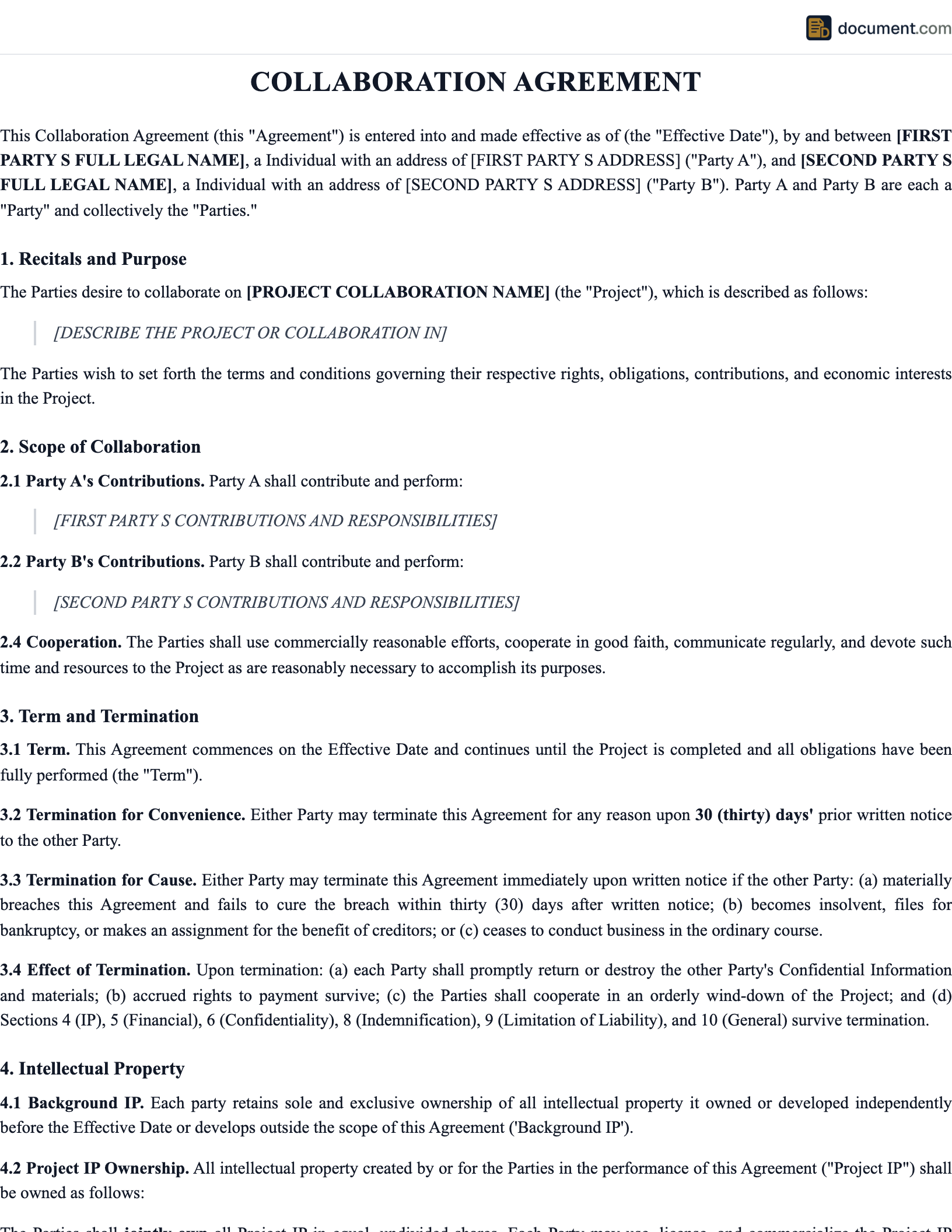



What Is a Collaboration Agreement?
A collaboration agreement is a written contract between two or more independent parties — businesses, individuals, universities, or any combination — that defines how they will work together on a defined initiative without forming a new entity, sharing profits and losses generally, or holding themselves out to the public as a single business. It is the lightest-weight form of cooperative arrangement, designed for situations where the parties want to combine resources for a specific purpose but want to remain legally and operationally separate.
Collaboration agreements are common in product development partnerships, joint research projects, co-marketing campaigns, music co-writes, film co-productions, university-industry technology partnerships, influencer-brand activations, and strategic alliances between non-competing businesses. In each case, the parties bring complementary capabilities — capital, technology, distribution, audience, expertise, or content — and want a predictable framework for combining them without the overhead of forming a joint venture entity.
The biggest legal questions in any collaboration are who owns the intellectual property created during the project, how revenue and credit are split, who has decision-making authority, what happens if one party wants out, and what each party's confidentiality obligations are. The default rules of copyright, patent, and partnership law often produce surprising results when applied to collaborations — joint copyright authors can each license the work without the others' consent, joint patent inventors cannot sue infringers without joining the others, and parties who share profits may inadvertently form a partnership for tax and liability purposes. A well-drafted collaboration agreement overrides those defaults with explicit provisions.
The contract typically distinguishes between background intellectual property — what each party brings into the collaboration — and foreground intellectual property — what is created during it. Background IP usually stays with the originating party, with a limited license to the other parties to use it during the project. Foreground IP can be assigned to one party, jointly owned, or allocated to the party best positioned to commercialize it, depending on the goals of the collaboration.
Whether you are co-writing a song, launching a co-branded campaign, partnering with a university lab, or aligning with a strategic partner on a six-figure go-to-market initiative, our attorney-reviewed collaboration agreement templates give you a tested foundation that addresses the structural, operational, financial, and IP issues that derail unstructured cooperation.
IP Clarity
Clear ownership of background and foreground intellectual property prevents post-project disputes
No Entity Required
Achieve cooperative goals without the cost of forming a JV entity or partnership
Defined Exits
Termination, wind-down, and post-collaboration rights are written down in advance
Collaboration Form Preview
Walkthrough of the standard sections in our collaboration agreement template.
Collaboration Agreement
Project: Joint Product Launch
Section 1: Collaborators
Section 2: Project Description
Section 3: Contributions
Party A: Adaptive engine, hosting infrastructure, $75,000 cash, engineering team (2 FTE)
Party B: 1,200 hours of curriculum content, brand assets, marketing channels, $25,000 cash
Section 4: Revenue Split
Section 5: IP Ownership
Background IP: Each party retains ownership of pre-existing IP
Foreground IP: Joint ownership of co-developed work product, with cross-licenses
Types of Collaboration Agreements
Different cooperative arrangements need different templates. Pick the closest fit to your situation.
Collaboration vs Other Cooperative Structures
A collaboration agreement is one of several structures for cooperative work. Knowing how it differs from a joint venture, a partnership, or a service contract helps you pick the right vehicle.
Collaboration vs Joint Venture
Collaboration
- - Pure contractual relationship
- - No new entity formed
- - Each party invoices its own revenue
- - Lower cost, faster setup
Joint Venture
- - Often a separate JV entity
- - Joint capital and shared profits
- - One JV books the revenue
- - More overhead, more durable
Collaboration vs Partnership
Collaboration
- - Defined project scope
- - No fiduciary duties between parties
- - No joint and several liability
- - Disclaim partnership formation explicitly
Partnership
- - Ongoing business for profit
- - Fiduciary duties between partners
- - Joint and several liability for debts
- - Files Form 1065 / K-1s
Collaboration vs Vendor / Service Contract
Collaboration
- - Mutual contributions of value
- - Shared upside in outcomes
- - Joint decision-making
- - Both parties bear risk
Service Contract
- - One-way provision of services
- - Fixed fees, no shared upside
- - Customer directs the work
- - Vendor bears performance risk
How to Create a Collaboration Agreement: 8 Steps
Drafting a collaboration agreement is a process of negotiating shared expectations into binding language. Work through these eight steps with all parties at the table.
Define the Project and Goals
Write a one-paragraph project description that captures what the parties are trying to accomplish, the deliverables, the timeline, and the success metrics. The clearer this paragraph is, the easier every other section becomes to draft. Keep it specific — vague goals breed vague disputes.
Itemize Each Party's Contributions
List exactly what each party will provide: cash, hours of labor, technology, IP licenses, marketing channels, content, equipment, expertise. Quantify wherever possible — 'engineering support' is meaningless, '120 hours of senior engineer time over Q2' is enforceable. Attach a contributions schedule as an exhibit.
Inventory Background and Foreground IP
List each party's background IP that will be brought into the project, grant cross-licenses limited to the project, and decide who will own foreground IP — created during the collaboration. Joint ownership is common but creates complications, so consider assigning to one party with a license to the other. Address moral rights for creative collaborations.
Set the Revenue or Profit Split
Decide how revenue will be allocated. Common formulas include flat percentages, tiered with expense recoupment, milestone-based, contribution-weighted, and per-deliverable. Specify the accounting party, the payment schedule, statement requirements, and audit rights. Cap audit rights at one or two per year to control disruption.
Establish Governance and Decision-Making
Define how decisions are made — designated lead, steering committee, unanimous consent, majority vote with reserved matters. List the major decisions that require special approval (admitting new parties, taking on debt, terminating the project, settling disputes, granting licenses). Include a deadlock resolution mechanism.
Draft Confidentiality and Non-Use Provisions
Define confidential information broadly, exclude information that becomes public or was already known, restrict use to project purposes only, require return or destruction at termination, and set a survival period of 3 to 5 years (indefinite for trade secrets). Avoid conflicting with any pre-existing NDA between the parties.
Address Term, Termination, and Wind-Down
Specify the term (or open-ended with termination rights), termination for convenience with notice, termination for cause with cure, and the procedure for winding down at the end. Address what happens to ongoing customer commitments, IP licenses, joint assets, and surviving obligations. Allow each party to keep using foreground IP unless agreed otherwise.
Add Boilerplate That Actually Matters
Include disclaimers of partnership, agency, and joint employer relationships; mutual limitation of liability; reciprocal indemnification for third-party claims; choice of law and venue or arbitration; and a tiered dispute resolution clause. Boilerplate is where most collaborations get into trouble in practice — invest the time to get it right.
Key Components
Every comprehensive collaboration agreement covers these elements.
| Component | Description |
|---|---|
| Parties | Legal names, entity types, and jurisdictions of each collaborator |
| Recitals and Purpose | Background context and statement of the collaboration's goals |
| Project Description | Specific scope, deliverables, timeline, and success criteria |
| Contributions Schedule | Itemized list of what each party will provide |
| Background IP | Pre-existing IP each party brings, with limited project licenses |
| Foreground IP | Ownership and licensing of IP created during the collaboration |
| Revenue Split | Formula for allocating project revenue or profits |
| Accounting and Audit | Statement frequency, payment timing, and audit rights |
| Governance | Decision-making process, reserved matters, deadlock resolution |
| Confidentiality | Definition, restrictions, term, and exclusions |
| Exclusivity | Whether the parties may work with competitors during the term |
| Representations and Warranties | Each party's representations about authority, IP, no conflicts |
| Indemnification | Mutual indemnity for third-party claims arising from each party's acts |
| Limitation of Liability | Aggregate cap and exclusion of consequential damages |
| Term and Termination | Duration, termination triggers, and wind-down procedures |
| No Partnership | Express disclaimer of partnership, agency, and joint employer |
| Governing Law and Dispute Resolution | Choice of law, venue, and tiered dispute mechanism |
Legal Requirements and Considerations
Collaboration agreements are governed by general contract law, but several specialized doctrines affect them in important ways.
Inadvertent Partnership Risk
Under the Revised Uniform Partnership Act adopted in most states, two or more persons who carry on as co-owners a business for profit form a partnership regardless of whether they intend to. If your collaboration shares profits, you may have created a partnership for state law and tax purposes — with joint and several liability and fiduciary duties between the parties. Always include an explicit no-partnership disclaimer and structure the financial relationship as revenue-sharing or cost-sharing rather than profit-sharing where possible.
Joint Authorship and Joint Inventorship
17 U.S.C. § 101 defines a joint work as a work prepared by two or more authors with the intention that their contributions be merged into inseparable or interdependent parts of a unitary whole. Joint authors each own an undivided interest in the entire work and can independently exploit it, subject to a duty to account for profits. Patent law similarly allows any joint inventor to license the patent without consent. These default rules surprise many collaborators — overrride them expressly in your agreement.
Antitrust and Exclusivity
Section 1 of the Sherman Act and Section 5 of the FTC Act prohibit agreements that unreasonably restrain trade. Collaborations between competitors carry the highest antitrust risk, particularly when they involve information sharing on pricing, customers, or output. The DOJ and FTC have published joint guidelines for collaborations among competitors that distinguish efficiency-enhancing cooperation (generally permissible) from market-allocation and price-fixing arrangements (per se illegal). Limit information sharing to what is necessary for the collaboration and use clean teams for sensitive data.
University Tech Transfer
Collaborations with universities involve unique constraints under the Bayh-Dole Act, university publication policies, student involvement, and faculty consulting rules. Expect the university to require ownership of IP created by its researchers, the right to publish results after a brief review period, and a march-in right under federal funding regulations. Engage the university tech transfer office early.
Data and Privacy
- GDPR: If the collaboration processes EU personal data, the parties may be joint controllers under Article 26 and need a written allocation of GDPR responsibilities.
- CCPA / CPRA: Sharing personal information of California residents may require service provider or third-party language.
- HIPAA: Health-related collaborations may require business associate agreements between the parties.
Sample Collaboration Agreement
Condensed preview of our collaboration agreement template.
COLLABORATION AGREEMENT
[Project Name]
This Collaboration Agreement is entered into between[Party A] and[Party B](collectively the "Parties") for the purpose of cooperating on[Project Description](the "Project").
1. CONTRIBUTIONS
Each Party shall contribute the resources described in Schedule A. Contributions shall be made on the timeline set forth therein.
2. INTELLECTUAL PROPERTY
(a) Each Party retains all right, title, and interest in its Background IP. (b) Each Party grants the other a non-exclusive, royalty-free license to use its Background IP solely for purposes of the Project. (c) Foreground IP shall be jointly owned by the Parties, with each having an undivided interest and the right to use and license such IP independently, subject to the obligations of this Agreement.
3. REVENUE SHARING
Project revenue shall be allocated [%]to Party A and [%] to Party B, after deduction of shared expenses approved in advance.
4. NO PARTNERSHIP
Nothing in this Agreement shall be construed as creating a partnership, joint venture, agency, employment, or fiduciary relationship between the Parties. Neither Party has authority to bind the other.
5. CONFIDENTIALITY
Each Party shall maintain the confidentiality of the other Party's Confidential Information and use it only for purposes of the Project. This obligation shall survive termination for a period of three (3) years.
6. TERM & TERMINATION
This Agreement shall commence on the Effective Date and continue until completion of the Project. Either Party may terminate for material breach upon thirty (30) days written notice and an opportunity to cure.
Frequently Asked Questions
Common questions about collaboration agreements, IP ownership, and partnership risk.
Official Resources
Authoritative sources on cooperative structures, IP, and antitrust.
USPTO
U.S. Patent and Trademark Office guidance on joint inventorship and IP ownership
U.S. Copyright Office
Joint authorship rules and copyright registration for collaborative works
FTC Competitor Collaboration Guidelines
Joint DOJ/FTC guidelines on antitrust analysis of collaborations among competitors
ULC - Uniform Partnership Act
Revised Uniform Partnership Act and inadvertent partnership formation
AUTM - Tech Transfer
Association of University Technology Managers resources on industry-university collaboration
WIPO
World Intellectual Property Organization guidance on international IP collaboration
American Arbitration Association
AAA commercial arbitration rules and dispute resolution resources
IRS Partnerships
Federal tax guidance on partnership classification and Form 1065 reporting
Create your Collaboration Agreement in under 10 minutes.
Answer a few questions and download a compliant, attorney-drafted document ready for your state.