
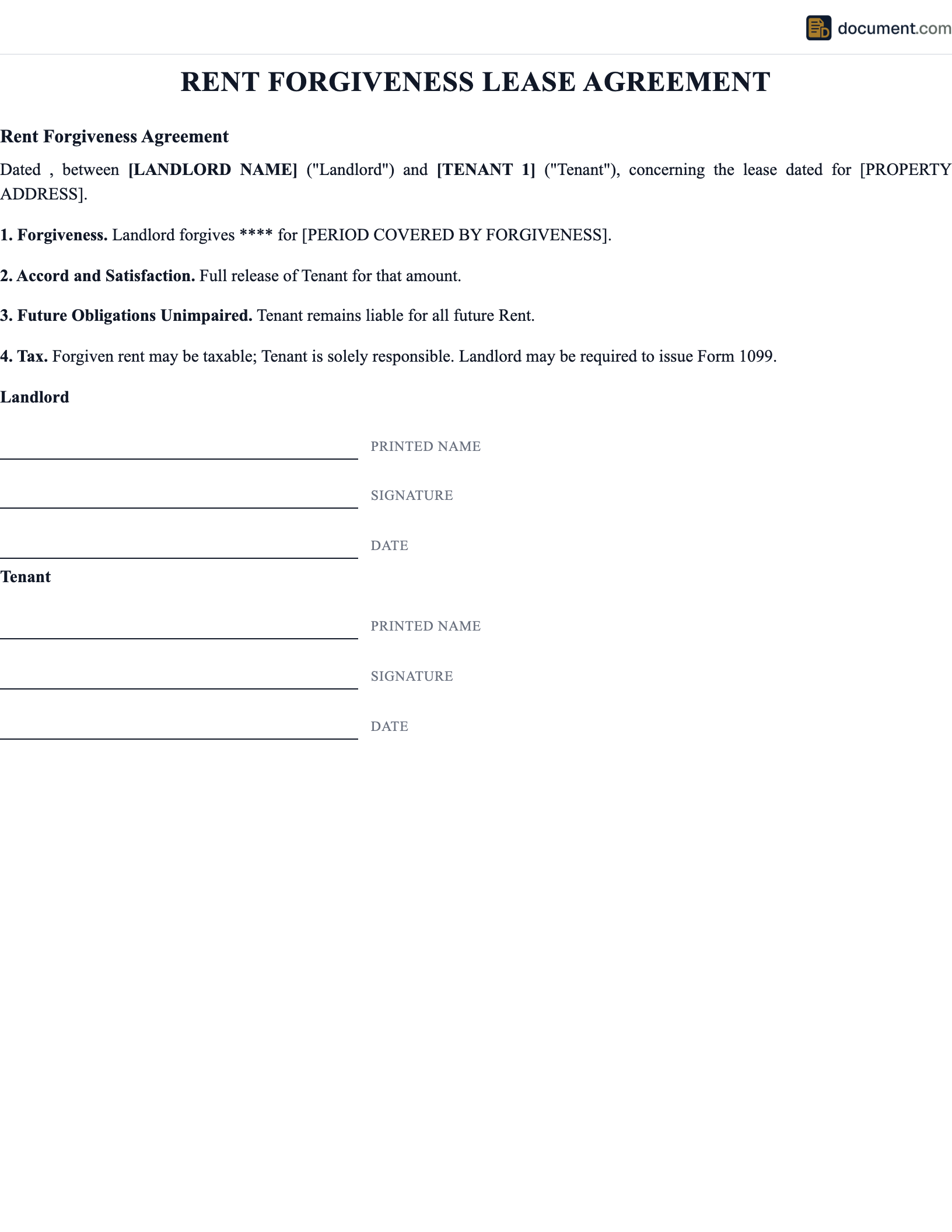



What Is a Rent Forgiveness Amendment?
A rent forgiveness amendment is a signed contract in which the landlord agrees to discharge some or all of the tenant's accrued unpaid rent. It is most commonly used in three situations: compassionate settlement for a struggling tenant who has recovered financially and wants to remain in the unit; eviction-avoidance compromise where tenant and landlord agree to a partial payment plus full discharge in lieu of pursuing unlawful detainer; and closeout of a disputed accounting where the parties resolve to a zero balance to end the dispute. The COVID-19 pandemic generated a fourth widespread use case: documenting forgiveness tied to the federal Emergency Rental Assistance Program (ERAP, established by the Consolidated Appropriations Act of 2021 and the American Rescue Plan Act of 2021), where landlords accepted ERAP funds in exchange for forgiving the tenant's unpaid balance.
The amendment must be structured carefully because three independent legal regimes apply. Tax law: forgiven rent over $600 generates a 1099-C information return and ordinary income to the tenant under IRC §61(a)(12), subject to the IRC §108 insolvency, bankruptcy, and qualified-principal-residence exclusions. Loan covenant law: nearly every commercial mortgage on multifamily property restricts rent-roll concessions through DSCR covenants, Fannie/Freddie multifamily concession-notice requirements, CMBS pooling-and-servicing-agreement restrictions, and HUD §223(f) loan-modification approvals. Contract law: partial payment does not discharge a full debt under Foakes v. Beer (1884) and the common-law accord-and-satisfaction rule, so the amendment must include express full-discharge language to prevent the landlord from later pursuing the unpaid balance.
Our template handles all three regimes. The 1099-C section identifies the forgiven amount, the discharge date, and the IRC §108 exclusion analysis the tenant should consider with a tax professional. The loan-covenant section requires the landlord to confirm lender consent has been obtained where required and provides carveout language for ERAP-funded forgiveness which is exempt from 1099-C reporting under specific IRS guidance. The accord-and-satisfaction section makes the forgiveness binding and irrevocable through express full-discharge language, prevents the landlord from later pursuing the unpaid balance, and recites the consideration flowing from the tenant (continued tenancy, cure of defaults, release of counterclaims) to defeat any later claim that the forgiveness lacked consideration under the pre-existing duty rule.
COVID-era forgiveness as the modern model
The COVID-era forgiveness programs created a generation of standard practice for rent discharge. ERAP under the Consolidated Appropriations Act of 2021 and ARPA distributed roughly $46 billion through state and local programs, with payments structured as direct-to-landlord rental assistance in exchange for tenant retention and forgiveness of any uncovered balance. California SB 91, New York's ERAP under SSL §131-y, Texas Rent Relief, and the Los Angeles County Stay Housed LA program all required participating landlords to accept the payment as full satisfaction of the covered rent and to forgo eviction for the covered period. IRS Rev. Proc. 2020-4 and subsequent COVID-era guidance exempted these specific forgiveness arrangements from 1099-C reporting because the payment was structured as a third-party assistance rather than a debt discharge by the creditor. The COVID model remains the template for any third-party-funded rental assistance program: the landlord receives payment, accepts it as full satisfaction, forgives any uncovered balance, and obtains express tenant release of any habitability or other defenses.
Security deposit interaction
Rent forgiveness discharges past rent obligations but does not affect the security deposit, which secures future obligations through move-out under state deposit-accounting statutes (Cal. Civ. Code §1950.5, NY GOL §7-103, Mass. G.L. c. 186 §15B). A landlord who forgives back rent can still claim against the deposit at move-out for unforgiven amounts, future damage, or unpaid rent through the end of the term. The amendment should state expressly that the forgiveness applies only to the specified amounts and that all other lease obligations (security deposit, rent through the end of the term, damage liability, restoration obligations) remain in effect. Tenants who assume forgiveness extends to the deposit are routinely surprised at move-out; the express disclaimer prevents the dispute and clarifies the parties' intent.
Tax Treatment and IRC §108
Forgiven rent is generally taxable income to the tenant under IRC §61(a)(12). The mechanics:
- 1099-C threshold: Landlord files Form 1099-C for any forgiveness of $600 or more under IRC §6050P and the Consumer Protection Act of 1996.
- Filing deadlines: January 31 to debtor; February 28 (paper) or March 31 (e-file) to IRS.
- Debtor treatment: Tenant reports COD income on Form 1040, or claims an IRC §108 exclusion on Form 982.
- §108 exclusions: Insolvency (§108(a)(1)(B), excluded to extent of insolvency), bankruptcy discharge (§108(a)(1)(A)), qualified principal residence indebtedness (§108(a)(1)(E), rarely applicable to rent).
- Timing: Income is recognized in the year the debt is discharged, not the year the underlying rent accrued.
- Penalty for non-filing: Up to $310 per 1099-C under IRC §6722 (2024 inflation adjustment), capped at $3.78 million per filer per year for large businesses.
IRS gift implications and the §102 question
Tenants occasionally ask whether forgiven rent qualifies as a tax-free gift under IRC §102. The answer is no for arm's-length landlord-tenant relationships. IRC §102 excludes only true gifts motivated by 'detached and disinterested generosity' under Commissioner v. Duberstein, 363 U.S. 278 (1960). Forgiveness in a commercial relationship motivated by the landlord's business interest in tenant retention, eviction avoidance, or settlement of disputed claims is not a gift; it is COD income. The narrow exception is forgiveness between family members where the landlord is genuinely motivated by personal generosity rather than business considerations; in that case the §102 exclusion may apply but the forgiveness must satisfy the §2503 annual-exclusion or §2522 lifetime-exclusion gift tax rules. A landlord forgiving rent to a non-family tenant should always treat the discharge as COD income subject to 1099-C reporting.
Bank Covenants and Loan Agreements
Commercial mortgages on multifamily and mixed-use properties typically restrict concessions that reduce the property's net operating income. Common covenant types and their thresholds:
Fannie/Freddie multifamily
Advance notice for concessions over $1,000 per unit per Multifamily Selling and Servicing Guide §304.04. DSCR covenants typically 1.20x to 1.30x.
CMBS loans
Stricter. Pooling and servicing agreement typically requires special-servicer consent for any material rent change. DSCR covenants typically 1.30x to 1.40x.
Partial Payment vs. Full Discharge
Under the common-law accord-and-satisfaction rule from Foakes v. Beer, 9 App. Cas. 605 (H.L. 1884), partial payment does not satisfy a liquidated debt unless the landlord accepts it as full and final satisfaction in writing. The amendment must be explicit. Use language like: 'Tenant shall pay $X on or before [date]. Upon such payment, Landlord accepts the same as full and final satisfaction of the Rent Balance specified herein, and Landlord releases Tenant from any further claim for the balance.' Without this accord-and-satisfaction clause, a partial payment can be accepted while the landlord still pursues the unpaid balance, which routinely surprises tenants who assumed payment-plus-handshake-agreement was sufficient.
UCC §3-311 for negotiable-instrument tenders
Where the tenant tenders payment by check or other negotiable instrument with conspicuous notation that it is in full satisfaction of the disputed amount (typically 'PAID IN FULL' written on the check or accompanying letter), UCC §3-311 codifies the accord-and-satisfaction rule with statutory teeth. The creditor's deposit of the check, if accompanied by proper notation and tendered in good faith over a disputed claim, constitutes acceptance of the discharge as a matter of law. The creditor cannot subsequently sue for the unpaid balance even if the deposit was inadvertent. Several states (California Comm. Code §3311, New York UCC §3-311, Texas Bus. & Com. Code §3.311) have adopted the rule with minor modifications. The rule provides a tenant-friendly mechanism for discharging disputed balances even without a signed amendment, but the better practice is always a signed amendment with express discharge language.
How to Use This Amendment
Itemize the back rent
List each month or charge being forgiven with amounts. Ambiguity invites future disputes about which amounts remain outstanding. Allocate across categories (rent, late fees, utilities, parking) for IRS classification clarity.
Check loan covenants
Review your mortgage for concession restrictions. Get written lender consent if required by Fannie/Freddie Multifamily Guide §304.04, CMBS pooling and servicing agreement, or HUD §223(f) loan modification rules.
Set the consideration
Document what the tenant is giving in return: lease extension, cure of current default, release of counterclaims, or waiver of habitability defenses. Defeats pre-existing duty rule challenges.
Draft the accord-and-satisfaction language
Make clear the forgiveness is 'full and final satisfaction.' Use the express UCC §3-311 release language for negotiable-instrument tenders. Include the no-revival clause preventing the landlord from later pursuing the forgiven amount.
Prepare the 1099-C
If forgiveness is $600 or more, file Form 1099-C with the IRS by the filing deadline and provide a copy to the tenant by January 31. Identify ERAP-funded forgiveness as exempt under Rev. Proc. 2020-4 if applicable.
Sign and retain
Both parties sign. Each keeps a copy. File with property manager and tax records. Retain for at least the seven-year IRS audit window for the year the discharge was reported.
Frequently Asked Questions
Tax, loan-covenant, and contract-law questions about rent forgiveness.
Official Resources
IRS Form 1099-C (Cancellation of Debt)
Required for forgiveness $600 or more under IRC §61(a)(12)
IRS Publication 4681 (Canceled Debts)
Taxpayer guide to IRC §108 insolvency exclusion
Fannie Mae Multifamily Loan Covenants
Concession and rent-roll restrictions
CFPB Rental Assistance Programs
Federal and state ERAP program guidance
Forgive back rent cleanly in under 8 minutes.
Pick your state, answer a few questions, and download a forgiveness amendment with the tax, loan, and accord-and-satisfaction language you need.